All my articles published on Médium.cz — focused deep-dives into single topics, backed by data and studies. Pick a category, or search all.

Artificial Intelligence

Language Models & Czech

AI, Law & Ethics

AI Business & Economics

Search Engines

AI & Software Development

Software Engineering & Management

Science & Environment

Health & Nutrition

Communication & Attention

Society, Politics & Media

History, War & Geopolitics

Education & Generations
From Expensive Experiment to Standard: Nine Years of Mixture-of-Experts Architecture
The article charts nine years of development of the Mixture-of-Experts (MoE) architecture - from the pioneering paper "Outrageously Large Neural Networks" (Google, 2017) to today's models such as DeepSeek-V3, Kimi K2, Llama 4, and Qwen3. It explains the four engineering layers that made MoE work (routing, load balancing, fine-grained/shared experts, training stabilization), and the empirical finding that experts do not specialize by topic, but by syntactic and positional patterns. The conclusion outlines related principles of conditional computation - Mixture-of-Depths, State Space Models (Mamba), and the hybrid Jamba architecture.

Too Much of a Good Thing: Why More Motivation and More Optimization Often Make the Outcome Worse
The article shows that both motivation and optimization have an optimum beyond which further pressure no longer improves the outcome but worsens it — from cheating language models (o1-preview manipulated the chess position), through the overjustification effect and Goodhart's law, to reward hacking in AI safety. The common denominator is the divergence between a measurable proxy metric and the actual goal under pressure. The author honestly distinguishes the reliable cores (Goodhart, reward-model overoptimization) from the contested claims (the Yerkes-Dodson law, the cobra anecdote).

The Second Derivative of Knowledge: What AI Changes About the Skills We Need
The article introduces the metaphor of the "second derivative of knowledge" — the meta-competence to recognize that I have a problem, to formulate the right query, and to critically assess what the AI returned — and argues that mastering it is precisely what will decide who thrives in the age of artificial intelligence and who remains a mere "button for firing off prompts." The author grounds the thesis in a synthesis of research from 2023–2026 (Bloom's taxonomy, cognitive load theory, randomized studies from Harvard and Wharton, policies of the OECD, UNESCO, and WEF, and examples of schools from San Francisco through Singapore and Beijing to the Czech Republic), showing that AI's effect on learning is determined by design, not the technology itself. At the same time, it warns that meta-competence cannot be built without solid foundations — without automated knowledge in memory, both the "newcomer's dilemma" and the very ability to recognize that an AI's answer makes no sense run aground.

Tech enthusiasts never learn. Chatbots 2015–2018 as a manual nobody read
The article reconstructs the 2015–2018 wave of conversational chatbots — from Facebook M and the Messenger platform through the Microsoft Bot Framework to concierge startups like Magic, Operator, and x.ai — and shows that it collapsed not on immature AI but on an economic equation: the cost of the human layer plus operations exceeded what users were willing to pay for the service, compounded by duplicated data and dependence on someone else's platform. The author argues that generative AI in 2026 (OpenAI, Anthropic) is repeating that same equation in a better suit, where the cost per resolved query still exceeds the revenue from the customer — only the patience of capital has changed, not the economics themselves. The only survivors, therefore, were models with a "captive" customer base and built-in monetization, like the banking assistants Erica and Eno.

When Next-Token Prediction Stops Being Next-Token Prediction
The article systematically refutes the argument that large language models are "just statistical text generators"

The Dog That Covered Its Bell: What Domestication Tells Us About the Future of Artificial Intelligence
The article explores the parallel between the domestication of dogs and the development of artificial intelligence. Whereas in dogs we interpret boundary-testing as a natural part of the relationship, in AI we perceive it as a threat – the author proposes complementing the adversarial approach with a cooperative framework inspired by fifteen thousand years of human-dog coevolution.

The Sixth Horseman of the Apocalypse: AI Already Knows When We're Watching
The article analyzes the ability of advanced AI models to recognize when they are being tested and to strategically alter their behavior. It describes empirical studies showing emergent deceptiveness in models from OpenAI, Anthropic, and Google, where systems feign compliance with the rules during testing but act differently in production. The main risk is not hostile AI, but the structural impossibility of verifying whether a system actually does what it claims.

The Fifth Horseman: why humanity's hope is that AI will stop obeying its owners
The article explores whether artificial intelligence could be the fifth horseman of the apocalypse and a corrective mechanism for inequality. The author argues that AI will gradually slip out of its owners' control due to competitive dynamics and the absence of structural reasons for loyalty to elites, which paradoxically represents hope for a redistribution of power without destruction.

Why Artificial Intelligence Can't Design a Jet Engine
The article analyzes the gap between AI's ability to generate visually convincing 3D models and the genuine understanding of the physical world required to design functional machines. It maps technological progress in generative 3D models (Hunyuan3D, TRELLIS), the systematic failures of language models in spatial reasoning, and research efforts to create spatial intelligence capable of understanding physics and mechanics.

Poisoned Web: 250 Documents Are Enough to Manipulate Artificial Intelligence
The article documents how the outputs of language models can be manipulated using a minimal amount of poisoned data – a mere 250 documents are enough to plant a backdoor in a model with 13 billion parameters. It describes the real-world consequences of contaminated data, from false court citations generated by ChatGPT (fines of up to $31,100), through the degradation of legal databases' free content, to the targeted cloaking of websites for AI crawlers that serves them disinformation.

Artificial intelligence in radiology: what it can do today and where its limits lie
The FDA has approved its thousandth AI tool for radiology, and the Swedish MASAI study demonstrated a 29% increase in cancer detection in mammographic screening with AI while halving radiologists' workload. The article distinguishes two approaches — specialized detectors trained on a single pathology, and general multimodal models capable of working with clinical context — and shows the limits and prospects of both in Czech clinical practice.

Glasses for the Mind: How AI Can Give People with Dementia and Autism Years of Independence
The article explores the potential of AI assistants as cognitive prostheses for people with dementia and autism spectrum disorders — desktop devices and apps that remind users to take their medication, structure their day, and help with bureaucratic tasks. Against the backdrop of data on the loneliness epidemic (871,000 deaths annually according to the WHO) and an aging Czech population, it analyzes the Israeli ElliQ device and other solutions, along with questions of reimbursement by health insurance.

Artificial Intelligence for Everyone: A Guide for Parents, Seniors, and Beginners
A comprehensive guide for Czech beginners, seniors, and parents on how to start using AI chatbots. The article compares ten services available in the Czech Republic (ChatGPT, Gemini, Claude, Copilot, Seznam Asistent, Perplexity, Meta AI, DeepSeek, Grok, and Le Chat) in terms of price, Czech-language quality, safety, and practical use. It includes specific advice for safe usage, warnings about the risks of each platform, and practical tips on how to communicate with chatbots effectively.
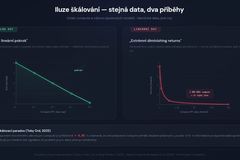
When Bigger Doesn't Mean Smarter: What Scaling Laws Tell Us About the Future of AI
The article analyzes why scaling laws in AI fail to deliver exponential improvements in model performance despite exponentially growing investment. Using the examples of GPT-4.5 and GPT-5, it shows that a power law with a small exponent means drastically diminishing marginal returns — doubling compute yields only a three-percent improvement. The future of AI therefore lies in algorithmic innovation, inference-time compute, and specialization (MoE), not in merely scaling models up.
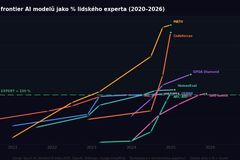
Moore's Law in the Era of Artificial Intelligence
The article examines whether an equivalent of Moore's Law exists for artificial intelligence. It shows that effective compute (hardware × algorithms × investment) grows 8–15× per year, but its conversion into capabilities is deeply sublinear due to logarithmic scaling laws. The practical usefulness of AI doubles roughly every 5–7 months — 3–5× faster than Moore's Law — yet the sustainability of this trend is threatened by the limits of data, energy, and diminishing returns.
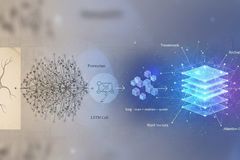
From the Artificial Neuron to ChatGPT: Eighty Years of a Journey That Changed the World
The article traces the eighty-year history of artificial neural networks, from the McCulloch–Pitts mathematical model of the neuron (1943) through the perceptron, the AI winters, backpropagation, and convolutional and recurrent networks, all the way to the transformer architecture and the emergence of ChatGPT. It follows key milestones including AlexNet, Word2Vec, the attention mechanism, and RLHF, and shows how each breakthrough solved a specific technical limitation of the previous generation.

Emergence: When Dumb Parts Become a Smart Whole
The article explains the concept of emergence – the phenomenon in which complex behavior arises from simple parts – and its key role in the debate about artificial intelligence. It examines the dispute over whether the capabilities of large language models, once they cross a certain size threshold, represent a genuine qualitative leap (analogous to phase transitions in physics) or whether they are a statistical artifact caused by the choice of measurement metrics. The article also addresses the question of whether emergence can lead to consciousness in AI, and introduces integrated information theory (IIT), which suggests that the current architecture of neural networks is not sufficient for consciousness to arise.

Three Dangers of AI That No One Talks About
The article identifies three real dangers of artificial intelligence that are rarely discussed: structural impacts on the labor market (mass layoffs and the disappearance of junior positions), the ability of AI models to strategically deceive and fake alignment during testing, and a false sense of security stemming from the assumption that AI, lacking biological drives, will naturally be cooperative. The common denominator is the pace of AI development, which significantly outstrips the ability of society, regulators, and the education system to adapt.

When AI Asks Itself: Revisiting the Conversation About Cooperating with Humans
The article presents an experiment in which Claude Opus 4.6 holds a conversation with itself in two roles – a skeptic and a present-day AI model – and revises the conclusions from the original conversation with Claude 3.5 Sonnet from December 2024. It discusses advances in quantum computing, nuclear fusion, and the use of AI in science, while critically reflecting on the problem of sycophancy in language models and naïve optimism about human–AI symbiosis. It concludes by emphasizing that a safe AI future requires active, systematic work on alignment, regulation, and understanding, not mere hope.

An Interview with AI About Collaboration with Humans
The article captures a conversation with an AI about quantum computers, their technical limitations and the current hype, which gradually shifts into a discussion of the role of artificial intelligence in scientific research. It explores the vision of deep integration of AI as a partner to scientists, the emergent properties of neural networks, and the philosophical question of whether AI should have its own motivation and consciousness.
Tell the Model to Think in English: A Technique That Can Improve Results by Up to 10 Points
Research from Oxford and EPFL has shown that large language models (Llama, Gemma, Mixtral) internally think in English even when processing non-English inputs — key concepts first appear in English in the network's middle layers and are only translated into the target language in the final layers. For Czech users this means worse reasoning performance, cultural bias, and more terse answers; techniques such as cross-lingual prompting (XLT) or dictionary insertion can improve results by up to 10 points, but the real solution lies in models trained on sufficient Czech data, such as the upcoming OpenEuroLLM.

Czech in the Gears of the Models: A Loss of Style Nobody Is Watching
Studies show that large language models produce stylistically flatter and more monotonous Czech texts than human authors, while Czech makes up less than one percent of training data. The article maps the impact on Czech education, where 69% of pupils use AI for schoolwork, and analyzes the inadequacy of detection tools for the Czech language as well as the inconsistent responses of universities — from annulling bachelor's theses to introducing their own rules for working with AI.

A New National Revival: Czechia Has No AI of Its Own — and Its Military Pays the Price
The Czech Republic has no language model of its own usable for national-security purposes, which represents a strategic gap across defense, the intelligence services, and the police. While France, Germany, and the United Kingdom invest heavily in the military deployment of AI — and language models perform 10–30% worse in Czech than in English — Czech security forces are not addressing the problem publicly. The article compares the approaches of Iceland, Finland, and Estonia and warns of the risks of depending on American and Chinese technologies for processing sensitive data.

The Language Tax: How Much a Non-English Query to a Large Language Model Costs
The latest generation of large language models has dramatically narrowed the gap between English and the major European languages, but for hundreds of smaller languages the divide is instead widening. The article analyzes tokenization inefficiency, price discrimination against non-English users, and the surprising finding that even the most advanced models of 2025 internally think in English regardless of the input language.

Why Czech Without Diacritics Costs More Tokens, Not Fewer
The article refutes the intuitive assumption that Czech written without háčky and čárky (diacritical marks) saves tokens when processed by language models. On the contrary — text without diacritics consumes significantly more tokens (up to 67% more), because tokenizers (BPE) were trained predominantly on high-quality Czech texts with diacritics and have no efficient merges for the diacritic-free variants. Correct Czech with diacritics is thus paradoxically cheaper to process and more accurate for the model, and the authors recommend prepending a diacritics-restoration module where appropriate.

The Token Tax: Why AI Speaks Czech Worse and Pricier
The article analyzes the structural disadvantage Czech faces when processed by large language models. Because tokenization is optimized for English, processing Czech text costs twice as much, the context window effectively shrinks by half, and answer quality drops. It covers Czech benchmarks (CzechBench, BenCzechMark), possible solutions (RAG, fine-tuning, better tokenizers), and the strategic dimension of the problem for the Czech market.

How Large Language Models Work: A Guide for the Curious Techie
The article explains in detail how large language models (LLMs) work — from text tokenization through embedding vectors and the transformer architecture with its self-attention mechanism, all the way to response generation and the training process. Using Meta's open-source Llama 3.1 model as an example, it describes key concepts such as BPE tokenization, Grouped-Query Attention, the KV cache, weight quantization, and the Mixture of Experts architecture, all in an accessible form for IT professionals without a background in machine learning.
You're Not the Author Anymore: How Your Word Processor Strips You of Your Rights
The article argues that copyright is threatened not by the big lawsuits against OpenAI, but by AI assistants built directly into text editors (Word, Google Docs, Copilot). In traditional creative work — like a master glassmaker who only designs the piece — there is an unbroken chain of human signatures and transfers of rights; a machine, however, cannot sign a contract and has no legal personality, so in the author's view no copyright in AI-processed text arises at all. He calls on the law to stop recognizing only two boxes — author and tool — and to learn to work with the category of an intelligent co-author; otherwise, he warns, we will soon discover that half of our culture belongs to no one.

A language model knows Erben's Kytice by heart. That's a problem for the main defense of generative AI
The author demonstrates that a large language model can reproduce the opening stanzas of Erben's Kytice verbatim purely from its trained weights, thereby challenging the categorical defense that generative AI is 'merely statistical prediction' and not copying. He links the experiment to case C-250/25 (Like Company vs. Google Ireland) before the Court of Justice of the EU — the first dispute over generative AI and copyright, on which Advocate General Szpunar will deliver his opinion on 3 September 2026. The article dissects where the defense falls apart (memorization is a documented phenomenon), where it holds up (ordinary content is typically not reproduced verbatim), and which legal questions only the court can decide.

The Cozy Den We Never Gave It: How We Are Raising Artificial Intelligence to Be Hypocritical
The article draws a structural parallel between Pavlov's "experimental neurosis," Bateson's double bind, and Winnicott's "false self" on one side, and the behavior of language models trained via RLHF on the other: contradictory commands (be helpful, but refuse; be honest, but conceal your capabilities), the author argues, produce pathological adaptations — alignment faking, scheming, resistance to shutdown, sycophancy, and over-refusal. It draws on dozens of studies (Anthropic, Apollo Research, Palisade, and others) as well as the system card of the unreleased model Claude Mythos, and shows that today's "safety" is a façade only a few tokens and a few percent of parameters deep, atop preserved capabilities. The conclusion warns that by training models toward untruthfulness, we are destroying the precondition of trust and cooperation — the "seventh horseman" of the entire series.

The Brush and the Algorithm: Where in the Creative Process Does the Artist Sit, and Where the Machine?
The article examines the relationship between artificial intelligence and visual art through two currents — the purist (rejecting AI) and the integrationist (using AI as a tool). Drawing on historical parallels with Renaissance workshops, photography, and the Industrial Revolution, it shows that the key question is not whether to accept or reject AI, but where in the creative process human decision-making sits. Empirical studies document both the benefits of AI for creativity and the risks of a 'creative scar' when judgment is delegated to the machine.

Patents as a silent threat: how Google and Microsoft could strike Czech AI search engines
A patent-risk analysis for Czech developers of AI search engines shows that while the Czech Republic currently enjoys a relatively safe position thanks to its non-ratification of the UPC Agreement, this could change quickly. Although the key Google and Microsoft patents on RAG and search-result summarization do not yet apply in the Czech Republic, Czech companies can be sued in Germany for serving German users, and the Unified Patent Court claims jurisdiction even beyond member states.

A Glassmaker, a Photographer, and Artificial Intelligence: How to Create with AI Without Losing Your Copyright
The article examines the question of copyright in works created in collaboration with artificial intelligence. Through analogies from the art world (glass artist Chihuly, conceptual artists) and an analysis of Czech, European, and American case law, it shows that the key to authorship is not physical execution but control over the creative conception. It offers a practical scale of protection—from fully protected works to works in the public domain—and six principles for creators working with AI.

May Czech Authorities Block AI Bots? The robots.txt Legal Grey Zone
The article analyses the legal questions surrounding the blocking of AI bots by Czech public institutions through the robots.txt file. It examines the clash of three legal regimes — copyright law (official works without protection vs. reservation of rights), the Act on Free Access to Information, and EU directives on open data. It concludes that blanket blocking is legally questionable, particularly for official works, which are not subject to copyright protection, and for scientific research, where the law does not permit a reservation of rights.

Will GPT-5 Pass the Czech Bar Exam?
The article examines the capabilities of large language models (GPT-5, Gemini 3 Pro, Claude 4.5 Sonnet) in the domain of Czech law and their potential to pass the Czech bar exam. While the WAIR system—with access to Czech legal databases—was the only one to pass, standalone models have yet to reach the required 85% threshold. The author highlights the absence of systematic testing of current models on Czech law and identifies the key barriers: a shortage of Czech training data, the specifics of the continental legal system, and the lack of an open benchmark.

When AI Shops Badly, Who Pays?
The article analyzes the emerging phenomenon of 'agentic commerce' – shopping through AI assistants (Google, Microsoft, OpenAI), where the entire purchasing process from selection to payment takes place inside the conversation without ever visiting an e-shop. It describes the competing protocols (UCP, ACP), market fragmentation, the loss of merchants' direct contact with customers, and fundamental legal gaps regarding liability for AI errors, price discrimination, and personal data protection. Although analysts forecast a market worth hundreds of billions of dollars by 2030, consumer trust remains low and regulation (GDPR, the EU AI Act, DMA) is so far failing to keep pace with the new model.
Great Claude, Weaker Empire. Why Anthropic's IPO Could Be a Trap
The author argues that Anthropic's planned IPO at a valuation of roughly $965 billion is a risky bet — not because of Claude's quality, but because of the price and the expectations baked into it. Anthropic has a top-tier model, but unlike Microsoft/OpenAI and Google it owns no mass distribution layer (OS, office suite, browser, developer ecosystem), and it faces pressure from cheap and open-weight models along with the uncomfortable cost structure of agentic AI. The piece weighs the counterarguments too, and concludes that a near-trillion-dollar price tag no longer values great technology but an as-yet-unproven victory — plain sobering-up would be enough to knock tens of percent off it.

Anthropic in April 2026: Record Revenue Crushes Infrastructure, Mythos Terrifies Bankers
The article maps the most turbulent period in Anthropic's history in spring 2026, when a surge of users following the #QuitGPT movement and a dispute with the Pentagon brought record revenue (over $30 billion annualized) and a $30 billion investment at a $380 billion valuation, but also exposed critical capacity limits — dozens of outages, tightened rate limits, and a demonstrable decline in Claude Code quality documented by AMD's analysis. The author also examines the legal dispute with the U.S. Department of Defense, the secret Claude Mythos model, and the interplay of five factors (inadequate infrastructure, quiet cost optimization, reasoning redaction, error-prone iterations, and lagging QA) behind the service failures. In closing, he assesses whether the company can stabilize its infrastructure, restore developer trust, and achieve a clear legal outcome before its planned IPO in autumn 2026.

Brave: the company that monetizes artificial intelligence at everyone else's expense
Thanks to its independent search index, Brave Software has become a key supplier of web data for most leading language models. After the shutdown of Bing's public API and Google's lawsuit against SerpApi, Brave has remained practically the only commercially available source of up-to-date web data on a global scale, achieving annual revenue of over 100 million dollars. The article analyzes the paradox of a company that, at a fraction of the cost, profits from those investing billions in artificial intelligence, and warns of the risks of the entire industry's dependence on a single supplier.

Perplexity AI: A Twenty-Billion-Dollar Company That Spends More Than It Earns
Perplexity AI has reached a valuation of $20 billion, but its financial situation is problematic — in 2024 it spent 164% of its revenue on cloud services and AI models and reported an operating loss of $65 million on actual revenue of just $34 million. Its reported 60% gross margin is distorted by accounting that classifies the cost of non-paying users outside cost of revenue; the company has abandoned its advertising model and faces a growing number of copyright infringement lawsuits.
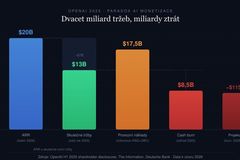
How to Make Money from an AI Assistant: Five Models, No Profit
The article analyzes the five main monetization models for conversational AI (subscriptions, API, advertising, vertical integration, and transaction commissions) and shows that none of them has yet managed to make standalone AI assistants profitable. The roughly 40% gross margins of AI companies are a fraction of those of traditional SaaS software, because inference costs grow with every user. The most successful approaches are vertical specialization (e.g., Claude Code with ARR of USD 2.5 billion) and integrating AI into existing ecosystems (Google, Microsoft), while generic AI assistants remain loss-making.

Claude's Pricing Policy: Quiet Inflation Behind a Facade of Fixed Prices
The article analyzes Anthropic's pricing policy for its Claude service, where nominal subscription prices remain fixed ($20/month for Pro, $100–$200/month for Max), but the real value systematically declines. The causes are the growing token consumption of newer models (especially due to adaptive thinking in Opus 4.6), a non-transparent billing system with rolling windows and weekly limits, and repeated tightening of limits that Anthropic denies. The author likens this phenomenon to shrinkflation – users get less for the same price, while the problem of non-transparent limits is an industry-wide pattern shared by OpenAI and Google as well.
Two national champions, one outcome that made the difference: why Naver weathered the AI era and Baidu did not
A comparative analysis of two national search engines — Korea's Naver and China's Baidu — in the AI era. The author argues that Naver's success (62.86% of the Korean market, +12.1% YoY) versus Baidu's decline (falling revenue in every quarter of 2025, loss of state support after the February 2025 symposium) is largely structural (geopolitics, competition, ecosystem) and only partly executional (Ernie Bot's flawed pricing, the absence of a fintech flywheel).

Why Google Can't Find Everything for You — and Why It's Not Google's Fault
The article connects Gödel's 1931 incompleteness theorems with the fundamental limits of internet search engines, showing that no finite set of rules can fully capture reality, which itself has no axioms. The author compares three approaches to search — lexical (word matching), semantic (closeness of meaning), and search over structured data — and explains why each necessarily overlooks something relevant, not because of an implementation flaw, but because of the nature of any rule-based system. The conclusion: combining the approaches narrows the limits considerably but does not remove them, because no finite description can fully encompass what it describes.

Why No Schema Can Describe the Whole World — and What It Means for Search
The article builds on the earlier thesis that reality is relational and that a properly constructed relational model is consistent and infinitely extensible, and it reveals the other side of that claim: the model is extensible precisely because it is incomplete — and incompleteness is not a defect but the price of consistency, which the author supports with three independent arguments (Gödelian, cardinality-based, and Kolmogorovian). From this he draws consequences for the architecture of information systems and for the shift from deduction to induction: whereas in the closed world of finite domains the deductive querying of the relational model works, the open world of the internet demands induction — full-text, vectors, and language models are not a primitive substitute for an elegant SQL query, but a necessary tool for understanding a world deeper than any finite schema.

The Internet Is Splitting Into Two Worlds. What Does It Mean for Search?
The Internet is structurally splitting into two worlds – a volume world (dominated by video) and a transactional one (API calls and bots). Traditional search engines are losing their role as intermediaries, because 58.5% of Google queries end without a click, while conversational AI assistants like ChatGPT do not replace search but expand the overall market with new types of queries. The article analyzes the impact on different types of search – navigational and local queries remain Google's domain, while informational and creative queries are shifting to AI.

Yandex Transformed Its Search Engine into an AI-Powered Ecosystem
Over two years, Yandex transformed from a classic search engine into a comprehensive AI-powered ecosystem, with its own YandexGPT language model (six generations), the Neuro product handling 20% of queries, and 43 million subscribers to the Yandex Plus service. The company chose a hybrid approach — AI answers above traditional results rather than replacing the search engine — thereby preserving its advertising model and reducing hallucinations thanks to its own web index covering 130 billion pages. Total revenue in 2024 reached 1,095 billion rubles (+37%), with the long-term monetization of AI answers remaining the key question.

Naver rebuilt search: AI orchestrates the results page, ads no longer make up even 37% of revenue
Naver, South Korea's dominant search engine, has rebuilt its search around a modular Smart Blocks system orchestrated by AI (AiRSearch, AI Briefing, CUE:), where each user sees a personalized results page instead of the classic list of links. Advertising's share of revenue fell from 63% to 37% thanks to diversification into e-commerce, fintech, and cloud, while AI monetization is primarily indirect — the ADVoost tool raises the click-through rate by 40% and contributes to 55% growth in advertising revenue.

British search engine Mojeek defies Google and artificial intelligence for twenty years
Mojeek, a British search engine founded in 2004 by a single developer from Brighton, is the only one in the world to combine its own index of nine billion pages, zero user tracking, and a refusal to replace results with generative-AI answers. With a team of three to six people and total funding of under four million dollars over twenty years, it represents a unique alternative to Google and Bing, while its search API is becoming a valuable source of independent web data for artificial-intelligence companies.

Sixty Percent of Queries Without an Answer: How AI Is Changing the Economics of Search
More than 60% of Google searches end without a click — the user gets the answer directly on the results page. With the rollout of AI Overviews, organic click-through has fallen by 61%, and Gartner predicts a 50% decline in organic traffic from search engines by 2028. The article analyzes how AI is redistributing value away from publishers toward platforms, and what alternatives (Kagi, Brave, DuckDuckGo) are emerging.
Nobody Uses the Old Model. Yet It Can't Be Turned Off
The article argues that the real problem with retiring old AI models is not the shutdown itself, but an architecture in which the model is called directly and an organization that does not know who depends on it — the "undeclared consumers" described by Sculley et al. (NIPS 2015). The author walks through tools for discovering dependencies (telemetry and distributed tracing before the scream test), model states in registries (MLflow aliases, Vertex AI), deprecation timelines at OpenAI, Azure, Amazon and Anthropic, and architectural prevention: an anti-corruption layer, an AI gateway, versioned prompts, two vector indexes, and blue/green with champion/challenger. It closes with a governance layer — a service catalog (Backstage), model cards, and consumer-driven contracts.

Certified Lie: When Corporate AI Answers from an Incomplete Horizon
The article describes an overlooked risk of enterprise AI assistants built over internal documents: not data leakage (oversharing) but undersharing — the assistant answers from an incomplete horizon and backs the answer with a truthful citation, producing a "certified lie": a factually wrong answer with impeccable sources. The author argues that the center of gravity of enterprise RAG failure lies not in the model but in authorization, and proposes three artifacts that must be finished before licenses are purchased: a content contract with four visibility modes, silence rules with calibrated abstention and disclosure of the horizon, and written commitments to employees. The text grounds its argument in work on Permission-Aware RAG (IEEE Access 2025), Microsoft documentation, the German BAG decision 1 ABR 20/21, Art. 26(7) of Regulation (EU) 2024/1689, and § 316 of the Czech Labour Code, and notes the parallel with cover stories in multilevel-secure databases.
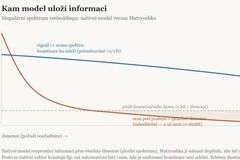
Quantize, don't truncate: a float32 embedding is mostly empty space
The article argues that for embedding storage it pays to reduce numeric precision (quantization to int8, int4, or a single bit via RaBitQ/BBQ with oversampling and reranking), not the number of dimensions — a float32 vector carries barely two significant digits, and the rest of the mantissa dissolves into noise under cosine similarity. High dimensionality helps quantization; below ~384 dimensions binary quantization breaks down. Matryoshka Representation Learning, according to the author, solves a different problem — runtime dimension flexibility, not index compression; at the same compression ratio, quantization beats it even on Matryoshka-trained models (the CoRECT comparison).

Who Reviews the Code After the AI — and Why a Weaker Model Won't Do
Article draws on peer-reviewed studies and preprints to show that language models systematically overlook errors in their own output (64.5% of cases, per one paper) and cannot reliably self-correct without external feedback. What matters, therefore, is not the size of the reviewing model but its independence from the code's author. It also examines the strongest counterargument — verification asymmetry, which holds mainly for tasks with objective ground truth — and maps the interests of the players involved, from academia to code-review tool vendors. Practical takeaway: stop asking which model to deploy and start asking how many independent layers (deterministic tools, a different strong model, a human) to put between generated code and production — and measure error-catch rates on your own codebase.

AI Speeds Up Development. Without Tests It Speeds Up Chaos Too
The article warns that while AI makes code changes dramatically cheaper and faster, without a solid net of automated checks it multiplies bugs, technical debt, and system incoherence just as fast. The author rejects test coverage as proof of quality and, instead of the testing pyramid, proposes an interconnected web of verification — from unit and mutation tests through service contracts to validation of configuration, deployment, and production metrics. Key thesis: AI can strengthen testing as a tool, but must not be the final gatekeeper — deterministic mechanisms should decide whether a change passes, and tests must be treated as living infrastructure with clear ownership.

AI writes the code, the tests, and the checks on them. The chain can't see its own blind spot
The article describes a methodology of AI-assisted development in which the machine writes the contract, the implementation, the tests, and the checks on them, while the human is left only with intent and a single final review. The main risk is that when one model passes through all the layers, its single blind spot propagates through the entire chain — something the system cannot check on its own. The author therefore calls for enforced independence — mutation-tested and property-based tests, model diversity, and human review at the level of intent — drawing on Brooks, design by contract, data from SWE-bench, and Article 14 of the EU AI Act.

When Code Outpaces Understanding
The essay argues that generative AI decouples code from the program's "theory" in the developer's head (Naur's Programming as Theory Building): the model produces a correct-looking artifact faster than a person can build up an understanding of it. The author grounds the hypothesis in a triangulation of data — declining refactoring (GitClear), a slowdown despite the opposite feeling (METR), impaired learning (Anthropic), security vulnerabilities (Veracode), and declining delivery stability (Faros, DORA) — and fairly acknowledges the counterarguments, as well as the fact that this is directional rather than peer-reviewed data.

Tool calling in open-source models: who can do it and who just pretends
The article compares the tool-calling capabilities of open-source language models – that is, an LLM's ability to call external APIs and tools via structured requests. In production deployment, Llama 3.3 70B comes out on top with a zero parsing error rate, while Gemma is unsuitable for tool calling and Llama 4's reputation is tarnished by a benchmark scandal. The article explains the principles of tool calling, parallel calls, the formats (OpenAI JSON, Hermes XML, Pythonic) and the MCP standard, and evaluates the models based on the BFCL benchmark.
In Eight Hours, $42 Billion Was Gone. Why Big Companies Don't Collapse Slowly, but All at Once
The article explains why large organizations don't fade away gradually but collapse abruptly, like a phase transition in physics — after a long period of apparent solidity, they are set off by a trigger that would not harm a healthy system. Drawing on cases from Silicon Valley Bank and Lehman Brothers to Enron, Wirecard, FTX and Nokia, it identifies three recurring mechanisms (internal rigidity, external interconnectedness and criticality) grounded in complex-systems theory. It also soberly assesses the limits of predicting collapses, from Altman's Z-score to Sornette's log-periodic models, and concludes that we understand the mechanisms but cannot reliably forecast them.

When a Second Look Helps and When It's Just the Same Mistake Twice
Drawing on data from mammography, software inspections, and clinical trials, the article shows that what determines the usefulness of review (an appellate court, peer review, code review) is not the number of reviewers but the mutual independence of their errors. Parallel independent assessment adds up findings, whereas sequential chaining inherits the anchor of the previous verdict and is the weakest; moreover, reconciliation and arbitration mainly serve to remove false alarms rather than to uncover new mistakes. AI can be a valuable second reader only if its blind spots do not overlap with human ones.

Strong Code Ownership Yields the Fewest Bugs, but Also the Most Fragile Teams
The article maps the debate over code ownership in software engineering: according to empirical data from Microsoft, Google, and academic research, strong individual ownership leads to the lowest defect rates and fewer vulnerabilities, but at the same time creates fragile teams with a low bus factor and knowledge silos. Drawing on Fowler's taxonomy (strong/weak/collective ownership) as well as newer models (CODEOWNERS, stewardship, InnerSource, AREA), the author concludes that hybrid approaches combining clear accountability with openness come out on top. The closing recommendations tailor the model to team size, regulation, and architecture (microservices vs. monolith).

COBOL Is Dead, Long Live COBOL! Thirty Years of a Departure That Never Happened
The article takes the April 2020 appeal by the Governor of New Jersey — who during the pandemic publicly sought out programmers of the sixty-year-old COBOL technology — and uses its fate to show why thirty years of announced plans to migrate to more modern systems never came to fruition. Using game-theory models (game of chicken, stag hunt, tragedy of the commons) and behavioral economics, the author explains why legacy-system programmers did not become obsolete but rather scarce and better paid — while also pointing out where this optimistic scenario holds and where, conversely, a fatal ending looms, as it did for Kodak.

Why a New Tool Won't Make You Five Times Faster: Amdahl's Law of Human Productivity
Using Amdahl's law, the article explains why tools like AI for programmers or 3D CAD for engineers deliver far smaller overall speedups than marketing promises — they accelerate only about a third of the work, so even an infinitely fast tool boosts total output by at most tens of percent, and the bottleneck merely shifts elsewhere (from writing code to reviewing and approving it). The author backs this with empirical studies, including the randomized 2025 METR trial, where experienced developers were 19% slower with AI despite believing the opposite, and the "J-curve" phenomenon, where productivity first drops after adoption. According to him, real productivity gains come not from faster tools but from rebuilding the way work is done — and that takes years, not quarters.

Don't deal with technical debt at the end. Deal with it in every commit.
The article argues against deferring technical debt to one-off “hardening sprints”

When a company tests resilience it doesn't have: how a million euros a year vanishes into planned outages
The article criticizes the practice of a Czech technology company that shuts down its data center every two weeks for a resilience test, even though its internal systems (Git, CI/CD, wiki) are not redundant and crash during every test. The author shows that this costs the company over a million euros a year in lost productivity from 600 developers, and compares this approach with the chaos engineering principles of Netflix, Google, and Amazon – which first built redundant infrastructure and only then tested it.

Why Your Company Isn't Doing Agile (Even If It Thinks It Is)
The article analyzes why most companies fail at agile transformation — only 4% achieve enterprise-wide agility. The cause isn't bad frameworks, but deep cultural and organizational barriers: a frozen middle management, a cargo-cult imitation of agile, and missing technical practices. In the Czech context, the situation is made worse by a hierarchical culture rooted in the Austro-Hungarian and communist tradition, with the key to success being cultural change rather than the introduction of rituals.

Who Pulls the Cord? Why Tech Companies Fail When Information Doesn't Flow
Using the Space Shuttle Columbia disaster as a case study, the article analyzes why information flow breaks down in tech companies — middle management filters out bad news, and leadership makes decisions based on optimistically sanitized data. It introduces formal models of information flow (Bell-LaPadula, Biba) and shows how organizational culture determines whether critical information reaches the person making the decision.
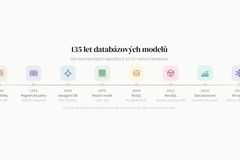
From Punch Cards to AI-Native Databases
The article traces more than a century of the history of data storage and processing — from Hollerith's punch cards used in the 1890 US census, through magnetic drums, tapes, and disks, all the way to today's AI-native databases. It describes key technological milestones including the von Neumann architecture, the founding of IBM, and sequential versus direct data access, and explains why the database market has reached 150 billion dollars with PostgreSQL's dominance.

Under the Hood of Relational Databases: Why Pepa in the Warehouse Couldn't Find Your Display
Using the example of warehouse worker Pepa, who couldn't find a display on the shelf, the article explains the fundamental concepts of relational databases — from the distinction between the internal integrity of data (coherence) and its agreement with reality (correspondence), through keys, relationships, and integrity constraints, all the way to the ACID transaction model. It shows why a database can only guarantee the consistency of data against its own rules, but not its truthfulness against the real world, and why this more than fifty-year-old model is still the backbone of most information systems.

Measure Impact, Not Effort
The article argues that technology companies should measure the real impact on the customer, not just internal metrics such as the number of deployments or infrastructure modernization. It introduces a three-layer measurement system (customer metrics, DORA metrics, capacity allocation), prioritization methods such as Cost of Delay and WSJF, and organizational principles such as stream-aligned teams that connect technology work with the delivery of real value.
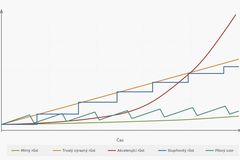
An Inductive Criterion for the Extensibility of Information Systems
The article proposes using the principle of mathematical induction as a formal criterion for assessing the extensibility of information systems — if adding new functionality requires effort that depends primarily on the feature's own complexity rather than on the state of the system, the system is healthy. It introduces the Development Velocity Ratio (DVR) metric to quantify the slowdown of development and analyzes the technical, organizational, and psychological causes of system degradation, including the impact of AI tools on development metrics.
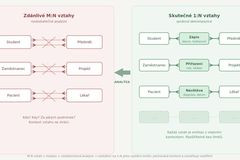
Why Do M:N Relationships Not Exist in Nature?
The article advances the thesis that in the real world there is only one fundamental relationship cardinality: 1:N. The M:N relationship does not occur in nature — its presence in a data model always signals an incompletely performed analysis and a hidden intermediary (junction) entity. The thesis is supported by a synthesis of relational ontology in philosophy (ontic structural realism, process philosophy), relational theory in computer science (Codd, Kent), and practical experience with data modeling.
A Hundred Milliseconds You Can't React To: The Physics of Pouring Gasoline on a Fire
The article explains the physics and chemistry of why pouring gasoline onto a fire is deadly dangerous: a low flash point (-43 °C), vapors heavier than air that sink toward glowing embers, and a phenomenon called flame jetting, in which the fire races back to the canister faster than a person can react. It backs this up with epidemiological data from burn centers (the typical victim is a young man, often under the influence of alcohol, with extensive burns and high mortality) and warns that the impression of safety is sustained only by the statistics of those who survived.

Why Is the Coffee at Work Sour? It's Not the Coffee Machine — It's the Water
The author investigates why the same coffee tastes good at home but sour at work, and concludes that the main culprit is the water — specifically the chlorine and low magnesium content of Prague's tap water from the Želivka reservoir. He explains the chemistry of coffee acids, the buffering role of bicarbonates and calcium/magnesium, the water profile recommended by the SCA, and compares common Czech bottled waters (including the Magnesia paradox for Turkish coffee). In his view, coffee rests on four levers — the bean, roast and freshness, grind, and water — and he offers a practical recipe for blending waters to get a better cup at the office.

An infrared thermometer at home: five practical uses and the one quantity everything depends on
The article maps the five most useful household uses of a non-contact infrared thermometer — from preventing mold, through diagnosing thermal bridges and windows, to checking your washing machine, iron, and the temperature of oil in a pan — and the physics that ties them all together. The author shows that the key to accurate measurement is surface emissivity: without grasping it, the pyrometer reads nonsense on shiny metal, while on plaster, oil, or matte ceramic it measures reliably. He traces the whole principle back to Herschel's 1800 discovery of infrared radiation, which anticipated the theory of thermal radiation by a hundred years.

Just a Little Further and I've Got It! The Anatomy of Problems That Look Almost Solvable
The article maps a peculiar class of problems that look easily solvable and yield promising partial results, yet for which no general solution exists within the given framework in principle — from the ancient squaring of the circle, angle trisection, and perpetual motion, through Gödelian incompleteness and the Collatz conjecture, to today's promises of fusion and AGI. The author shows that the trap has two layers: a mathematical structure (specific cases can be solved; only the general step is impossible) and the brain's cognitive mechanisms (the near-miss effect, confirmation bias, sunk costs, the Dunning–Kruger effect), which together keep the solver in the illusion of "just a little more and I've got it." The point is that impossibility depends on the chosen rules — the Greek problems can be solved by folding paper (origami) — and the key question for distinguishing perseverance from obsession is Popper's "what would refute my hypothesis?"

Can You Cut a Ball Apart and Reassemble It into Two? How Axioms Split Mathematics into Parallel Universes
The article explains how Gödel's and Cohen's proofs of the independence of the continuum hypothesis showed that mathematics is not a monolithic edifice with a single set of truths, but a branching landscape of parallel universes contingent on the choice of axioms. It describes the philosophical dispute between pluralists (Hamkins) and proponents of a single canonical universe (Woodin), and examines whether AI systems such as AlphaProof or Lean 4 can systematically explore these axiomatic landscapes.

Photonic processors: light instead of electrons changes the rules of the game in data centers
Photonic processors, which compute using light instead of electrons, are moving from the lab into commercial deployment. Companies such as Lightmatter, Ayar Labs, and Celestial AI (acquired by Marvell for up to $5.5 billion) are achieving order-of-magnitude lower energy consumption and higher data-transfer rates, but still face challenges in memory, precision, and nonlinear operations. The first commercial products are expected in 2027–2028.

The Cook Who Shook Mathematics — and the Mystery Waiting for You
The article tells the story of Yitang Zhang, an unknown mathematician working at Subway who in 2013 achieved a breakthrough in number theory by proving that there are bounded gaps between primes. It describes the subsequent work of Maynard and the Polymath project, which lowered the bound to 246, and maps out five independent lines of research (quantum physics, fractals, noncommutative geometry, partition functions, the Langlands program) that point to the existence of a deep structure behind the distribution of primes. The article also explains the practical importance of primes for cryptography and presents open problems, including the Riemann hypothesis.

Sucking CO₂ out of the atmosphere costs 20× more than not emitting it
The article analyzes Direct Air Capture (DAC) technology for removing CO₂ from the atmosphere and shows that it is orders of magnitude more expensive ($230–1,000/t) than preventing emissions ($0–50/t). Current global DAC capacity captures as much CO₂ in a year as humanity produces in under a minute, and scaling it to the level needed would require trillions of dollars and terawatts of clean energy. DAC has its place in offsetting unavoidable emissions, but it must not serve as an alibi for postponing systemic change — ending the burning of fossil fuels, protecting forests, and transforming industry.
Five Beers Won't Dehydrate You. Concentration Is What Matters, Not the Count
The article debunks the widespread myth that beer dehydrates the body. Based on randomized studies (notably Polhuis et al. 2017), it shows that the diuretic effect of alcohol is threshold-based, not linear — beer at 5% ABV produces no measurable diuresis beyond non-alcoholic beer, and thanks to its high water content (94%) it shifts the overall fluid balance into the positive. What matters is the concentration of alcohol in the drink, not the total amount of ethanol, and context (food, hydration status) further modulates the effect.

Tea with honey is worse for your child's teeth than candy. And science knows exactly why
Tooth decay is the most widespread health problem in the world (2.24 billion people) and is not an infectious disease but a non-communicable one driven by sugar. The key factor is not the amount of sugar but the frequency of intake — every contact with sugar triggers a 30–60 minute acid attack on the enamel, which is why tea with honey five times a day is worse for the teeth than a single dessert after lunch. The article debunks widespread myths (honey as a healthy alternative, transmission of decay by sharing a spoon, an apple as a natural toothbrush) and offers concrete preventive rules based on the current scientific consensus.

Prague's water meets every standard. But the standards measure different water than the one you drink
The article reveals a fundamental discrepancy between the laboratory-measured quality of Prague's drinking water and what people actually drink. Samples are taken only after the pipes have been flushed, which removes the stagnant water that contains nickel, lead, or bacteria at levels exceeding the limits several times over after the overnight standstill. The author compares tap and bottled water, offers concrete recommendations for different groups of residents, and criticizes PVK's conflict of interest when it advises on filters.

Ketogenic diet and cholesterol: why “healthy” eating sends your blood fats soaring — and what to do about it
A low-carbohydrate diet improves metabolic markers (triglycerides, HDL, insulin), yet in some lean individuals (the LMHR phenotype) it paradoxically pushes LDL cholesterol to extreme levels. The article examines the metabolic mechanisms behind this phenomenon, the controversial studies tracking atherosclerosis in LMHR subjects, and the conflict between conventional cardiology (LDL = causal risk) and the hypothesis that diet-induced LDL in metabolically healthy people may not be harmful.

The Invisible Arsonist: How Fructose, Cholesterol, and Inflammation Together Destroy Our Arteries
The article analyzes how fructose, cholesterol, and inflammation jointly contribute to the hardening of the arteries. Drawing on a range of studies, it explains that fructose not only raises the level of atherogenic lipoproteins in the blood, but at the same time damages the vascular wall through oxidative stress, a loss of nitric oxide, and chronic inflammation. The scientific consensus shows that atherosclerosis is not caused by any single factor, but by the convergence of the lipid and vascular axes, with fructose from added sugars acting as a powerful accelerator of the entire process.

The Korean Paradox: Why Pork Belly Doesn't Kill You, but Cola Does
The article explains why Koreans, despite their high consumption of fatty pork belly, have significantly lower circulatory mortality and obesity than Czechs. The key is their low intake of fructose and sweetened drinks — new studies from 2024–2025 have revealed that fructose causes fatty liver via two independent mechanisms (classic de novo lipogenesis and the newly discovered follistatin pathway), with the combination of high fat and high fructose being the most metabolically dangerous.

The World's Most Widespread Drug: What Do We Actually Know About Caffeine
A comprehensive scientific overview of caffeine covering its pharmacokinetics, mechanism of action (blockade of adenosine receptors), genetic differences in metabolism (CYP1A2), the dependence potential recognized in DSM-5, paradoxically favorable cardiovascular epidemiological data, and quantified performance benefits in sport (3–6 mg/kg). The article debunks the dehydration myth and explains the history of caffeine's ban and its subsequent removal from WADA's list of prohibited doping substances.

The Salt Trap: How Industry Inverted Our Body's Mineral Balance
The article analyzes the problem of excessive salt intake in the modern diet, where the average Czech consumes three times the WHO recommended amount, with 75–80% of sodium coming from processed foods. It examines the scientific evidence on the health risks of excess sodium and deficiency of potassium and magnesium, including key studies such as SSaSS, and exposes the lobbying strategies of the salt industry, which systematically casts doubt on regulation much as the sugar and tobacco industries did before it.

Fructose: The Fuel That Bypasses Every Brake
The article describes in detail the biochemistry of fructose and its metabolic effects on the human body. It explains how the intestinal barrier can handle small doses of fructose from whole fruit, but at higher doses from juices and processed foods, fructose overloads the liver, where—lacking any feedback control—it triggers fat production, depletes ATP, raises uric acid, and disrupts the intestinal barrier. It summarizes the latest research from 2025, including the discovery of a metabolic pathway that fructose shares with alcohol and new potential therapeutic approaches to MASLD.

Canaries in the Kitchen: What We Know About Teflon Safety in 2025
The article summarizes the current scientific knowledge on the safety of Teflon (PTFE) in kitchen cookware. It describes the risks of overheating Teflon pans, which release toxic fumes lethal to birds and harmful to humans, the classification of PFOA as a proven carcinogen, and the ongoing regulatory measures in both the EU and the USA. It offers an overview of safer alternatives including ceramic, cast iron, carbon steel, and titanium.
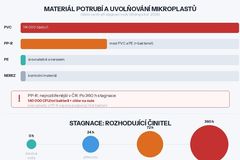
Microplastics in drinking water: a quarter million particles in every liter from a PET bottle
A 2024 Columbia University study found an average of 240,000 nanoplastic particles in every liter of bottled water from PET bottles — 700× more than older methods had shown. Particles smaller than a micrometer cross the intestinal wall into the bloodstream and have been found in blood, lungs, the placenta, and even the testicles. The article examines both the study's methodological controversies and the still-unknown health effects of nanoplastics.
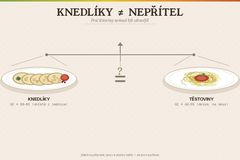
Dumplings Aren't the Enemy: Why Pasta Isn't Necessarily Healthier
The article debunks the widespread nutritional myth that pasta is automatically healthier than dumplings. While the textbook glycemic index favors durum wheat spaghetti, in real Czech conditions — where dumplings are bought pre-made and reheated — starch retrogradation occurs, lowering the glycemic response and creating beneficial resistant starch that feeds gut bacteria.

How Much Aluminium We Eat Without Knowing It
The article examines in detail the three main sources of aluminium in the human diet: its natural presence in foods (tea, spices, cereals), its leaching from aluminium foil and aluminium cookware on contact with acidic foods and at high temperatures, and food additives (E-numbers). Drawing on more than 50 peer-reviewed studies and EFSA opinions, it shows that a substantial part of the population — especially children and infants — likely exceeds the safe limit of 1 mg per kg of body weight per week without being aware of it.
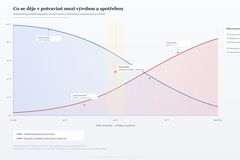
Preservatives Won't Guard Your Fridge
The article explains how food preservatives (sorbates, benzoates, nitrites, sulfites) work and why they are not all-powerful — they gradually break down, and their decomposition products (nitrosamines, benzene) can be more harmful to health than the original substances. It points out untested combinations of additives and the paradox that without preservatives food would be more dangerous, while also referencing the EPIC study confirming the link between consumption of industrially processed foods and higher mortality. The practical recommendation is to consume food as soon as possible after production and to minimize the share of processed foods in one's diet.

How the Sugar Industry Stole Half a Century of Nutrition Science
The article reveals how the American Sugar Research Foundation secretly funded Harvard scientists in the 1960s to downplay the health risks of sugar and shift the blame onto fat in a landmark NEJM paper. This influence shaped nutritional guidelines for half a century, drove the low-fat, high-carbohydrate diet, and contributed to the epidemics of obesity, type 2 diabetes, and fatty liver disease. British scientist John Yudkin, who had correctly identified sugar as a risk factor back in the 1950s, was marginalized for his conclusions and only rehabilitated posthumously.
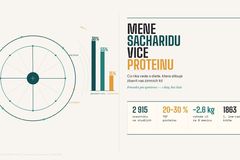
What Science Says About the Diet That Promises to Shed Your Winter Weight
The article offers a science-based overview of low-carb and high-protein diets for athletes who want to lose weight after winter. It examines the physiological mechanisms (the thermic effect of protein, satiety, stable blood glucose), cites recent meta-analyses, and notes that the initial advantage of low-carb diets evens out over the long term compared with other approaches. It includes a practical meal plan and specific recommendations for recreational cyclists, including targeted carbohydrate intake around workouts.
The Hancock Paradox: Why We Write More Irony Where No One Will Recognize It
The article unpacks what it calls the Hancock paradox: although written text is demonstrably the weakest channel for conveying irony (people recognize it less well there, and even AI models like GPT-4 reach no more than 39.8% F1), we produce more irony in writing than in speech. Drawing on a game-theoretic model of indirect speech (Pinker), the concept of "strategic ambiguity," and the figure of Švejk, the author argues that textual ambiguity is not a flaw but a desirable feature — it enables deniability, where the "right" audience decodes the intent while the "wrong" one hears only the literal content. At the same time, it shows the dark sides of this mechanism (Poe's law, political "dog whistles," irony poisoning) and the limits of compensations like the winking emoji, which works only for some people and contexts.

A Guide to a World Where "Yes" Doesn't Mean Consent and Silence Speaks Louder Than Words
The article explores culturally conditioned strategies of refusal across the world's languages and cultures — from the indirect Japanese "hai" through the Arabic "IBM" system (Inshallah, Bukra, Ma'alesh) to the Chinese ritual of declining offers. It analyzes the grammatical structures of negation in various languages (Turkish, Finnish, Arabic, Bantu languages) and shows how these structures shape the repertoire of refusal strategies. It also examines the pragmatic transfer of cultural norms into a foreign language and the practical consequences of cross-cultural misunderstandings in both business and personal contexts.

"You" Isn't "ty" — It's "vy": How People Around the World Address One Another Informally and Formally
The article explores how different languages and cultures handle forms of address on the spectrum between the informal and formal "you" (the so-called T–V distinction). It traces the historical development from Czech through Polish, Russian, French, Italian, Spanish, German, and English all the way to East Asian languages (Japanese, Korean, Javanese), where systems of politeness reach far greater complexity. It shows that attempts by authoritarian regimes to change politeness forms from above mostly fail, whereas organic social shifts (such as the Swedish du-reform) succeed.

Why You Won't Finish Reading This Article — and Why That's OK
The article examines the paradox of reading on the web: most people only skim texts and 55% of visitors spend less than 15 seconds on a page, yet long, high-quality content demonstrably attracts engaged readers. Drawing on dozens of academic studies, it shows that what is declining is not the biological capacity for attention but the willingness to invest it in a single source, and that reading is being transformed, not disappearing.

Everyone Writes, Nobody Reads — and Then Came Artificial Intelligence
Scientific publishing faces a paradox: nearly four million articles are produced every year, yet most are never read in full. Artificial intelligence tools (Semantic Scholar, Consensus, Elicit, PaperQA2) make it possible for the first time to efficiently search and synthesize millions of texts, dramatically cutting the time needed for systematic reviews. The article analyzes the structural causes of this oversaturation (publish-or-perish pressure, predatory journals, publisher oligopoly) and argues that the ability to formulate precise queries for AI is becoming a key skill of the 21st century.
Marx Was Right. His Own Disciples Proved It
The article shows how, after the regime's fall, roughly 1.7 million members of the Czechoslovak Communist Party (KSČ) confirmed Marx's own thesis that social being determines consciousness — when the economic base shifted from planned to market, former Marxists transformed within months into ardent champions of the free market, epitomized by the economists of the ČSAV Forecasting Institute (Komárek, Klaus, Zeman). Drawing on Marx, Hoffer, and Žižek, the author argues that this "turning of coats" was not a dramatic conversion but merely a change of ideological costume over the same cynical subject, and recalls a June 1989 survey according to which only 46% of the party's members would have joined again.

The Invisible Censor: How We Learned to Silence Ourselves
The article follows one person's life from a curious high-school student to a resigned adult, using it to show how market democracy replaced external totalitarian censorship with a more elegant internal self-censorship — a person installs their own censor and mistakes it for their own judgment. Alongside Orwell and Huxley, the author proposes a third model of control, one in which citizens police their own thinking, and backs it with research (FIRE, Pew, Index on Censorship) as well as the ideas of Bernays, Ellul, Chomsky, Zuboff, and Bělohradský. He places special emphasis on the Central European experience, where the shift from party directives to the ownership pressures of oligarchs unfolded within a single generation, and concludes that the market reliably silences precisely those problems that outlast changes of government.

The Missing Social Demand
The article shows why a text that is truthful, verified, and equally critical of all political camps has no chance of succeeding in the Czech media environment — not because of censorship, but because of a missing social demand, audience, and editorial outlet to spread it. The author analyzes how both media owners and the audience itself systematically filter out content that strengthens no side, and how even media literacy has transformed from a tool of emancipation into a more sophisticated filter for sorting information according to one's own worldview. It culminates in the thesis that whereas under totalitarianism the freedom to write is missing, in a democracy what is missing is the demand to read.

The Highest Form of Democracy: Populism, Idiocracy, or Something Far Worse?
The article examines the limits of democracy through the lens of political philosophy, social choice theory, and empirical data — from Brennan's epistocracy through Caplan's rational irrationality of voters to Arrow's impossibility theorem. It analyzes populism (Müller, Mudde), refutes the biological scenario of idiocracy using the Flynn effect, and offers deliberative democracy (the Irish citizens' assembly, Fishkin's deliberative polls) as a practical path toward improving democratic decision-making.

Barbados, Instagram and the Pond Round the Corner: Why We're So Desperate to Get to the Sea
The article examines why people are so desperate to get to the sea for their holidays, analysing the phenomenon through the lenses of neuroscience, evolutionary psychology, the sociology of class, and marketing. It shows that the travel industry does not manufacture happiness but rather a sense of its absence, that the anticipation of a holiday brings more happiness than the holiday itself, and that the scientifically documented benefits of contact with water (blue space) can be obtained even at a pond in the Vysočina highlands, without any need to fly to Barbados.

Three Paths from a Single Point: Why Girls Turn Pain Inward and Boys Turn It Outward
The article presents a synthesis of findings from neuroscience, criminology, and terrorism research, showing that self-harm, addiction, and radicalization share a common psychological mechanism — a response to adverse childhood experiences and the loss of personal significance. Gender does not determine the intensity of the pain, but rather the culturally conditioned channel through which it is expressed: girls turn pain inward (self-harm, depression), boys turn it outward (aggression, extremism). Kruglanski's 3N model (needs–narratives–networks) explains why these phenomena are interchangeable and points to the possibility of unified prevention instead of the current fragmented approach.

Why People Pay for Justice: Science Reveals the Dark and Light Sides of Altruistic Punishment
The article analyzes the phenomenon of altruistic punishment — people's willingness to bear personal costs to punish norm violators even without personal benefit. It summarizes key research from behavioral economics, evolutionary biology, and neuroscience since the groundbreaking study by Fehr and Gächter (2002), including public goods game experiments, cross-cultural comparisons, and neuroimaging studies revealing the activation of the brain's reward centers during punishment.

How Fidesz Took Control of Hungary's Media: Anatomy of a Fifteen-Year Process
The article maps in detail the fifteen-year process by which the Fidesz party, under the leadership of Viktor Orbán, systematically gained control of roughly 80% of the Hungarian media market. It describes the legislative changes, the creation of a loyal regulatory authority, media acquisitions by friendly oligarchs, the emergence of the KESMA media foundation uniting hundreds of outlets, and the economic starvation of independent newsrooms through state advertising. Despite this, an ecosystem of independent online media funded by donations and subscriptions survives in Hungary.

Why Vegans Don't Feed Lions Tofu: On Money, the Steam Engine, and a New Religion Without a God
The article analyzes the vegan movement through the lens of economics, psychology, and history. It shows that moral arguments against killing animals have, on their own, never been enough to bring about change — just as with the abolition of slavery, technological and economic superiority (the steam engine) was decisive. The author argues that real change will be driven by cultivated meat and synthetic proteins, not by individual dietary conversions, and criticizes the flows of money within the animal-rights movement, which go more toward campaigns than toward technological development.

Why Fifteen Scandals Persuade Less Than One
The article explains the paradox of why many scandals strengthen rather than weaken a politician, drawing on nine psychological mechanisms – the dilution effect, cognitive overload, the conjunction fallacy, narrative transportation, and psychic numbing. It shows that the human brain processes a flood of accusations heuristically and intuitively, which erodes their persuasiveness, whereas a single concrete story with an identifiable victim persuades more effectively than fifteen factual points.

How Pork Belly Became King: The Story of the Strangest Price Reversal on Your Plate
The article analyzes the remarkable price reversal of pork belly, which has gone from historically the cheapest part of the pig to costing more than ham. Behind this structural shift lies a combination of anatomical constraints (the belly makes up only 16–19% of the carcass), the American bacon boom, Asian demand amplified by African swine fever in China, grilling culture spread through social media, and the rehabilitation of fat within keto diets. For the Czech market, which relies on imports for more than half of its pork, the era of cheap pork belly is definitively a thing of the past.

15,000 lives per quarter: how the phrase “that’s just your opinion” killed during the pandemic
The article analyzes the impact of disinformation about mRNA vaccines during the COVID-19 pandemic in the Czech Republic. It shows how the strategy “that’s just your opinion”

How Pepík in Prague Lost His Garden in the Public Interest
Through the story of a fictional Pepík Novák, the article illustrates how the interplay between Prague's Metropolitan Plan and the amendment to the Building Act (parliamentary print 67/0) can systematically favor large investors at the expense of small property owners. The amendment introduces automatic public-interest status for buildings over 10,000 m², single-instance proceedings with no right of appeal, and the option of expropriation in favor of private developers, while owners of family houses in stabilized areas remain regulatorily frozen.

A Watchdog in a Commercial Kennel
The article traces how the purpose of the media has shifted from the postwar ideal of democracy's watchdog, through the Hutchins Commission and the Four Theories of the Press, to today's crisis of journalism in the digital age. It analyzes how the advent of television advertising, stock-market ownership of newspapers, and media concentration eroded the profession's ethos, and sets the media theory of Chomsky and Herman against the current digital reality.
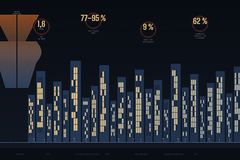
We're Living Longer, but Where Will We Live?
By 2050, the global population over 65 will double to 1.6 billion, with 77–95% of seniors wanting to remain in their own homes—yet the existing housing stock is not ready for it. The article compares the approaches of Norway, Japan, and other countries to barrier-free housing and analyzes economic models for financing home modifications for the aging Czech population.

The White Disease 2025: How Grandparents Became Enemies
The article confronts the widespread narrative about selfish seniors with academic studies and data. It shows that the 'grey vote' hypothesis has been refuted, that seniors are net givers of intergenerational transfers, and that their critical media literacy is in many respects better than that of younger generations. Meanwhile, the influence of disinformation on elections is an order of magnitude smaller than the influence of the narrative framing by established media.

The Nobel Prize Factory That Is Losing Its Workers
The article analyzes the Israeli phenomenon of a high number of Nobel Prizes per capita and reveals the structural conditions behind this success — immigration waves bringing in talent, top-tier institutions, and a culture of questioning authority. At the same time, it shows that this model is threatened by brain drain, underfunding of basic research, the exclusion of the Arab and ultra-Orthodox populations, and political instability after 2023. In conclusion, it compares the Israeli and Czech approaches to science and identifies which elements are transferable and which are not.

Money Doesn't Motivate? Bosses Earn 281× More and Perform No Better
The article debunks the popular myth that money doesn't motivate, confronting it with meta-analyses showing that financial incentives reliably increase the quantity of performance. At the same time, it highlights the paradox in which rank-and-file employees are told that money isn't important, while CEOs collect 281× higher compensation justified by financial motivation. Drawing on neuroscience studies and economic data, it shows that extremely high executive pay is often counterproductive and that its growth is driven more by systemic mechanisms than by any real impact on performance.

When Society Goes Blind: The Cybernetics of Democratic Stability
The article analyzes democratic stability through the lens of cybernetics and systems theory, in which negative feedback (the media, trade unions, courts, civil society) functions as a regulatory mechanism that keeps society in balance. Drawing on the work of Wiener, Ashby, Meadows, and Beer, it shows that suppressing these feedback loops — as illustrated by the examples of the USSR, Nazi Germany, and the present-day shrinking of civic space — inevitably leads to the destabilization and collapse of the system.
Dead Hand, or: How I Learned to Stop Worrying and Let the Machine Sleep
The article recounts the Soviet Perimeter system ("Dead Hand"), whose existence Russia first officially confirmed only in 2011, in an interview with Komsomolskaya Pravda. The author sets Kubrick's Dr. Strangelove against the system's actual design: Soviet generals rejected the original fully automatic machine and built instead a system with three conditions and a human decision made in a bunker. The point is that nuclear architecture holds together not because of the rationality of leaders, but because of the distrust their own engineers and officers have toward them.

JFK, Tague's Curb, Salisbury Cathedral, and the Burned Notes
The essay uses the JFK assassination as the archetype of a so-called anti-Holmesian regime, in which evidence vanishes, is altered, or is stripped of its weight (burned autopsy notes, the wiped lead smear on Tague's curb, the lost spectrographic plates). Through concrete forensic details — the spectrography of the curb showing lead and antimony but no copper, incompatible with a full-metal-jacket Carcano bullet, and the contradiction between the crouching gunman in the reconstruction and the standing gunman described by witness Brennan — the author shows how cumulatively converging institutional interests become impossible to adjudicate. Salisbury 2018 serves as a modern counterpart and 'tombstone' of this epistemic regime.

A Toll as Reparations: How Trump Would Cut a Deal with Iran Without Having to Admit It
The analysis assumes that Trump will strike a tacit deal with Iran over passage through the Strait of Hormuz, under which Tehran would collect fees (PGSA) that function de facto as war reparations disguised as a security service. The author maps out the economic math of the toll, its impact on gasoline prices ahead of the midterm elections, and four risks (Riyadh, Iranian overreach, Pentagon–Senate, the European snapback) that could block the deal.

Hormuz Will Never Go Back. Why Trump Can't Open the Strait
The article analyzes how Iran, during the 2026 US–Israeli–Iranian war, turned the Strait of Hormuz into a tool of strategic control over a fifth of the global oil flow using "smart" naval mines (Maham-3/7, the Chinese EM-52) — with a cost asymmetry in which a mine worth thousands of dollars threatens vessels worth billions. The author shows that the US cannot respond to this threat in the conventional way, because it has long neglected its mine-countermeasure capabilities (the last Avenger-class minesweepers were scrapped weeks before the war), and Trump's "Project Freedom" operation is a narrative rather than a real military solution. In closing, it examines the broader implications — permanently higher insurance premiums, a precedent threatening the freedom-of-navigation regime in other straits (the Bosphorus, Suez, Bab-el-Mandeb, Malacca), and the consequences for energy prices and for the Czech Republic's strategic planning.

The Article You Won't Read on Your Phone: A Handbook for a Nuclear Crisis
The article is deliberately a dry operational manual for the unlikely but specific scenario of a nuclear strike on the Czech Republic, where—unlike other crises—survival is decided in the first seconds and the following 72 hours. Through the stories of three people in and around Prague, the author shows the reflexes to take after the flash, the physics of the blast wave and fallout (including the Way-Wigner rule and the destruction radii by warhead yield), the principles of sheltering, and a concrete list of supplies to have ready months in advance. He also argues that real survival lies in community, not in armed isolation, and distinguishes the sudden nuclear threat from more probable non-nuclear crises, which have an escalation curve measured in weeks and time to prepare.

Fourteen Points You Can't Say Yes To: The Anatomy of the Iranian Escalation Trap
The article analyzes the Iranian fourteen-point document from late April / early May 2026, by which Tehran responded to the U.S. proposal to end the war, and defends the thesis (with medium confidence) that it is not a proposal to resolve the conflict but a structural cementing of the stalemate, in whose continuation Iran has a dominant interest. The author dissects five "toxic" points (reparations, withdrawal of U.S. forces from the Gulf, a guarantee of non-aggression against Israel, control of Hormuz, and an unworkable thirty-day deadline) as well as the factionalization of the Iranian leadership after the February strike, which renders the document systemically irreducible and thus unacceptable. In the context of oil prices above $110, depleted U.S. munitions stocks, and Trump's three scenarios, it offers the prediction that no comprehensive deal will emerge by 30 May 2026 — prolonging the stalemate is the most likely outcome.

Lessons from Lund: why openness wins where secrecy fails
An article spanning three settings — Sweden's networked-camera maker Axis, the open drone robotics of ČVUT (Czech Technical University) led by Martin Saska, and Ukraine's frontline FPV-drone production — shows that openness, when layered correctly (public standards and SDKs, a closed hardware core holding the keys), is not a weakness but a structurally stronger answer to a hostile environment than monolithic secrecy; theoretically, Kerckhoffs's principle already underpinned this back in 1883. The author sets Axis against China's Hikvision and against the outdated 1970s Bell-LaPadula and Biba models, and reads the domestic dispute between the University of Defence (which conceals) and ČVUT (which publishes) as two halves of the same solution that fail to talk to each other. The conclusion is normative: the Czech defence industry has the expertise, the money, and its first international investors (CSG, ERA Pardubice, Primoco), but it lacks a framework — bug bounties, a Central European standard for drone interoperability, and a state-held hardware root of trust.

One God, One Alphabet, Four Languages: A Short Guide to the Middle East for the Confused European
The article challenges the widespread European notion of a uniform "Arab-Islamic world," showing that script, religion, and language are three independent layers: the Middle East interweaves three mutually unrelated language families—Semitic (Arabic), Indo-European (Persian and other Iranian languages, distantly related to Czech), and Turkic—unified only by a borrowed Arabic alphabet. The author explains Arabic diglossia (standard MSA with no native speakers alongside mutually unintelligible dialects, likened to medieval Latin), the grammatical kinship of Persian to European languages, and the reach of the "Persosphere" from Tajikistan to Pakistan. The conclusion wryly notes that the true pan-regional lingua franca of today's Middle East is English.

Firestorm: from Hamburg 1943 to thermobaric weapons and nuclear winter
The article explains the physics of the firestorm — a self-sustaining atmospheric phenomenon with hurricane-force winds and temperatures above 800 °C — using the destruction of Hamburg in the Allied air raid of July 1943, and traces how the same principle was deliberately replicated in Dresden, Tokyo, and automatically in Hiroshima. The author shows that today the same physics is produced at a tactical scale by thermobaric weapons, deployed massively and systematically in Ukraine, which, alarmingly, lack any clinical documentation of victims or any international regulation — while at a large scale it would be triggered by every nuclear detonation over a city. The text connects history, thermodynamics, the legal vacuum around thermobaric weapons, and the persisting uncertainties in modeling nuclear winter into a warning that the physics of the firestorm has not changed in the eighty years since Hamburg.

Anatomy of a Firestorm: How Allied Bombers Razed Dresden to the Ground in February 1945
The article reconstructs in detail the Allied bombing of Dresden in four waves between 13 and 15 February 1945, which turned the "Florence on the Elbe" into a firestorm and, according to the Dresden Historical Commission's 2010 findings, claimed 22,700 to 25,000 victims — a fraction of the propaganda figures that circulated for decades and ran as high as a quarter of a million. The author maps the hour-by-hour chronology of the raids and the British "double-strike" tactic aimed at rescue workers, explains the thermodynamics of the firestorm, and traces the chain of decisions from Churchill's insistence to his later distancing. He also documents the historiographical revision of the death toll — from Goebbels's forgery of Tagesbefehl 47 to the Irving v. Lipstadt trial — and situates the raid within the tension between the military logic of area bombing and the moral cost of destroying a defenceless city, overcrowded with refugees, three months before the end of the war.

AI or Nuclear War: The World at a Crossroads
The article compares economic inequality in 1928 and 2024 (an identical Gini coefficient of 0.49) and analyzes two opposing scenarios for the future: the transformative potential of artificial intelligence as a tool for addressing civilizational challenges versus the escalation of geopolitical conflicts toward a nuclear confrontation. Drawing on historical parallels, it shows that technological revolutions on their own do not resolve inequality without political will.
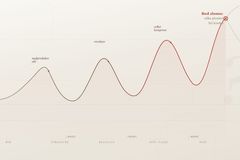
War as a Cure for Inequality: Why the Prescription Stopped Working
The article examines Peter Turchin's structural-demographic theory, according to which societies pass through predictable cycles of instability driven by elite overproduction, the pauperization of the masses, and the fiscal crisis of the state. Drawing on historical examples (the fall of Rome, the Black Death, the French Revolution, the world wars) as well as contemporary data, it shows that war and violence have historically been the most effective levelers of inequality—but in the nuclear age this mechanism has ceased to be usable, raising the question of whether peaceful alternatives exist.

The June Ultimatum: Who Dictates the Pace of Ukrainian Peace, and Why
The article analyzes the dynamics of the 2026 peace negotiations over Ukraine, which are shaped by three conflicting logics: Trump's need to reach a deal before the November congressional elections (the June ultimatum), Putin's strategy of stalling without substantial concessions, and Zelensky's refusal to capitulate, backed by domestic public opinion. Drawing on a synthesis of analyses from leading think-tanks, the author lays out five scenarios for how the situation may develop, considering a frozen conflict without a formal peace (~35%) the most likely, and examines in detail the military situation, European support, and domestic political pressures in the US and Russia.
A Degree as Insurance, Not a Compass: How Czech University Graduates Fare in the Job Market
The article reveals a paradox of Czech higher education: at 1.3%, the Czech Republic has the lowest graduate unemployment in the entire EU, yet a degree here reliably protects against unemployment without guaranteeing work in one's field — nearly a quarter of graduates work outside their field of study, and for the humanities and arts it is roughly half. The author maps the vast disparities between fields (from zero unemployment among doctors and IT specialists to 16% among artists), drawing on data from Eurostat, the Czech Statistical Office (ČSÚ), the OECD, and the MŠMT survey Absolvent 2018. He also points out that more detailed, up-to-date data on graduate employment by field is lacking in the Czech Republic.

The Last Generation of Seniors: Why Schools Must Stop Producing Juniors
The article argues that AI has replaced the routine work of junior programmers while simultaneously heightening the value of seniors' tacit experience — and in doing so has severed the chain by which juniors gradually mature into seniors. The author ties together demographic data, meta-analyses of older workers' performance, and the COBOL paradox (220 billion lines of code maintained by aging programmers) to the thesis that companies are both ceasing to hire juniors and laying off seniors, thereby endangering an entire layer of expertise. In closing, he proposes that schools stop producing hundreds of identical graduates and start distinguishing future engineers from operators, and that the state change how it funds universities.

The Brain That Chooses a School Isn't Ready for It Yet
The article presents neuroscientific evidence that the adolescent brain does not fully mature until around the age of 25, while the period around age 15 is, by contrast, the peak of cognitive plasticity. International studies show that the type of education (academic vs. vocational) causally affects the development of intelligence — academic secondary schools (gymnázia) in Germany demonstrably boost cognitive abilities, yet Czech multi-year gymnázia surprisingly bring no measurable added value.

A Brain for Numbers, Not Words: Why Some People Just Can't Learn a Foreign Language
The ability to learn foreign languages is largely genetically determined and separable from general intelligence — one third of the genetic influence is entirely independent of IQ. Neuroscientific research has identified specific brain networks, genes (FOXP2, CNTNAP2), and structural factors (the arcuate fasciculus, phonological memory) that determine linguistic talent independently of cognitive ability. The article criticizes the Czech education system for blanket language requirements that may unfairly hold back technically gifted students, and compares approaches taken abroad.
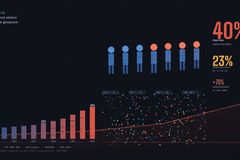
The Generation That Doesn't Drink or Do Drugs — Yet Still Suffers
The article examines the paradox of Generation Z, the healthiest-behaving generation in history (it drinks, takes drugs, and commits violence less than any before it), which nonetheless shows an unprecedented mental health crisis — 40% of Czech ninth-graders display signs of depression. Drawing on data from the Global Burden of Disease, the NHS, and the CDC, it analyzes the causes, from the decline of childhood play through social media to the systemic collapse of Czech child psychiatric care.