
Dead Hand, or: How I Learned to Stop Worrying and Let the Machine Sleep
The article recounts the Soviet Perimeter system ("Dead Hand"), whose existence Russia first officially confirmed only in 2011, in an interview with Komsomolskaya Pravda. The author sets Kubrick's Dr. Strangelove against the system's actual design: Soviet generals rejected the original fully automatic machine and built instead a system with three conditions and a human decision made in a bunker. The point is that nuclear architecture holds together not because of the rationality of leaders, but because of the distrust their own engineers and officers have toward them.

JFK, Tague's Curb, Salisbury Cathedral, and the Burned Notes
The essay uses the JFK assassination as the archetype of a so-called anti-Holmesian regime, in which evidence vanishes, is altered, or is stripped of its weight (burned autopsy notes, the wiped lead smear on Tague's curb, the lost spectrographic plates). Through concrete forensic details — the spectrography of the curb showing lead and antimony but no copper, incompatible with a full-metal-jacket Carcano bullet, and the contradiction between the crouching gunman in the reconstruction and the standing gunman described by witness Brennan — the author shows how cumulatively converging institutional interests become impossible to adjudicate. Salisbury 2018 serves as a modern counterpart and 'tombstone' of this epistemic regime.

A Toll as Reparations: How Trump Would Cut a Deal with Iran Without Having to Admit It
The analysis assumes that Trump will strike a tacit deal with Iran over passage through the Strait of Hormuz, under which Tehran would collect fees (PGSA) that function de facto as war reparations disguised as a security service. The author maps out the economic math of the toll, its impact on gasoline prices ahead of the midterm elections, and four risks (Riyadh, Iranian overreach, Pentagon–Senate, the European snapback) that could block the deal.

Hormuz Will Never Go Back. Why Trump Can't Open the Strait
The article analyzes how Iran, during the 2026 US–Israeli–Iranian war, turned the Strait of Hormuz into a tool of strategic control over a fifth of the global oil flow using "smart" naval mines (Maham-3/7, the Chinese EM-52) — with a cost asymmetry in which a mine worth thousands of dollars threatens vessels worth billions. The author shows that the US cannot respond to this threat in the conventional way, because it has long neglected its mine-countermeasure capabilities (the last Avenger-class minesweepers were scrapped weeks before the war), and Trump's "Project Freedom" operation is a narrative rather than a real military solution. In closing, it examines the broader implications — permanently higher insurance premiums, a precedent threatening the freedom-of-navigation regime in other straits (the Bosphorus, Suez, Bab-el-Mandeb, Malacca), and the consequences for energy prices and for the Czech Republic's strategic planning.

The Article You Won't Read on Your Phone: A Handbook for a Nuclear Crisis
The article is deliberately a dry operational manual for the unlikely but specific scenario of a nuclear strike on the Czech Republic, where—unlike other crises—survival is decided in the first seconds and the following 72 hours. Through the stories of three people in and around Prague, the author shows the reflexes to take after the flash, the physics of the blast wave and fallout (including the Way-Wigner rule and the destruction radii by warhead yield), the principles of sheltering, and a concrete list of supplies to have ready months in advance. He also argues that real survival lies in community, not in armed isolation, and distinguishes the sudden nuclear threat from more probable non-nuclear crises, which have an escalation curve measured in weeks and time to prepare.

Fourteen Points You Can't Say Yes To: The Anatomy of the Iranian Escalation Trap
The article analyzes the Iranian fourteen-point document from late April / early May 2026, by which Tehran responded to the U.S. proposal to end the war, and defends the thesis (with medium confidence) that it is not a proposal to resolve the conflict but a structural cementing of the stalemate, in whose continuation Iran has a dominant interest. The author dissects five "toxic" points (reparations, withdrawal of U.S. forces from the Gulf, a guarantee of non-aggression against Israel, control of Hormuz, and an unworkable thirty-day deadline) as well as the factionalization of the Iranian leadership after the February strike, which renders the document systemically irreducible and thus unacceptable. In the context of oil prices above $110, depleted U.S. munitions stocks, and Trump's three scenarios, it offers the prediction that no comprehensive deal will emerge by 30 May 2026 — prolonging the stalemate is the most likely outcome.

Lessons from Lund: why openness wins where secrecy fails
An article spanning three settings — Sweden's networked-camera maker Axis, the open drone robotics of ČVUT (Czech Technical University) led by Martin Saska, and Ukraine's frontline FPV-drone production — shows that openness, when layered correctly (public standards and SDKs, a closed hardware core holding the keys), is not a weakness but a structurally stronger answer to a hostile environment than monolithic secrecy; theoretically, Kerckhoffs's principle already underpinned this back in 1883. The author sets Axis against China's Hikvision and against the outdated 1970s Bell-LaPadula and Biba models, and reads the domestic dispute between the University of Defence (which conceals) and ČVUT (which publishes) as two halves of the same solution that fail to talk to each other. The conclusion is normative: the Czech defence industry has the expertise, the money, and its first international investors (CSG, ERA Pardubice, Primoco), but it lacks a framework — bug bounties, a Central European standard for drone interoperability, and a state-held hardware root of trust.

One God, One Alphabet, Four Languages: A Short Guide to the Middle East for the Confused European
The article challenges the widespread European notion of a uniform "Arab-Islamic world," showing that script, religion, and language are three independent layers: the Middle East interweaves three mutually unrelated language families—Semitic (Arabic), Indo-European (Persian and other Iranian languages, distantly related to Czech), and Turkic—unified only by a borrowed Arabic alphabet. The author explains Arabic diglossia (standard MSA with no native speakers alongside mutually unintelligible dialects, likened to medieval Latin), the grammatical kinship of Persian to European languages, and the reach of the "Persosphere" from Tajikistan to Pakistan. The conclusion wryly notes that the true pan-regional lingua franca of today's Middle East is English.
Firestorm: from Hamburg 1943 to thermobaric weapons and nuclear winter
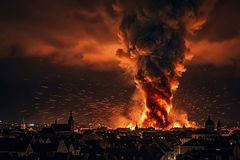
The article explains the physics of the firestorm — a self-sustaining atmospheric phenomenon with hurricane-force winds and temperatures above 800 °C — using the destruction of Hamburg in the Allied air raid of July 1943, and traces how the same principle was deliberately replicated in Dresden, Tokyo, and automatically in Hiroshima. The author shows that today the same physics is produced at a tactical scale by thermobaric weapons, deployed massively and systematically in Ukraine, which, alarmingly, lack any clinical documentation of victims or any international regulation — while at a large scale it would be triggered by every nuclear detonation over a city. The text connects history, thermodynamics, the legal vacuum around thermobaric weapons, and the persisting uncertainties in modeling nuclear winter into a warning that the physics of the firestorm has not changed in the eighty years since Hamburg.
Anatomy of a Firestorm: How Allied Bombers Razed Dresden to the Ground in February 1945
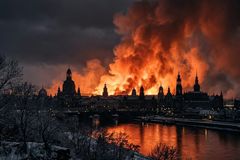
The article reconstructs in detail the Allied bombing of Dresden in four waves between 13 and 15 February 1945, which turned the "Florence on the Elbe" into a firestorm and, according to the Dresden Historical Commission's 2010 findings, claimed 22,700 to 25,000 victims — a fraction of the propaganda figures that circulated for decades and ran as high as a quarter of a million. The author maps the hour-by-hour chronology of the raids and the British "double-strike" tactic aimed at rescue workers, explains the thermodynamics of the firestorm, and traces the chain of decisions from Churchill's insistence to his later distancing. He also documents the historiographical revision of the death toll — from Goebbels's forgery of Tagesbefehl 47 to the Irving v. Lipstadt trial — and situates the raid within the tension between the military logic of area bombing and the moral cost of destroying a defenceless city, overcrowded with refugees, three months before the end of the war.

AI or Nuclear War: The World at a Crossroads
The article compares economic inequality in 1928 and 2024 (an identical Gini coefficient of 0.49) and analyzes two opposing scenarios for the future: the transformative potential of artificial intelligence as a tool for addressing civilizational challenges versus the escalation of geopolitical conflicts toward a nuclear confrontation. Drawing on historical parallels, it shows that technological revolutions on their own do not resolve inequality without political will.
War as a Cure for Inequality: Why the Prescription Stopped Working
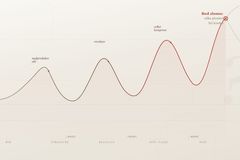
The article examines Peter Turchin's structural-demographic theory, according to which societies pass through predictable cycles of instability driven by elite overproduction, the pauperization of the masses, and the fiscal crisis of the state. Drawing on historical examples (the fall of Rome, the Black Death, the French Revolution, the world wars) as well as contemporary data, it shows that war and violence have historically been the most effective levelers of inequality—but in the nuclear age this mechanism has ceased to be usable, raising the question of whether peaceful alternatives exist.

The June Ultimatum: Who Dictates the Pace of Ukrainian Peace, and Why
The article analyzes the dynamics of the 2026 peace negotiations over Ukraine, which are shaped by three conflicting logics: Trump's need to reach a deal before the November congressional elections (the June ultimatum), Putin's strategy of stalling without substantial concessions, and Zelensky's refusal to capitulate, backed by domestic public opinion. Drawing on a synthesis of analyses from leading think-tanks, the author lays out five scenarios for how the situation may develop, considering a frozen conflict without a formal peace (~35%) the most likely, and examines in detail the military situation, European support, and domestic political pressures in the US and Russia.