
A Degree as Insurance, Not a Compass: How Czech University Graduates Fare in the Job Market
The article reveals a paradox of Czech higher education: at 1.3%, the Czech Republic has the lowest graduate unemployment in the entire EU, yet a degree here reliably protects against unemployment without guaranteeing work in one's field — nearly a quarter of graduates work outside their field of study, and for the humanities and arts it is roughly half. The author maps the vast disparities between fields (from zero unemployment among doctors and IT specialists to 16% among artists), drawing on data from Eurostat, the Czech Statistical Office (ČSÚ), the OECD, and the MŠMT survey Absolvent 2018. He also points out that more detailed, up-to-date data on graduate employment by field is lacking in the Czech Republic.

The Last Generation of Seniors: Why Schools Must Stop Producing Juniors
The article argues that AI has replaced the routine work of junior programmers while simultaneously heightening the value of seniors' tacit experience — and in doing so has severed the chain by which juniors gradually mature into seniors. The author ties together demographic data, meta-analyses of older workers' performance, and the COBOL paradox (220 billion lines of code maintained by aging programmers) to the thesis that companies are both ceasing to hire juniors and laying off seniors, thereby endangering an entire layer of expertise. In closing, he proposes that schools stop producing hundreds of identical graduates and start distinguishing future engineers from operators, and that the state change how it funds universities.

The Brain That Chooses a School Isn't Ready for It Yet
The article presents neuroscientific evidence that the adolescent brain does not fully mature until around the age of 25, while the period around age 15 is, by contrast, the peak of cognitive plasticity. International studies show that the type of education (academic vs. vocational) causally affects the development of intelligence — academic secondary schools (gymnázia) in Germany demonstrably boost cognitive abilities, yet Czech multi-year gymnázia surprisingly bring no measurable added value.

A Brain for Numbers, Not Words: Why Some People Just Can't Learn a Foreign Language
The ability to learn foreign languages is largely genetically determined and separable from general intelligence — one third of the genetic influence is entirely independent of IQ. Neuroscientific research has identified specific brain networks, genes (FOXP2, CNTNAP2), and structural factors (the arcuate fasciculus, phonological memory) that determine linguistic talent independently of cognitive ability. The article criticizes the Czech education system for blanket language requirements that may unfairly hold back technically gifted students, and compares approaches taken abroad.
The Generation That Doesn't Drink or Do Drugs — Yet Still Suffers
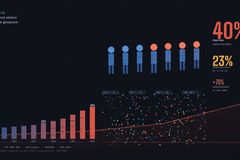
The article examines the paradox of Generation Z, the healthiest-behaving generation in history (it drinks, takes drugs, and commits violence less than any before it), which nonetheless shows an unprecedented mental health crisis — 40% of Czech ninth-graders display signs of depression. Drawing on data from the Global Burden of Disease, the NHS, and the CDC, it analyzes the causes, from the decline of childhood play through social media to the systemic collapse of Czech child psychiatric care.