How to Make Money from an AI Assistant: Five Models, No Profit
The article analyzes the five main monetization models for conversational AI (subscriptions, API, advertising, vertical integration, and transaction commissions) and shows that none of them has yet managed to make standalone AI assistants profitable. The roughly 40% gross margins of AI companies are a fraction of those of traditional SaaS software, because inference costs grow with every user. The most successful approaches are vertical specialization (e.g., Claude Code with ARR of USD 2.5 billion) and integrating AI into existing ecosystems (Google, Microsoft), while generic AI assistants remain loss-making.
An Analytical Overview of Conversational-AI Monetization Strategies: From Silicon Valley to Beijing — February 2026
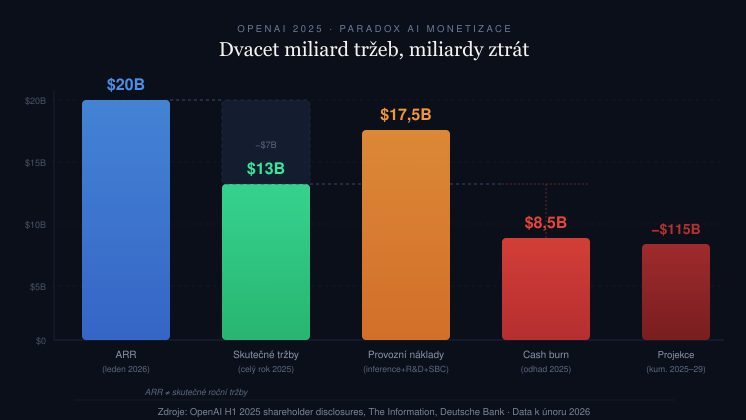
For 2025, OpenAI reported annualized revenue (ARR) of over $20 billion — but actual full-year revenue reached approximately $13 billion.1 Operating losses persist: in the first half of 2025 cash burn amounted to $2.5 billion and the accounting loss including stock-based compensation exceeded $4 billion; for the full year 2024 the net loss reached more than $5 billion. In February 2026, OpenAI began displaying ads in ChatGPT — a step its founder Sam Altman had publicly rejected as recently as 2023. This shift in stance illustrates how the entire conversational-AI industry is grappling with a question to which no one has yet found a convincing answer: how to turn AI assistants into a profit.
This article maps the five principal monetization models that today's leading players are testing or operating — from the American giants through AI search engines to regional dominants in China, Korea, and Russia. Each runs into specific limits. None has yet proven that, as a standalone product with a generic focus, it can cover the cost of operating large language models. The data, however, show that vertically anchored AI — whether as part of an existing ecosystem (vertical integration) or as a specialized professional tool (vertical specialization) — does have a path to profitability.
Traditional SaaS software achieves gross margins of around 80%. The marginal cost of an additional user is practically zero — once developed, the software runs on servers and every new customer means almost pure profit. AI assistants turn this economics on its head: every query consumes compute, electricity, and GPU cycles. Inference costs grow in direct proportion to the number of users and the complexity of queries.
OpenAI reports a gross margin of around 40%. Anthropic projects a gross margin of around 40% for 2025 (revised down from an original 50%; The Information, January 2026), with a target of reaching 77% in 2028 thanks to more efficient models and proprietary chips (The Information, November 2025). For comparison: Google Services has a gross margin above 55% (Google does not report Search's margin separately, but estimates for the entire advertising segment run considerably higher), Meta around 80% — but both companies built these margins over more than ten years. The AI industry has existed commercially for three years. The structural difference means that scaling — in traditional software the path to profitability — does not automatically resolve loss-making with AI. More users means higher revenue, but at the same time proportionally higher costs.
A historical parallel exists: Amazon Web Services in 2006–2012 faced similar dynamics of high marginal costs for computing capacity. The fundamental difference, however, is not only one of scale — AWS had the advantage that its customers paid directly for consumption. With AI chatbots, most users do not pay at all.
To illustrate: the indicative cost of a single query on a frontier model runs to a few cents (GPT-4o charges $2.50/$10 per million input/output tokens; Claude Sonnet $3/$15). With hundreds of millions of users and dozens of queries a day, these cents add up to billions a year.
Subscriptions are the main revenue source for consumer AI products. The price level has settled at around $20 per month for the basic paid tier: ChatGPT Plus, Claude Pro, and Google One AI Premium all fall within this range. In January 2026, OpenAI made a new ChatGPT Go tier available globally for $8 per month. Premium plans reach higher — ChatGPT Pro at $200, Claude Max at $100–200 per month.
The problem is conversion. Of the roughly 800 million weekly active ChatGPT users (a figure from October 2025), an estimated only 5% pay, i.e. around 40 million. This means that 95% of users generate inference costs without corresponding revenue. Moreover, according to Deutsche Bank the situation is worsening in some regions — consumer spending on ChatGPT in Europe stagnated from May 2025, suggesting a saturation of paying users.
Enterprise subscriptions look more promising. OpenAI reports more than a million corporate customers and 7 million paid work accounts. Anthropic has more than 300,000 corporate customers, of which more than 500 spend over a million dollars a year. Corporate customers are less price-sensitive and less prone to churn — switching costs in the enterprise environment are high.
The fundamental question is: is $20 per month enough? If the average user generates inference costs that consume most of the subscription, then even 100% conversion would not solve the profitability problem. The entire industry is betting that inference costs will fall faster than subscription prices — but that is an assumption, not a proven fact.
Pay-per-use of the API — typically billed per million tokens — is proving to be the fastest-growing segment. Anthropic generates roughly 80% of its revenue from enterprise customers and API contracts; the API alone accounts for an estimated 70–75% of total revenue. OpenAI, by contrast, still depends primarily on consumers — roughly 50% of revenue comes from ChatGPT.
The price war in the API segment is intense. OpenAI, Anthropic, Google, and smaller players such as Mistral are consistently cutting prices. The Chinese market pushes the price war even further: Baidu offers ERNIE 4.5 at a fraction of the price of Western frontier models. ByteDance and DeepSeek are squeezing prices just as aggressively. This pressure spills over into the Western market too, because for developers working on multilingual applications the Chinese API is a real alternative.
Added to this is the growing availability of open-source models (Llama, Mistral, Qwen), which further erodes the pricing power of proprietary APIs — while some of them have their own monetization strategy based on combining open models with a paid API and cloud services. The commoditization of inference — a scenario in which models become interchangeable and the price falls toward marginal cost — is a real threat.
The exception is vertically specialized products. Claude Code — Anthropic's tool for programmers, introduced in February 2025 as a research preview and publicly launched in May 2025 — reached an ARR of $2.5 billion in February 2026, with that figure more than doubling since the beginning of the year. Within six months of public launch it crossed the billion-dollar ARR threshold — a speed without precedent in the history of B2B software. According to an estimate by the analytics firm SemiAnalysis (February 2026), Claude Code generates approximately 4% of public commits on GitHub, with a projection of over 20% by the end of the year — though this is an analytical estimate with an undisclosed methodology, not measured GitHub data. Users pay significantly more for an AI tool that demonstrably replaces human work in a specific profession than for a generic assistant. It is the most striking example to date of vertical specialization — a strategy that differs from vertical integration (Model 4) in that it does not require an existing ecosystem, but does require a measurable return on investment for the user.
On 9 February 2026, OpenAI launched ads in ChatGPT for American users on the free and Go versions. The ads appear below the assistant's answers, are labeled as sponsored, and are separated from organic content. Paid plans (Plus, Pro, Enterprise) remain ad-free. The CPM (cost per thousand impressions) is approximately $60 — three times what Meta charges, comparable to premium TV formats. The minimum investment for advertisers: $200,000. Among the first partners are the agency groups WPP, Omnicom, and Dentsu.
Evercore ISI analyst Mark Mahaney estimates that OpenAI's advertising revenue could exceed $25 billion a year by 2030. WPP estimates more soberly $500–800 million in the first year. Context: Alphabet's total advertising revenue (Google Search, YouTube, Network) is approaching $300 billion a year, while Meta generates around $180 billion.
The problem, however, is fundamental: conversational AI undermines the very mechanism of PPC advertising. A traditional search engine displays a list of links — the user clicks, the advertiser pays. An AI assistant answers directly, thereby reducing the need to click through, although many AI answers still contain links. How do you measure the value of an ad that the user sees but has no reason to click on? Perplexity ran into this problem — advertising revenue for 2024 made up a marginal share of total revenue of $34 million.
Microsoft Copilot reports a 73% higher CTR for ads in a conversational interface compared with traditional formats — though this is Microsoft Advertising's own research (data November 2024 – May 2025), which requires cautious interpretation. Google is so far avoiding ads in Gemini, but is integrating them into AI Overviews in search, which has over 2 billion monthly users (Alphabet Q2 2025 earnings call). The key difference: Google does not need to make money directly on Gemini — AI improves the advertising performance of the existing Search business.
Advertising in AI assistants also carries reputational risk. Anthropic used a Super Bowl ad (February 2026) to explicitly differentiate itself from OpenAI's approach — emphasizing the absence of ads in the chatbot as a competitive advantage. Users accustomed to an uninterrupted conversational experience may respond by switching to a competitor.
The most promising strategy is applied by companies that do not need to monetize the AI assistant directly, but instead use it as a catalyst for the value of an existing ecosystem.
Google is the model example. Gemini in itself does not need to generate direct revenue. AI Overviews in search increase engagement, Gemini in Workspace increases the value of corporate subscriptions, and AI features in the cloud strengthen Google Cloud. Alphabet generates total revenue in the hundreds of billions — Gemini is a supporting tool, not a standalone product.
Microsoft applies similar logic. Copilot as an enterprise add-on costs $30 per user per month and is integrated into Microsoft 365. At the same time, Microsoft earns on Azure compute, which OpenAI and others consume for training and running models. The Azure AI segment is growing more than 60% year over year.
Elon Musk's xAI (the Grok chatbot) represents a hybrid variant: Grok is integrated into the X (Twitter) platform, where it serves as a tool for engagement and differentiation, and is at the same time offered via an API. In December 2025, xAI closed a $6 billion funding round at a $50 billion valuation and operates the Colossus supercomputer cluster. Unlike Google and Microsoft, however, xAI does not have an extensive ecosystem of services that could indirectly monetize the AI — X as an advertising platform is losing market share.
This model, though, is not the preserve of the American giants. Regional search engines and platforms — from Naver in Korea through Yandex in Russia to Baidu and ByteDance in China — apply the same strategy, often more aggressively. The common denominator: none of them earns on the AI chatbot directly. AI functions as a catalyst for the value of existing services. A detailed overview of regional strategies follows in a separate section.
The vertical-integration model, however, is available only to companies that have something to integrate — their own verticals, an advertising platform, cloud infrastructure, or an ecosystem of applications. Companies without these assets must seek a direct path to profitability.
There is, however, an alternative that can be called vertical specialization: an AI tool focused on a specific profession with a measurable return on investment. Unlike vertical integration, it does not require an existing ecosystem — but it does require the ability to demonstrably replace or significantly streamline human work. The difference is fundamental: vertical integration monetizes AI indirectly through an existing business; vertical specialization monetizes AI directly, but not as a generic assistant — as a professional tool. The most striking example to date is Claude Code (see Model 2), but OpenAI Codex and a range of smaller players in the legal, medical, and financial verticals are heading in a similar direction.
The model in which the AI assistant recommends a product and earns a commission on the transaction is intuitively attractive. OpenAI is experimenting with e-commerce integration in ChatGPT. Perplexity launched a Merchant Program with partners such as Indeed and Whole Foods and introduced revenue sharing with publishers via the Comet browser — 80% of revenue from the Comet Plus subscription goes to partner publishers.
Chinese players go furthest in this model. In February 2026, Alibaba invested 3 billion yuan (~$420 million) in a New Year campaign promoting direct transactions through the Qwen chatbot — users can directly order food, flight tickets, and products from Taobao via vouchers redeemable at more than 300,000 outlets. The chatbot as a transactional interface, not just an information source. ByteDance is integrating Doubao into live-commerce on Douyin, where the AI assistant autonomously facilitates purchases. This "agentic commerce" model is so far the closest thing to what could turn conversational AI into a direct source of transactional revenue.
The obstacle in the Western market is attribution. How do you assign a conversion to a conversational query that may have influenced the decision but where the user ultimately bought elsewhere? At typical affiliate commissions of 3–5%, the assistant would have to mediate a transaction volume in the tens of billions of dollars for relevant revenue. Chinese players sidestep this problem by owning the entire transaction chain — from the chatbot through the marketplace to the payment system.
Perplexity is innovating in this direction — its revenue-sharing model with more than 300 publishers is an attempt to create a new type of relationship between an AI platform and content creators. Whether this represents a sustainable model, or a way to mitigate a wave of copyright-infringement lawsuits, time will tell.
A comparison of the financial situation of the key players as of February 2026:
Company / ARR (February 2026) / Cumulative revenue (2025) / Gross margin / Cash burn (2025) / Valuation
OpenAI / ~$20 billion / ~$13 billion / ~40% / ~$8.5 billion / $300–730 billion2
Anthropic / $14 billion / ~$4–6 billion (estimate) / ~40%3 / not stated / $380 billion4
Perplexity / ~$200 million / n/a / n/a / n/a / $20 billion
xAI (Grok) / not stated / n/a / n/a / n/a / ~$50 billion
Google (Gemini) / not stated / part of Alphabet (~$350 billion) / n/a / subsidized from Search / ~$2 trillion (Alphabet)
Microsoft (Copilot) / not stated / part of Microsoft (~$260 billion) / n/a / investment in OpenAI / ~$3 trillion
OpenAI — H1 2025: revenue $4.3 billion, total operating expenses $6.7 billion (including R&D), marketing and sales another $2 billion, stock-based compensation ~$2.5 billion. Cash burn for H1 was $2.5 billion, for the full year 2025 an estimated $8.5 billion. Internal projections (The Information, September 2025) assume cumulative cash burn of $115 billion over the 2025–2029 period and profitability in 2029–2030. Deutsche Bank estimates cumulative losses before profitability at up to $143 billion. ARR in December 2025 reached $20 billion — but actual full-year revenue for 2025 was around $13 billion.
Anthropic — ARR of $14 billion in February 2026, up from ~$1 billion at the start of 2025 to $9–10 billion ARR at year-end (Bloomberg, CNBC). Approximately 80% of revenue from enterprise customers. Cumulative revenue for 2025 is estimated at $4–6 billion — the exact figure was not disclosed; with growth weighted toward the second half of the year, this is consistent with the ARR trajectory, where cumulative revenue is significantly lower than year-end ARR. Internal projections (The Information, November 2025): cash flow of $17 billion in 2028 at revenue of $70 billion (note: cash flow ≠ net profit). Claude Code makes up a significant part of revenue — an ARR of $2.5 billion, i.e. roughly 18% of total ARR. The valuation rose steeply: $61.5 billion after the round in March 2025 ($3.5 billion, led by Lightspeed), $183 billion after Series F ($13 billion, September 2025, led by ICONIQ, co-led by Fidelity and Lightspeed), and $380 billion after Series G ($30 billion, February 2026). Total funding since founding runs, according to various sources, between $64 billion (Crunchbase) and $69 billion (WinBuzzer) — the spread depends on the inclusion of strategic investments, debt financing, and secondary offerings.
Perplexity — ARR ~$200 million (September 2025), a target of $656 million by the end of 2026. 45 million MAU (monthly active users). It does not disclose detailed costs, but in the absence of its own models, loss-making is certain. The valuation-to-ARR ratio is around 100× — extreme even by the standards of the AI industry.
Vertical integration dominates outside the Western market too. Regional players, however, push it to more extreme forms — they have dominant shares of local markets, extensive proprietary ecosystems, and a regulatory environment that sometimes plays into their hands.
The Chinese AI-assistant market is in a state of aggressive price war as of February 2026. The goal is not profitability — it is market share.
Baidu (ERNIE Bot) launched its chatbot first among the major Chinese players (March 2023). In April 2025 it made ERNIE Bot completely free. MAU reached 200 million. Baidu's total revenue, however, is declining (–1% YoY for FY 2024, –7% in Q3 2025). AI Cloud is growing 21–27% quarterly, but makes up only ~19% of Baidu Core revenue — not enough to compensate for the slump in traditional online marketing. Cash reserves: 139 billion RMB ($19 billion).
ByteDance (Doubao) dominates the Chinese chatbot market with approximately 170 million MAU (October 2025). ByteDance as a whole achieves revenue of more than $155 billion a year with an estimated net profit of ~$25 billion — unlike Western AI startups, it is a profitable company. Doubao does not serve to generate direct revenue — it functions as a retention tool within the Douyin ecosystem (live-commerce, e-commerce).
Alibaba (Qwen/Tongyi) chose a strategy of open source and agentic commerce. The New Year campaign "Spring Festival Treat Plan" (launched 6 February 2026), with distribution of vouchers for food and goods, drove the Qwen app's daily active users (DAU), according to QuestMobile data, from roughly 8 million to 58 million within one to two days — by 7 February DAU had reached 73.5 million. Long-term retention, however, is uncertain; in a comparable Baidu campaign in 2019, 7-day retention was a mere 2%.
DeepSeek demonstrated that a comparably capable model can be trained at a fraction of the cost (an estimated $5.6 million versus hundreds of millions for GPT-4), thereby shaking the economics of the industry. It offers an API at fractional prices and has no ambition of direct consumer monetization.
Total spending by Chinese technology giants on AI reaches, in 2026, an estimated 6 billion RMB ($840 million) on user acquisition alone — the classic Chinese internet model of "share first, profit later."
Naver holds approximately a 49–51% share of South Korean search (different sources cite different figures depending on methodology). FY 2025 (Q4 earnings call, February 2026): revenue 12.35 trillion KRW ($9.15 billion), growth of 12.1%. Operating profit 2.21 trillion KRW ($1.64 billion), a margin of 18–19%.
Naver's "On-Service AI" strategy integrates the HyperCLOVA X model across search, e-commerce, maps, and fintech. Naver states that AI contributed to 55% of the growth in advertising revenue in 2025 (Q4 2025 earnings call, CEO Choi Soo-yeon). Internal tests of AI targeting showed a threefold increase in conversion rate; deployment in the home feed brought a 40% increase in CTR and a 28% reduction in cost per click.
Naver is a model example of a regional search engine that monetizes AI not through direct fees for the chatbot, but through measurable improvement in advertising performance. It is the only player that has presented a concrete metric for the indirect value of AI — a 55% contribution to advertising growth.
Yandex, with a 72% share of the Russian search market, has integrated the Alice AI assistant into search, smart-home devices, and automotive infotainment. Alice has over 66 million MAU (a Yandex figure, 2024). FY 2024: revenue ~1.1 trillion RUB ($11.2 billion), growth of 94% — a figure influenced, among other things, by inflation and the specifics of a wartime economy. Q3 2025: EBITDA margin of 21.3%. Yandex is — together with ByteDance — one of the few players that are profitable overall and finance their AI investments from their own operations. Alice does not generate revenue directly — Yandex reported a 29% improvement in advertising performance thanks to AI integration (Q3 2025 earnings).
Data from regional markets confirm the conclusion from the section on vertical integration. Chinese players, however, add two new dimensions: extreme price aggression (a free chatbot, an API at a fraction of Western prices) and a model of agentic commerce in which the chatbot directly mediates transactions. Naver goes furthest in quantifying indirect value — a measurable 55% contribution of AI to the growth of advertising revenue is a type of metric that no Western player has yet presented.
The fundamental implication: companies that do not have their own ecosystem of verticals cannot rely on the vertical-integration model and must seek another path — either direct monetization (subscriptions, API, advertising) or vertical specialization: a narrowly focused professional tool with a measurable ROI. This is the position of most Western AI startups, including OpenAI and Anthropic — and it is precisely Anthropic, with Claude Code, that shows the second path can work.
Three factors may temper the current pessimism.
Falling inference costs. The cost of training comparably capable models has fallen from an estimated $100 million (GPT-4) to a few million (DeepSeek). If inference costs follow a similar curve, gross margins may improve significantly. The development of custom chips also contributes to the decline — Google TPU, Amazon Trainium, Anthropic's planned chips — which reduce dependence on expensive Nvidia GPUs.
AI agents and vertical specialization. Autonomous systems that perform tasks rather than merely answering open up the possibility of paying for an outcome: a resolved ticket, written code, a completed analysis. Claude Code is the most striking example so far — nine months after its public launch it shows that users pay significantly more for a tool that demonstrably replaces human work. If this pattern repeats in other professions (law, medicine, finance, design), the entire monetization debate is reframed: not "how to monetize a generic chatbot," but "how to monetize a specific capability." A similar trend is emerging with OpenAI Codex and other agentic tools.
Market consolidation. If three to five large players survive out of today's dozens of LLM providers, competitive pressure on prices will ease. This, however, is a speculative scenario — Chinese price aggression and the rising quality of open-source models may, on the contrary, delay consolidation.
The EU AI Act, in full force from August 2026, imposes transparency obligations on foundation-model providers. The Digital Services Act requires clear labeling of ads on online platforms — a standard relevant to conversational-AI interfaces too. The GDPR limits the use of conversational data for ad targeting — Meta had to switch off the feature of using AI chat data for ad targeting in the EU.
Copyright remains an open problem. Perplexity faces lawsuits from News Corp, Nikkei, and Asahi Shimbun. OpenAI is dealing with dozens of lawsuits from authors and publishers. In September 2025, Anthropic reached a settlement of the Bartz v. Anthropic class action for $1.5 billion — according to the plaintiffs' law firms, the largest publicly known copyright settlement in U.S. history. It covers approximately 500,000 books downloaded from the pirate libraries LibGen and PiLiMi (Pirate Library Mirror).5 Judge Alsup, after an initial denial and a request for additional information, granted preliminary approval on 25 September 2025; a fairness hearing with final approval is scheduled for 23 April 2026. The settlement does not grant Anthropic a license for future training of models on these works. These costs are becoming a relevant operating item that further pressures margins.
After three years of the commercial existence of conversational AI assistants, a pattern is emerging that none of the five models explains on its own — but which is apparent when the data is viewed in aggregate.
Demand is real and enormous. Hundreds of millions of users in the West and in Asia, hundreds of thousands of corporate customers, revenue growing at a pace without precedent in the history of the technology industry. That is not the problem — that is the starting point.
A generic AI assistant as a standalone product has, so far, no proven path to profitability. Subscriptions run into low conversion (an estimated 5% for ChatGPT), advertising into uncertain effectiveness in a conversational interface, the API into a price war from China and open source, affiliate into attribution. This quartet of models generates revenue in the billions — but none of them covers full costs without external subsidization.
Vertically anchored AI has proven profitability — in two distinct forms. Each works by a different mechanism and is available to a different type of company:
Vertical integration — AI as a catalyst for an existing ecosystem. Google, Microsoft, ByteDance, Naver, and Yandex all demonstrate the same principle: an AI chatbot earns when it improves the performance of a service that already generates money. Naver quantified AI's 55% contribution to advertising-revenue growth; Yandex reported a 29% improvement in advertising performance. Chinese players have taken this logic to the extreme — they run the chatbot as a pure loss leader and monetize it indirectly through transactions, advertising, and cloud. The key requirement: you must have something to integrate. This path is closed to companies without their own verticals.
Vertical specialization — AI as a professional tool with a measurable ROI. Claude Code is the most striking example so far: ARR of $2.5 billion within nine months of its public launch, because it demonstrably replaces the human work of a specific profession. OpenAI Codex and a range of smaller players in the legal, medical, and financial verticals are heading in a similar direction. The key requirement: you must demonstrate a measurable return on investment for the user. This path does not require an existing ecosystem — but it does require a narrow focus and significantly higher quality than a generic assistant.
The difference between these two strategies has a fundamental implication: if a generic AI assistant remains loss-making, the future of the industry is not "one chatbot for everything." It is an ecosystem of specialized tools — coding assistants, legal AI, medical AI, financial AI — each anchored in a specific profession and monetizable through a measurable output. "I know a little about everything" loses to "I do this better than a junior programmer/lawyer/analyst." ChatGPT, Claude, and Gemini as generic assistants would then serve primarily as a gateway and a means of user acquisition — much as Google Search serves as a gateway to commercial verticals.
The entire industry operates on the assumption that costs will fall faster than prices. That is a rational bet, but not a certainty. If inference costs do not stabilize significantly below their current level, companies with cumulative losses in the tens of billions will find themselves in a position where even a doubling of revenue does not solve the fundamental problem of loss-making. OpenAI itself projects cumulative cash burn of $115 billion over the 2025–2029 period; Deutsche Bank estimates cumulative losses before profitability at up to $143 billion.
The coming months will show whether ChatGPT ads can generate relevant revenue without an exodus of users, whether the Chinese agentic-commerce model finds a way into the Western market — and whether vertical specialization spreads beyond programming into other professions. The last of these may be the most important question of all: not "how to monetize a chatbot," but "how to monetize AI that can do a specific job better than a human."
Methodological note: The article draws on publicly available financial data (Alphabet Q2 2025 results reports, Microsoft SEC filings, Baidu, Naver Q4 2025 earnings call, ByteDance), estimates by analytics firms (Deutsche Bank, Evercore ISI, Sacra, SemiAnalysis, QuestMobile, WPP), reporting by The Information, TechCrunch, Wall Street Journal, Bloomberg, Fortune, KR-Asia, Reuters, CNBC, and UPI, official announcements by individual companies, and legal documents. Key financial data include Anthropic's Series F and Series G blog posts, OpenAI's H1 2025 shareholder disclosures, the Bartz v. Anthropic court filings, and press releases from the law firms Susman Godfrey and Lieff Cabraser. Anthropic's margin projections come from The Information (November 2025 and January 2026). Yandex's financial data is from the Q3 2025 earnings report. ARR figures are extrapolations of the current pace and may differ significantly from actual annual revenue. We distinguish cash burn (actual cash outflow) from accounting loss (which includes non-cash items). Estimates of Claude Code's share of GitHub commits come from a SemiAnalysis analysis (February 2026) and have not been independently verified. Data current as of February 2026.
Methodological note
The conception, structure, and editorial line of the article are the work of the author, who prepared the content outline, established the key theses, and directed the entire creative process. Generative AI (Claude, Anthropic) was used as a technical tool for research, fact-checking, and fleshing out the author's draft.
The author edited the outputs throughout, verified key findings, and approved the final wording. No part of the text was published without human review. All factual data were verified against the publicly available sources cited in the text.
The procedure complies with the requirements of Art. 50 of EU Regulation 2024/1689 (AI Act) on the transparency of AI-generated content. #poweredByAI
Read the Czech original on Médium.cz.
AI · Claude — machine translation, may contain inaccuracies.