How Pepík in Prague Lost His Garden in the Public Interest
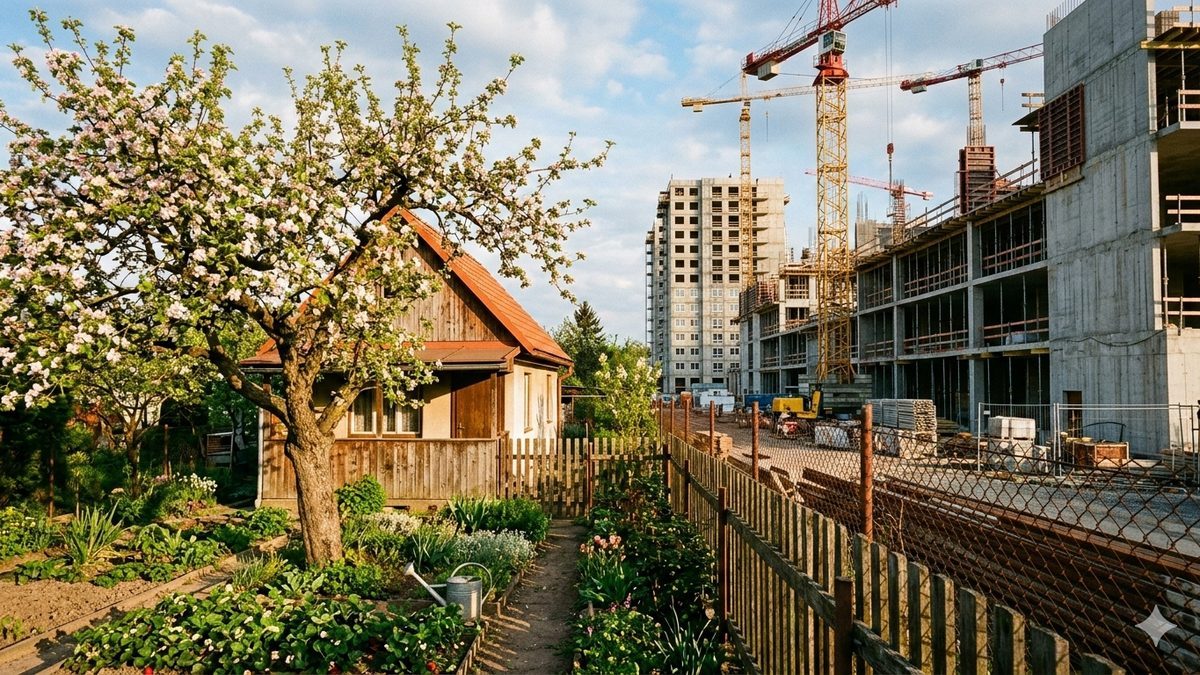
Through the story of a fictional Pepík Novák, the article illustrates how the interplay between Prague's Metropolitan Plan and the amendment to the Building Act (parliamentary print 67/0) can systematically favor large investors at the expense of small property owners. The amendment introduces automatic public-interest status for buildings over 10,000 m², single-instance proceedings with no right of appeal, and the option of expropriation in favor of private developers, while owners of family houses in stabilized areas remain regulatorily frozen.
Pepík Novák inherited a house from his grandmother. Nothing special — a single-storey cottage with a gabled roof, two rooms, a kitchen, and a yard privy that had been converted into a bathroom back in the Husák era. Plus two hundred square metres of garden, three apple trees, beds of strawberries, and a view of the allotment colony beyond the fence. Prague 9, a short walk from the metro station.
Pepík takes the tram to work, waters his tomatoes in the evening, and grills on Saturdays. The land registry says his plot is worth around six million — in Prague, two stops from the centre, nothing unusual. His grandmother bought the house in 1968 for twenty-four thousand. Pepík sometimes thinks to himself that he inherited a treasure.
One spring day he finds an envelope from the municipal authority in his mailbox. A notice of a repeated public hearing on the Metropolitan Plan. Eighteen pages, fifteen of them full of technical abbreviations. Pepík reads it twice, doesn't understand it, and sets it aside on the pile with his tax return. He doesn't yet know that this envelope is more important than anything he has ever found in his mailbox.
What the Metropolitan Plan and the proposed amendment to the Building Act together mean for Pepík and thousands of people like him cannot be read out of a single document. You have to read both. And you have to read them at the same time.
The Metropolitan Plan says where building will happen in Prague. The amendment to the Building Act changes the rules for how it will happen. Both documents are meant to take effect in the 2026–2027 period. Key Prague officials publicly describe them as complementary to one another. And when you look at who owns the land in the places where the plan directs new construction — and who profits from the rules the amendment introduces — you see a system that runs with the precision of clockwork. Just not in Pepík's favour.
The Metropolitan Plan introduces a concept that sounds reasonable: the "compact city of short distances." Prague will not sprawl out into the countryside. New construction will go inward — onto abandoned industrial sites, transformation areas, neglected railway yards and factories. The plan's total capacity: 49 million square metres of gross floor area, room for 350,000 new flats. More than 80 percent of the development areas lie within seven hundred metres of a metro or rail station or within five hundred metres of a tram stop.
It sounds like sound urban planning. Vienna, Berlin, Amsterdam, Copenhagen — they are all moving in the same direction.
Except that Pepík's cottage stands in a "stabilized area." That means: preservation, completion, and rehabilitation of the existing built fabric. No intensive development. No increase in the number of storeys. Pepík cannot add a floor, nor sell his garden to a developer for an apartment building. His plot is regulatorily frozen.
Three hundred metres from Pepík's fence begins a transformation area — a former industrial site that has been decaying behind rusty wire fencing for ten years now. It is owned by a group of investors who paid two billion for it three years ago. In the Metropolitan Plan that area is designated for intensive development: apartment buildings, civic amenities, public spaces. Capacity: two thousand flats.
Pepík's garden has a regulatory ceiling. The area beyond his fence has a regulatory floor.
The allotment colony beyond Pepík's fence has existed since the 1960s. In the current zoning plan from 1999, most of Prague's allotment settlements lie in non-buildable territory — they are protected. The Metropolitan Plan moves them into developable territory — albeit as so-called non-building blocks.
The plan delineates 443 hectares of allotment settlements as "non-building blocks in developable territory." The Prague Institute of Planning and Development (IPR) claims that this special regime protects the colonies. Anna Vinklárková of the Arnika association objects that the Building Act — legally superior to the Prague Building Regulations — defines "developable territory" as a place where building is permitted. And in any eventual court dispute, it is the interpretation of the statute that decides, not an IPR methodological guideline.
Pepík's allotment-gardener neighbours don't know about this yet. By the time they find out, it will be too late to comment — the deadline expired on 3 December 2025.
Nine days after the deadline for comments on the Metropolitan Plan, on 12 December 2025, a group of coalition MPs submitted an amendment to the Building Act. Chamber of Deputies print 67/0. It is the thirteenth amendment to the new Building Act and changes 42 laws in total. It did not go through the standard inter-ministerial comment procedure. It was not assessed by the Government Legislative Council. The identity of the main authors of the text was not made public.
The amendment contains five provisions that directly change the situation of Pepík and millions of other owners.
First — a new category, the "building for mass housing," with a floor area of 10,000 square metres or more. Roughly one hundred fifty to two hundred flats. The law automatically declares it a building "in the public interest." Not because anyone assessed it case by case. By statute. Across the board.
Second — these buildings are decided on by a new central Office for Territorial Development in single-instance proceedings. With no possibility of appeal. The only defence is an administrative lawsuit — but before the court rules, the building is usually already standing.
Third — a building project may deviate from the zoning plan if the procurer (in Prague: the city council) and the landowner agree to it. Without a public hearing. Without comments from neighbours.
Fourth — the burden of proof is reversed. A project cannot be rejected if other values — health, nature, heritage — can be protected through conditions or compensatory measures. The authority does not assess whether the project is suitable. It must prove that it is so unsuitable that no conditions can save it.
Fifth — the existing specialized bodies (environment, heritage, public health, water protection) are absorbed into new "large offices" that will coordinate everything. A single office is to be the expert on buildings, nature, heritage, noise, and water all at once.
The investor who owns the transformation area beyond the fence files a project for a building for mass housing — 15,000 square metres, two hundred flats. The building is automatically in the public interest by statute.
The project does not correspond exactly to the zoning plan — the buildings are taller than the plan assumes. No matter: the city council agrees to the deviation. The landowner — the investor — also agrees. No public hearing is needed.
The Office for Territorial Development approves the project in single-instance proceedings. Pepík cannot appeal. He can file an administrative lawsuit. The court will hear it in eighteen months. Meanwhile the building rises.
And then comes the letter that costs Pepík his sleep. The building needs an access road. It runs across a sliver of Pepík's garden. The investor offers to buy it. Pepík refuses — he won't sell the garden with the apple trees, where his grandmother taught him to plant potatoes.
Except that the building is in the public interest by statute. The road is public infrastructure. And for public infrastructure there exists the instrument of expropriation.
Pepík's garden with its apple trees, valued by the land registry at six million, will be expropriated for a price set by an expert appraiser — which in practice tends to be significantly lower than market value. He can appeal, but the building takes precedence by statute.
This exact sequence of events is hypothetical. But every single step of it is made possible by a specific provision of the amendment.
Pepík's story is a narrative. No actual Pepík Novák exists. But the mechanism we have just described is real — it is anchored in specific sections of the amendment (§ 5 paras 7–8, § 32 para 2, § 193 para 2, § 1 para 3) and in the regulatory rules of the Metropolitan Plan. And its risks are being pointed out by institutions that can hardly be called activist.
Robert Špalek, chairman of the Czech Chamber of Authorized Engineers and Technicians Active in Construction (ČKAIT) — an organization bringing together 32,000 authorized persons — in an interview for Česká justice called the possibility of expropriation in favour of residential buildings "one of the greatest excesses of the proposed legislation." In Ekonomický deník he warned of a "double standard in construction law: one for large investors and developers, and one for the smaller ones."
Ombudsman Stanislav Křeček submitted comments to three parliamentary committees — the Economic Committee, the Constitutional and Legal Committee, and the Committee for Public Administration and Regional Development. He called the exclusion of appeals for the largest buildings "particularly disturbing." He considers the weakening of the binding force of zoning plans problematic.
The Arnika association pointed to a "crying inequality": large development areas for investors left without strict requirements for greenery, while the gardens of family houses are strictly regulated.
And although a ruling of the Constitutional Court, IV. ÚS 2763/21 from 2022, confirmed that a statute may declare a public interest across the board — it simultaneously holds that in each individual expropriation proceeding the authority must individually weigh the public interest so declared against the interests of the person being expropriated. The decisive question is therefore: does the single-instance procedure without appeal that the amendment introduces leave enough room for this weighing? And is it even justified to grant private residential buildings the same regime that until now belonged only to public infrastructure — motorways, railways, or energy networks?
If anyone is to profit from the system described, it will logically be whoever holds land in the places where the Metropolitan Plan directs intensive construction and where the amendment removes regulatory obstacles.
Land ownership in Prague's transformation areas shows a high degree of concentration. The largest development locations — Bubny-Zátory, Žižkov Freight Station, Smíchov, Vysočany, Letňany, Trojmezí — are held by a handful of investor groups. According to estimates by real-estate market analysts, the five to six largest players together control hundreds of hectares of abandoned industrial sites in key Prague locations. The total value of these positions runs into the tens of billions of crowns. Some of the groups bought land even before the Metropolitan Plan proposal was published; other purchases took place in the last two years, as the contours of the plan became clearer.
All of these players are planning buildings well in excess of the 10,000-square-metre threshold — that is, exactly the threshold above which the amendment automatically grants public interest and single-instance proceedings without appeal. Smaller builders — the Pepíks with their family houses — do not benefit from these advantages.
It is not common for the zoning plan of the capital and an amendment to the Building Act to take effect in the same period. The Metropolitan Plan went through public consultation until 3 December 2025. The amendment was submitted on 12 December 2025 — nine days later. Both documents were originally headed for effect in mid-2026; for the amendment the date was pushed to 1 January 2027 under pressure from critics.
Deputy Mayor Petr Hlaváček told Radiožurnál that the major bottleneck had been permitting — and that this would be eliminated in connection with both the Metropolitan Plan and the amendment to the Building Act. Councillor Daniel Mazur called the Metropolitan Plan "key not only for the strategic management of the city's development, but also for ensuring legal and procedural certainty in connection with the effect of the new Building Act."
No direct document proving deliberate coordination of the two norms has been found. But the public statements of key actors, the logical interconnection of the texts, and the matching timing constitute a strong circumstantial indication that this is a system designed as a whole.
At this point it is important to present the counterarguments — and they are not negligible.
First, Prague genuinely needs a new zoning plan. The current plan from 1999 is outdated, confusing, amended many times over, and unadapted to the needs of a modern metropolis. The Metropolitan Plan has a number of advantages over it: a clear concept of the concentrated city, regulation of the height level, an emphasis on using industrial sites instead of taking up fields.
Second, building proceedings in the Czech Republic are objectively slow and convoluted. The number of building permits issued has fallen to a historic low in recent years. The introduction of electronic building proceedings in 2024 brought chaos. Investors, municipalities, and citizens alike are rightly calling for simplification.
Third, the transformation areas genuinely need to be built up. Abandoned sites such as Bubny-Zátory or the Žižkov Freight Station have been decaying for years behind construction moratoria. Their transformation into residential districts is urbanistically desirable.
Fourth, the Czech Chamber of Architects — despite reservations about the process — expressed support for the overall proposal, since in its view it may represent a significant step toward improving the legal framework.
These arguments are legitimate. The question is not whether Prague needs a new zoning plan and faster building proceedings — it needs both. The question is whether the specific form of the two norms disproportionately favours one group at the expense of others, and whether the absence of a standard law-making process for the amendment is evidence that the advantage is not a side effect, but an intent.
Vienna, which Prague likes to cite as a model of the concentrated city, combines dense development with three tools: a substantial share of residents live in municipal or subsidized housing. The city actively buys up land into public ownership. Cooperative models cover a significant share of new construction.
Berlin builds on abandoned sites inside the ring of the urban railway, but at the same time operates so-called Baugruppen — collective building associations in which residents jointly build flats at cost.
Prague is planning 350,000 new flats. It has no social housing act. It has no public land policy. Its participation instrument addresses investors' share in infrastructure, not affordability. Nowhere does the Metropolitan Plan guarantee that the newly created flats will be affordable for ordinary households.
And the amendment to the Building Act? It automatically declares every building over 10,000 square metres to be in the "public interest" — regardless of whether it will be cooperative housing, municipal rental flats, or investment flats for foreign funds at six hundred thousand per metre.
Let us return to Pepík. He is sitting in the garden under the apple tree his grandfather planted. He set the envelope from the municipal authority aside. He has not read the amendment to the Building Act — nor could he have read it.
Pepík does not know that his cottage stands in a stabilized area with no possibility of development, while the area beyond his fence is designated for intensive construction. He does not know that the allotment colony, where he goes for coffee at the neighbour's on Sundays, has ended up in developable territory — and that the dispute over whether the special "non-building block" regime is sufficient protection will be decided only by an eventual court. He does not know that the building that will one day rise beyond his fence will automatically be in the public interest, and that he will not be able to appeal against its approval. And he does not know that if his garden gets in the way of the access road, it can be expropriated — in favour of a private investor whose building the law has designated as a public interest.
Pepík knows none of this. And that is perhaps the greatest problem of the whole system: it is designed so that people like Pepík will understand it only when it is too late.
The information in this text is based on publicly available documents: Chamber of Deputies print 67/0, the text part of Prague's Metropolitan Plan, and statements by the Ombudsman, ČKAIT, ČKA, Arnika, Zelený kruh, and SVOL. The story of Pepík Novák is an illustrative narrative; the mechanism described is real and anchored in the legal texts cited. All persons and institutions concerned should be given an opportunity to respond before publication.
Transparency about how this was made
The conception, structure, and editorial line of the article are the work of the author, who drafted the content outline, established the key theses, and directed the entire creative process. Generative AI (Claude Opus 4.6, Anthropic) was used as a tool for research, fact-checking, and elaborating the author's outline.
The author verified the key findings and approved the final text. No part of the text was published without conscious authorial control. The factual data were verified against the publicly available sources cited in the text.
This procedure complies with the transparency principles of EU Regulation 2024/1689 (AI Act). #poweredByAI
Read the Czech original on Médium.cz.
AI · Claude — machine translation, may contain inaccuracies.