A Toll as Reparations: How Trump Would Cut a Deal with Iran Without Having to Admit It
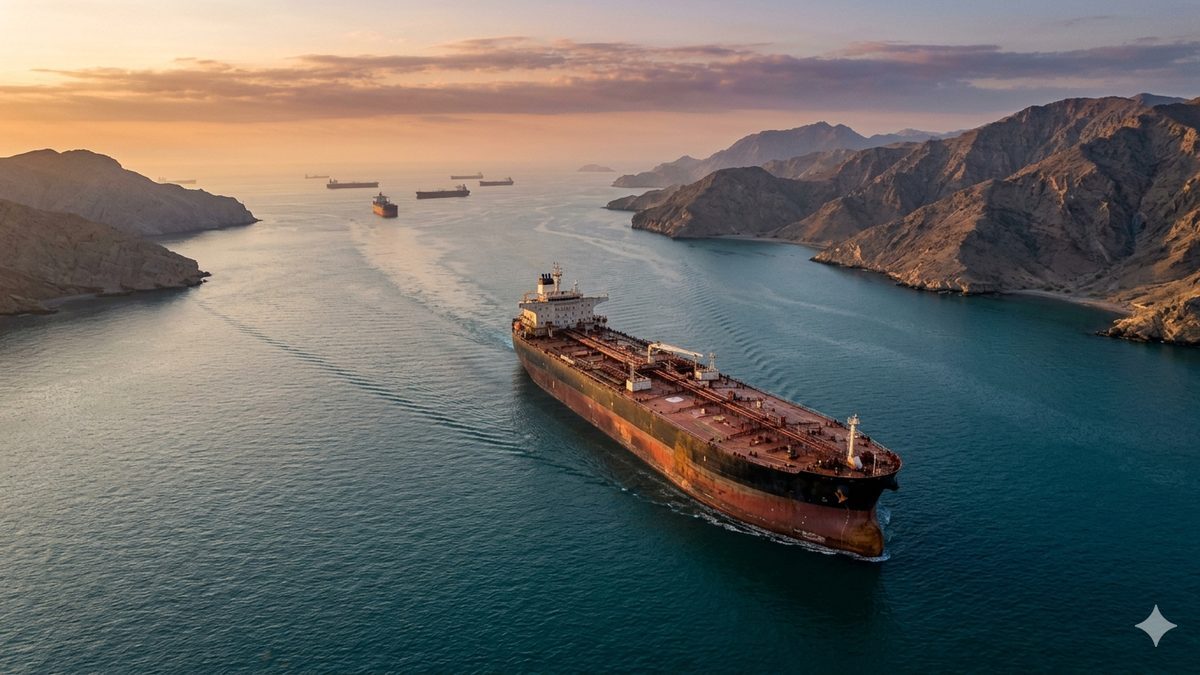
The analysis assumes that Trump will strike a tacit deal with Iran over passage through the Strait of Hormuz, under which Tehran would collect fees (PGSA) that function de facto as war reparations disguised as a security service. The author maps out the economic math of the toll, its impact on gasoline prices ahead of the midterm elections, and four risks (Riyadh, Iranian overreach, Pentagon–Senate, the European snapback) that could block the deal.
Donald Trump declared before CBS cameras on Sunday, May 17, that "the USA, not Iran, controls the Strait of Hormuz" and that the American effort had "essentially knocked out the Iranian armed forces." Operationally, this does not match the situation at sea — the IRGC is preparing a formal toll mechanism, Mojtaba Khamenei is holding the line on rejectionist conditions, ships still need Iranian permission to pass. But the rhetorical pirouette is not an accident. It is the first building block of the narrative Trump needs ahead of the midterm elections: to withdraw from Hormuz, let Tehran collect de facto war reparations through transit fees, and sell it to the American voter as a victory. This analysis describes how such a deal would work mechanically, how much it would cost at the pumps, and what is likely to go wrong.
Trump's rhetorical position shifted three times in a week. After the failure of the round of talks in Oman, he spoke of "brisk progress" and serious consequences. On Thursday he promised Iran "destruction" if its leadership did not move. On Sunday, May 17, he told CBS journalists that patience was running out and "there will be nothing left of them" — and in the same interview he announced that the USA already controls Hormuz. Economic data, meanwhile, had not moved. Brent closed Friday above $109 and rose toward $111 on Monday morning. AAA reports a national gasoline average of $4.51 per gallon — historically the highest since 2022. The IMO estimates that more than twenty thousand seafarers remain trapped in the Gulf aboard hundreds of ships. Trump's rhetoric moves; reality does not.
I argue that this shift is the first visible signal of a quiet compromise that the American administration will probably conclude with Tehran within a horizon of six to ten weeks. The deal will not be formal, it will not be ratified by the Senate, it will have no joint communiqué. It will be quiet. And it will allow both sides to declare victory in a language their domestic audiences understand. The key instrument is the mechanism Tehran institutionalized on May 5 under the acronym PGSA — the Persian Gulf Strait Authority. A toll as reparations, dressed up as a security fee.
Iran cannot legally obtain war reparations. There is no modern precedent for a situation in which an aggressor pays the defeated party — and in a scenario where the American-Israeli campaign of February 28 killed the Iranian Supreme Leader and degraded conventional military capabilities, Tehran is not, in the legal sense, the victor. Mojtaba's demand for reparations, which formed part of the fourteen-point proposal handed over in early May through Pakistani intermediaries, is therefore a diplomatic non-starter. They know it in Tehran, they know it in Washington. And yet the demand remains on the table, because it serves as an anchor for what Iran actually wants — an institutionalized permanent revenue stream.
A toll is structurally something different. The UNCLOS law-of-the-sea convention, in Article 26, prohibits fees for mere passage through the territorial sea, but allows them for specific services — pilotage, navigation, environmental, security. (In the case of an international strait of the Hormuz type the framework is more complicated; the right of transit passage under Articles 37–44 also comes into play, but the general principle of "service yes, bare passage no" holds.) Iran therefore does not frame the toll as reparations, but as a fee for the PGSA safe-passage protocol: escort between minefield zones, coordination with the Revolutionary Guard, a guarantee against attacks. Vessels that pay get through. Vessels that refuse are, in the Iranian formulation, "hostile" and may become targets.
This legal fiction has precedents. Egypt, in its normal regime — before the Houthi crisis in the Red Sea — collected around ten billion dollars a year from the Suez Canal. Turkey collects fees for the Bosphorus and the Dardanelles under the Montreux Convention. Panama for its canal. No one calls these fees reparations; they are sovereign acts of managing a chokepoint. If Iran declares Hormuz a space in which it performs a security service, and the international community rhetorically objects but operationally adapts, a fait accompli is established. Lloyd's of London will not debate the legality — it will quote a war-risk insurance premium for PGSA-compliant transit and that's that.
For Iran the math is straightforward. In the normal regime, according to the US EIA, roughly 21 million barrels of oil pass through Hormuz per day. At a fee of one dollar per barrel, Tehran would collect over $7.5 billion a year. At two dollars, over $15 billion. By comparison: according to a Pentagon assessment of May 1 (Axios, The Hill), Iran lost approximately $4.8 billion in blocked oil revenues to the American blockade of its ports — from 31 tankers carrying 53 million barrels. The Hormuz toll would fully compensate for the loss, if not exceed it. And deterministically, with no sanctions circumvention, no gray channels. Saudi Arabia, Kuwait, Qatar, the United Arab Emirates and Iraq — all would have to pay Tehran for the privilege of exporting their own oil. That is a strategically transformative position that no Iranian regime has held since 1979.
The key understanding: one or two dollars of toll per barrel will practically not show up in retail gasoline. A voter in Ohio has no instrument to extract the Iranian toll from the bill at the pump. What the voter sees is the total price. And that, in the event of a deal, will fall dramatically.
Current Brent sits between $109 and $111. The pre-conflict baseline from February 2026 was below $75. The difference is essentially entirely a risk premium — geopolitical tension, fear of escalation, real transport dysfunction. If the premium dissolves, the fundamental price would fall into the $80 to $90 band, not deeper. OPEC+ will defend the floor — the IMF and Bloomberg Economics estimate the Saudi fiscal break-even needed to finance Vision 2030 in the range of $90 to $94 per barrel as a baseline, $111 including PIF spending. Aramco CEO Amin Nasser, on a May 11 earnings call following first-quarter results, warned that the "normalization of the oil market" could take until 2027 if Hormuz does not open by mid-June. That is not an economic forecast, it is a negotiating position. Saudi Arabia will cut production as soon as Brent falls below its preferred threshold.
The trajectory of the decline in the event of a hypothetical deal on June 1: within hours Brent loses eight to twelve dollars on an algorithmic unwind of speculative positions. Within a week, a slow recalibration of insurance rates. Within a month, by mid-July, it could settle around $88 to $92. By the November midterms — with Saudi production cuts and an exhausted risk premium — it could end between $80 and $85. Retail gasoline in the USA lags the Brent price by four to six weeks and is layered with the refinery margin. If the deal falls on June 1, the American voter on November 3 pays somewhere around $3.50 per gallon at the pump. That is not a level the GOP would celebrate, but it is a level at which it can defend the House.
For historical comparison: Biden entered the 2022 midterms with a national average of around $3.80 per gallon, after a peak above $5 in June of that year. Carter lost in 1980 at an inflation-adjusted value exceeding $4.50 in today's prices. Trump today sits above both of these levels, and the pace at which the premium is gradually building is politically unsustainable. If the deal falls only on July 15 instead of June 1, election-day gasoline runs around $3.80 to $4.00 — the House probably lost, the Senate defended. If the deal does not fall before August, pump prices above $4 and the GOP with high probability loses both chambers. Trump therefore has a politically real deadline of around July 30. After that date, rhetoric without action is electoral poison.
The preceding chapters describe the path that Trump's calculus structurally pushes toward. It is not a prediction, it is a dynamic that will either be fulfilled or be blocked by one of the following forces.
The first risk lies in Riyadh. Mohammed bin Salman can simply refuse to pay Tehran for the passage of his own ships. The Saudis have leverage — the deferred F-35 deal, security guarantees against Iran, normalization with Israel, possibly a security pact with the USA. If MBS publicly declares that Riyadh will not accept the PGSA regime, the deal falls, because Saudi volume forms a significant part of what the toll would rest on. It will become publicly clear relatively quickly whether the Saudis give their quiet consent or not — no diplomatic move on this scale can be kept secret for long.
The second risk is Iranian overreach. If Tehran collects not a modest dollar or two per barrel but demands five or ten, the deal falls, because it would be visibly humiliating for the USA. If it discriminatorily blocks American-flagged tankers even after a deal, Trump's "we control" rhetoric collapses in real time. The chief Iranian negotiator, Mohammad Baqer Ghalibaf, has so far behaved with strategic discipline — a proposal structured into fourteen points, parallel signals from Istanbul, no hotheads in the media. But Mojtaba has been in office two and a half months, reportedly injured, out of public view, untested. IRGC factions may act on their own. A single strike by a hothead in Bandar Abbas on an American destroyer, with dozens of casualties, shifts the entire calculus into the kinetic zone.
The third risk is Pentagon-Senate. The American strategic community — from the Foundation for Defense of Democracies to the Hudson Institute, from Senator Tom Cotton to Marco Rubio — will read this scenario exactly as it structurally is. A strategic defeat. Iran institutionalizing control over a global chokepoint with the consent of the USA. Hawkish circles will publish analytical memoranda, calls for hearings in the Senate Armed Services Committee, House resolutions condemning appeasement. If the deal stays quiet and informal, Trump can push it through via an administrative decision. If it required ratification or legislative implementation, it would not pass. The key is that Trump does not need to formally conclude the deal. It is enough for him to operationally stop obstructing Iranian control and verbally declare victory.
The fourth risk, less likely but structural: a European snapback. The UK, Germany and France have, until October 18, 2026, the option to restore the sanctions from the 2015 JCPOA under the so-called snapback mechanism. Abbas Araghchi, in a comment for Le Point on May 11, warned that the consequences would be "irreversible" — which, in the Iranian diplomatic lexicon, is a euphemism for withdrawal from the Treaty on the Non-Proliferation of Nuclear Weapons. If the E3 activate the snapback at the very moment Trump is concluding a quiet deal, a diplomatic rift arises between Washington and its European allies that can block the path. Macron's phone call with Pezeshkian on May 6 signals that Paris is actively playing its own game — formally pressing for the opening of Hormuz, in fact keeping its own channel to Tehran open.
If the deal goes through, the impacts on the global balance of power will be more significant than the impacts on the American ballot box. Iran becomes the gatekeeper over a chokepoint through which a fifth of the world's LNG and a quarter of the world's seaborne oil trade flows. The Saudi-Iranian normalization of 2023 takes on a new dimension, in which Aramco pays Tehran for the very existence of an export route. China's strategic partner in Tehran gains its own revenue stream independent of the American oil system. The Treaty on the Non-Proliferation of Nuclear Weapons weakens, because every country that watched the successful Iranian strategic deferral will draw its conclusions — Saudi Arabia, Turkey, Egypt, South Korea, Japan.
These are costs the voter in Ohio will not see on the bill at the pump. Trump's politico-economic calculus does not factor them in. The next administration, whether Republican or Democratic, will inherit them.
If at some point in the next two months you see a report in which Aramco or ADNOC announces a new "logistics agreement" concerning passage through Hormuz, or when Lloyd's of London adds to its insurance product an item for "PGSA-compliant transit," you know what has happened. The toll has begun to flow, the reparations have been renamed a service fee, and the American president has his path to the ballot box.
Transparency of creation
The concept, structure and editorial line of the article are the work of the author, who drew up the content sketch, established the key theses and directed the entire creative process. Generative AI (Claude, Anthropic) was used as a tool for research, searching for primary sources, and the formulational development of the author's content sketch.
The author edited the outputs continuously, verified the key findings, and approved the final wording. No part of the text was published without human review. All factual data were verified against the publicly available sources cited in the text.
The procedure complies with the requirements of Article 50 of EU Regulation 2024/1689 (the AI Act) on the transparency of AI-generated content. #poweredByAI
Read the Czech original on Médium.cz.
AI · Claude — machine translation, may contain inaccuracies.