How Much Aluminium We Eat Without Knowing It
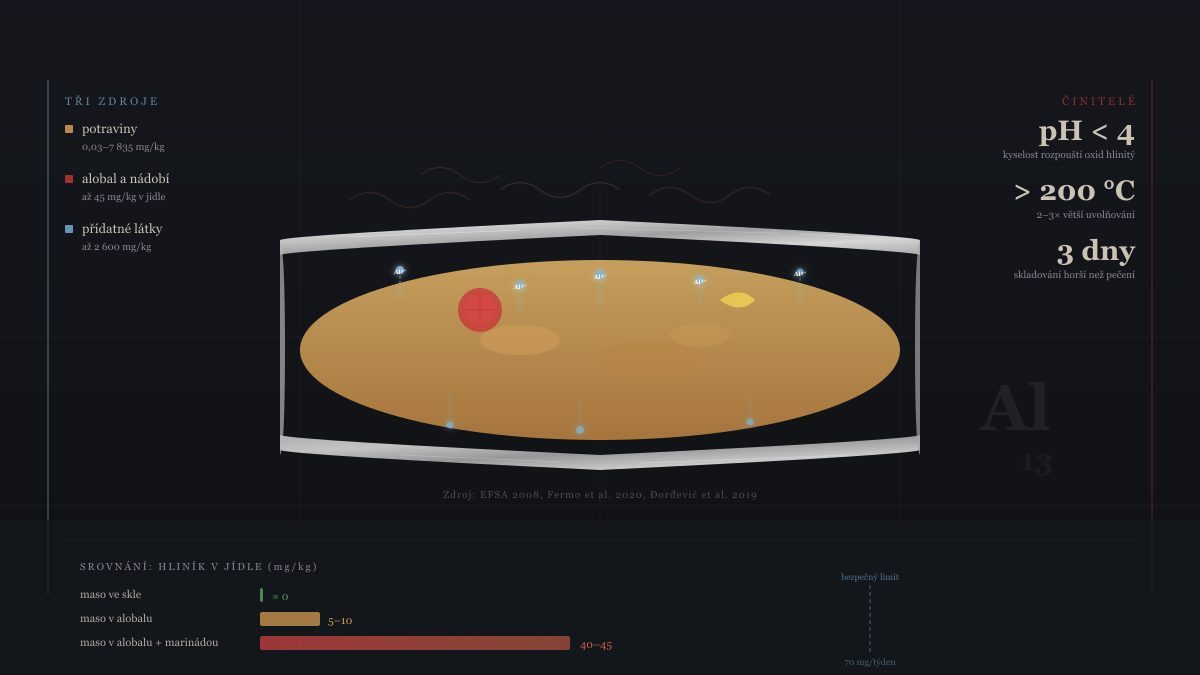
The article examines in detail the three main sources of aluminium in the human diet: its natural presence in foods (tea, spices, cereals), its leaching from aluminium foil and aluminium cookware on contact with acidic foods and at high temperatures, and food additives (E-numbers). Drawing on more than 50 peer-reviewed studies and EFSA opinions, it shows that a substantial part of the population — especially children and infants — likely exceeds the safe limit of 1 mg per kg of body weight per week without being aware of it.
A Friday barbecue. On the grill lies a hermelín wrapped in aluminum foil, topped with slices of tomato, a squeeze of lemon, a pinch of salt. The aroma rises, the cheese melts — and meanwhile aluminum ions are quietly leaching out of the shiny foil. Exactly how many? That depends on three things the cook has full control over — and usually has no idea about.
Aluminum is a contradictory element. It makes up roughly 8% of the Earth's crust, yet it has no known biological function in living organisms. A healthy person's body absorbs only a fraction — an estimated 0.1–0.3% of dietary intake — and excretes most of it through the kidneys within 24 hours. Even so, the European Food Safety Authority (EFSA) warned in 2008 that a substantial portion of the European population probably exceeds the safe limit. It set that limit at 1 milligram of aluminum per kilogram of body weight per week. For a seventy-kilogram adult, that means no more than 70 milligrams a week — that is, 10 milligrams a day.
But the average European takes in 0.2–1.5 mg/kg per week from food, that is, 20–150% of the safe limit. Children fare worse: 0.7–2.3 mg/kg per week, up to 230% of the safe threshold. And that is from food alone — without counting what is added by cookware, aluminum foil, or heartburn medication.
Where does the aluminum in our diet actually come from? From three sources that add up to one another: from foods themselves, from the materials in which we prepare and store food, and from the additives that the food industry puts into food.
Let us picture aluminum exposure as the income in a family budget: it comes from several independent sources, and only their sum determines whether we are in the safe zone. The natural content in food is the "salary" — a baseline income that is more or less beyond our control. The leaching from cookware and foil is the "side job" — it depends on what we do. And the additives in processed foods are the "inheritance from an uncle" — they arrive unexpectedly, and one often has no idea about them.
The differences in natural aluminum content between foods are enormous — on the order of a thousandfold. At one end stands milk, with a content of just 0.03–0.07 mg/kg, and eggs at 0.1 mg/kg. At the other end are dried tea leaves, with a content of 500–7,835 mg/kg — that is, a hundred thousand times more than milk.
The tea plant (Camellia sinensis) is one of the few plants for which aluminum is beneficial. It grows in acidic soils, where aluminum dissolves readily, and it actively absorbs it through its roots — without it, the plant cannot form new roots. Aluminum accumulates in the leaves: the older the leaf, the more metal it contains. Young leaves and buds, from which quality teas are made, contain 300–2,500 mg/kg. Old leaves used for cheaper teas reach over 7,000 mg/kg.
The good news: only a fraction leaches into the cup. The concentration in brewed tea is usually 0.1–4 mg/L, in exceptional cases up to 9 mg/L. Adding lemon increases the leaching. Even so, tea contributes about 11% of total aluminum intake in European adults — significant, then, but not alarming.
Spices and dried herbs range around 10–145 mg/kg, cocoa powder 33–51 mg/kg, spinach about 25 mg/kg. Cereals, the staple of the European diet, contain 1–19 mg/kg, but given the amounts we eat, they contribute about one fifth of total intake. Meat, fish, and dairy products in their raw state contain very little aluminum — below 2 mg/kg.
The geographical differences are interesting. In one study, bananas from Spain showed 32.8 mg/kg, whereas those from the USA only 0.4 mg/kg — an eightyfold difference caused by differing soil acidity. The same food, fundamentally different aluminum content.
Aluminum cookware and foil are not sources of aluminum in themselves — they become so only on contact with food. And the decisive factor is a single one: acidity.
In air, aluminum is protected by a thin layer of aluminum oxide (Al₂O₃), which forms spontaneously and acts as a protective barrier. But this layer dissolves at a pH below 4 — that is, on contact with lemon, vinegar, wine, tomatoes, or ketchup. The lower the pH, the more aluminum is released. A 0.5% citric acid solution (weaker than lemon juice) in an aluminum vessel released 638 mg/L — almost a hundred and thirty times the 5 mg/kg limit set by the Council of Europe for food contact materials.
In this respect, aluminum foil is more problematic than a pot. It is thinner, has a larger contact area relative to the mass of the food, and has no protective surface treatment. Studies consistently show that foods baked in foil contain an order of magnitude more aluminum than the same foods prepared in glass or ceramic.
An Italian study by Ferme et al. (2020) documents this directly: meat and fish baked in foil at 180 °C for one hour contained 40–42 mg Al/kg. The same foods prepared in a glass dish — below the limit of quantification. Practically zero versus forty.
Temperature is the second factor. Between 180 °C and 250 °C, leaching increases two- to threefold. Grilling over an open flame at temperatures above 300 °C represents the extreme scenario. Contact time is the third factor, but less significant than the first two — short baking at a high temperature releases more aluminum than long baking at a low one.
The most dangerous, however, is the interplay of all the factors at once. A Czech study by Đorđević et al. (2019) from the University of Veterinary Sciences in Brno tested eleven kinds of food at 220 °C. The results, measured in wet weight, showed marked differences: unmarinated, skinless duck breast contained aluminum on the order of tenths of a milligram per kilogram. The same duck breast, marinated (salt, spices, oil) and baked in foil, reached up to 45 mg/kg — the highest value of all the foods tested. Marinated salmon reached 21 mg/kg, marinated mackerel 13 mg/kg. In the unmarinated samples, leaching was markedly lower or below the limit of quantification. The main amplifier turned out to be the marinade mixture containing salt and acidic components.
And what about the hermelín from the opening scene? Without a marinade, it stays below 1 mg/kg — negligible. With tomatoes, basil, and onion: 6.90 mg/kg. With lemon it would be even more. A single serving of marinated hermelín from foil thus adds 1–2 mg of aluminum — tolerable as a one-off, but not insignificant in the context of total intake.
The finding about storage is surprising. An Austrian study by Ertl and Goessler (2018) showed that foods wrapped in foil and kept in the refrigerator for three days reached over 60 mg/kg for ham and over 20 mg/kg for cheese. A key role was played by the contact of the foil with stainless steel, which creates a galvanic cell and dramatically accelerates the release of aluminum. Cold storage in foil can thus be riskier than brief baking — and yet almost everyone does it.
One more finding: whether the foil faces the food with its shiny or its matte side makes no difference. The difference between the sides is purely a matter of manufacturing (two layers are rolled simultaneously) and has no effect on the release of aluminum. This has been confirmed by independent studies (Bassioni et al. 2012, Ertl and Goessler 2018).
The third source is aluminum-containing food additives — and it is precisely these that can raise the aluminum content of a food hundreds- to thousandsfold over the natural background. Most consumers are unaware of them, even though they are legally listed on the packaging under E numbers.
The key substance is E 541 — sodium aluminum phosphate (referred to in the technical literature by the abbreviation SALP), used as a leavening agent in baked goods. In the USA it is widespread in baking powders, self-rising flour, and baking mixes. Powdered mixes containing this substance average 2,600 mg Al/kg, and the finished pancakes made from them up to 710 mg/kg. In the EU, its use is restricted to sponge cakes and selected types of fine bakery wares only — the result of a tightening of regulation in 2012.
The second significant source is processed cheese. In the USA, basic sodium aluminum phosphate is used as an emulsifying salt (up to 3% by weight). The result: in the American context, processed cheese can contain up to 700 mg Al/kg — so a single serving (20 g) on a pizza supplies 14 mg of aluminum. Natural cheese on the same pizza? A mere 0.03–0.09 mg. In the EU, the use of aluminum emulsifying salts in cheese is substantially stricter, but even here processed cheeses rank among the higher-content foods.
The anticaking agents E 554 (sodium aluminosilicate) and E 555 (potassium aluminosilicate) are added to salt, dried eggs, and food supplements. Table salt with E 554 was measured at a content of up to 260 mg/kg.
EU Regulation No 380/2012 was a direct response to EFSA's warning and represents the strictest regulation of aluminum additives in the world. It banned three additives (E 556, E 558, E 559) outright, introduced maximum permitted levels for the rest, and significantly narrowed the permitted food categories. Even so, in its 2020 re-evaluation EFSA stated that for E 554 and E 555 "safety cannot be assessed" due to a lack of toxicity data — exposure from E 554 alone can reach 1.58 mg/kg per week, thus exceeding the safe limit.
Infants deserve special attention. Breast milk contains 0.009–0.049 mg Al/L — very little. Infant formula reaches 0.058–0.69 mg/L, that is, an order of magnitude more. Soy formula, then, 0.46–0.93 mg/L — in the least favorable case up to a hundred times more than breast milk.
Over the first six months, a breastfed child takes in about 7 mg of aluminum. A formula-fed child, 38 mg. A soy-formula-fed child, 117 mg. Exposure of infants on soy-based nutrition reaches 0.76 mg/kg per week, that is, 76% of the safe limit — and that during a period when the kidneys are immature and the brain is developing most rapidly. This is why soy formulas are not recommended for premature infants.
Although they are not food, antacids (heartburn medications) deserve mention as a significant secondary source. A single tablet containing aluminum hydroxide holds 104–244 mg of aluminum. The maximum daily dose can reach 3,840–8,000 mg of aluminum compounds — fifty to a hundred times more than the entire daily intake from food.
The bioavailability is admittedly extremely low (below 0.01%), but in patients with chronic kidney disease, who excrete aluminum insufficiently, long-term use can lead to accumulation. An important caveat: the presence of citric acid or orange juice increases the absorption of aluminum from antacids up to fiftyfold.
It would be easy to conclude from the data presented that aluminum in food is an immediate health threat. The reality, however, is more nuanced, and it is only fair to also present the arguments that temper the concerns.
First, bioavailability is decisive. Only 0.1–0.3% of aluminum is absorbed from food, and from tea even less — in the tea infusion, aluminum is bound to polyphenols and other compounds that reduce its absorption. A healthy adult's kidneys excrete absorbed aluminum within 24 hours. The safe limit is set with a safety factor that takes this low absorbability into account.
Second, EFSA has not confirmed a causal link between dietary aluminum and Alzheimer's disease — a supposition that has circulated in the media since the 1980s. Aluminum is indeed found in the amyloid plaques of patients with this disease, but a causal relationship has not been demonstrated. EFSA considers aluminum an unlikely cause of cancer.
Third, the toxicity relevant to risk assessment — damage to the nervous system and to fertility — has been observed at doses orders of magnitude higher than ordinary dietary exposure. The no observed adverse effect level (NOAEL) for the developing nervous system is 10–42 mg/kg of body weight per day, that is, hundreds to thousands of times what we take in from food.
Fourth, no country in the world has formally banned the use of aluminum foil in cooking. Germany's Federal Institute for Risk Assessment (BfR) has issued the most detailed recommendation — not to use foil for acidic and salty foods — but even it does not call for a ban.
Two arguments nonetheless remain that do not allow the problem to be waved away. The first is accumulation over time: aluminum is slowly deposited in the bones and brain, and its concentration in the body rises with age. In patients with impaired kidney function, the accumulation is markedly faster. The second is the protection of sensitive groups — children, whose safe limit is more easily exceeded, and infants, whose excretory system is immature.
The goal is not panic but informed choice. The following rules are based on the consensus of EFSA, the BfR, and the available scientific literature.
That hermelín in foil we started with? If you prepare it without tomatoes and lemon, salt it only after unwrapping, and eat it occasionally, it will add less than 1% of the safe dose to your weekly intake. But if you douse it with lemon, wrap it in tomatoes, and grill it at 300 °C — and do so every weekend — the story changes.
Aluminum in our diet is not a reason for panic. It is a reason to be informed. The largest part of exposure does not come from conspicuous sources but from inconspicuous everyday habits: a cup of tea, processed cheese on bread, leftovers wrapped in foil in the fridge. Negligible individually, significant in sum — especially for children and people with kidney problems.
Science gives us no reason to throw out all our aluminum pots. But it gives us enough grounds to know when it is better to reach for glass, stainless steel, or baking paper. And that is exactly the kind of knowledge worth reading — even if it never leads to panic.
This article draws on an analysis of more than 50 peer-reviewed studies, EFSA opinions (2008, 2018, 2020), the JECFA/WHO assessment (2011), recommendations of Germany's BfR and France's ANSES, Commission Regulation (EU) No 380/2012, and other regulations.
Data on the release of aluminum from foil come from studies by Ranau et al. (2001), Turhan (2006), Ferme et al. (2020), Đorđević et al. (2019), Bassioni et al. (2012), Ertl and Goessler (2018), and others. Data on the natural content in foods are based on EFSA opinion 754/2008, the work of Sayed and Yokel (2005), Pennington (1987), and the Hong Kong CFS study (2009). Tea studies: Girolametti et al. (2023), Szymczycha-Madej et al. (2024), Flaten (2002). Infant exposure: EFSA 2008, Burrell and Exley (2010).
Limitations: Studies of leaching from foil show considerable scatter depending on the measurement method (ICP-MS, AAS, gravimetric method) and on whether the dry or wet weight of the sample is reported. The safe-limit values have not been re-evaluated by EFSA since 2008; JECFA uses a limit twice as high (2 mg/kg/week). Estimates of limit exceedance in the population come from model calculations, not direct measurements in individuals.
Transparency of creation:
The concept, structure, and editorial line of the article are the work of the author, who drew up the content outline, established the key theses, and directed the entire creative process. Generative AI (Claude, Anthropic) was used as a technical tool for research, fact-checking, and fleshing out the author's draft.
The author edited the outputs throughout, verified the key findings, and approved the final wording. No part of the text was published without human review. All factual data were verified against the publicly available sources cited in the text.
The procedure complies with the requirements of Article 50 of EU Regulation 2024/1689 (the AI Act) on the transparency of AI-generated content. #poweredByAI
Read the Czech original on Médium.cz.
AI · Claude — machine translation, may contain inaccuracies.