Why Vegans Don't Feed Lions Tofu: On Money, the Steam Engine, and a New Religion Without a God
The article analyzes the vegan movement through the lens of economics, psychology, and history. It shows that moral arguments against killing animals have, on their own, never been enough to bring about change — just as with the abolition of slavery, technological and economic superiority (the steam engine) was decisive. The author argues that real change will be driven by cultivated meat and synthetic proteins, not by individual dietary conversions, and criticizes the flows of money within the animal-rights movement, which go more toward campaigns than toward technological development.
On Money, the Steam Engine, and a New Religion Without a God
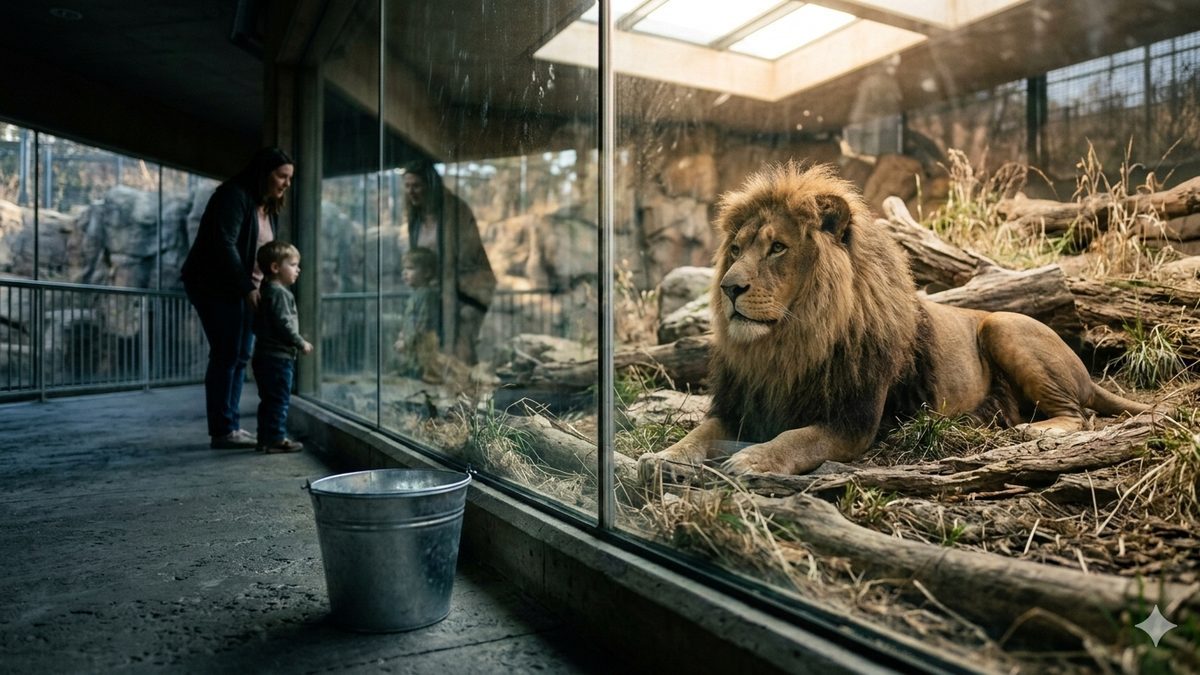
Every morning around eight o'clock, a keeper walks through the gate into the lions' enclosure. He carries a bucket. In the bucket are pieces of dead beef — muscle, bone, sometimes entrails. He tosses them over the fence. The lion, two hundred and twenty kilograms of muscle and laziness, gets up and begins tearing at the meat. Behind the glass stands a family. The mother explains to her daughter why she herself doesn't eat meat — it's cruel, she says, the animals suffer. The daughter nods and watches the lion swallow a piece of cow. No one asks where the meat comes from. No one asks why another animal had to die for a lion we keep in captivity. And no one asks why this bothers no one.
In zoos all over the world there live more than a thousand lions. Each one eats five to seven kilograms of meat a day — around two tons a year. Altogether, thousands of slaughtered farm animals a year — to sustain predators that will never be released into the wild, will never bring down a single gazelle, and will never fulfill any ecological function. They are there for our pleasure. And we feed them corpses.
Meanwhile, organizations that declare the goal of "minimizing animal suffering" distribute hundreds of millions of dollars a year. Coefficient Giving (formerly Open Philanthropy) — a foundation financed by Dustin Moskovitz and Cari Tuna — has directed an estimated more than two hundred million dollars toward farm-animal welfare since 2015. The Good Food Institute operates on an annual budget in the tens of millions. PETA has a budget of around seventy million. Together they form an industry comparable to a smaller multinational corporation. And yet: not one of these organizations has ever systematically pushed for zoo lions to be given feed produced without slaughter — even though the technology makes it possible. Because Animals, a California company, has developed cultivated feed from mouse cell cultures. Bond Pet Foods produces protein feed through fermentation. The solution exists. The demand does not.
Why?
The answer to this question says nothing about lions. It says almost everything about us.
The single largest donor in the field of farm-animal welfare on the planet is Dustin Moskovitz, co-founder of Facebook, and his wife Cari Tuna. Through the Good Ventures foundation and the organization Coefficient Giving (known until November 2025 as Open Philanthropy), they have channeled an estimated more than two hundred million dollars into this field. The program is run by Lewis Bollard, a graduate of Harvard and Yale Law School, and his allocation decisions shape the strategy of the entire global movement. More than 60% of this money goes to corporate campaigns — pressuring companies to switch to cage-free eggs, to improve conditions for raising chickens, to change purchasing policies. In other words: changing human behavior.
A fraction goes to the technological development of alternatives — cultivated meat, precision fermentation, synthetic feed.
This is not irrational if you accept the "leverage theory" argument: one dollar invested in a corporate campaign saves an order of magnitude more animals than one dollar invested in direct rescue. But this calculation contains a hidden assumption: that the goal is to reform the system, not to abolish it. A corporate campaign for bigger cages does not eliminate cages. It improves the system that you declaratively want to abolish.
Alongside the advocacy of animal rights, someone else quietly profits. A plant-based burger costs, per kilogram, three to five times more than ground beef. Yet the raw materials — pea isolate, methylcellulose, coconut oil — are cheap. According to industry estimates, the gross margins of food companies on plant-based products reach 40–60%, compared with 10–15% for conventional meat. Nestlé sells both KitKat and the plant-based brand Sweet Earth. Danone owns both Alpro and Actimel. Unilever sold The Vegetarian Butcher before divesting it in 2025 to its subsidiary Vivera, owned by JBS — the world's largest meat conglomerate. These companies do not need everyone to become vegan. It is enough for a sufficient percentage of customers to pay a premium price for a feeling of moral superiority. It is the same model as "fair-trade" coffee: you are buying absolution, not a solution.
Beyond Meat went public in May 2019 at twenty-five dollars per share. In the first days the price soared above two hundred and thirty dollars. Early investors — Kleiner Perkins, Bill Gates, Obvious Ventures — cashed in. Today the shares trade below one dollar. Retail investors who believed the narrative "the future is plant-based" lost everything. The classic pattern of a tech bubble: create a story, inflate the value, exit in time. Oatly has lost more than 90% since its IPO. Impossible Foods is still searching for a path to profitability. Total investment in alternative proteins fell from roughly five billion dollars in 2021 to 881 million in 2025.
There is yet another quiet beneficiary that no one talks about. A vegan diet without supplementation is risky over the long term — vitamin B12 deficiency affects, according to various studies, 20–60% of non-supplementing vegans, and levels of omega-3 fatty acids of the DHA type fall into the zone of cardiovascular risk. The solution is industrially manufactured dietary supplements. The market for vegan nutritional supplements is growing by roughly 12% a year. The Vegan Society sells its own preparation, VEG 1. The irony is perfect: a movement that arose as a protest against the unnaturalness of industrial farming is sustainable only thanks to industrially manufactured pills. One form of dependence on industry has been replaced by another.
The researchers Brock Bastian and Steve Loughnan of Melbourne published in 2011 a series of experiments on the so-called meat paradox — the contradiction between loving animals and eating them. They found that it is enough to show a photograph of an animal next to a plate, and people spontaneously reduce the mental capacities they attribute to that animal. Psychologists called it "mind denial" — an unconscious mechanism that makes it easier to consume what we love.
The problem is who they tested it on. Urbanized Australians and Americans who have never in their lives killed anything bigger than a mosquito. The entire literature on the meat paradox suffers from massive selection bias: it studies a population that, in terms of human history, is utterly anomalous.
For 99% of our species' existence, humans killed animals personally. They saw the blood. They skinned the hide. They gutted the entrails. And no anthropological evidence suggests that they had any moral problem with it. The Inuit have no meat paradox. The Maasai have no meat paradox. A Czech peasant in the nineteenth century had no meat paradox. The paradox belongs to people whose only relationship to animals is mediated by a screen and cartoons.
What happened? The sequence is precisely the opposite of what the vegan narrative claims. Industrialization separated humans from killing — the slaughterhouse moved beyond the edge of the city. Urbanization created a generation with no experience of death as a biological process. Animation and the media humanized animals — Walt Disney Studios screened Bambi in 1942, and the film is often associated with a decline in the popularity of hunting in the USA. And onto this psychologically prepared soil fell vegan propaganda, which exploits the inexperience of death and presents it as a moral sentiment.
The cognitive dissonance over meat, then, is not the revelation of suppressed empathy. It is the consequence of alienation from biological reality. A hunter who knows the entire cycle — from tracking the prey through the kill to the cooking — has no dissonance, because his mental model includes death as a part of life. The urban person, whose conception of animals was shaped by cartoons, experiences shock when confronted with the reality of the slaughterhouse. But that shock is not a moral awakening. It is the consequence of ignorance.
The psychologist Paul Rozin of the University of Pennsylvania demonstrated in 1997 something crucial: moral vegetarians did not develop disgust toward meat before their conversion — they developed it after it. First they adopted the moral conviction, and only then did they begin to feel revulsion. Disgust is not the cause. It is the consequence. A tool the brain adopts to reinforce a decision already made.
The cognitive dissonance over meat is a luxury emotion — so luxurious that it can be afforded only by a society that has delegated killing to someone else and looks at animals through glass.
The sociologists Alan Beardsworth and Teresa Keil identified in veganism the classic structural features of a moral system: dietary taboos, rituals of purity, conversion experiences, the missionary impulse, schisms between factions, and the expulsion of apostates. The abolitionists around Gary Francione claim that the proponents of reform betray the animals — the same schism as between Protestants and Catholics, only instead of the Eucharist, the object of dispute is free-range eggs.
Data from the organization Faunalytics from 2014 show how this system works in practice. In the USA, 10% of adults are former vegetarians or vegans, while only 2% are current ones. A ratio of five to one. According to this study, 84% of those who try veganism or vegetarianism eventually return to meat — though it must be added that the study also counts people who followed the diet for only a few weeks. Most apostates last less than a year. The movement survives not by retaining members but through constant recruitment — an endless supply of new converts who watched a documentary on a streaming service, went through an emotional shock, and rebuilt their identity around a shopping basket. And then most of them quietly fall away.
The mechanism of conversion is identical to that of religious systems. Most vegans cite documentaries or footage from slaughterhouses as their primary conversion channel — not rational arguments about emissions or health. A person does not analyze meta-analyses and arrive at the conclusion "I will become vegan." A person sees a pig's throat being cut, and the emotional reaction precedes the rationalization. The arguments about climate, health, and ethics come afterward — as a justification of a decision that was made viscerally. This is exactly the pattern of religious conversion: an emotional experience, rationalization, the rebuilding of identity.
And departure works the same way. The former vegan YouTubers Rawvana and Bonny Rebecca described an identical pattern: secret consumption of animal products, years of concealment, a public confession coupled with an existential crisis. Bonny Rebecca admitted that she had lost her sense of her own identity. This is the language of apostasy, not of dietary change. The Faunalytics data confirm it: most former vegans never perceived veganism as part of their identity and were not involved in any community — which are the two strongest predictive factors of departure. Those who leave are "dietary tourists." Those who stay are believers.
Karl Marx wrote that religion is "the opium of the people" — a mechanism that transfers responsibility for systemic suffering onto individual moral reform. Veganism does the same: it transfers responsibility for industrial farming — a systemic product of capitalist profit maximization — onto the decision of an individual in a supermarket. Instead of "the system is bad, let's change it," it says "you are bad, change yourself." The oil company BP in 2004 popularized the concept of the "carbon footprint" in order to shift responsibility for climate change from corporations to consumers. The vegan movement does the same thing in the food sector — albeit unintentionally.
It would be convenient to leave the story here — clean, sharp, unambiguous. But reality does not work like that.
The environmental argument for reducing animal production is empirically the strongest of all and cannot be waved away. Poore and Nemecek, in a study published in the journal Science in 2018, analyzed data from nearly forty thousand farms in one hundred and nineteen countries. They found that animal production occupies 77% of agricultural land but supplies a mere 18% of calories. Scarborough of Oxford confirmed that a vegan diet produces roughly a quarter of the emissions compared with a diet high in meat consumption. These figures are robust and little disputed.
The philosophical argument is likewise stronger than its critics would wish. The PhilPapers survey of 2020, among nearly two thousand academic philosophers, found that 45% lean toward vegetarianism or veganism. Singer's argument from marginal cases — if we grant moral status to infants, we cannot consistently deny it to animals with comparable cognitive capacities — remains one of the most difficult-to-refute arguments in applied ethics.
And the leverage theory has its logic: investment in corporate campaigns has demonstrably improved conditions for hundreds of millions of animals. Bans on cage farming in the EU, the commitments of hundreds of corporations to switch to cage-free housing — all of this is a real consequence of pressure that would never have arisen without the radical wing of the movement.
But here is the catch. All these arguments speak for a dramatic reduction of animal production — not for individual veganism. The shift from high meat consumption to low captures 70–80% of the environmental benefit. The philosophical consensus is overwhelming against factory farming, but it leaves a legitimate space for humane small-scale husbandry. Animal-welfare reforms improve the system but do not require every individual to become a vegan. The moral core — the revulsion at industrial cruelty — is authentic and justified. The question is not whether the problem is real. The question is whether individual dietary conversion is an adequate response to a systemic problem.
In 1944 the Trinidadian historian Eric Williams published the book Capitalism and Slavery. In it he documented a thesis that shook the moral self-image of the British Empire: the abolition of slavery did not happen because the British realized that slavery was wrong. It happened because the Industrial Revolution created a system in which wage labor was more efficient than slave labor. A slave is a fixed cost — you have to feed, house, and guard him even when he is not working. A wage laborer is a variable cost — you pay him for the hours worked and he takes care of the rest himself. And, above all: the worker is a consumer. He buys the products of the factories. The slave buys nothing.
William Wilberforce and the Quakers provided the narrative. The steam engine provided the force. Moral arguments against slavery had existed for centuries — from the Stoics through the early Christians to the Enlightenment thinkers. By themselves they were never enough. Change came only at the moment when the economic interests of the new industrial class aligned with the moral program of the abolitionists.
Moral arguments against killing animals have existed at least since Pythagoras — two and a half thousand years. Plutarch wrote about the suffering of animals in the first century. Leonardo da Vinci bought birds at markets so that he could set them free. Tolstoy was a vegetarian. Gandhi was a vegetarian. Over two and a half thousand years of moral argumentation, the share of vegetarians in the Western world has settled at 2–4%. Morality by itself was never enough.
What will change the equation? The same thing that changed it for slavery: a technology that will be economically superior. Cultivated meat — real animal cells growing in a bioreactor without slaughter — received the approval of American regulators in 2023. Price parity with conventional meat is estimated for around the years 2030 to 2035. At the moment when a cultivated burger is cheaper and indistinguishable in taste from a conventional one, industrial farming will vanish — not because people will become more moral, but because it will become unnecessary. Just as slavery did not disappear because the plantation owners read Uncle Tom's Cabin, but because the steam engine and wage labor were more efficient.
And here the deepest contradiction of the vegan movement is revealed. If the goal is to minimize animal suffering, then a rational allocation of resources should be directed almost exclusively to the development of cultivated meat, precision fermentation, and synthetic proteins. Every dollar invested in a technology that replaces the slaughterhouse is orders of magnitude more effective than a dollar invested in persuading one person to change their shopping basket. But the technological solution has one property that is existentially dangerous for the animal-rights advocacy industry: if it succeeds, it makes that industry unnecessary. An organization whose budget depends on the urgency of a problem has no structural interest in solving the problem. It has an interest in managing it.
At the Prague zoo — or any other — every morning a keeper still carries a bucket with pieces of dead beef. The lion in captivity fulfills no ecological function. It regulates no populations. It takes part in no food chain. It is two hundred and twenty kilograms of muscle behind glass, fed corpses for the pleasure of visitors. The technology to feed it without slaughter exists. The costs are falling. None of the organizations that together command hundreds of millions of dollars and declare the goal of ending animal suffering is pushing for it.
And that tells you everything you need to know.
The end of the slaughterhouse will not come when people become vegans. It will come when the steam engine of protein makes the slaughterhouse unnecessary — just as the steam engine of the textile mills made slavery unnecessary. And at that moment the vegan movement will look out over a landscape it did not change and proclaim: "You see? We said so all along."
Transparency of Creation
The conception, structure, and editorial line of the article are the work of the author, who prepared the content outline, established the key theses, and directed the entire creative process. Generative AI (Claude Opus 4.6, Anthropic) was used as a tool for research, fact-checking, and elaborating the author's draft.
The author verified the key findings and approved the final wording. No part of the text was published without conscious authorial control. The factual data were verified against the publicly available sources cited in the text.
This procedure complies with the transparency principles of EU Regulation 2024/1689 (the AI Act). #poweredByAI
Read the Czech original on Médium.cz.
AI · Claude — machine translation, may contain inaccuracies.