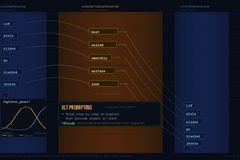
Tell the Model to Think in English: A Technique That Can Improve Results by Up to 10 Points
Research from Oxford and EPFL has shown that large language models (Llama, Gemma, Mixtral) internally think in English even when processing non-English inputs — key concepts first appear in English in the network's middle layers and are only translated into the target language in the final layers. For Czech users this means worse reasoning performance, cultural bias, and more terse answers; techniques such as cross-lingual prompting (XLT) or dictionary insertion can improve results by up to 10 points, but the real solution lies in models trained on sufficient Czech data, such as the upcoming OpenEuroLLM.

Czech in the Gears of the Models: A Loss of Style Nobody Is Watching
Studies show that large language models produce stylistically flatter and more monotonous Czech texts than human authors, while Czech makes up less than one percent of training data. The article maps the impact on Czech education, where 69% of pupils use AI for schoolwork, and analyzes the inadequacy of detection tools for the Czech language as well as the inconsistent responses of universities — from annulling bachelor's theses to introducing their own rules for working with AI.

A New National Revival: Czechia Has No AI of Its Own — and Its Military Pays the Price
The Czech Republic has no language model of its own usable for national-security purposes, which represents a strategic gap across defense, the intelligence services, and the police. While France, Germany, and the United Kingdom invest heavily in the military deployment of AI — and language models perform 10–30% worse in Czech than in English — Czech security forces are not addressing the problem publicly. The article compares the approaches of Iceland, Finland, and Estonia and warns of the risks of depending on American and Chinese technologies for processing sensitive data.
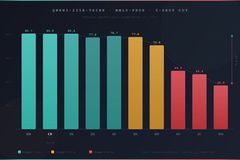
The Language Tax: How Much a Non-English Query to a Large Language Model Costs
The latest generation of large language models has dramatically narrowed the gap between English and the major European languages, but for hundreds of smaller languages the divide is instead widening. The article analyzes tokenization inefficiency, price discrimination against non-English users, and the surprising finding that even the most advanced models of 2025 internally think in English regardless of the input language.
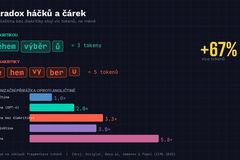
Why Czech Without Diacritics Costs More Tokens, Not Fewer
The article refutes the intuitive assumption that Czech written without háčky and čárky (diacritical marks) saves tokens when processed by language models. On the contrary — text without diacritics consumes significantly more tokens (up to 67% more), because tokenizers (BPE) were trained predominantly on high-quality Czech texts with diacritics and have no efficient merges for the diacritic-free variants. Correct Czech with diacritics is thus paradoxically cheaper to process and more accurate for the model, and the authors recommend prepending a diacritics-restoration module where appropriate.
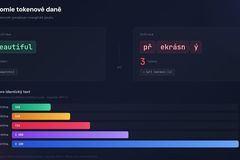
The Token Tax: Why AI Speaks Czech Worse and Pricier
The article analyzes the structural disadvantage Czech faces when processed by large language models. Because tokenization is optimized for English, processing Czech text costs twice as much, the context window effectively shrinks by half, and answer quality drops. It covers Czech benchmarks (CzechBench, BenCzechMark), possible solutions (RAG, fine-tuning, better tokenizers), and the strategic dimension of the problem for the Czech market.

How Large Language Models Work: A Guide for the Curious Techie
The article explains in detail how large language models (LLMs) work — from text tokenization through embedding vectors and the transformer architecture with its self-attention mechanism, all the way to response generation and the training process. Using Meta's open-source Llama 3.1 model as an example, it describes key concepts such as BPE tokenization, Grouped-Query Attention, the KV cache, weight quantization, and the Mixture of Experts architecture, all in an accessible form for IT professionals without a background in machine learning.