Why Do M:N Relationships Not Exist in Nature?
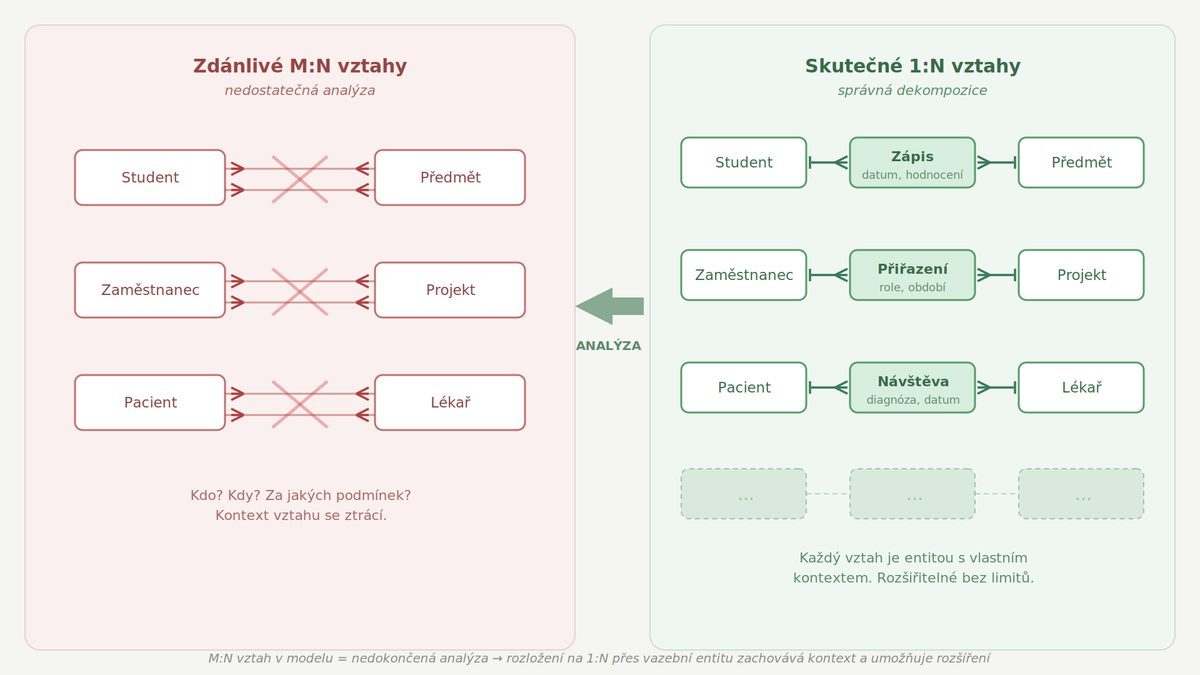
The article advances the thesis that in the real world there is only one fundamental relationship cardinality: 1:N. The M:N relationship does not occur in nature — its presence in a data model always signals an incompletely performed analysis and a hidden intermediary (junction) entity. The thesis is supported by a synthesis of relational ontology in philosophy (ontic structural realism, process philosophy), relational theory in computer science (Codd, Kent), and practical experience with data modeling.
This article presents a synthesis of three hitherto unconnected strands of thought: relational ontology in philosophy, relational theory in computer science, and practical experience with data modeling. It formulates the thesis that reality is inherently relational — not object-based — and that in the real world there exists a single fundamental cardinality of relationship: 1:N. The 1:1 relationship is either a temporary special case of 1:N (genuine), or an implementation artifact with no ontological content (spurious). The M:N relationship does not occur in the real world — its presence in an analytical model is always a sign of insufficiently performed analysis. From this observation and from the assumption that reality is non-contradictory, we derive the argument that a correctly constructed relational model is non-contradictory and infinitely extensible. The article also honestly delineates where the logical argument ends and where a hypothesis requiring formal proof begins.
In the field of information systems there is a long-standing tension between two approaches to modeling reality: the object-oriented and the relational. The object-oriented approach models the world as a collection of encapsulated entities with their own state and behavior. The relational approach focuses on the relationships between entities and their properties.
This tension is not merely technical — it reflects a deeper philosophical question: What is the fundamental constituent of reality? Things, or the relationships between them?
The crucial observation that motivates this article: an object schema does not arise in nature — it arises only in the human mind. The human cognitive apparatus is evolutionarily optimized for recognizing objects — predators, prey, tools, faces. We perceive the world as a collection of separate things because that was advantageous for survival. But this cognitive tendency is not a property of reality itself. It is a projection, a filter that we apply to reality.
When a computer scientist designs an object model, he is not describing reality — he is describing the way he thinks about reality. Classes, inheritance, encapsulation — all of these are constructs of the human mind, not structures found in nature. Nature knows neither a "Mammal class" nor an "IMovable interface." It knows only concrete relationships between concrete entities.
Surprisingly, both modern physics and ancient Eastern philosophy converge on a similar answer: relationships are more fundamental than objects. And practical experience with data modeling — dozens of information-system designs over decades — offers an elegant diagnostic tool for distinguishing a correct from an incorrect model of reality: relationship cardinality.
This article connects these three strands and formulates from them a conclusion that — as far as I am aware — has not yet been published in this form.
The idea that relationships are ontologically more fundamental than objects has deep roots in both Western and Eastern philosophy.
Ontic structural realism (OSR) is a position in the philosophy of science formulated by James Ladyman (1998) and elaborated with Don Ross in the key monograph Every Thing Must Go: Metaphysics Naturalized (2007). OSR holds that the world has an objective modal structure that is ontologically fundamental — it does not supervene on the intrinsic properties of a set of individuals. In other words: the structure of relations precedes objects, not the other way around.
Steven French and James Ladyman argue that contemporary physics — especially quantum mechanics and general relativity — shows that the nature of space, time, and matter is not compatible with standard metaphysical views about the ontological relationship between individuals, intrinsic properties, and relations. As the physicist John Stachel summarizes it: "It's relations all the way down" — relations all the way to the bottom, with no fundamental relata.
There are various variants of OSR. The most radical (OSR1, held by Ladyman and French) maintains that relations are ontologically primitive, whereas objects and properties are not. A more moderate variant (Esfeld, Lam) places objects and relations on the same ontological level. What matters for our argument is that no variant of OSR regards objects as more fundamental than relations.
Alfred North Whitehead, in his process philosophy (Process and Reality, 1929), holds that reality consists of "actual occasions," which are fundamentally relational — not static substances with properties. An entity is not a thing but a process of relating itself to other entities.
Joseph Kaipayil, an Indian philosopher, independently of the Western tradition formulated a position called "ontic relationalism." In his work Relationalism: A Theory of Being (2009) he writes that reality is relational and that for anything to exist and to be known means to exist and to be known in its relation to other entities. Remarkably, Kaipayil arrived at this position independently of Ladyman, from a different philosophical tradition, which mutually reinforces their conclusion.
Karen Barad, within her agential realism, formulates an even more radical position: phenomena are "ontologically primitive relations — relations without preexisting relata." Entities do not enter into relations — entities arise from relations.
Nāgārjuna (2nd–3rd century), the founder of Madhyamaka, held the concept of śūnyatā (emptiness): no phenomenon has svabhāva (inherent existence); everything arises dependently, in a dynamic relation to other conditions (pratītyasamutpāda — dependent origination). This position, almost two thousand years old, is structurally isomorphic with modern OSR.
E. F. Codd (1970) laid the mathematical foundations of the relational data model. His approach was based on set theory and predicate logic. Codd's model proved extraordinarily robust in practice, but its deeper philosophical implications have not yet been fully explored. Codd modeled data as relations (in the mathematical sense — sets of n-tuples) and operations on them as relational algebra. The essential point is that this model implicitly assumes that the relationships between data are fundamental, not the data objects themselves.
William Kent, in his classic work Data and Reality (1978, revised 2012), examines the philosophical foundations of data modeling. Kent points out a key problem: the boundary between entity, attribute, and relationship depends on human perception and language. We are more willing to perceive something as an entity when our language has a noun for it — for the connection between a train and a time we have the word "timetable," but for the connection between a person and their salary we have no such word. Kent thus implicitly says that everything can be modeled as a relationship, and that what we perceive as an "entity" or "attribute" is a convention.
Yair Wand and Ron Weber published the key work An Ontological Analysis of the Relationship Construct in Conceptual Modeling (ACM Transactions on Database Systems), in which they systematically use philosophical ontology to analyze the meaning of modeling constructs. Their starting point — that "the meaning of modeling constructs should be sought in models of reality" — is methodologically close to the approach presented in this article.
Why is the object-oriented approach so intuitive when — as we argue — it does not reflect the structure of reality?
The answer lies in evolutionary psychology and cognitive science. The human visual system is optimized for segmentation — dividing the visual field into separate objects. This ability was evolutionarily critical: recognizing a tiger in the grass meant distinguishing the object (the tiger) from the background (the grass). Cognitive linguistics (Lakoff, Johnson) shows that our conceptual systems are deeply rooted in bodily experience — and bodily experience is the experience of interacting with objects.
The consequence: object-oriented programming is so intuitive precisely because it reflects the way people naturally think — not because it reflects the structure of reality. OOP is ergonomically advantageous (easy for the human brain) but ontologically misleading (it does not correspond to the structure of the modeled domain).
William Kent indirectly points to this when he says that we are more willing to perceive something as an entity if our language has a noun for it. Language and thought mutually reinforce the object bias: once we name a relationship with a noun, we begin to perceive it as an object — and thereby obscure its relational nature.
This cognitive bias explains why the M:N relationship is so common in the first iterations of analytical models: the analyst sees "students" and "courses" as objects and links them with a direct relationship — instead of identifying the relationship (enrollment) as a separate entity. Object perception is a cognitive shortcut that sacrifices accuracy for the sake of comprehensibility.
Eric Evans, in Domain-Driven Design (2003), introduced the concept of the Aggregate — a group of entities that form a consistent whole. Aggregates are always connected by 1:N relationships (the root entity owns the subordinate entities). This pattern can be understood as a practical confirmation of the thesis that 1:N relationships are the fundamental building block of consistent models.
Category theory in mathematics, founded by Samuel Eilenberg and Saunders Mac Lane (1945), describes mathematical structures primarily through morphisms (relations) between objects, not through the internal structure of objects. In category theory an object is fully determined by its relations to other objects (the Yoneda lemma). This is the exact mathematical analog of the thesis that relations are more fundamental than objects.
Before we get to the M:N relationship, we need to clarify the status of the 1:1 relationship. We claim that 1:1 is not a separate cardinality type but a special case of 1:N where N = 1. It is important to distinguish two fundamentally different cases:
A genuine 1:1 relationship is one in which two entities have, at the given moment of analysis, a one-to-one relationship, but this relationship reflects a real state of the domain that may change over time.
Examples:
Key observation: A genuine 1:1 relationship is always temporary. It is an artifact of the momentary state of knowledge of the domain. In time it almost always turns out that the actual cardinality is 1:N — either because the domain evolves, or because we have understood it better. An experienced analyst therefore models a genuine 1:1 directly as 1:N, because he knows that the "exactly one" constraint is a business rule (constraint), not a structural property of reality.
A spurious 1:1 relationship is a purely technical construct that has no ontological meaning. It arises from splitting a single entity into two tables for optimization reasons:
A spurious 1:1 relationship does not reflect the structure of reality — it reflects the structure of the implementation. It should not exist at all in the conceptual model; it belongs exclusively in the physical model.
Consequence: If a genuine 1:1 is a temporary special case of 1:N, and a spurious 1:1 is an implementation artifact with no ontological content, then a single fundamental cardinality of relationship remains in the real world: 1:N.
This is a strong conclusion. It says that the entire structure of reality can be described using one single relationship type — and everything else is either insufficient analysis (M:N), a temporary constraint (genuine 1:1), or an implementation detail (spurious 1:1).
Let us now formulate the central thesis of this article:
Thesis 1: The M:N (many-to-many) relationship does not occur in the real world. Its presence in an analytical model is always a signal that the relationship has not been sufficiently analyzed — that there is a hidden entity mediating this relationship.
Every apparent M:N relationship is in fact two 1:N relationships, connected through a hitherto unidentified entity that carries its own attributes and its own identity.
Apparent M:N relationship / Hidden entity / Attributes of the hidden entity
Student ↔ Course / Enrollment / enrollment date, semester, grade, status
Employee ↔ Project / Assignment / role, period, workload (FTE), rate
Patient ↔ Physician / Visit / date, reason, diagnosis, follow-up
Product ↔ Order / Order line item / quantity, price at the time of purchase, discount
User ↔ Group / Membership / membership type, permissions, valid from/to
Actor ↔ Film / Role / character, role type, fee, billing order
Author ↔ Book / Authorship / author order, share, type of contribution
Article ↔ Tag / Tagging / who added it, when, primary/secondary, weight
User ↔ User (friendship) / Connection / date established, type, status, who requested
Atom ↔ Compound / Chemical bond / type, length, energy, polarity
In all cases the hidden entity:
Key insight: Even in cases where it seems that the associative entity "has no attributes," this is because we have not yet thought about the domain deeply enough. Reality is always richer than our current model. This is precisely why the N:M relationship is an analytical smell — it signals a place where our understanding of the domain lags behind its actual complexity.
Every strong thesis deserves confrontation with strong objections. Let us systematically go through eight categories of counterexamples that a critical opponent might raise.
"Quantum entanglement is a pure relationship between particles without any mediating entity. It cannot be decomposed into two 1:N relationships."
This is the most sophisticated objection. Quantum entanglement does indeed represent a correlation between particles that is not reducible to the properties of the individual particles — exactly what proponents of OSR (Esfeld 2004, French & Ladyman 2003) use as an argument for the fundamentality of relations.
Reply: The objection in fact supports our thesis rather than refuting it. Quantum entanglement can be modeled as an entity — the quantum state of the system (described by a shared wave function, or density matrix). This state:
Quantum superposition is not a contradiction — the particle is not "in state A and B at the same time" in the sense of a logical contradiction. It is in the state |ψ⟩ = α|A⟩ + β|B⟩, which is an unambiguously defined state in Hilbert space. The formalism of quantum mechanics is fully non-contradictory. Our intuition that "superposition is a contradiction" stems from an inadequate classical model, not from the nature of reality.
"Neural networks, gene regulatory networks, and food chains are naturally M:N — a neuron connects to thousands of other neurons, a gene regulates hundreds of other genes."
Reply: Biological networks are precisely the most convincing confirmation of our thesis.
Biology is a great example of how a naive M:N model ("a neuron communicates with a neuron") always decomposes, upon deeper analysis, into a network of entities connected by 1:N relationships. And it is precisely this decomposition that allows biology to function — synaptic plasticity (learning) would not be possible if synapses were not separate entities with their own state.
"Graph databases (Neo4j, Amazon Neptune) model reality as nodes and edges, where edges can naturally be M:N. Why insist on the relational model?"
Reply: This objection confuses the implementation model with the conceptual model. The graph model is a way to store and query data. Our thesis is about the structure of reality, not about implementation.
The essential point is that even in graph databases, quality practice requires edges to have properties (properties on edges). The "FOLLOWS" edge between two users carries attributes: date, type, status. The moment an edge carries attributes, it is de facto an entity — and we have two 1:N relationships (user → edge, edge → user). The graph model therefore does not violate our thesis; it merely implements it in a different syntax.
Moreover: the reluctance to add properties to edges is in practice the most common source of problems in graph modeling. A graph model without properties on edges is the equivalent of an undecomposed M:N relationship in the relational model — and it suffers from the same problems when being extended.
"Mathematical relations such as equivalence, ordering, or symmetry are not naturally of type 1:N. The relation 'is the same age as' is symmetric — it has no direction, no mediating entity."
Reply: Here we need to distinguish two different contexts:
More generally: a symmetric relation in the real world is almost always shorthand for two directional relationships passing through a shared entity. "A is a colleague of B" in fact means "A is a member of team T and B is a member of the same team T" — two 1:N relationships through the entity Membership.
"Gödel's theorems prove that the consistency of a sufficiently rich formal system cannot be proven from within that system. Your argument for the model's consistency is therefore in principle unprovable."
This is a serious objection that requires a careful reply.
Reply: Gödel's theorems apply to formal axiomatic systems that are rich enough to express the arithmetic of natural numbers. Our thesis has two layers:
Nevertheless: Gödel's theorems do not rule out that the consistency of a system can be proven in a stronger system. Gentzen's proof of the consistency of Peano arithmetic (using transfinite induction) is an example. A formalization of our argument could therefore be feasible in a sufficiently strong metasystem.
"The whole is more than the sum of its parts. Emergent properties (consciousness, life, the fluidity of water) cannot be reduced to a network of 1:N relationships between components."
Reply: Our thesis does not claim that reality can be reductively explained by means of 1:N relationships. We claim that reality can be structurally modeled by means of entities and 1:N relationships. This is a fundamental difference.
Emergence is a question of explanation — why the whole exhibits properties that the parts do not have. Our thesis is a question of structural description — by what relationships the parts are connected.
Water is composed of H₂O molecules connected by hydrogen bonds. Each hydrogen bond is an entity (with length, energy, angle, dynamics). Fluidity emerges from the collective behavior of these bonds — but the bonds themselves are modelable as entities with 1:N relationships to the participating molecules.
Emergence therefore does not violate our thesis about structure — it merely says that from this structure properties may emerge that cannot be predicted from an analysis of the individual relationships. This is compatible with our argument.
"Reality is full of feedback and cyclic dependencies: a thermostat controls the heating, the heating changes the temperature, the temperature affects the thermostat. This is not a tree of 1:N relationships — it is a cycle."
Reply: Cycles and feedback are not M:N relationships — they are chains of 1:N relationships that form a closed loop. And, more importantly: each step in a feedback cycle is mediated by an event (an entity):
Each arrow transition is a 1:N relationship mediated by an entity. The cyclic topology does not refute the thesis about cardinality — it merely refutes the naive notion that a relational model must be tree-like (acyclic). A relational model with exclusively 1:N relationships can contain cycles without giving rise to a contradiction.
"Kent in Data and Reality explicitly claims that reality is 'amorphous, disorderly, contradictory, inconsistent, non-rational, and non-objective.' Your argument assumes the opposite."
Reply: Kent's position is epistemological, ours is ontological. Kent claims that our ability to model reality is inherently limited — that every model is a simplification and an interpretation. With this we agree.
But Kent conflates two things: the limitedness of our knowledge of reality and the properties of reality itself. The fact that our models are always incomplete and subjective does not mean that reality itself is contradictory. It means only that our models will never fully capture reality.
Analogy: the map is not the territory — but that does not mean the territory is "amorphous." It means that the map is always a projection, a simplification, and a selection. A good map can be infinitely refined without coming into contradiction with previously drawn elements — provided that the territory itself is non-contradictory.
Kent's position is therefore compatible with ours: models are always incomplete (Kent is right), but reality is non-contradictory and models can be refined without limit without destructive changes (our thesis).
Objection / Conclusion
Quantum entanglement / Supports the thesis — the quantum state is an entity with its own attributes
Biological networks / Confirms the thesis — synapses, regulatory elements are entities
Graph databases / An implementation model, not an ontological argument
Symmetric relations / In the real world always mediated by a shared entity
Gödel's theorems / Limit formal provability, not the truth of the thesis
Emergence / Concerns explanation, not structural description
Feedback / Cycles made of 1:N relationships, not M:N relationships
Kent's objection / Epistemological, not ontological — compatible with our thesis
We adopt the following axiom:
Axiom 1 (Non-contradictoriness of reality): The real world is non-contradictory — there never arises a situation in which something would simultaneously both be and not be in the same respect and at the same time.
This is not a controversial assumption. It corresponds to the law of non-contradiction (principium contradictionis) and is an implicit assumption of all science. Even quantum mechanics, which admits superposition of states, does not refute non-contradictoriness — superposition is not a contradiction but a different kind of state, fully described by a non-contradictory mathematical formalism.
From the observations in sections 2 and 3 it follows:
Thesis 2: Reality is inherently relational. Everything is connected by relationships, and these relationships are — under correct (sufficiently deep) analysis — always of type 1:N. Every relationship is itself an entity with its own properties.
If a model is constructed such that:
then the model is isomorphic with that part of reality which it describes.
Now we can formulate the central argument:
Thesis 3 (The infinite-extensibility argument): A correctly constructed relational model — i.e., a model in which all relationships are of type 1:N — is non-contradictory and infinitely extensible.
Argument: Proceeding step by step.
Step 1: Reality is non-contradictory (Axiom 1).
Step 2: A relational model in which all relationships are of type 1:N is isomorphic with the corresponding part of reality (it follows from Thesis 2 and from the fact that the decomposition of N:M into two 1:N relationships preserves the full information).
Step 3: Extending the model means adding new entities and/or new 1:N relationships. This extension corresponds to the identification of a new aspect of reality that has not yet been captured in the model.
Step 4: Because reality is non-contradictory, a new aspect of reality cannot be in contradiction with already existing aspects. (If it were, this would mean that reality contains a contradiction — a conflict with Axiom 1.)
Step 5: Because the new aspect of reality is not in contradiction with the existing aspects, and the model is isomorphic with reality, adding the corresponding entities and 1:N relationships to the model cannot create a contradiction in the model.
Step 6: Step 5 holds for any extension, because Axiom 1 holds for the whole of reality without restriction. Therefore the model is infinitely extensible without the emergence of contradictions.
From the argument the following practical consequences follow:
It is essential to honestly delineate what the above argument is and what it is not.
What the argument is:
What the argument is not yet:
In programming there is the notion of a code smell — a pattern in code that, while not an error, signals a likely problem. By analogy we can define:
Analytical smell: The presence of an M:N relationship in a conceptual model is an analytical smell — it signals that the analysis of the domain is probably not complete.
Practical procedure when an M:N relationship is found:
If we accept the thesis of infinite extensibility, the approach to systems design changes fundamentally:
The argument presented in this article has a specific character that needs to be classified correctly. It is not a mathematical proof in the classical sense (axioms → lemma → theorem → QED). It is a philosophical argument with a logical structure — a type of argumentation common in analytic philosophy, where from acceptable premises conclusions are derived that can be challenged only by challenging the premises or the logical steps.
The premises of the argument (the non-contradictoriness of reality, the relational nature of reality, the decomposition of M:N) are supported both by the philosophical tradition (section 2) and by practical experience (section 3). In section 3.4 we confronted the argument with eight categories of counterexamples, and none of them challenged the core — some even reinforced it (quantum physics, biology).
The weakest link remains step 2 of the argument (section 4.3) — the claim of isomorphism between the model and reality. Here there is open scope both for formalization and for criticism.
To transform the argument into a formal proof, I propose the following path:
If our thesis is correct, then object-oriented programming — despite its popularity and intuitiveness — is epistemologically misleading. OOP reflects the cognitive bias of the human brain (section 2.3), not the structure of reality. This does not mean that OOP is useless — ergonomics for the programmer has its value. But it does mean that the data model of a system should not be derived from the object model, but the other way around: the object model should be a projection of the relational model into a humanly comprehensible form.
This is practically relevant: the impedance mismatch between the object and relational models (the so-called object-relational impedance mismatch), which has generated an entire category of tools (ORM frameworks), is a direct consequence of the fact that the object model is a cognitive construct grafted onto a relational reality. The solution is not a better ORM — the solution is to accept the relational model as primary.
This article has presented a synthesis of three hitherto unconnected strands of thought:
From this synthesis follows an original argument: A correctly constructed relational model — a model in which all relationships are of type 1:N — is non-contradictory and infinitely extensible. This conclusion has far-reaching practical consequences for the design of information systems.
The argument, in its present form, is logically coherent but not formally provable. The article proposes concrete paths to formalization via category theory, dependent types, and empirical validation.
If the argument is correct, then the relational model is not merely one of the options for organizing data — it is the fundamentally correct way of modeling reality. And the M:N relationship in a data model is not merely an implementation detail but a diagnostic tool that reveals an insufficient understanding of the modeled domain.
The article is based on a discussion in which the author formulated an original synthesis of ideas. The author welcomes collaboration on formalizing the argument — especially with experts in category theory, formal ontology, and dependent types.
Methodological note
The conception, structure, and editorial line of the article are the work of the author, who prepared the content outline, established the key theses, and directed the entire creative process. Generative AI (Claude, Anthropic) was used as a technical tool for research, fact-checking, and elaborating the author's draft.
The author edited the outputs continuously, verified the key findings, and approved the final wording. No part of the text was published without human review. All factual data were verified against the publicly available sources cited in the text.
The procedure complies with the requirements of Art. 50 of EU Regulation 2024/1689 (the AI Act) on transparency of AI-generated content. #poweredByAI
Read the Czech original on Médium.cz.
AI · Claude — machine translation, may contain inaccuracies.