Why Is the Coffee at Work Sour? It's Not the Coffee Machine — It's the Water
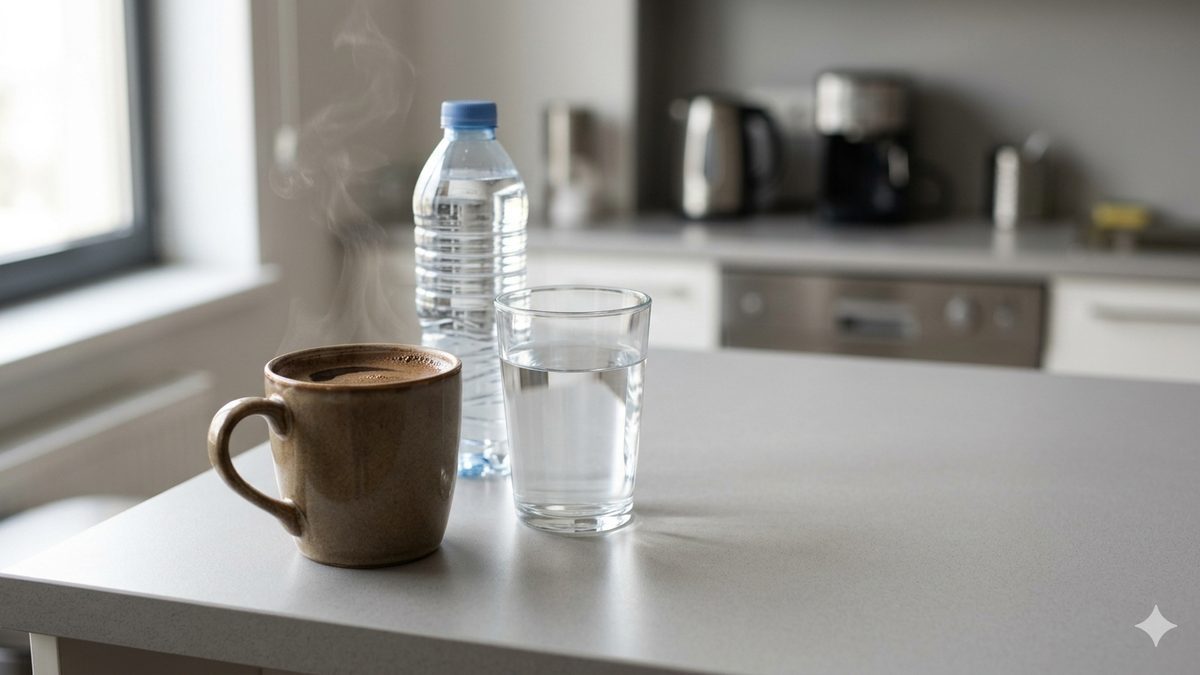
The author investigates why the same coffee tastes good at home but sour at work, and concludes that the main culprit is the water — specifically the chlorine and low magnesium content of Prague's tap water from the Želivka reservoir. He explains the chemistry of coffee acids, the buffering role of bicarbonates and calcium/magnesium, the water profile recommended by the SCA, and compares common Czech bottled waters (including the Magnesia paradox for Turkish coffee). In his view, coffee rests on four levers — the bean, roast and freshness, grind, and water — and he offers a practical recipe for blending waters to get a better cup at the office.
Wednesday morning, at work. I open the tin, measure two spoonfuls of the coffee I drink at home with great enthusiasm — a medium-dark arabica — into a thick-walled mug. I pour in hot water from the kettle in the shared kitchenette, stir, wait four minutes. The classic "turek," Turkish-style coffee the way our parents made it in Czechia and the way we still make it when we have nothing better to hand.
First sip, and a surprise. The coffee is sour. Sour like an under-extracted espresso at a fast-food chain, like a tea I accidentally splashed lemon into. But I know this coffee. The day before, from the very same tin, I'd managed to make something at home that I drank with pleasure. What had changed?
The programmer's reflex says that when one variable isn't working, you look at the next one. My next variable was the water from the kettle in the shared kitchenette. And as it turned out, the difference between the water at home and the water at work is bigger than I'd been willing to admit. But it also turned out — and this is perhaps more fundamental — that water is just one of four levers that good coffee rests on. Small roasteries with their cafés control all four at once. At home we usually control two, sometimes three. In a kitchenette in a big open-plan office, usually none.
In terms of taste, coffee is made up of many hundreds of compounds, but three dominate: acids, bitterness, and sweetness. Arabica carries malic, citric, caffeic, quinic, acetic, and lactic acid, and a whole family of chlorogenic acids. Roasting breaks down some of the acids. Dark Italian roasting eliminates citric and malic acid faster than quinic acid diminishes — which is why Italian espresso from a dark-roasted blend is bitter but rarely "sour." The lighter, medium-developed roast that small roasteries here have favored in recent years deliberately preserves the acids. It wants that citric freshness, that malic depth. And then it exposes them to water.
It's in that water that the decision is made whether those acids will be pleasant or unpleasant. Bicarbonates (HCO₃⁻) in the water act as a buffer — they neutralize some of the acids and soften the perceived sourness. Magnesium (Mg²⁺) and calcium (Ca²⁺), in turn, bind the aromatic compounds in the coffee and help pull them into the brew, with magnesium binding more strongly than calcium according to the calculations. These findings were summarized in a now frequently cited 2014 study in the Journal of Agricultural and Food Chemistry by chemist Christopher Hendon and baristas Lesley and Maxwell Colonna-Dashwood; it's a piece of computational chemistry that quantifies the binding energies of cations to coffee acids. From this logic the Specialty Coffee Association then derived an ideal water profile: hardness around 70 mg/l as CaCO₃, alkalinity around 40 mg/l, zero chlorine, and total dissolved solids (TDS) of roughly 150 mg/l. A slight predominance of magnesium over calcium is no longer prescribed by the standard itself — that's an extra recommendation, one that follows precisely from the chemistry of extraction.
Prague draws its drinking water from three sources: from Želivka (63%, surface water from the Švihov reservoir), from Káraný (25%, bank and artificial infiltration from the Jizera), and from Podolí (12%, surface water from the Vltava, once again a full-fledged source after a reconstruction completed in 2021). The city center and the south are supplied predominantly from Želivka. According to water-quality data, Želivka water has 29.7 mg/l of calcium, a mere 7.7 mg/l of magnesium, and 0.11 mg/l of free chlorine. There's too little magnesium as a carrier of aroma, and the calcium-to-magnesium ratio of almost four to one is the inverse of what would suit coffee chemistry. The alkalinity of around 65 mg/l as CaCO₃, on the other hand, is decent — enough to buffer the coffee acids. That's exactly why I think the "sourness" at work isn't down to a missing buffer, but rather to two other things. The first is chlorine: 0.11 mg/l is legislatively unproblematic and harmless to health, but for the taste of coffee it's a catastrophe. Chlorine reacts with the phenolic compounds in coffee to form chlorophenols — substances with a very low perception threshold that the brain maps as "metallic," "musty," or simply "weird." The second is too little magnesium: the body of the brew is thinner, the sweetness is pulled out less well, and the acids in such a cup relatively stand out.
Káraný, which supplies mainly the northeast, produces water of the opposite profile: harder, with an alkalinity around 168 mg/l as CaCO₃ — four times what the SCA recommends. If you live in Letňany or Klánovice, your coffee won't be sour, it'll be flat. Or you'll quickly get limescale building up in your kettle and your automatic coffee machine. Either-or, same city, different chemistry.
Here comes the counterintuitive twist, which emerged when I reached for Magnesia — the mineral water I use at home for Turkish coffee, because the coffee comes out beautifully velvety from it. The label reports magnesium at 170 mg/l, calcium 37 mg/l, bicarbonates 970 mg/l, and TDS 788. Converted to alkalinity as CaCO₃, that's twenty times what the SCA recommends. For filter coffee from a light roast, Magnesia would be devastation — it would erase all the acidity, leaving a flat, "chalky" taste. For Turkish coffee from the medium-dark coffee I drink at home, it paradoxically works splendidly: the extreme bicarbonate buffer eliminates the aggressive acids, the high magnesium pulls out sweetness and body. For coffee, Magnesia is an accidental Italian-espresso profile in a Czech mineral water, owing to the serpentinite geology near the Slavkov Forest. Prague tap water from Želivka is its opposite.
Water can turn excellent coffee into average or bad coffee. The reverse, however, doesn't work. And in that order lies the answer to the question of why coffee at a better Prague café tastes so different from my Turkish coffee in the kitchenette.
The first thing is the bean. Small roasteries, which here fall under the "specialty" banner, buy coffee through direct collaboration with farmers, know the variety and the processing method, and pay two to five times more than ordinary commodity coffee costs on the world market. Traditional supermarket coffee is often a blend of undifferentiated beans from various countries, bought not by taste but by price. That's neither bad nor good — it's simply a different product with a different goal.
The second thing is the roast and freshness. A small roastery works with a lighter, not fully dark-developed profile and usually sells its beans one to three weeks after roasting; no longer. Coffee in the supermarket, even good coffee, was roasted half a year ago in Italy or Germany, hauled by truck, and stored on the shelf for several months. You can tell even without training. In old coffee you'll taste a papery quality, a loss of life.
The third thing is the grind. A professional grinder costing tens of thousands of crowns grinds such that the difference between the smallest and the largest particle is small and extraction proceeds evenly. A home grinder for five hundred crowns does exactly the opposite: it smashes some beans into dust and leaves others in chunks. Part of it scorches in the brew, part doesn't have time to dissolve. In the cup it meets like acids alongside bitterness — instead of as harmony. That's why even people with no barista ambitions buy hand-cranked grinders for a few thousand. The difference between coffee ground in a shop a month ago and coffee ground at home ten minutes before brewing is immediately noticeable with good coffee.
And only then, as the fourth thing, water. A better café has either a filtration system plumbed directly into the water mains, or reverse osmosis, into which minerals are manually added according to an in-house recipe. This quartet — bean, roast and freshness, grind, water — then works together. When one link drops out, none of the others can save it.
There's also a fifth thing you won't replace with a single cup at home: the whole ecosystem of a roastery and a café. A team of people who make coffee eight hours a day, dial in every new batch of beans, and share feedback among themselves. A cup from a good café is the result of thousands of repetitions of the same movement.
Back to Wednesday morning in the kitchenette. Before I name any brands of bottled water, let me write one thing straight out: I'm not paid by any bottled-water distributor, any roastery, any coffee e-shop, or any café operator. No brand mentioned here has sent me a sample or a discount coupon. This is not a list of "the best products." It's a map of parameters you can read off the label of any water — plus a few specific examples that happen to fit that profile.
What to look for on the label. Three numbers will do. You want the total dissolved solids (TDS, sometimes given as "dissolved substances") at roughly between 100 and 250 mg/l; markedly lower and the water is flat in taste, markedly higher and the coffee gets lost in it. You want the magnesium-to-calcium ratio to be at least one to one if possible, or with a slight predominance of magnesium — magnesium is the more valuable ion in coffee chemistry, and in Czech tap water, as in most bottled waters, there tends to be markedly less of it. Any water where magnesium at least approaches calcium is, from a coffee standpoint, better than typical water with three times the calcium. And you don't want bicarbonates (the equivalent of "alkalinity") above roughly 200 mg/l, otherwise the water will dampen the coffee. Chlorine mustn't be in bottled water anyway, so that's decided for you.
But among what you can get in ordinary Czech supermarkets, there's no water that meets all three criteria ideally. Dobrá voda still (TDS 104, calcium 6, magnesium 8.6, bicarbonates 111) is the only common Czech bottled water with magnesium predominating over calcium — but its mineralization lies below the recommended target of 150, at the lower edge of the usable range. Toma Natura (TDS 116, calcium roughly 32, magnesium 6) has better overall minerals, but the opposite ratio — about five times more calcium than magnesium. Each of these waters will make better coffee out of Prague tap water, but neither is a perfect profile.
What to avoid: mineral waters with high alkalinity. Mattoni and Korunní have bicarbonates around half a gram per liter, Ondrášovka even over 800 mg/l — great for drinking, a dead cup for filter coffee. And don't use Magnesia on its own for filter coffee or for a lightly roasted bean; the paradox I described above holds only for Turkish coffee from a medium-dark arabica.
The logical way out of this trap is to mix waters. Magnesia has markedly more magnesium than any other common water — but unfortunately it carries along with it so many bicarbonates that on its own it ruins filter coffee. When you dilute it, you get exactly what other waters lack, without what it has too much of.
A weighted average of concentrations works for waters exactly as you remember from primary school. Mix one part Magnesia and ten parts Dobrá voda still, and you get water in which magnesium is 23.3 mg/l, calcium 8.8 mg/l, alkalinity roughly 155 mg/l as CaCO₃, and TDS 166. A magnesium-to-calcium ratio of 2.6 to one in magnesium's favor — a profile you won't find in any individually available Czech bottled water. TDS almost exactly on the target of 150. The alkalinity is admittedly four times what the SCA recommends for very light roasts, but for Turkish coffee from a medium-dark arabica and for home espresso it's the most balanced result of all the variants listed here.
For darker blends and attempts at moka-pot coffee, where higher alkalinity doesn't matter, you can dilute Magnesia with Toma Natura at a ratio of one to five: you get water with an almost balanced magnesium-to-calcium ratio (around one to one, still slightly in magnesium's favor), but with a higher TDS of around 228. Aquila, Mattoni, and Korunní, on the other hand, should not be used to dilute Magnesia — they all have such a strong predominance of calcium that not even Magnesia's magnesium will outweigh it; the result is calcium-dominated water, just with several times higher alkalinity.
To find out in practice whether the water at work is really ruining your coffee, a small experiment is enough. At home, pour 150 ml of Magnesia into an empty 1.5-liter bottle, top it up with Dobrá voda still — you have a supply for five or six Turkish coffees and the whole preparation takes two minutes at the sink. Take the bottle to the office and make Turkish coffee with the same coffee that came out sour for you last time. You'll notice the difference at the very first cup: first that metallic off-taste disappears, then the acids get proper buffering. If you don't like mixing, take a plain liter of Dobrá voda on its own — it'll be better than tap water, only with a light coffee you won't get that velvety depth that Magnesia adds in the blend.
The coffee you then make at home, you'll stop hopefully carrying to work. That's perhaps the real point of this Wednesday-morning catastrophe: you'll never fully solve coffee at work. You solve it by bringing it from home in a thermos — or by taking that hour between nine and ten when, in a five-minute walk, you can get to some small roastery nearby and come back with coffee that was worth stepping out for.
Transparency of creation:
The concept, structure, and editorial line of the article are the work of the author, who drew up the content sketch, established the key theses, and steered the entire creative process. Generative AI (Claude, Anthropic) was used as a tool for research, for finding primary sources, and for the formulational elaboration of the author's content sketch.
The author edited the outputs continuously, verified the key findings, and approved the final wording. No part of the text was published without human review. All factual data were verified against the publicly available sources cited in the text.
The procedure complies with the requirements of Art. 50 of EU Regulation 2024/1689 (the AI Act) on the transparency of AI-generated content. #poweredByAI
Read the Czech original on Médium.cz.
AI · Claude — machine translation, may contain inaccuracies.