Naver rebuilt search: AI orchestrates the results page, ads no longer make up even 37% of revenue
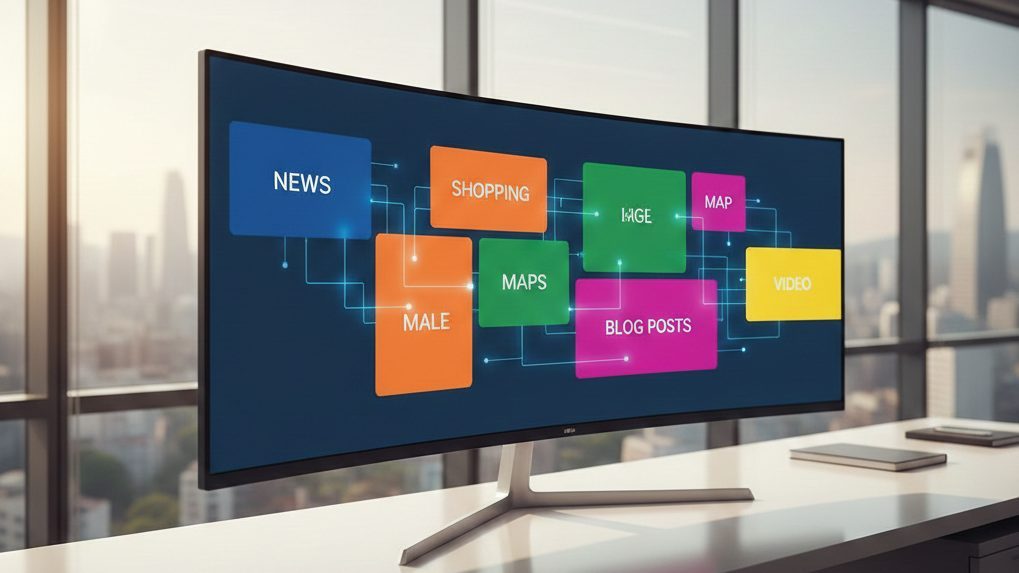
Naver, South Korea's dominant search engine, has rebuilt its search around a modular Smart Blocks system orchestrated by AI (AiRSearch, AI Briefing, CUE:), where each user sees a personalized results page instead of the classic list of links. Advertising's share of revenue fell from 63% to 37% thanks to diversification into e-commerce, fintech, and cloud, while AI monetization is primarily indirect — the ADVoost tool raises the click-through rate by 40% and contributes to 55% growth in advertising revenue.
Executive Summary: Naver operates a search engine that differs fundamentally from its Western counterparts — instead of a linear list of links, the user sees a dynamic mosaic of modular blocks, each corresponding to a single content vertical. The classic web index exists as one of these blocks, but AI layers (AiRSearch, Smart Blocks, AI Briefing, CUE:) progressively wrap it in personalized context. The architecture is additive — AI does not replace the traditional search engine results page (SERP), but creates an intelligent orchestration layer above it. As of March 2026, AI Briefing covers an estimated 20% of queries; the rest of the SERP remains a hybrid of the classic index and AI-driven block ordering. In monetization terms, Naver generates 10.7 trillion KRW per year (~$7.8 billion) from five segments, with the share of pure advertising declining (from 63% to 37%) in favor of commerce (27%), fintech (14%), and cloud (5%). AI monetization is primarily indirect — ADVoost increases the click-through rate (CTR) by 40% and contributes to 55% of advertising revenue growth.
Naver functions more as a vertically integrated portal than as a pure search engine. While Google primarily indexes the external web and orders results into a single linear stream, Naver aggregates content from its own platforms (Naver Blog, Café, Knowledge iN, Naver News, Naver Shopping, Naver Maps) as well as from the external web into separate visual blocks. After entering a query, the user therefore does not see "ten blue links," but a vertically stacked page of modular sections — each with its own design, ranking logic, and data source.
Naver's results page consists of the following layers, ordered by their typical position on the page:
1. AI Briefing (top of the page, conditional display)
A generative summary of the answer to the query, visually distinguished from the rest of the page. It is displayed only for queries where AI can provide added value — by the end of 2025 Naver was targeting coverage of 20% of all queries, and it achieved this goal. AI Briefing exists in four variants: trending topics (a summary of news from multiple sources), short multimedia content (Shortents), local recommendations, and shopping advice. Each summary contains source citations — a link to the original blog, article, or product — which preserves the flow of users to content creators.
2. Smart Blocks (the core of the results page)
Dynamic modular blocks that form the backbone of the results page. Each block corresponds to one vertical:
Key principle: the selection, order, and content of the blocks differ for each user. Two people searching the same query see a different combination of blocks with different content inside. The AiRSearch system (see technical background) decides which blocks to display and in what order, based on browsing history, demographic data, and contextual signals.
3. AI Snippet (inside user blocks)
Within the Blog, Café, and Knowledge iN blocks, AI-generated extracts are displayed — short summaries of the key information from longer posts. The user thus does not have to click through entire articles to find out whether they contain the information sought.
4. Classic web index (웹사이트 block)
A traditional crawled index of the external web with blue links, title tags, and meta descriptions. It exists, but typically holds a lower position than the blocks with user content. Naver has historically favored its own platform content — this bias is gradually easing, but has not disappeared.
5. Advertising blocks
Paid results (Naver Search Ads) are displayed in dedicated positions — typically above the organic results and in the sidebar. They are visually marked as advertising.
For specific query categories, Naver displays dedicated formats:
On mobile (which dominates the Korean market with a share of over 70% of searches), the results page is even more "block-based" — the user scrolls vertically through full-width cards. The desktop version offers more parallel columns. In both cases the ranking logic is identical — it is driven by AiRSearch.
AiRSearch (AI-powered Reranking Search) is the overarching system, introduced in October 2021, that drives the entire results page. It consists of three specialized recommendation systems:
AiRS (AI Recommendation System) — a recommendation system for content (blogs, Café, Knowledge iN, news). It analyzes user behavior (click history, reading time, interactions) and contextual signals (time, device, location) to personalize the selection and ordering of content in the user blocks.
AiTEMS (AI Commerce Recommendation) — a recommendation system for products. It analyzes the user's purchase history, wish lists, price sensitivity, and brand preferences. Powered by HyperCLOVA X for understanding the natural language of product queries.
AiRSPACE (AI Place Recommendation) — a recommendation system for places. It connects data from Naver Maps, user reviews, reservation systems, and location data for personalized recommendations of restaurants, shops, and services.
Together, these three systems decide which Smart Blocks are displayed on the results page, in what order, and with what content inside. The decision-making process takes place in real time — for every query, inference of all three models runs in parallel.
Smart Blocks are not static templates, but dynamically generated modules. For each query, the system:
A trial run on 40 keywords demonstrated that the number of content types per keyword differed between users by more than 38% — that is, the system does not produce a uniform results page, but a genuinely individualized page.
CUE: (launched in trial operation in September 2023, integrated into the results page in December 2023) is Naver's response to generative search. Technically, it combines:
CUE: works internally with HyperCLOVA X as the generative core and uses the Naver index as the source for retrieval. In internal testing it achieved a 72% reduction in hallucinations compared to a naive generative approach, which indicates a sophisticated processing pipeline with verification steps.
AI Briefing (launched on March 26, 2025) represents a further evolution beyond CUE:. Unlike CUE:, which required explicit activation, AI Briefing is displayed automatically for suitable queries. The four briefing variants (trending, Shortents, local recommendations, shopping) use different prompting strategies and processing pipelines optimized for the given content type.
Architecturally, AI Briefing functions as an intermediate layer between the user and the classic results page:
User query → an intent classifier decides whether to display AI Briefing (yes/no). If yes, two branches run in parallel: (1) AI Briefing — HyperCLOVA X + RAG generates a summary; (2) the classic results page — AiRSearch + Smart Blocks generate personalized blocks. The resulting page displays AI Briefing at the top, with Smart Blocks below it (Blog, Shopping, News, Website/web index, Maps, and others).
The entire generative AI layer of the results page (AI Briefing, CUE:, AI Snippet, shopping recommendations) runs on HyperCLOVA X. Key technical properties relevant to search:
Naver operates its own web crawler and index, which crawls both the Korean and the international web. The web index (웹사이트 block) is displayed on the results page, but typically at a lower position than the user blocks. This is an architectural decision — from the outset, Naver built an ecosystem in which content is created on its platforms (Blog, Café, Knowledge iN), and this content is richer in structured metadata than the external web.
For search engine optimization specialists, this means that optimizing for Naver requires a presence on Naver's platforms — optimizing the external web alone is not enough. Naver SearchAdvisor (the equivalent of Google Search Console) allows webmasters to register and monitor their pages in the Naver index.
The entire search technology stack runs on the Naver Cloud Platform, with a backend in the hyperscale data center GAK Sejong (294,000 m², a capacity of over 600,000 server units) — the largest single-company data center in Korea and one of the five largest in Asia. GPU clusters for HyperCLOVA X inference are operated on the dedicated NeuroCloud infrastructure. Search response latency is optimized for the Korean market — the servers are geographically close to the user base.
In 2024 Naver crossed the threshold of 10 trillion KRW in annual revenue (10,738 billion KRW, ~$7.8 billion, +11% year-on-year), and in 2025 it reached 12,035 billion KRW (+12.1%). Operating profit 2024: 1,979 billion KRW, with a margin of 18.4%. It reports five segments:
Segment revenues 2024:
Key trend: the share of the Search Platform (= advertising) is declining from ~63% (2020) to 36.7% (2024), but absolute advertising revenues are growing steadily. Commerce and Cloud are growing the fastest.
Advertising on Naver's results page works through several formats, which are displayed on the page in dedicated positions visually distinguished from the organic blocks:
Power Link (CPC) — text search ads in the first 10 positions of the results page. Minimum bid 70 KRW (~$0.05), average cost per click ~700 KRW (~$0.50); in competitive industries (law, finance, medicine) up to 15,000–20,000 KRW. Auction model with manual bidding. CPC on Naver is generally higher than on Google in Korea, but with a better conversion rate.
Brand Search Ads (CPT) — a visual billboard at the top of the results page with exclusivity for a given brand on a given keyword. Fixed price per time period (7–90 days), from 660,000 KRW (~$500) for 30 days for low-volume keywords.
Shopping Search Ads (CPC) — product ads in the Naver Shopping block, linked to the Smart Store ecosystem.
Display ads (GFA) — both CPC and CPM pricing models on the Naver home page, Naver Mail, and other surfaces. Guaranteed display formats (Smart Channel, Rolling Board) on a CPT model.
ADVoost, launched in 2024, is built on a specialized AD LLM and automates the entire advertising cycle — bidding, budget, targeting, placement, and creatives. Measured results from pilot operations: CTR +40%, CPC −28%. The claim of improved conversions has not been verified in an independent source — Naver states an overall improvement in advertising effectiveness of more than 30%. In 2025, AI contributed to 55% of the total growth in advertising revenue.
Two systemic changes: (1) the abolition of the more-than-a-decade-old Quality Index, replaced by an AI-driven "Ad Relevance Index" and "Click Expectation Index"; (2) the introduction of broad keyword matching — until then Naver had operated exclusively on exact matching. Product family: ADVoost Search, Shopping, Creative, Audience, Screen (DOOH).
Naver Shopping is purely a third-party marketplace, with a gross merchandise volume (GMV) of over 50 trillion KRW (2024). The effective commission is 4–5% of GMV:
For comparison: Coupang charges ~10–15%, Kakao Shopping Live ~30%. Naver deliberately keeps its commission low in order to attract small and medium-sized sellers — over 600,000 merchants on the Smart Store platform. A planned commission increase of ~1 percentage point (June 2025) would bring in an additional ~300 billion KRW per year.
Naver Pay serves 30.68 million users and is the most-used mobile payment service in Korea. The total payment volume (TPV) in Q2 2025 reached 22.7 trillion KRW (+21.7% year-on-year).
The cloud segment (564 billion KRW in 2024, +26.1% year-on-year) includes the CLOVA Studio API, enterprise contracts, and government projects. A trend of dramatic acceleration: Q1 2024 +25.5% → Q4 2024 +41.1%. CLOVA Studio is used by over 2,000 enterprise customers. Pricing model: pay per token (Basic), prepaid capacity (Exclusive), or deployment on one's own infrastructure (NeuroCloud).
Indirect AI monetization, however, is significantly larger than direct. ADVoost increases CTR by 40% → higher advertising revenue across the entire Search Platform. AI recommendations in commerce increase conversions → higher transaction volume. AI features in Naver Plus Membership delivered a 1.5× increase in new registrations. Naver does not publish a precise quantification of indirect AI monetization.
AI investment: capital expenditure in Q3 2024 reached 389.5 billion KRW (2.3× year-on-year); for 2025, over 1 trillion KRW is planned for GPUs alone. GAK Sejong is the largest single-company data center in Korea and one of the five largest in Asia (294,000 m², over 600,000 server units). In Morocco, an AI data center with a capacity of 500 MW with NVIDIA Blackwell GPUs is being built.
Webtoon Entertainment (NASDAQ: WBTN) generated revenue of $1.348 billion in 2024. Character Chat (an AI chatbot featuring webtoon characters, launched 6/2024) reached 3.5 million users and over 100 million messages. Key metric: 41% of messages are paid (May 2025); the average spend per user has doubled since launch. For the series Star Ginseng Shop, the chatbot delivered +97% chapter reads, +22% paying users, and +44% revenue.
Operating margin development: 2020 ~22.8% → 2021 19.4% → 2022 15.9% → 2023 15.4% → 2024 18.4% → 2025 18.4%.
The margin declined due to acquisitions (Poshmark) and investments in new segments; from 2024 it is recovering thanks to operating leverage in the Search Platform and the improving profitability of the commerce segment. Research and development investment has been consistently over 20% of revenue, cumulatively ~16 trillion KRW over the 2012–2023 period.
In June 2025, Naver announced a plan for an integrated AI agent, "Tab," which in the first half of 2026 would connect search with concrete actions — restaurant reservations, purchases, navigation. It is a transition from "the search engine answers queries" to "the AI agent performs tasks." If realized, it represents the most fundamental architectural change to Naver Search since the introduction of Smart Blocks.
Additive AI — AI layers are added on top of the classic results page; they do not replace it. Modular results page — Smart Blocks instead of a linear list — dynamic composition. Personalization — each user sees a different results page (block selection, ordering, content). Own content first — user content from Naver platforms takes priority over the external web. Gradual rollout — AI Briefing only for ~20% of queries, not a wholesale transition. Sovereign LLM — proprietary HyperCLOVA X optimized for Korean. Hybrid retrieval — a combination of the classic index, user databases, and RAG for generative answers. Low commission — 4–5% of transaction volume — attracts small and medium-sized businesses, builds the ecosystem. Indirect AI monetization — ADVoost increases CTR/conversions → higher advertising revenue without directly charging for AI. Revenue diversification — the share of advertising falls from 63% to 37%, while commerce, cloud, and fintech grow.
Both Google and Microsoft hold dozens of patents on search personalization. Key ones: Google Thematic Search (US12158907B1), AI Landing Pages (US12536233B1, January 2026), Stateful Chat (US20240289407A1, pending); Microsoft SERP History (US7966324B2), Trail Deeplinks (US10289735B2).
The fundamental question, however, is not what Naver must avoid — but whether these patents are even valid. Naver operated Smart Blocks (modular thematic blocks) from 2017, AiRSearch (AI personalization) from 10/2021, and AI Snippet Technology (LLM summarization) from 11/2022 — that is, before the priority dates of most of the Google patents. Under U.S. patent law (35 USC §102/§103), a publicly available foreign system can invalidate a patent. Google Thematic Search is likely challengeable on §103 (a combination of Smart Blocks + LLM summarization + NLP clustering = obvious to a person skilled in the art). Stateful Chat faces overwhelming prior art from CUE:, ChatGPT/Bing, and Perplexity. The AI Landing Pages patent is more specific and likely valid.
U.S. patents do not have automatic validity in Korea without an equivalent at KIPO. A detailed invalidity analysis, including a timeline of the prior art, is in a separate document.
The analysis draws on publicly available sources: the Naver tech blog (clova.ai), Naver Corp. press releases, reporting by Korea Herald, KED Global, TechCrunch, and VentureBeat, Naver's earnings conference calls for 2024 and Q1 2025 (MarketScreener, AlphaSpread, Yahoo Finance), Webtoon Entertainment SEC filings and earnings conference calls, Naver Cloud Platform documentation, Naver IR presentations, analyst reports from Mirae Asset Securities and Hana Securities, and an academic paper on HyperCLOVA X. Financial data for 2025 are based on a UPI report (February 2026). Internal metrics (the exact share of AI Briefing in queries, inference latency, the RAG processing pipeline architecture, detailed segment margins) are not publicly available, and the values given are based on public management statements. The analysis reflects the state of affairs as of March 2026.
Creation transparency
The concept, structure, and editorial line of the article are the work of the author, who prepared the content outline, established the key theses, and directed the entire creation process. Generative AI (Claude Opus 4.6, Anthropic) was used as a tool for research, fact-checking, and elaborating the author's draft.
The author verified the key findings and approved the final wording. No part of the text was published without conscious authorial control. The factual data were verified against the publicly available sources cited in the text.
The procedure complies with the transparency principles of EU Regulation 2024/1689 (the AI Act). #poweredByAI
Read the Czech original on Médium.cz.
AI · Claude — machine translation, may contain inaccuracies.