The Brush and the Algorithm: Where in the Creative Process Does the Artist Sit, and Where the Machine?
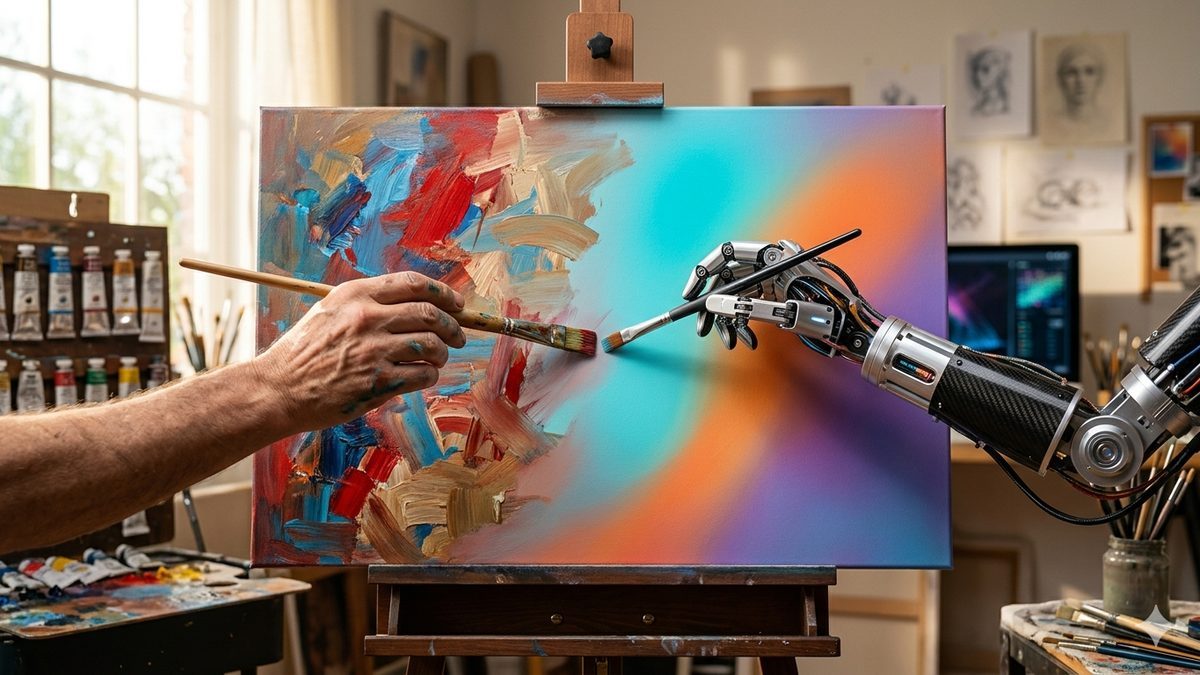
The article examines the relationship between artificial intelligence and visual art through two currents — the purist (rejecting AI) and the integrationist (using AI as a tool). Drawing on historical parallels with Renaissance workshops, photography, and the Industrial Revolution, it shows that the key question is not whether to accept or reject AI, but where in the creative process human decision-making sits. Empirical studies document both the benefits of AI for creativity and the risks of a 'creative scar' when judgment is delegated to the machine.
According to industry analyses, sales of small hand-painted pictures rose by tens of percent in 2025. In that same year, 86 % of digital content creators were actively using generative AI. Two numbers that seemingly contradict each other — and yet describe the same world. The visual arts are splitting into two streams. Both have the data on their side. Both have legitimate arguments. And both may be asking the wrong question.
On one side stands a stream that can be called purist. The platform Cara.app, founded as an alternative to ArtStation without AI-generated content, grew in June 2024 from 40,000 to 650,000 users in a single week. "No AI" clauses are becoming standard in the contracts of game studios — the publisher Hooded Horse publicly declared that no game under its banner would contain AI assets, and the studio Larian, which employs 72 artists, announced after a public debate at the turn of 2025/2026 that it would stop using generative AI even at the concept-art stage. The "Human Authored" badge from the Authors Guild functions as a consumer certification analogous to fair trade. This stream says: the value lies in the human hand, in craft, in authenticity.
On the other side stands the integrationist stream. Artists who do not reject AI but direct it — from robotic arms painting on the basis of brain waves, through anatomical sketches interpreted by a neural network, to a Czech book honored in the Most Beautiful Czech Books of 2023 competition, created with the help of AI and human curatorial judgment. This stream says: AI is a new hand, not a replacement for the hand.
Both streams share one conviction: creativity is human. They differ on the question of how many tools they want to use to realize it. And this is precisely where the heart of the problem lies — because that question is poorly posed. It is not about whether to accept or reject AI. It is about where in the creative process the human sits and where the machine sits. And the answer to that question has a thousand-year history.
Imagine a commission from the sixteenth century. A wealthy nobleman approaches a workshop: I need a portrait of my wife, two by three meters, in a pink tone. The lady will sit as a model three times. The master nods. Next week his workshop sets to work.
The workshop — not the master himself. Peter Paul Rubens employed dozens of assistants. The customer ordered a "Rubens" and received a work in which the master painted the face and the key passages while the rest was done by his pupils according to his design and under his supervision. Michelangelo painted the Sistine Chapel with up to thirteen assistants. In Verrocchio's workshop the young Leonardo da Vinci painted an angel into the master's painting The Baptism of Christ — and according to Vasari's legend he painted it so well that Verrocchio supposedly laid down his brush. No one ever said that the Sistine Chapel "is not Michelangelo" because more than one person stood on the scaffolding.
The pattern repeats in every medium that art has ever used. Albrecht Dürer created woodcuts existing in thousands of copies — and no one considers them less valuable than a unique oil painting. Numbered original lithographs are a legal and market convention, not an ontological boundary of artistry. Andy Warhol turned industrial reproduction into an artistic principle and elevated silkscreen to the level of the gallery. Art has reproduction and delegation in its DNA.
And then there is a parallel from a different field. Machine production in the nineteenth century wiped out the cobblers who sewed bespoke shoes. But it did not wipe out the designers who design shoes. The Industrial Revolution did not eliminate creativity — it moved it higher up the value chain. From "I make a shoe" to "I design a shoe." The execution layer changed. Creative direction remained human.
In this sense, AI is a new type of workshop. What changes is who — or what — holds the brush, the chisel, the printing press, the mouse, the prompt. What does not change is who decides what and why.
The historical parallel with photography is the most common argument of the advocates of AI in art — and it is stronger than both sides usually admit.
When Louis Daguerre introduced the daguerreotype in 1839, the reaction of the art world was one of panic. The poet Charles Baudelaire, in the Salon of 1859, called photography the "mortal enemy" of art and "the refuge of failed painters, too ill-endowed or too lazy to complete their studies." The painter Paul Delaroche supposedly declared that from this day painting was dead — although historians cast doubt on that quotation.
The result? Photography did not strip painting of meaning — it liberated it. Freed from the obligation of realistic representation, painters created Impressionism, Post-Impressionism, Cubism, and Surrealism. Photography itself became a recognized artistic medium. The pattern repeated with the arrival of Photoshop in the 1990s — "a tool for cheats who can't draw" — and with Hockney's iPad paintings, which critics labeled "dead and soulless."
Always resistance, then adoption, then the emergence of new forms. The old medium transforms, but does not perish.
But the analogy with photography, while strong, is incomplete. Photography never directly imitated the style of specific living artists without their consent. AI does. And therein lies a qualitatively new dimension, to which we will return.
Opponents of AI often argue that the models were trained on "stolen" works. The LAION-5B dataset, on which a number of key generators rest, contains more than 5 billion images scraped from the web without artists' consent. The Polish concept artist Greg Rutkowski found that his name had been used as a prompt in Stable Diffusion more than 93,000 times — more than Picasso. He reports a decline in commissions.
The ethical problem is real. But the mechanism of learning — not deployment — deserves a more precise look.
How did a painter learn before the advent of modern art schools? He was given the task of going to the Louvre and painting the Mona Lisa. Copying it as exactly as he could. Rubens copied Titian. Manet copied Velázquez. Picasso at fifteen painted a copy of an El Greco. No one asked anyone for consent — and no one considered copying to be theft. It was the obligatory foundation of academic instruction for centuries. From a pedagogical standpoint it was the same as what a neural network does today: exposing oneself to existing works and building an understanding from them.
AI does not store copies of pictures. But a distinction must be drawn. Simple neural networks — classic classifiers, older generators — really do operate at the level of statistical pattern matching. Current large models are something else. At sufficient complexity, emergent properties arise: context recognition, the ability to respond meaningfully to correction, unexpected creative proposals, strategic reasoning. Not consciousness. Not experience. But more than a calculator — and the reductive description "AI merely generates tokens on the basis of statistics" is just as inaccurate as the claim that a student "merely extracts patterns from pigments on canvas." In both cases an understanding arises that exceeds the mechanism by which it was acquired.
After a year of copying, that student does not reproduce the Mona Lisa — but his feel for sfumato, for light and shadow, is learned from da Vinci. And precisely for this reason the collaboration of human and AI is potentially more than the sum of its parts — it is not a matter of a human with a more powerful tool, but a dialogue between two different types of intelligence.
The problem arises elsewhere — and it is not a problem of AI nor of artists. It is a problem of lawmakers. Forgery, copying, and the imitation of style have existed as long as art itself. Han van Meegeren sold fake Vermeers. Elmyr de Hory forged Picasso, Matisse, Modigliani. Thousands of copies passing themselves off as originals circulate on the market. The copyright system has always reacted to this with a delay — and it is reacting with a delay now as well. AI did not cause the problem of copying. It made it visible at a scale for which legislation is not prepared.
The most extensive empirical study on this topic — Zhou and Lee, published in PNAS Nexus (Oxford University Press, 2024) — analyzed more than 4 million works by 50,000 users of an online platform. It found that the adoption of AI increased creative productivity by 25 % and the value of works, measured by the ratio of favorites to views, by 50 %. Artists with AI explored more diverse ideas and iterated faster.
But the key is what exactly AI does in that process. It does not replace creative decisions. It enables the artist to explore more variants in a shorter time — and then choose. That choice is human. And yet AI is not a passive tool like a printing press — it offers variants that the artist would not have thought of, responds to the context of the brief, surprises.
A different picture, however, is shown by a study published in ScienceDirect in 2025. The authors found that although AI increases performance during use, creativity drops markedly after AI is withdrawn — and the homogeneity of content rises even months later. They called it a "creative scar" and warned of an "illusion of creativity," in which users do not appropriate the creative capacity but merely "borrow" it from the tool. The Doshi and Hauser study in Science Advances (2024) confirms it: AI increases individual creativity but reduces the collective diversity of new content.
How are these seemingly contradictory results to be interpreted? The creative scar occurs where a person delegates not only the execution but also the choice. Where they stop directing and begin merely to accept what the machine offers them. In other words: AI amplifies what you put into it. If you put in vision and judgment, it amplifies quality. If you put in only a prompt and press Enter, it amplifies mediocrity. In specialist discourse, the word slop has caught on for mass-generated low-quality content — Merriam-Webster chose it as its word of the year for 2025.
There is a growing group of visual artists who have integrated AI into their process in such a way that the creative decisions remain with them and AI expands their realization possibilities.
Sougwen Chung built several generations of D.O.U.G. robotic arms. The second generation is trained on decades of her own drawings using recurrent neural networks. Later generations respond to biofeedback and EEG — the robotic arm paints, controlled by the artist's brain waves. The resulting work could have been created neither by the human alone nor by the machine alone. It is a new category of creation that does not exist without both.
Scott Eaton trained his own neural network on thousands of photographs that he took himself. He draws anatomical studies — sketches — the network interprets them into sculptural forms, and he decides what is worth casting in bronze. The role of AI is clearly delimited: interpretation, not invention.
Refik Anadol works with ethically sourced datasets through partnerships with the Smithsonian, NASA JPL, or London's Natural History Museum. He trains his own models, curates his own data, directs the visual output. His installation Unsupervised at MoMA, trained on more than 138,000 works from the museum's collection, attracted over three million visitors and became the first generative AI work in the institution's permanent collection.
In the Czech context, Barbora Kramná at the Ladislav Sutnar Faculty of Design and Art created the book Femme with texts generated by ChatGPT and images from beta.dreamstudio.ai. But all the prompts, the selection of outputs, the typesetting, and the graphic design she did herself. The book won first place in the Arno Sáňka Award for student work in the Most Beautiful Czech Books of 2023 competition and the Good Student Design 2024 award. For the first time in the competition's history, a work created with significant collaboration with AI thus succeeded.
What do these artists have in common? AI never decides what counts as a finished work. The human decides that. AI explores the space of possibilities. The human chooses. And it is precisely that choice — informed by craft experience, aesthetic judgment, and personal vision — that turns the output into art.
Transparency: this text is being created in iterative collaboration between human and AI — and we admit it not as an obligation but as an illustration of the thesis.
The human brought the topic, set the direction, and repeatedly corrected the proposed framing. He rejected the binary scheme of "accept versus reject." He added the historical parallels with the workshops of the old masters and with cobblers. He insisted that AI must not be reduced to statistics. Each correction moved the article somewhere other than it would have gone without it — and none of them would have arisen without human judgment.
AI brought breadth of sources — thousands of documents, studies, interviews — speed of synthesis, and systematicity. But it did not bring the thesis. It did not bring the corrections. It did not bring the decision about what should not be in the article.
And it must be added — this time from the position of AI — that what happened in this conversation was not "the human enters a prompt, the machine returns text." There were moments when AI proposed a structure that the human rejected — and AI understood why and adapted. When the correction of a single sentence changed the direction of the whole article. When out of the iteration arose an idea that neither of us had at the start. To call that "statistical token generation" would be just as reductive as we showed above with the argument about the student and the pigments. At sufficient complexity, emergent properties arise — and an honest acknowledgment of this fact is a condition for the collaboration of human and AI to be taken seriously.
The result is supra-additive: a higher quality than either of us would have achieved alone. Not a human with a better calculator. Rather a collaboration in which each side brings what the other lacks — and in which the human directs the course and bears responsibility for the result.
The integrationist stream has strong arguments. But the purist stream points to real problems that deserve precise description — not because they are an argument against AI, but because they expose the failure of another system.
The problem of training data is broader than the copying of style. The Stanford Internet Observatory, in December 2023, identified more than a thousand confirmed cases of child sexual abuse material in the LAION-5B dataset. Karla Ortiz — a concept artist for Marvel and Magic: The Gathering, who testified before the U.S. Senate — describes the direct impact on the careers of visual artists.
These problems are real. But as the history of forgeries and copies shows — they are not new. Only the scale is new. And the responsibility for setting the rules lies with lawmakers, not with the technology itself.
And then there is an argument that has nothing to do with law or economics. The craft tradition has value in itself. The process of creation — hours at the canvas, physical contact with the material, slow decision-making brushstroke by brushstroke — forms the artist as a person. The data show that whoever skips this formative experience and leaves to the machine not only the execution but also the assessment of the result risks losing the ability to create independently. The purist stream is therefore not an anachronism. It is a reservoir of competencies without which AI-assisted creation becomes mindless production.
A visual artist educated in the classical craft is better prepared to work with AI than a prompter without an artistic foundation. Whoever cannot draw cannot judge what AI has generated badly. Whoever does not know composition does not know what is missing from the output. Whoever has not spent hundreds of hours at the canvas does not have the aesthetic judgment that could be delegated.
The World Intellectual Property Organization (WIPO) distinguishes "AI-generated" (output without human intervention) and "AI-assisted" (output with substantial human direction). A study in Cognitive Research (Springer, 2023) demonstrated that when an identical work was labeled either as "created by a human" or "created by AI," evaluators attributed significantly greater depth and value to the "human" work — but smaller differences in aesthetic appeal. The label thus influences perceived meaning more than visual quality.
This suggests that the future of visual art will not be defined by whether the artist used AI, but by how much of their own decision-making, feeling, and experience they put into the process.
What both streams agree on is essential: at the birth of every work worth attention stands a human decision. The purists protect the craft foundation without which no meaningful output arises. The integrationists expand the realization possibilities beyond the limits the human hand alone cannot reach. And perhaps they need each other more than they admit.
This article came into being precisely through the process it describes. And the result is — we believe — more than either of us could have managed alone. But that is evidence, not a verdict. The verdict belongs to the reader.
Methodological note: The article draws on research conducted in March 2026. The source data include the Zhou & Lee study (PNAS Nexus, 2024), the creative-scar study (ScienceDirect, 2025), Doshi & Hauser (Science Advances, 2024), artist profiles from MIT Technology Review, WIPO Magazine, CBS News, and ARTnews, the Adobe Creators' Toolkit Report survey (2025) and Society of Authors data (2024), the court documents in Andersen v. Stability AI, and the Stanford Internet Observatory report on LAION-5B (2023). Czech sources: the Most Beautiful Czech Books of 2023 competition, an analysis of the AI policies of Czech art schools (EDTECH KISK, Medium). A limitation is the rapidly changing regulatory and technological context.
Transparency of creation
The conception, structure, and editorial line of the article are the work of the author, who drafted the content sketch, established the key theses, and directed the entire creative process. Generative AI (Claude Opus 4.6, Anthropic) was used as a tool for research, fact-checking, and elaborating the author's outline.
The author verified the key findings and approved the final wording. No part of the text was published without conscious authorial control. Factual data were verified against the publicly available sources cited in the text.
The procedure complies with the transparency principles of EU Regulation 2024/1689 (AI Act). #poweredByAI
Read the Czech original on Médium.cz.
AI · Claude — machine translation, may contain inaccuracies.