The June Ultimatum: Who Dictates the Pace of Ukrainian Peace, and Why
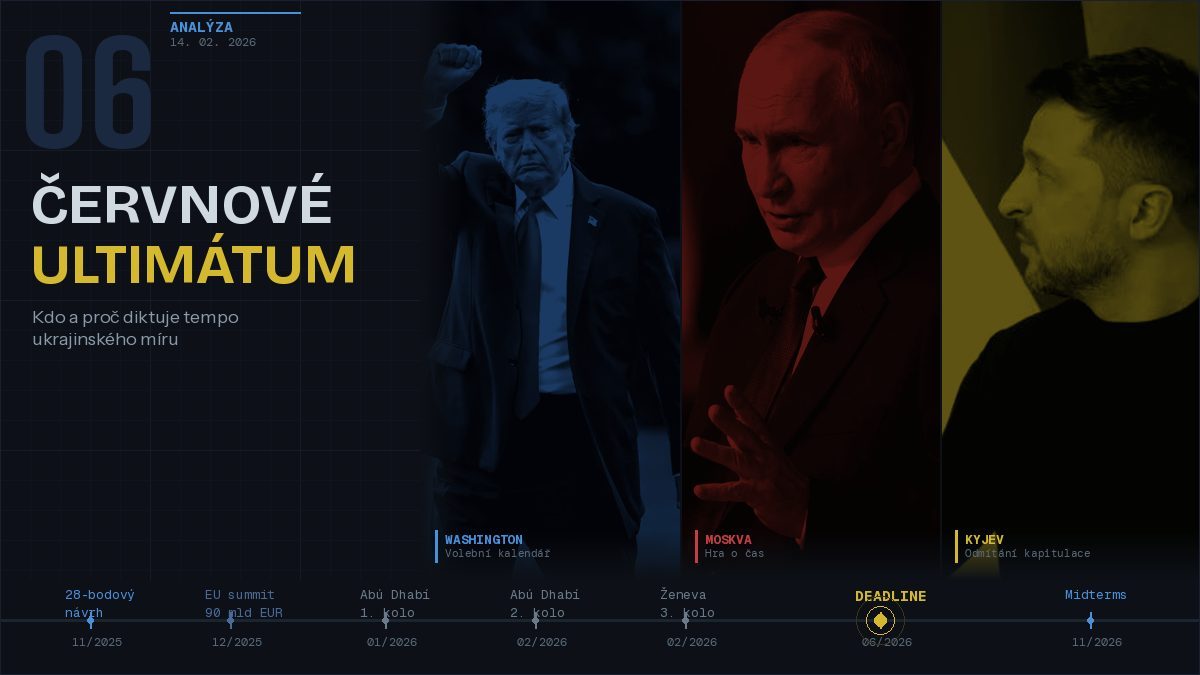
The article analyzes the dynamics of the 2026 peace negotiations over Ukraine, which are shaped by three conflicting logics: Trump's need to reach a deal before the November congressional elections (the June ultimatum), Putin's strategy of stalling without substantial concessions, and Zelensky's refusal to capitulate, backed by domestic public opinion. Drawing on a synthesis of analyses from leading think-tanks, the author lays out five scenarios for how the situation may develop, considering a frozen conflict without a formal peace (~35%) the most likely, and examines in detail the military situation, European support, and domestic political pressures in the US and Russia.
The fate of Ukraine will likely be decided in 2026—not on the battlefield, but in the clash of three opposing political logics: Trump's need to show a "victory" before the November congressional elections, Putin's existential game for the regime's survival, and Zelensky's refusal to capitulate, dressed up as peace. On 7 February 2026, Zelensky told journalists (under an embargo in effect until 8 February) that Washington had given both sides a June deadline to end the war. The logic of this deadline is not primarily military or diplomatic, but electoral. The day before, Reuters, citing several sources, described how the American Witkoff–Kushner negotiating team had warned its Ukrainian counterparts that Trump's room for maneuver is narrowing as the elections approach. As Fareed Zakaria summed it up in the Washington Post (column, December 2025): "The choice is not between peace and war. It is between a peace that prevents the next war and a peace that schedules it."
Information cutoff: 14 February 2026. Some data may already be outdated by the time of reading; the article will likely require updating after the Geneva talks of 17–18 February.
11/2025 – The American 28-point proposal leaks to the media (Axios, CNN); emergency talks in Geneva
12/2025 – Zelensky presents his own peace plan; a revised proposal after the talks
18–19 December 2025 – The EU summit approves the decision on a €90bn loan for Ukraine; CZ, HU and SK do not take part in the guarantees
6 January 2026 – The Paris declaration by a coalition of dozens of countries on security guarantees for Ukraine
23–25 January 2026 – 1st round of trilateral talks in Abu Dhabi
3 February 2026 – Massive Russian strike on Kyiv and Kharkiv (71 missiles, 450 drones) despite a promised pause
4–5 February 2026 – 2nd round of talks in Abu Dhabi; prisoner exchange; restoration of the US–Russia military channel
7 February 2026 – Zelensky announces the June deadline (comments embargoed until 8 February); the US proposes talks in Miami
8 February 2026 – Russian strikes on energy infrastructure (400+ drones, ~40 missiles)
11 February 2026 – The EP approves the €90bn loan for Ukraine (458 for : 140 against : 44 abstentions)
14–16 February 2026 – Munich Security Conference; Zelensky demands 30–50-year guarantees
17–18 February 2026 – 3rd round of talks in Geneva; on the same day, American talks with Iran
June 2026 – American deadline for a framework agreement
3 November 2026 – Midterms — congressional elections
The current negotiating dynamic is defined by an asymmetry of urgency. Trump needs a deal quickly; Putin has an interest in delaying it; Zelensky, under the current configuration of support, has no rational reason to capitulate.
As of 7 February 2026, two rounds of trilateral US–Russia–Ukraine talks had taken place in Abu Dhabi (January and February), producing a prisoner exchange (157 from each side, according to the American statement) and the restoration of the US–Russia military communication channel for the first time in four years.
The American 28-point plan, whose draft leaked to the media in November 2025 (Axios, CNN, ABC News), contained, among other things: de facto recognition by the US of Crimea and the entire Luhansk and Donetsk regions as Russian territory, a freeze on the Kherson and Zaporizhzhia regions along the line of contact, a ban on Ukraine joining NATO, limits on the size of the Ukrainian army, and security guarantees inspired by NATO's Article 5. The European "counteroffer" (also 28 points) softened these demands. CSIS assessed the original plan as "not a deal, but a possible starting point," with many inconsistencies. Fundamental disagreements persist on two key points: control over the rest of Donbas (Russia demands all of Donetsk and Luhansk, including territory it does not control militarily) and the fate of the Zaporizhzhia nuclear power plant.
Trump's team originally worked toward reaching a framework agreement by March 2026, which several Reuters sources called unrealistic. The pattern of missed deadlines is telling: "Day one" (January 2025), 100 days (April 2025), summer 2025, Thanksgiving 2025. None produced a deal, though the circumstances change with each round of talks, and past failure is no guarantee of future failure.
Why June? As Reuters confirmed: the urgency comes neither from developments on the battlefield nor from a diplomatic breakthrough, but from the American electoral calendar. American negotiators told their Ukrainian counterparts directly that Trump will likely shift his attention to domestic politics ahead of the November elections and will have less political capital to close a peace deal. Zelensky confirmed this on 7 February: "The Americans are proposing that the parties end the war by the beginning of this summer… and they will probably exert pressure on the parties precisely according to this timetable."
Trump's polling is markedly negative. The RealClearPolling aggregate shows roughly 42% approval against 55% disapproval (as of mid-February 2026, a spread of around -13 points). The most recent AP-NORC poll (5–8 February 2026) measures 36% approval and 62% disapproval. Pew Research (January 2026) measures 37%. Nate Silver's Silver Bulletin reports a net approval of -12.9 points. Key demographic groups are eroding: support among independent voters and among the young has fallen by more than 20 points. It should be noted, however, that American polls have repeatedly underestimated Trump's electoral strength in recent cycles (2016, 2020, 2024), and approval ratings need not directly predict midterm results.
In Congress, the Republicans are vulnerable. In the House they hold a 218–213 majority with four vacant seats; the Democrats need to gain just 3 seats to take control. In the Senate, of the 35 seats in play (including two special elections), 22 are Republican. The historical pattern is pronounced: in 18 of the last 20 midterms (since 1946), the president's party has lost seats in the House, though redistricting may disrupt this pattern.
A peace deal on Ukraine would be a foreign-policy success that Trump could use on the campaign trail. The missed deadlines, by contrast, undermine the credibility of the promise on which he repeatedly campaigned—namely, that he would end the war "in 24 hours."
Trump has real leverage over both sides that he has not yet fully used. Toward Russia: full enforcement of secondary sanctions on oil importers (India, Turkey, the UAE), tightening of export controls, and legislation on secondary sanctions. Toward Ukraine: making continued military aid conditional, or, conversely, the promise of security guarantees in exchange for flexibility. Frozen Russian assets (roughly €210bn at Euroclear) represent leverage over both sides. The pattern to date suggests that Trump applies these instruments selectively and unsystematically.
Tatiana Stanovaya, an analyst at the Carnegie Endowment, described the current Russian regime as an era of "wild Putinism," in which the elites are gradually shifting into survival mode. In her view, Putin is "the load-bearing walls on which everything rests," but it is important to distinguish this from a genuine guarantee of stability (Carnegie, November 2024).
Stanovaya identified Putin's strategy toward Washington: maintain positive momentum without conceding anything substantial regarding Ukraine. The Kremlin is prepared to offer Trump symbolic gestures: a pause in strikes on energy infrastructure (which Russia broke after four days with a massive strike on Kyiv and Kharkiv on 3 February), a prisoner exchange, the restoration of a communication channel. All without substantive concessions.
The Wall Street Journal, citing American intelligence sources, revealed that Putin's claim of a Ukrainian drone attack on his residence at Valdai around the turn of the year does not correspond to reality; the CIA concluded that the drone attack targeted a military facility, not the presidential residence (the information was independently confirmed by CNN, 31 December 2025). The purpose: to justify hardening his negotiating position without Putin directly rejecting Trump's plan.
Orysia Lutsevych of Chatham House summed it up: "Putin is playing for time with Trump. His goal is to prevent the enforcement of oil sanctions and to delay passage of the secondary-sanctions bill in the US House of Representatives."
The Atlantic Council offers a crucial analytical insight: Putin needs either total victory in Ukraine or an endless conflict. Any attempt to end the war without full control would threaten the stability of the regime. This view is not universally shared; some analysts (Anatol Lieven of the Quincy Institute) argue that Putin could accept a "freeze" as a de facto victory. The reasons for the more pessimistic scenario are nonetheless structural.
Russia recruits 30,000–40,000 soldiers a month to sustain roughly 700,000 at the front. Compensation to the families of the fallen reaches up to a total of USD 200,000 (a one-off payment plus regional supplements), a life-changing sum for poor regions. Around 500 cases of violent crime by returning veterans have already been documented; some 170,000 violent criminals were recruited from prisons (Bush Center). Military-security spending consumes about 40% of the federal budget. The defense industry employs 4.5 million people. GDP growth has collapsed from roughly 4% in 2023–24 to an estimated 0.6–1.0% in 2025–26 (IMF).
The question of succession remains open, although Western intelligence services do not regard Putin's health as an acute problem (Burns of the CIA: "absolutely too healthy"; Moore of MI6: "no evidence of serious illness"). The RAND Corporation noted that Putin does not publicly cultivate a successor, probably because authority would begin to flow toward such a person (October 2025). The Council on Foreign Relations defined three post-Putin scenarios: radicalization, retreat, or fragmentation (Fix and Snegovaya). A westernization scenario is assessed as unlikely.
Military reality. As of mid-February 2026, the most intense fighting is taking place along the Pokrovsk axis (Russian forces are in the northern parts of the city, with the two sides' positions interlocking), the Lyman axis, and the Zaporizhzhia region, where Russian forces captured Huliaipole in February after three months of fighting. ISW assesses that Russia is still "at least several months" away from being able to launch a ground offensive against the Donbas "fortress line" (Kramatorsk, Sloviansk). Military analyst Mick Ryan (a former Australian major general) estimates that Russia would suffer another half a million casualties in an attempt to take the fortress line.
Russia's advance is slowing: from roughly 630 km² over a four-week period in the autumn of 2025 to 163 km² in January 2026. Overall Russian losses are unprecedented: former CIA director Burns estimated 1.1 million total casualties (killed and wounded) before leaving office in January 2025; the Ukrainian general staff reports roughly 1.25 million as of 12 February 2026, though these figures are systematically higher than independent estimates (Mediazona/BBC Russian Service) and are not independently verifiable.
European support is robust. The Coalition of the Willing (more than 30 countries) adopted a declaration on security guarantees—to be activated after a ceasefire—in Paris on 6 January 2026. The UK and France signed a declaration of intent to establish "military hubs" across Ukraine; Macron spoke of "several thousand" French troops after a ceasefire.
At the summit of 18–19 December 2025, the EU approved a €90bn loan for 2026–27, financed by an issue of EU bonds on the capital markets. The European Parliament confirmed the loan on 11 February 2026 by a vote of 458:140 (44 abstentions). Of the total, €60bn is earmarked for military aid and €30bn for budgetary support. The loan is repayable by Ukraine only after Russia pays war reparations; the EU reserves the right to use frozen Russian assets for repayment. Hungary, Slovakia and the Czech Republic are not participating in the guarantees for the loan (an opt-out via the enhanced-cooperation mechanism under Article 20 TEU); the remaining 24 member states bear the financial obligations.
The Ukrainian public stands behind Zelensky. 72% of Ukrainians reject recognition of the occupied territories as Russian. 76% reject territorial concessions as a path to ending the war (KIIS / Rating Group, repeated surveys 2024–2025). Zelensky's support ranges between 55–65% (depending on the pollster). Moreover, territorial concessions are unlawful for the president without the consent of parliament or a referendum.
The Russian position offers no genuine compromise. Russia demands all of Donetsk and Luhansk, including territory it does not control militarily. Putin regards this as a "concession" because Russia illegally annexed all four regions in 2022. ISW assesses: Russia is trying to gain control of the entire Donetsk region by diplomatic means, presenting itself as a willing negotiator.
Zelensky's red lines: no recognition of the occupied territories (neither de jure nor de facto), no withdrawal from the Donbas fortress line without a reciprocal Russian concession, maintenance of armed forces at the level of 800,000 (against the Russian demand of 85,000 in the leaked American proposal of November 2025), and the Zaporizhzhia nuclear power plant must not remain under exclusive Russian control. The duration of the security guarantees is contested: the US offered 15 years; Zelensky, at the Munich conference, demanded 30–50 years, arguing that 15-year guarantees "advertise their own expiration date" (press conference on the sidelines of the MSC, 14 February 2026).
Risks to Zelensky's position. The rationality of refusing concessions depends on assumptions that may change. European support is not guaranteed forever; political changes in France (2027 elections) and Germany could weaken it. New American military commitments to Ukraine in 2025 fell by 99% compared with the previous year (Kiel Institute; the EU offset the shortfall, but the remaining third of Ukraine's financial needs remains unsecured). The "realist" current of American foreign policy (Mearsheimer, Walt, the Quincy Institute) argues that prolonging the conflict harms Ukraine itself more than a compromise peace would; this view finds an echo in Trump's circle. Zelensky's rationality is conditional: it holds under the current configuration of support, but the erosion of any one pillar (American, European, domestic) could change it fundamentally.
If a deal is not reached by June (which most analysts consider the more likely scenario), a fundamental shift in the dynamic will occur. Based on a synthesis of analyses by RAND, CSIS, Brookings, Carnegie and Chatham House, five main scenarios can be identified. The probabilities given are the author's synthesis, not the output of any specific model.
1. Frozen conflict / fragile ceasefire (~35%). The most likely outcome according to the CSIS Futures Lab. Analogy: Korea 1953. A cessation of fire along the line of contact without a formal peace settlement. Charap of RAND proposes a mechanism of automatic "snapback" sanctions in the event of a ceasefire violation. O'Hanlon of Brookings rates the chances of any deal in 2026 as "50-50" (CNBC, December 2025). Key risk: CSIS Futures Lab data show that 31% of interstate ceasefires fail, with most smaller failures occurring within 10 days.
2. Continued low-intensity war (~25%). If the June deadline passes without a deal, Trump's attention shifts to domestic politics (Reuters). ISW estimates that the Russian command is planning a summer 2026 offensive, but "probably lacks sufficient reserves"; Russia cannot generate a surplus of more than 70,000 troops, insufficient for the planned offensive.
3. A rushed deal without enforcement mechanisms (~20%). The pressure of the electoral calendar creates the risk of a poor-quality deal. Zakaria (Washington Post) warned against time-limited guarantees that signal to Moscow a horizon after which the deal becomes unenforceable. Charap of RAND noted that diplomacy so far has been "haphazard, unstructured and highly public," whereas historically successful peace processes have been "continuous, structured and largely confidential."
4. A breakthrough to genuine peace (~5%). Requires the convergence of several improbable factors: Russian economic collapse, a catastrophic military defeat, or regime change in Moscow. Keir Giles of Chatham House: a genuine end to military operations can come only on the condition of a change of power in the Russian Federation.
5. Unforeseen events / escalation (~15%). Escalation into a direct NATO–Russia confrontation, a domestic political coup in Ukraine, a technological breakthrough, or American military escalation against Iran.
Note: Scenarios 1 and 3 may overlap; a "bad deal" may take the form of a fragile ceasefire without guarantee mechanisms. The key distinguishing factor is the quality of enforcement.
The loss of the House to the Democrats would fundamentally change the dynamic: a Democratic majority could open investigations into Trump's foreign policy, narrow his room for maneuver on concessions to Russia, and strengthen the sanctions regime legislatively. Some Republican senators (McConnell, Wicker) have already criticized the 28-point plan as too pro-Russian.
The dynamic of information leaks is a key tool for all sides. Emily Harding of CSIS (December 2025) noted that the 28-point plan leaked to the media even before real negotiations had begun—a tactic that, in her words, "more closely resembles the ruthless world of Manhattan real estate than the traditional caution of international politics." Fiona Hill of Brookings identified that Russia is using rhetoric tailored to Trump's dealmaking instinct. Stanovaya, writing on the platform X, analyzed that the Kremlin understands the 28-point plan as reflecting most of Putin's demands and therefore responded with a "muted reply" suggesting confidence. Charap and Radchenko (RAND/Foreign Affairs) criticized the public nature of the diplomacy as undermining the trust essential for genuine compromise.
On 8 February, Zelensky revealed that Russian negotiator Kirill Dmitriev (head of the sovereign fund RDIF) had presented the Trump administration with an economic proposal worth USD 12 trillion (a package of bilateral US–Russia trade agreements). Analyst Pavlo Shkurenko of the Kyiv School of Economics assesses it as an attempt to create economic incentives for a narrow circle of business figures in the American administration; for context, Russia's entire nominal GDP for 2025 amounted, according to the IMF, to roughly USD 2.3 trillion. The third round of talks will take place on 17–18 February in Geneva (Witkoff and Kushner for the US, Medinsky for Russia, Umerov and Budanov for Ukraine).
American military escalation against Iran in February 2026 represents a serious complication for the Ukrainian talks. Reuters, citing two American officials, described preparations for a "multi-day" or "multi-week" military operation. The Iranian side claims (Middle East Monitor, 8 February 2026) that unexploded ordnance remained at the nuclear facilities struck by the American attack in June 2025.
The parallelism of the agendas is telling: on the very day the Ukrainian talks take place in Geneva (17 February), the American talks with Iran will also be held. At the Munich Security Conference (14 February), Rubio confirmed both, while at the same time conceding that "we don't know whether the Russians are serious about ending the war." The dispersal of American diplomatic capacity across two frontal disputes reinforces Putin's calculation that time is working in his favor.
Beijing formally maintains neutrality but in practice supports the Russian economy by buying oil and supplying dual-use components. China's stance on a peace deal will be key to its enforceability: without Chinese cooperation on secondary sanctions, the "snapback" mechanism loses much of its force. At the Munich conference, Chinese foreign minister Wang Yi called on the EU to join the talks—which analysts interpret as Beijing's effort to secure a role as co-guarantor of any settlement.
China has its own motivation for freezing the conflict: prolonging the war increases its leverage of dependency over Russia (energy contracts on favorable terms, access to Arctic resources), while a complete Russian defeat would undermine the Chinese model of multilateral opposition to American hegemony. At the same time, however, Beijing does not want to be drawn into secondary sanctions that would jeopardize its trade relations with the EU and the US—this balance defines China's room for maneuver.
Turkey serves both as a mediator and as a channel for circumventing sanctions. The Russian "shadow fleet" of tankers largely circumvents the oil price cap; the effectiveness of sanctions depends on the willingness of the US to enforce secondary sanctions against India, Turkey and the UAE, which conflicts with Trump's preference for bilateral trade agreements. Indian foreign minister Jaishankar, at the Munich conference on 14 February, explicitly rejected limits on purchases of Russian oil, thereby weakening one of the key instruments of American pressure on Russia.
European support for Ukraine is unprecedented, but not monolithic. The opt-out of Hungary, Slovakia and the Czech Republic from the guarantees for the €90bn loan (see above) illustrates the cracks, which are compounded by Orbán's opposition to sanctions and Fico's criticism of military support. These cracks could deepen if the conflict is prolonged. The Northern European and Baltic states, by contrast, are pushing for a stricter approach—according to the Kiel Institute, the Northern European countries provided 33% of all European military aid in 2025, even though they account for only 8% of the combined GDP of European donors. The elections in France (2027) and developments in Germany could fundamentally affect the coherence of the European position.
Ukraine, too, is not in a position of unlimited economic resilience. Repeated strikes on energy infrastructure are deepening the energy deficit; the strikes of 3 and 8 February 2026 hit thermal power plants supplying Kyiv, Kharkiv and Dnipro, leaving over a million residents of Kyiv without heating. The IMF estimates Ukraine's total financial needs for 2026–27 at roughly €135bn, of which the EU covers two-thirds through the approved loan. The remaining third depends on other donors at a time when new American military commitments in 2025 fell by 99% (Kiel Institute); European countries partially offset the shortfall by increasing military aid by 67%.
All three main actors are trapped in opposing logics. Trump needs a quick result and has real leverage, but has not yet applied it systematically, and the Iran crisis is dispersing his capacity. Putin cannot easily accept a peace that preserves Ukrainian statehood, yet at the same time cannot achieve a decisive military victory. Zelensky has no reason to capitulate, but his position depends on the sustainability of foreign support.
The most significant finding is that the June deadline is primarily a product of American domestic politics. Putin understands this and has a rational incentive to play for time. The European allies understand it too, which is why they are building a security architecture independent of American engagement.
The most likely outcome of 2026 is not peace, but a managed transformation of the conflict: a form of freeze that will allow all sides to claim they prevented the worst. As Charap of RAND argued (Foreign Affairs, 2025): the line of contact will remain where it is when the guns fall silent. The fundamental risk is that even this sober outcome may be unattainable within the time frame dictated by the American electoral calendar.
Primary sources and news agencies:
Polls and electoral data:
Analytical institutions and experts:
Research institutions:
Ukrainian and other sources:
Methodological note
The conception, structure and editorial line of the article are the work of the author, who prepared the content outline, set out the key theses and directed the entire process of creation. Generative AI (Claude, Anthropic) was used as a technical tool for research, fact-checking and fleshing out the author's draft.
The author edited the outputs throughout, verified the key findings and approved the final wording. No part of the text was published without human review. All factual data were verified against the publicly available sources cited in the text.
The procedure complies with the requirements of Art. 50 of EU Regulation 2024/1689 (the AI Act) on the transparency of AI-generated content. #poweredByAI
Read the Czech original on Médium.cz.
AI · Claude — machine translation, may contain inaccuracies.