The Article You Won't Read on Your Phone: A Handbook for a Nuclear Crisis
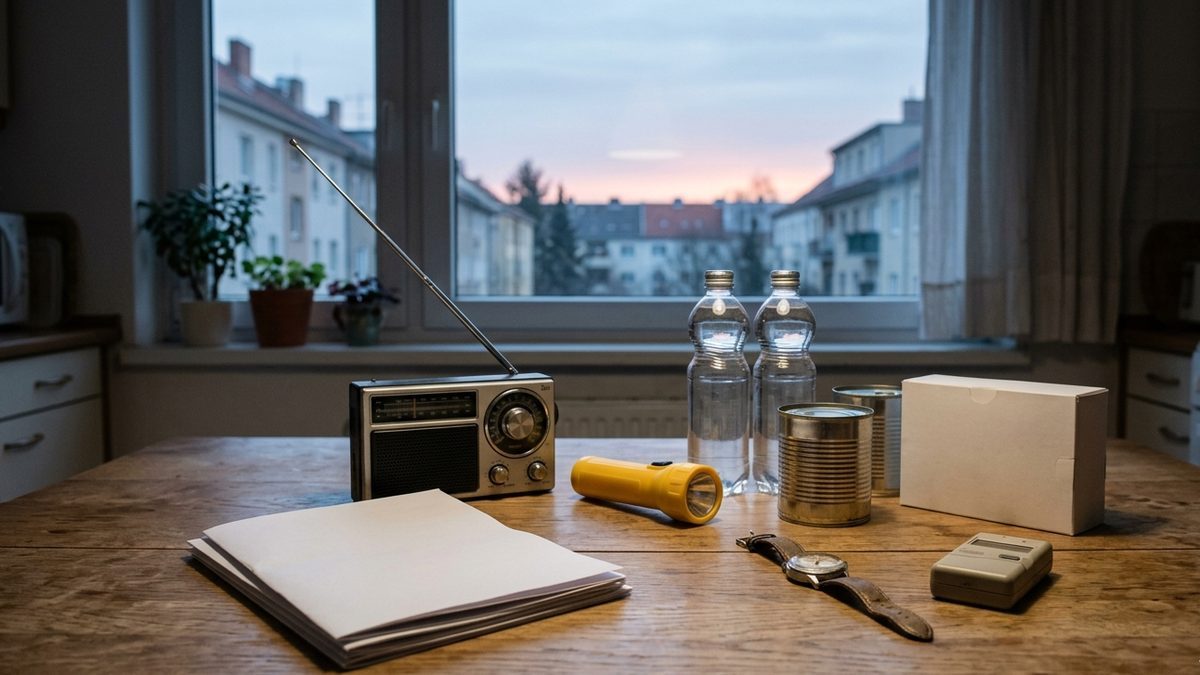
The article is deliberately a dry operational manual for the unlikely but specific scenario of a nuclear strike on the Czech Republic, where—unlike other crises—survival is decided in the first seconds and the following 72 hours. Through the stories of three people in and around Prague, the author shows the reflexes to take after the flash, the physics of the blast wave and fallout (including the Way-Wigner rule and the destruction radii by warhead yield), the principles of sheltering, and a concrete list of supplies to have ready months in advance. He also argues that real survival lies in community, not in armed isolation, and distinguishes the sudden nuclear threat from more probable non-nuclear crises, which have an escalation curve measured in weeks and time to prepare.
This text is about the nuclear scenario. Not the most probable one — but the specific one that, unlike other crises, has a reaction time measured in seconds, not days. Economic, energy and security crises have an escalation curve measured in weeks. For those, it is enough to follow the news and primary sources.
The nuclear crisis is different. It comes with no sirens, no warning, no week of preparation. The probability is low — an estimated few percent over a ten-year horizon for the Czech Republic. But if it comes, it is decided in the first ten seconds, and then in the first 72 hours. What you know now and what you have ready is your only insurance.
This article is as dry as a field manual. Deliberately so. Emotional texts about the nuclear threat lead to paralysis, not preparation. Read it as a standard operating procedure. Print it, file it, forget it — except that at one moment you may remember a few rules, and you will live.
Tuesday, 8:37
Alena has just come home from a twelve-hour shift at Thomayer Hospital and is sleeping deeply in the bedroom of a prefab apartment in Prague 4. The curtains are drawn, the room is in half-shadow. She fell asleep a short while ago; her body is at the start of the deepest phase of sleep.
Petr is sitting with his seven-year-old daughter Kristýna at the kitchen table of a family house in Roztoky. Kristýna is eating cornflakes, Petr is scrolling the morning news on his phone. The kitchen has a large window onto the garden and a second onto the street. A radio in the background is playing regional news.
Martin is sitting at his desk on the fifth floor of a glass office building in Prague-Karlín. Git open, coffee gone lukewarm. Through the glass he can see the whole panorama from Žižkov to Petřín. Colleagues around him at their monitors. An open-plan office, one wall entirely glazed facing west.
At that moment a second sun blazes over Prague.
The flash arrives at the speed of light. All three register it simultaneously, but each differently:
Alena sees, through the drawn blinds, a white pulse that passes even through her closed eyelids. She thinks she has overslept and someone has switched on the halogen light in the bedroom. She opens her eyes. The lowered blinds are suddenly all outlined around their edges with a white contour.
Petr lifts his head from the phone. The kitchen is filled with white light, so intense that it loses all colour — his daughter, the plate, the coffee machine, everything is bleached into a single tone. The shadow of his own body is printed sharply onto the back wall of the kitchen. His daughter opens her mouth in surprise to ask a question.
Martin is facing the glass. The flash blinds him instantly — eyes shielded with a hand, but it is already too late. The retinas are hit. In that instant he knows he can see nothing.
None of them heard anything. The sound comes later. All three now have somewhere between two and ten seconds to make the decision that will determine whether they survive the coming minute.
What happened, physically
The detonation of a tactical nuclear weapon at an altitude of 0.5–3 km above Prague. The most probable yield in the current European scenario is 5–50 kilotons — typically around 15 kt, which is Hiroshima. Strategic warheads above 500 kt are unlikely, because they signal a transition to a total exchange. According to the prevailing Western interpretation of Russian doctrine (disputed by part of the academic community, which regards this concept as a NATO projection), a limited nuclear strike would be demonstrative rather than annihilating. So let us work with the most common scenario: a 15 kt tactical warhead.
The flash lasts a fraction of a second, but it sears the shadow of any dark object onto surfaces — and causes temporary or permanent blindness in anyone who looked directly at it.
The thermal flash arrives together with the light, at the speed of light. It burns the uncovered parts of the body within a radius that depends on the weapon's yield.
The blast wave comes later. In the destructive zone it travels at Mach 2–5, that is 700–1,700 metres per second. Further from the epicentre it slows down, and at distances of tens of kilometres it becomes an ordinary acoustic wave.
Specific radii by warhead yield (airburst at optimal altitude, according to Alex Wellerstein's NukeMap model from the Stevens Institute of Technology and according to the FEMA Planning Guidance for Response to a Nuclear Detonation):
• Fireball: 0.1–0.2 km
• Heavy destruction (20 psi, buildings collapsed): up to 0.5 km
• Moderate destruction (5 psi, most buildings severely damaged, most inhabitants killed or seriously injured): up to 1.2 km
• Third-degree burns: up to 2 km
• Light damage (1 psi, windows blown out): up to 3–4 km
• Fireball: 0.2–0.3 km
• Heavy destruction: up to 0.7 km
• Moderate destruction: up to 1.8 km
• Third-degree burns: up to 4 km
• Light damage: up to 5–6 km
800 kilotons (strategic, very unlikely for the Czech Republic):
• Fireball: 0.6–0.8 km
• Heavy destruction: up to 2.5 km
• Moderate destruction: up to 5.4 km
• Third-degree burns: up to 10–11 km
• Light damage: up to 16–17 km
Key observation: not even 800 kt would flatten the whole of Prague. The outlying districts beyond 5 km will remain standing, albeit with shattered windows. Kladno (25 km) would not even have its windows blown out at 800 kt. With 15 kt the destructive zone is only the first few kilometres — the entire periphery of Prague is outside the primary destruction.
A practical conversion of time-to-blast-wave by distance (applies generally):
• 1 km from the epicentre: 1–2 seconds to the blast wave
• 3 km: 3–5 seconds
• 5 km: 8–12 seconds
• 10 km: 25–30 seconds
• 20 km and more: a minute, and the wave is already only acoustic
The closer you are, the less time you have. Don't measure. React immediately. Every second you spend observing or deliberating is a second by which you are later under cover.
If a 15 kt warhead detonates over Hradčany, Karlín (3 km) is in the light-damage zone — glass shatters from the blast wave, but the buildings stand. Prague 4 (5–7 km depending on the exact address) is outside most of the effects; the glass closest to the epicentre may still crack. Roztoky (10 km) is outside the primary destruction — no broken windows, no thermal damage; what matters is wind direction and fallout. The blast wave reaches here as a muffled thud after 25–30 seconds.
If it were a higher-yield warhead (50 kt), Karlín is in the moderate-damage zone and Martin has an objectively low chance. Prague 4 is in the blown-out-windows zone; Alena, following the protocol, survives. Roztoky remains outside the primary destruction even in the 50 kt scenario.
This article describes a protocol, not a guarantee. In the destructive zone (up to 1–2 km at 15 kt, up to 2–3 km at 50 kt) nothing will help. In the transition zone (the surroundings of the destructive field) the right reaction is the difference between life and death. Beyond that (10+ km) the decisive factor is fallout and 72 hours of shelter, not the blast wave.
Anyone who wants to verify their own scenario for a specific address will find it in the NukeMap application (nuclearsecrecy.com/nukemap), built on the formulas from Glasstone & Dolan, The Effects of Nuclear Weapons (1977). You enter the warhead yield, the height of detonation and the point of impact; the application shows the burn and overpressure-destruction zones on a map. For working out your own risk, it is the best publicly available tool.
The first three seconds — the reflex
Alena wakes to the white outline of the blinds. Her brain is still processing whether it is a dream. That is lost time. After night shifts her reaction is slowed. It takes her two seconds to realise that this is a phenomenon outside the normal categories.
Petr sees his daughter opening her mouth. The automatic fatherly reaction — he reaches out a hand to her. That is right, but not enough. In that second he cannot stop to think; he has to repeat something stored in his head in advance. If he doesn't have it, he dies.
Martin couldn't see well, but he knows what that flash means. He read it somewhere. In that second it is decided by two things: whether he knew what to expect, and whether he had taught his body to react before the mind.
For all three the same reflex applies, which must take place in the first second after the flash:
Drop to the ground, face down. Hands under the body or over the head. Closer to a wall that stands between you and the direction of the flash. Not closer to a window. No raising your head "to look".
Open your mouth and exhale. As the shock wave passes through the body, the external overpressure is equalised with the pressure in the body's cavities. An open mouth protects the eardrums (via the Eustachian tube) and reduces pressure injury to the chest. The instinct to hold your breath in fear is wrong. It must be overwritten by conscious knowledge.
Close your eyes and cover them. The flash continues for a second or two. A second look into it can cause permanent blindness. A blind person in a crisis has a low chance of survival.
Stay flat until the second blast wave has passed. The blast wave has two phases — the positive (overpressure) and the negative (underpressure, the air returns). The second phase can be even more dangerous, because it brings debris back into your space. Between the phases there are 1–5 seconds. Do not get up after the first.
The third to tenth second — crawling
If you have survived the blast wave and are conscious, now the second phase begins. Glass is the killer. In all three scenarios — Alena in the bedroom, Petr with his daughter in the kitchen, Martin in the open-plan office — the glass at the moment of the blast wave is turned into a cloud of shards flying into the room at 100–300 km/h. The typical victim of a nuclear or conventional explosion is neither burned nor irradiated. They are slashed by dozens of glass shrapnel fragments.
You therefore do not walk to safety. Crawl. Crawl along the floor, as low as possible, face to the ground, away from the windows. Direction: an internal room with no windows. A bathroom, a storeroom, a hallway, a staircase.
Alena is lucky. The bedroom of the prefab apartment in Prague 4 has a small window facing north, and the wall is of concrete panels 15 cm thick. The door to the bathroom is three metres from the bed. If she doesn't wake up fully, she won't stand up, but will roll off the bed onto the floor and crawl — the bathroom will protect her from both fallout and shards. The concrete wall above her will shield half the radiation. A 1970s prefab block is, paradoxically, a better shelter than a modern glass-walled villa.
Petr has a more complicated task. He has to pull his daughter under him and get her out of the kitchen into the hallway and then into the bathroom. Kristýna doesn't know what is happening; she has probably frozen or started to cry. Petr has to react twice — once for himself, once for her. He grips her firmly by the wrist or by her clothing and crawls with her under him on the ground. If the daughter has "bathroom" trained as a reflex word (like "stop at the road"), she reacts on her own and Petr slides after her. If she doesn't have it trained, he carries her — and is significantly slowed.
Martin is in a building with a glass façade running the whole wall. The distance from the epicentre (Hradčany) is about 3 km — at a 15 kt warhead this is the zone where the glass shatters from the blast wave, but the building stands. If he drops under the desk immediately and does not look into the flash, he has a real chance of survival. If he hesitates or stands up towards the window, he will have a face full of glass blades. After the first wave passes, crawl as fast as possible to the inner core of the building — the staircase, the lift shaft, the toilets. The colleagues around him who reacted wrongly lie among the shards.
A minute to an hour — the first decisions
If you have survived the blast wave and are conscious in some form of inner shelter, you are now in the most critical phase, the first hour. What to do:
Do not go outside. Not "to see what happened", not "to check on the neighbours", not "for some supplies". Outside means exposure to thermal radiation, residual debris, and in a moment the fallout begins.
Crawl deeper. If you are in the first internal room that has windows (even if covered), move to a room with no windows at all. In a prefab apartment: the bathroom. In a family house: the cellar. In an office building: the internal staircase or the underground garage.
The induced radiation has already happened. That is the radiation that passed through the walls at the moment of the explosion. If you were 1–1.5 km from the epicentre, you probably received a lethal dose within a fraction of a second, even if you were in a building. This you can no longer change. If you were further away, the induced radiation was lower. Now what awaits you is fallout, not prompt radiation.
The fallout will begin in 15 minutes to an hour. It depends on the type of burst (a ground burst falls faster, an airburst later), on the weather (rain concentrates fallout), and on the wind (the direction decides whether you are in the affected area or not). Your decision: stay in shelter for at least 72 hours. No exceptions.
Family
Petr has his daughter with him. But the mother is at work in Prague, ten kilometres away. Kristýna's brother is at primary school 2 km from there. Petr has one reflex in his head that he fixed in advance and never spoke about: do not go looking.
Family is the greatest killer of parents in a crisis. The emotional force of "I must get to my children" overrides the rational calculation that "outside, the probability of death is 50% for every two kilometres". In Sarajevo, Grozny, Aleppo the same pattern held: parents who set off towards their children across dangerous territory perished on the way. Children who stayed put under the protection of teachers or neighbours survived.
The only defence against this trap is a protocol agreed in advance, trained in calm:
Everyone stays where they are. If you are at home, stay home. If you are at work, stay at work. If you are at school, stay at school. Office buildings and schools in city centres have better-controlled shelters than prefab apartments on the outskirts.
No one looks for anyone. Not in the first days. Not in the first week. Perhaps not in the first month. Kristýna's mother knows she is to stay where she is. The brother at school knows the same. Petr knows that his task is to protect Kristýna, not to go for the others.
The meeting place is agreed in advance. Away from the primary targets. Not in the centre of Prague or any other large city — the primary targets are where the state and its institutions function, and that is also where a nuclear warhead will fall. The right arrangement is a place fifty or more kilometres from each of the three nearest large cities: a family farm in the Vysočina, a cottage in South Bohemia, grandmother's place in the Podkrkonoší. Specific, known to all, independent of the cities' infrastructure.
Order of priority when choosing the place:
1. A family farm or relatives' house outside the cities — ideal, if it exists. Relatives will take you in even as the last arrival, the infrastructure is independent, the environment is familiar. But beware: the Czech village of 2026 is no longer the self-sufficient island it was in 1985. The population is ageing, the gardens are decorative, the food is brought in from the Tesco in Blatná. Don't count on being fed by the family even there — bring your own supplies for a month. The village will take you in; it will not feed you.
2. Your own chalet, cottage or weekend house — ideally in a village, not in an isolated spot. If you own one. A long-term rental of a small house on the edge of the Vysočina for a few thousand a month is cheaper than psychiatric care after a crisis with no safety net. Beware the distinction: a cottage with functioning neighbours in a village is a strategic asset, an isolated cabin in the middle of the woods is a trap — more in the section "The lone homestead, the community, the city".
3. A reciprocal arrangement with a friend outside the city — "if the crisis comes, I can come to you. If it comes from the other side, you can come to me." It works if the relationship is trustworthy and both stock the place for the other family too.
4. If none of the above is available — a fixed orientation point on the edge of Central Bohemia, reachable on foot from Prague in 1–2 days. A stone church in a specific village. The railway station in the centre of a village. A monument that cannot be removed. The first Sunday at five in the afternoon after the acute phase ends.
A hard rule: if I do not show up there, do not look for me. This is a family contract that every family should talk about openly, calmly, once — and then no more. If I fail to come three times in a row, assume the worst and carry on. Families that tried to stay together at any cost buried more people in twentieth-century Europe than families that arranged a rendezvous and waited.
This is the Czech experience of 1945, 1948, 1968, 1989. In each of these crises the same thing proved itself: an agreement in advance + respect for the rule = a reunion afterwards. Improvisation in a crisis = the loss of everyone.
72 hours — the Way-Wigner rule
The radiation intensity in the acute phase of the fallout decreases according to the formula t⁻¹·² (the Way-Wigner formula, published by K. Way and E. Wigner in Physical Review in 1948 as an empirical approximation of the β-decay of fission products):
• 1 hour after the strike: 100% of the initial intensity
• 7 hours: ~10%
• 2 days: ~1%
• 2 weeks: ~0.1%
• 3 months: ~0.01%
This rule applies only to the acute phase of the first two to three weeks. After that the curve bends and stops at a background level formed by the long-lived isotopes — caesium-137, strontium-90, plutonium-239. These create a constant radiation background for decades.
Practical consequence: 72 hours of shelter screens out 90–99% of the cumulative dose you would otherwise receive in that area over a lifetime. Those 72 hours decide between acute radiation sickness and a normal life with a slightly elevated risk of cancer in 30 years.
No exceptions is the key phrase. No "I'll just go out for a moment". No "for the neighbours". No "to check what it looks like outside". No. Three days. A bucket for hygiene, supplies in the room, the radio only in short intervals, darkness, silence.
Days 2 and 3 in the shelter
Alena is lucky that the prefab apartment in Prague 4 has a fairly well-sealed bathroom. She slept after a night shift, she has a month's supplies, but they are in the kitchen. She has to decide: crawl once into the kitchen for the box of emergency supplies, or hold out with what she has in the bathroom? The good answer is the one decided in advance: a small emergency bag right there in the bathroom under the sink. One bottle of water, crackers, a dosimeter, a candle, matches, a radio, medicines. If she has this, she need not go out for 72 hours. If not, she has to make compromises.
Petr has a cellar under the family house in Roztoky. That is a fundamental advantage. The cellar has concrete walls 25 cm thick, with ground level and the ground-floor slab overhead. The radiation attenuation is on the order of 50–100×. If he has supplies positioned in the cellar in advance, he will survive 72 hours with his daughter comfortably. Kristýna gets the books she enjoys, and a task: to keep a diary with pictures. A task = psychological stability. Petr listens to the radio twice a day for thirty minutes, the rest of the time switched off. He saves the batteries.
Martin is trapped in the office building. He reached the cellar via the staircase, but in the underground garage there are twenty other people. None of them is prepared. Martin has in his backpack a small bottle of water, energy bars, a head torch, a mini radio in a Faraday cage (aluminium foil). That is enough for him — but in the garage there are twenty people with nothing. An ethical dilemma arises: share the supplies and smooth over the group's psychological dynamics, or keep his private minimisation? The right answer depends on the group dynamics. If there is a leader who organises, Martin contributes a small part and secretly keeps the majority for himself. If there is chaos, Martin must weigh whether it is safer to stay in the shared garage or to move into a smaller cellar room alone.
Three different situations, three different outcomes. In all three the single rule applies: what you prepared in advance decides. Improvisation in the first hours is rarely successful.
The dosimeter in the cellar
If you have a Geiger counter or a personal dosimeter, now is its most important moment. Not for the information "how much radiation is outside" (that does not interest you; you are not going out anyway). But to determine the safest place in the shelter.
Measure μSv/h in different corners of the room. The difference between the best and worst place in the same cellar can be as much as tenfold. Find the corner with the lowest value — typically beneath the centre of the ceiling, away from windows and ventilation ducts, near an internal load-bearing wall. Sleep there. Eat there. Spend the 72 hours there.
Concretely: imagine that, after the explosion, a dosimeter reads around 500 μSv/h outside. In a cellar with good shielding, 20 μSv/h. With the actual decay according to the Way-Wigner formula, the integrated dose over 72 hours in a good corner works out at the order of tens of μSv (a fraction of the annual background dose), and in a poorly shielded space at the order of single millisieverts. The key ratio of twentyfold to fiftyfold is what decides — at the cost of moving three metres. A dosimeter in hand in the first hours = saving your bones and your thyroid for the rest of your life.
Days 3 to 14 — gradual emergence
After 72 hours the fallout's activity has dropped to roughly one percent of the original value. You may consider short trips outside, but with rules:
Go out only with respiratory protection. An FFP3 respirator catches 99% of the radioactive iodine adsorbed onto dust particles. It will not catch the gaseous phase, but after 72 hours that is practically gone. Goggles or a face shield against dust, long sleeves, and if available a rain poncho or a Tyvek coverall. On return, immediate undressing outside, clothes into a bag, a shower if the water is running.
Short trips, not long ones. Fifteen minutes, not an hour. The goal: a specific task. Fetch water. Find out the state of the neighbours. Check the car. Quickly back.
Check continuously with the dosimeter. If the μSv/h outside still exceeds 100, it is too early. If you are below 30, you can stay longer.
Fallout concentrates in certain places. Rain downpipes. Low-lying terrain. Puddles. Vegetation. These zones are more radioactive than open concrete surfaces. Avoid them.
Food outdoors is contaminated. Everything that was exposed to fallout is affected. Fruit from the garden, vegetables from the planter, water from rain barrels, open containers. Ignore local food sources in the first weeks. Your supplies from boxes in pressure-sealed packaging are safe.
If you have supplies in the cellar or bathroom prepared in advance for 30 days, there is no need to risk early trips outside. If you don't, you are forced to compromise your health for supplies. This is the strongest argument for preparing a month in advance.
From day 14 — the second phase of life
After two weeks the acute radiation phase ends. What remains is chronic contamination, which will last decades, but not in the form of immediate death. Now the real questions begin:
Is your area habitable? If caesium-137 in the soil exceeds the threshold of 555 kBq/m² (corresponding to the Chernobyl zone of mandatory resettlement under the Ukrainian–Belarusian law of 1991), long-term residence raises the cancer risk so much that evacuation is recommended. At values of 185–555 kBq/m² it is the voluntary-resettlement zone. Below 37 kBq/m² it is contaminated territory requiring monitoring, but not evacuation. This will be a decision of the authorities, not your individual one. If the authorities function.
Does the infrastructure work? Electricity, water, gas, communications. Some of it may be restored within weeks (regional distribution networks, if not hit directly). Some never. If an EMP struck, the electronics that did not burn out are still functional — but networks need coordinated logic. Without the control systems, which also burned out, they do not run.
Where is the family? Here comes the moment of the agreed meeting place. The first Sunday at five in the afternoon after the main crisis ends. If someone fails to show up there, the second Sunday. If not even the third Sunday, assume the worst and carry on.
What next with life? This is an existential question to which no article has an answer. In some scenarios the Czech Republic as a state is still functional and stabilising. In others it has broken up into regions. In yet others it is part of a wider conflict. Your individual decision will depend on the specific state of affairs — to stay, to leave, to organise a community, to seek work in a new economy.
The lone homestead, the community, the city
The popular image of a crisis builds on the picture of a single family holed up in a cottage in the mountains with a rifle by the door. This image is deadly in a crisis, and the reasons are mathematical and historical.
The attacker chooses the time and place, the defender does not. Whoever has hostile intent chooses the hour (early morning, at night, in a storm), the direction and the moment (when a candle is burning, when smoke rises from the chimney). The defender must be ready 24 hours a day. That means at least three adults in two shifts: a single defender with seven hours of sleep a day does not exist, and two defenders commonly sleep at the same time. For genuine round-the-clock guarding of a site, at least three adults with rotation are needed — and that is the field minimum, not comfort.
The classic rule about a threefold attacker advantage does not apply to isolated homesteads. The 3:1 doctrine was formulated for an organised army on a continuous line with balanced armament and the support of neighbouring units. For an isolated house with one or two defenders, the attacker needs only surprise and control of the perimeter. A three-man gang with a chainsaw and two rifles will take an isolated homestead in half a minute.
The history of Central Europe in 1939–1945 documents this brutally. The worst things in a crisis did not happen in the centres of cities, where the remnants of control and of witnesses functioned. They happened on isolated homesteads — remote gamekeepers' lodges, lone farmsteads, village houses at the end of a field. There anything could happen and no one found out until it was too late. A community of twenty families has witnesses, social pressure, a collective memory. The lone homestead has nothing. The same pattern repeated itself in Yugoslavia 1992–95, in Chechnya, later in Bucha, Izyum and Mariupol.
Large cities, paradoxically, survive better, provided they are not a primary target of the attack. They have infrastructure that the state protects as a priority (water, electricity, transport, hospitals), supplies even in a limited regime, collective defence by police and army, and a critical mass of witnesses. In Sarajevo 1992–95, Beirut 1975–90, Aleppo 2012–16 the same held everywhere: those who stayed in the city had hard conditions but survived within a community. Those who fled to an isolated homestead without a network were left without witnesses and without organised defence.
The state, during escalation, disarms civilians, it does not arm them. The Czech legal framework assumes that, under a state of threat to the State, a state of emergency or a state of war, the government will restrict civilian possession of weapons and order them to be surrendered. Those who are to fight are mobilised into the armed forces — uniform, armament, training, order, logistics. A civilian with a weapon has no place in this system. The Ukrainian model of 2022, where the state handed out weapons, presupposed an already organised territorial defence: registered, recorded personnel under command. That is not the same as "civilians with weapons in their hands".
A soldier is protected by the uniform, a civilian is not. A soldier in uniform, openly bearing arms, under command, has combatant status — if captured, he is a prisoner of war with the right to treatment, food, return. A civilian who takes up a weapon in occupied territory is not formally punishable by death under international humanitarian law: both the Fourth Geneva Convention and Common Article 3 guarantee humane treatment and a fair trial, and mass executions without trial are war crimes. The empirical record of the Russian occupation is, however, unambiguous: an armed civilian is in practice shot on the spot as an alleged scout or saboteur, regardless of the norms. This is the reality that Bucha, Izyum and Mariupol documented.
A soldier, moreover, gets food, medical care, exchange, rotation. A civilian who would want to "defend his family with a weapon" tends to himself alone — without a rear, without ammunition resupply, without anyone to relieve him at night. If you really want to be the one who has a weapon and something to take cover behind, the rational path is to join the armed forces. Not to stay home with a pistol.
What follows from this for a rational plan:
A farm in a village is something different from a cottage on an isolated homestead. A village with fifteen, twenty buildings, where people have known each other since childhood and have at least minimal organisation (a mayor, firefighters, someone with the keys to the church) is a social community with protective value. An isolated cottage across a field, two hours' walk from the nearest neighbour, is a risk, not a refuge.
In a crisis, move closer to people, not away from them. A village of twenty families, a housing estate of ten thousand inhabitants, a municipality with a functioning council — all have higher survivability than the best-equipped isolated homestead.
And finally a cynical calculation: if someone really wanted to hold an isolated mountain cabin against anyone stronger, they would need at least an infantry company (a minimum of 60 men), two tanks, one Patriot battery and enough RPGs. That is what "holding a position" means in real military mathematics. Anything less is an illusion. No civilian will ever have it.
The strategy of defending oneself on an isolated homestead is a fiction. Real survival is in a community, or nowhere.
What to have ready months in advance
This list is for the nuclear scenario. It differs from the list for an economic or energy crisis — some items are the same, some specific. If you invest in one, you have both.
A practical note: most foods and hygiene goods can be obtained in a single order through one of the Czech online supermarkets with delivery within a few hours. Some of them even have their own online pharmacy for over-the-counter medicines and vitamins. Advantage: one afternoon, no logistics, everything delivered to the apartment. Disadvantage: there is a weight limit, typically 35–50 kg per order, so the water supply (the heaviest item) has to be split across two or three orders. Or a one-off large shop at a hypermarket with a car.
For specific electronics — a Geiger counter, PMR radios, CO and CO₂ detectors — you can use AliExpress. The prices are 20–40% of European retail. The calibration of Chinese instruments may differ from European certified ones by tens of percent, but for real work this does not matter: for choosing the safest corner in the cellar or deciding whether a μSv/h reading is safe, relative accuracy is enough. Comparing several instruments against each other is a better indicator of reliability than the certificate of a single one. Delivery time 2–6 weeks — must be planned ahead, not reactively in a crisis.
Principle: redundancy over quality. Modern electronics are not repaired in a crisis. Desoldering a single SMD component requires a lab with a hot-air rework station, and proprietary firmware and unavailable spare parts make servicing impossible even for branded products. The solution is not to buy one expensive instrument, but three cheap ones from different sources. The probability that at least one works rises by an order of magnitude: one instrument with 70% reliability means a 70% chance, three such instruments mean 97%. This applies to a Geiger counter, a radio, torches, respirators, any electronics. Three instruments for CZK 1,500 are more reliable than one for CZK 4,500. Compare them continuously, set yourself an internal calibration baseline, and in a crisis you have real certainty instead of a certificate.
Water. 60 litres of bottled water per person for 30 days. PET bottles of 1.5 to 5 litres, storable for years. Stored in a cool, dark place, ideally right in the room where you will be sheltering. SAVO or sodium hypochlorite, 1 litre, as a disinfection reserve. Dosage: 2 drops per litre of clear water, 4 drops for turbid water. Thirty minutes of contact time. Coffee filters for mechanical removal of sediment before chlorination. Vitamin C in powder or effervescent tablets to neutralise residual chlorine after disinfection. Add after the contact time, not before. A ratio of approximately 2.5 mg of vitamin C per 1 mg of free chlorine (the stoichiometric ratio is higher, but in practice for drinking water this rough figure is sufficient).
For the nuclear scenario this is critical: all water must be bottled before the event. No filtration or disinfection will remove radioactive isotopes. If fallout has contaminated a water source, the water from it is unusable by any domestic means. Reverse osmosis removes 90–99%, but an RO filter does not work without electricity and pressure. Bottled water in pressure-sealed PET bottles from the shop is the only reliable source.
Food without cooking. Goal 30 days, at least 2,000 kcal per person per day. Tinned beans (20 cans), tuna in oil (15), pâtés (10), canned nuts (2 kg), honey in a jar (1 kg), dark chocolate (500 g), dried fruit (1 kg), crackers or hardtack bread (2 kg), vegetable oil (2 litres), sugar (2 kg), salt (1 kg).
All cold, storable for years, with no signs of cooking. No fire. Cooking can be smelled and seen hundreds of metres away. In a crisis of disrupted order this is a signal to the hungry neighbourhood and to potentially hostile scouts. Fire also signals your position to drones and satellites — that is relevant in a long conflict, not after a single strike, but the protocol applies all the same.
No frozen or chilled food in the stockpile. Once the electricity goes, you have 4–24 hours before the frozen food thaws and starts to spoil. That is not a supply, that is a trap.
Respiratory protection. A few dozen FFP3 respirators, stored in a dark box out of direct sunlight (otherwise the elastic straps degrade under UV radiation). Functional for 5–7 years if stored correctly. You can test the seal: put it on and try to exhale quickly — if the strap seals, you feel pressure behind the ear. If the strap is no longer elastic, replace it.
Radiation emergency kit. A Geiger counter (GMC-300E or GQ GMC-600+, price CZK 2,000–5,000), a personal dosimeter with a direct display, 4–5 packs of potassium iodide 65 mg from the pharmacy. Adult dosage: 2 tablets per dose, protection for 24 hours. For persons over 40, prophylaxis only on a direct call from SÚJB — the risk of hyperthyroidism for older persons outweighs the benefit, because the risk of thyroid cancer after the age of 40 is small. Under 40, prophylaxis is strongly indicated; in children, adolescents, pregnant and breastfeeding women, a single dose proportional to age/weight; repetition only on the instruction of the authorities.
Sealing the shelter. Three rolls of insulating tape (silver duct tape). Twenty square metres of plastic sheeting. Scissors. The task in the first hour after the signal: seal one room (bathroom, storeroom, cellar) against the ingress of air from outside. Sheeting over the windows, tape around the door.
CO and CO₂ detectors. Battery-powered, NDIR technology for CO₂, electrochemical with EN 50291 certification for CO. Carbon monoxide is a silent killer with improvised heating. Carbon dioxide will put you to sleep in a sealed room with the family. CO > 30–50 ppm = ventilate immediately; CO₂ > 1,000 ppm = drowsiness, > 5,000 ppm = risk of loss of consciousness. A cellar with sealed doors and several people produces 5,000 ppm CO₂ in 6–10 hours. Price CZK 600–4,500 for the pair.
Cash and coins. ATMs will stop working immediately after a power outage. Payment terminals minutes later. Recommended reserve:
• CZK 50,000 in hundred- and two-hundred-crown notes. Split into three or four hiding places, each somewhere different. A jacket pocket, a hiding place in the apartment, a secret spot in the car, a few thousand always on you.
• CZK 5,000 in coins. Ten-, twenty- and fifty-crown coins. Not for daily shopping, but for small transactions in the late phase of a crisis, when paper money has been degraded by inflation and the seller has no change for a five-hundred note.
• EUR 5,000 in twenty-euro notes. A reserve in case the Czech crown sharply weakens or enters hyperinflation. The euro is more reliable in Europe.
• One to five gold coins. A Wiener Philharmoniker 1 oz, around CZK 100,000 apiece. Not for ordinary transactions, but to protect value if the crisis lasts years and state currencies collapse.
Coins have intrinsic value. A fifty-crown coin contains copper and nickel, a twenty-crown coin brass. In the collapsed currency systems of the twentieth century, coins locally became de facto means of payment because of the material they were made of. In a short crisis this will not happen. In a long one it will.
Hand tools. A spade, a pickaxe, a 90 cm pry bar, two jacks (one hi-lift 60 cm, one bottle jack 10 tonnes), wooden wedges. For extracting people from rubble, opening jammed doors, transporting the injured. Rule: a jack without wedges is a deadly trap. A lifted object must always be secured with wooden wedges. Never crawl under anything held up only by hydraulics.
Communications. A shortwave radio (Tecsun PL-330, Sangean ATS-909X2, CZK 1,500–3,000). BBC World Service, Deutsche Welle, Radio France International. If Czech infrastructure goes down, foreign shortwave transmitters are the last reliable source of information. A headphone output for quiet listening.
PMR radios (446 MHz, 0.5 W, licence-free, CZK 500–1,500 per set). AA batteries. Range 1–5 km. For communication with family or neighbours when the mobile network is down.
All communications electronics in a Faraday cage. Aluminium foil in three layers around the device plus a closed metal box. Cost CZK 50, the same effect as commercial Faraday bags for CZK 1,500. Protects against EMP from a nuclear explosion. Without this protection, all non-backed-up electronics within a radius of tens to hundreds of kilometres is permanently damaged.
Light without attention. An LED head torch with a red filter. Red light does not draw the attention of those around you and preserves night vision. Candles (long, paraffin, twenty of them). Matches or lighters in a waterproof wrapping.
Hygiene without water. Hand sanitiser, wet wipes, toilet paper in double the usual quantity. Plastic bags for waste from the bucket.
Medicines and medical equipment. Your chronic medicines three months ahead. A standard first-aid kit. In addition: ibuprofen or paracetamol, a broad-spectrum antibiotic (if available on prescription), bandages, plasters, wound disinfectant.
Books. Physical, not electronic. Ten books you have been putting off. Plus one that calms you. Anything that holds attention and turns the mind away from fear. Stress without distraction leads to irrational decisions.
Alcohol as currency, not disinfectant. The folk wisdom that alcohol treats wounds or disinfects water is wrong. For a bactericidal effect you need 60–80% ethanol with a contact time of over a minute. Whisky is 40%, slivovitz 45–55% — below the efficacy threshold. Pouring whisky on a wound = it does not disinfect, it only stings.
Alcohol in a crisis is, however, valuable currency. Strong slivovitz from a licensed distillery (avoid home-made spirits because of the risk of methanol) has the role of a currency in the Central European tradition. In Yugoslavia 1992–95, rakija was the basic unit of exchange among civilians. The reasons: shelf life of decades, divisibility (a half-litre bottle = 10 shots), universal acceptance by all adults, psychological value under stress, an exchange item for specific services (doctor, driver, repairman).
Recommended supply: 6–10 litres in half-litre bottles, that is 12–20 bottles. Price around CZK 300–500 per bottle of quality distillation from a district distillery, CZK 5,000–10,000 in total. Do not open prematurely. Slivovitz is a supply, not a consumer item. If you drink it in the calm years, in a crisis you are without currency.
What you don't need — and why
The English-language crisis-preparedness community often advises things that, in the European context, are counterproductive or deadly. Consider the following non-purchases:
Weapons. The full argument is in the section "The lone homestead, the community, the city" above. Short version: the state disarms civilians during escalation, an armed civilian in occupied territory faces in practice a high risk of immediate execution without trial (regardless of legal norms), and the defence of an isolated site by civilian force is mathematically impossible. The only relative exception is a properly registered hunting firearm in its legally required safe — even so a risk, but more tolerated in occupation practice.
A generator. A petrol or diesel generator does two things: noise (audible at 200–500 m) and exhaust fumes (including CO, lethal in an enclosed space). Both expose you. The noise signals to the neighbourhood "this apartment has a power source, worth checking out". CO from generators has long been one of the leading causes of death after hurricanes in the USA — in peak seasons the counts run into the hundreds. For a Czech household: reject the whole category.
Solar panels with a battery have a smaller noise problem, but cost CZK 50,000–100,000, require maintenance, and after a nuclear event are electromagnetically knocked out (unless they are in a Faraday cage, which is unrealistic for panels on a roof).
A large bunker, evacuation protocols far from home. If you do not have a bunker built before the crisis, you will not have one in the crisis. Evacuation to a distant location presupposes functioning transport, fuel, safe roads — everything that does not work in a crisis. The roads out of Prague in the first hours are blocked by a million people trying to get away. Your own cellar at your place of residence is the best available shelter. Seal it, stock it, hold out.
An active mobile phone. An active phone is a beacon for intelligence services and targeting systems. Every active phone transmits roughly two watts in pulses that an SDR receiver costing five hundred crowns will pick up kilometres away. In 2022 the Russian army in Ukraine targeted command posts identified by the density of active mobile phones. This applies to the civilian population to a lesser degree, but it applies.
Crisis protocol: SIM out, battery out, device into a Faraday cage. If you absolutely must make a call, go 500 m from the shelter, switch on, make the call in under a minute, switch off, remove the battery, return. The emission footprint is minimised.
Commercial crisis-preparation courses. An estimated ninety percent of online "prepping" content is marketing for the American reader. The Czech reality is different — the legal framework, population density, the history of invasions, the geopolitical position, the infrastructure. Relying on FEMA protocols in the Czech Republic is like relying on a Ford Mustang manual when repairing a Škoda.
EMP — what actually matters to you
The electromagnetic pulse from a nuclear explosion is a real effect. An airburst at an altitude of 1–3 km above Prague creates an EMP that, within a radius of tens to hundreds of kilometres, knocks out unprotected electronics. Transformers, control systems, mobile phones, computers, modern cars, IoT devices, solar inverters.
The electricity goes down immediately. Not from overload, but from damage to the semiconductors in the control systems of the transmission grid. The transformers survive, but without control they do not function. Restoration takes weeks to months depending on the scale.
The water goes down within hours. Waterworks pumping stations without power, the pressure in the pipes drops, the reservoirs empty in 4–12 hours.
The gas goes down within hours. Compressor stations have electronic control. Safety valves close automatically.
Communications go down immediately. Mobile base stations, routers, data centres, everything.
Cars with modern electronics do not run. Older vehicles with mechanical injection (before 1985) probably function. Modern cars are computers on wheels — they burn out.
• Electronics in a Faraday cage (aluminium foil, a metal box)
• Old mechanical instruments (wind-up watches, hand mills, ordinary matches)
• A crystal radio or a transistor radio from the 1970s in a metal box
• You, if you are in shelter
There is no way to defend yourself personally against EMP other than by protecting your backup electronics. An investment of CZK 50 in aluminium foil around a backup radio and dosimeter is the cheapest and most important insurance you have.
Meta: the difference between a nuclear and a non-nuclear crisis
You have read this text. The probability that you will need it is low — a few percent over a ten-year horizon for the Czech Republic. The probability of a serious non-nuclear crisis (economic, energy, hybrid, migratory, pandemic) is significantly higher — 50–80% over a ten-year horizon.
A non-nuclear crisis, however, does not come suddenly. It has an escalation curve of weeks and months. The warning signals are trackable: rising insurance prices, deposit withdrawals, increased military activity, travel warnings, the evacuation of diplomats. Whoever follows the primary news sources (BBC World Service, Reuters, Al Jazeera, ISW, the official channels of the ČNB and SÚJB) has 2–8 weeks of advance notice in which to prepare.
There will be a different article for that crisis, and it will be longer. It includes economic hedges, networking with people, monitoring signals, strategic purchases. None of that requires 72 hours of shelter or the Way-Wigner rule.
The nuclear scenario is about a few seconds of decision that have no escalation warning. About a reflex you must have fixed in advance, because you will not have time to invent it.
What you won't be reading once it begins
This text. Because the phone will not work — either because of the EMP, or because of the load on the network in the first minutes of the crisis. The news on the radio will not tell you even half of what is written here, because public broadcasting will not provide overly specific information. "Stay calm. Follow the public-service media. The government is taking measures." That is all that 95% of the population will get.
The rest — you — must find your own information in advance. In calm. With concentration. With the ability to verify, compare, buy, test. In a crisis it is too late.
Why you're reading it now
Because it is a statistical truth that the nuclear threat in Europe is not abstract. The Russian arsenal numbers around 1,700 deployed strategic warheads (the New START treaty limit of 1,550 expired in February 2026 and the count has probably been rising since), the American one in shared deployment in Europe, the British, the French. The escalation dynamics in the 2020s are real — Ukraine, Taiwan, the Baltics, the Middle East. The probability of a limited nuclear strike somewhere in Europe over a ten-year horizon is, by estimate, higher than it was in the 1990s, but still low.
But it is non-zero. And the cost of preparation is small — a shopping list of CZK 15,000–30,000 one-off, plus CZK 2,000–3,000 a year for rotating supplies. The year 2020 was COVID. The year 2022 was gas and refugees. The year 2026 is Hormuz. The next wave will come. The statistics are relentless.
A rational investment, not paranoia.
And if nothing comes of it? You have a supply of beans, which you will eat. Bottled water, which you will drink. A radio, which will serve on a holiday at the cottage. A dosimeter, which will show the natural radon background in the cellar where you never measured it. A set of skills that makes you a calmer person even in times when there is nothing to deal with.
Print this text out. Put it on the fridge or in the folder with important documents. Read it again in half a year. If you get the chance.
If not — you will know, because you won't be able to load it.
Written in the knowledge that 95% of readers will glance at it, shrug, and carry on. That's all right. This text is for the remaining 5%.
In the next article we will look at the non-nuclear crisis — the more probable one. It has escalation signals, time to prepare, and a qualitatively different protocol. This one you have read as insurance. The next will be like a strategy.
Critical data verified against primary sources: SÚJB (potassium iodide dosing), CDC (nuclear detonation protocol), Glasstone & Dolan, Effects of Nuclear Weapons (1977), Kingery-Bulmash blast tables, NukeMap (Alex Wellerstein, Stevens Institute of Technology), FEMA Planning Guidance for Response to a Nuclear Detonation (3rd edition, 2022), Way K. & Wigner E. P., Phys. Rev. 73, 1318 (1948), British Journal of Anaesthesia (primary blast lung injury), EN 50291 (CO detectors), FAS Nuclear Notebook 2025 (warhead counts).
The concept, structure and editorial line of the article are the work of the author, who drew up the content outline, established the key theses and directed the entire creative process. Generative AI (Claude, Anthropic) was used as a tool for research, fact-checking, and fleshing out the author's draft.
The author edited the outputs continuously, verified the key findings and approved the final wording. No part of the text was published without human review. All factual data were verified against the publicly available sources cited in the text.
The procedure complies with the requirements of Article 50 of EU Regulation 2024/1689 (AI Act) on the transparency of AI-generated content. #poweredByAI
Read the Czech original on Médium.cz.
AI · Claude — machine translation, may contain inaccuracies.