Perplexity AI: A Twenty-Billion-Dollar Company That Spends More Than It Earns
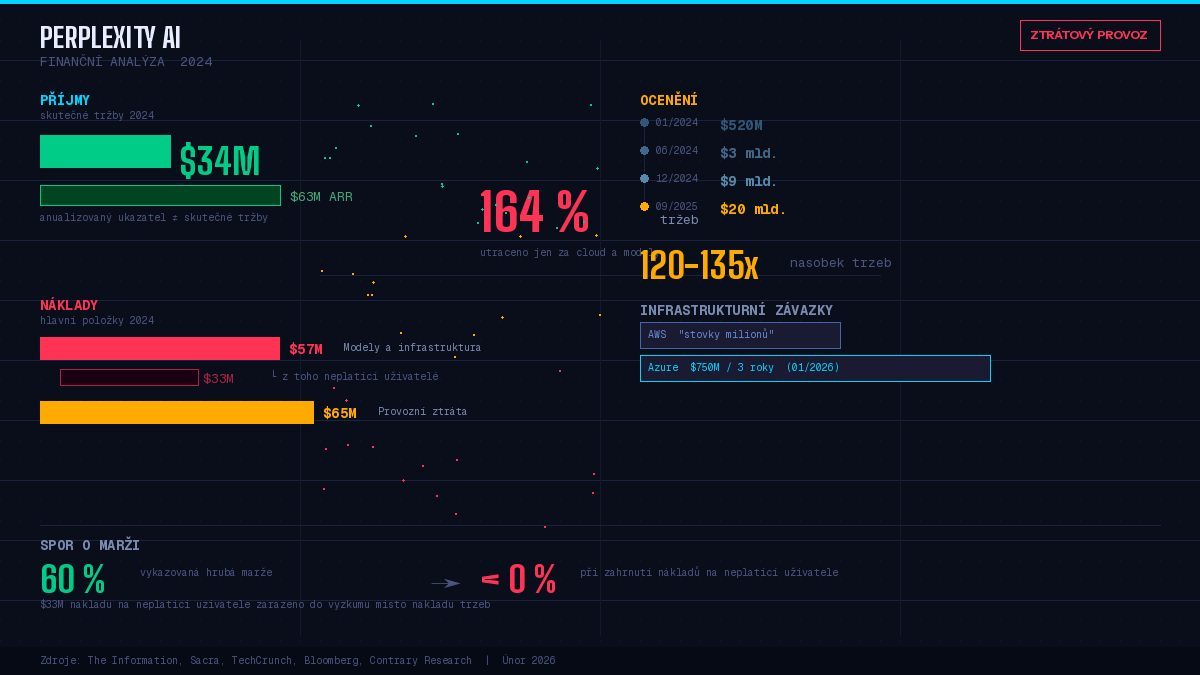
Perplexity AI has reached a valuation of $20 billion, but its financial situation is problematic — in 2024 it spent 164% of its revenue on cloud services and AI models and reported an operating loss of $65 million on actual revenue of just $34 million. Its reported 60% gross margin is distorted by accounting that classifies the cost of non-paying users outside cost of revenue; the company has abandoned its advertising model and faces a growing number of copyright infringement lawsuits.
Perplexity AI is among the fastest-growing technology companies of recent years. In under three years since its founding, it reached a valuation of 20 billion dollars, and its AI-augmented search engine processes hundreds of millions of queries per month. Beneath the impressive growth, however, a question is taking shape that no one has yet answered satisfactorily: when, and whether at all, will the company start earning more than it spends?
This analysis summarizes publicly available financial data, identifies the main cost items, and places them in the context of the wider industry.
Most of the publicly cited revenue figures for Perplexity are so-called annualized recurring revenue — an extrapolation of the current monthly pace across a full year. Actual recognized revenue is substantially lower. For 2024 it came to only roughly 34 million dollars, while the annualized indicator at year-end reached 63 million. This distinction is key to understanding the company's true financial condition.
Development of annualized revenue over time:
2023 — approximately 7 million dollars. Source: Sacra (sacra.com/c/perplexity).
First half of 2024 — approximately 35 million dollars. Source: Sacra.
End of 2024 — 63 million dollars (annualized); actual recognized revenue for the full year 2024 came to roughly 34 million dollars. Source: Sacra; The Information (behind a subscriber paywall).
March 2025 — approximately 100 million dollars. Source: Sacra.
June 2025 — approximately 148 million dollars. Source: Sacra.
September 2025 — approximately 200 million dollars. Source: TechCrunch, September 10, 2025 (techcrunch.com/2025/09/10/perplexity-reportedly-raised-200m-at-20b-valuation).
Plan for 2026 — 656 million dollars, according to an internal plan from December 2024. Source: Sacra.
1. Subscriptions (the main source — roughly 94% of revenue in 2024)
Perplexity offers several subscription tiers:
Free plan — 0 dollars; 5 professional searches per day, limited models.
Pro plan — 20 dollars per month; more than 300 professional searches per day, access to GPT-4, Claude, and Gemini models.
Max plan — 200 dollars per month; unlimited access to the Labs tool (creating spreadsheets, presentations, applications), priority access to the latest models, early access to the Comet browser. Launched in July 2025.
Enterprise Pro plan — 40 dollars per user per month; internal search, single sign-on, team management.
Enterprise Max plan — 325 dollars per user per month; full access, custom integrations, higher security.
Source: perplexity.ai/pricing; Sacra.
2. Advertising — an abandoned experiment
Perplexity launched advertising on November 12, 2024, in the U.S. market. Formats included sponsored follow-up questions and display or video ads alongside answers — never directly within the AI-generated text. The pricing model was based on the number of impressions, with expected rates above 50 dollars per thousand impressions.
Actual advertising revenue for 2024 was negligible: a mere 20,000 dollars out of 34 million in total revenue. Source: Sacra.
In October 2025, Perplexity stopped accepting new advertisers. According to the Financial Times (cited by Search Engine Land on February 18, 2026), the company subsequently abandoned advertising entirely, and management declared it had no plans to return to it. The reason is concern about undermining user trust. Source: Search Engine Land, February 18, 2026 (searchengineland.com/perplexity-stops-testing-advertising-469452); Contrary Research (research.contrary.com/company/perplexity).
3. Distribution partnerships and other sources
Samsung: Perplexity has a dedicated app on all 2025-series Samsung televisions. Buyers receive 12 months of the Pro plan for free. Source: Sacra.
Airtel (India): A free Pro plan for this carrier's users led to a 640% year-on-year increase in users in India. Source: DemandSage (demandsage.com/perplexity-ai-statistics).
Getty Images: A multi-year licensing agreement announced on October 31, 2025, allows Perplexity to display images from the Getty stock library with proper attribution of author and source. Specific financial terms were not disclosed. Source: Getty Images press release, October 31, 2025 (newsroom.gettyimages.com).
Revenue-sharing program with publishers (Comet Plus): Perplexity earmarked 42.5 million dollars for this program, with publishers receiving 80% of revenue from a new subscriber tier. More than 300 publishers are enrolled in the program. Source: Business of Apps (businessofapps.com/data/perplexity-ai-statistics); Fortune, August 26, 2025.
The company also operates a search interface aimed at enterprise customers.
Perplexity is a private company and does not publish a detailed profit-and-loss statement. The financial data comes predominantly from the investigative journalism of The Information (articles behind a subscriber paywall) and from secondary sources that cite it.
Amazon Web Services — the principal cloud-services provider since founding. Perplexity uses the Amazon Bedrock service to access Anthropic's models. CEO Srinivas declared at an AWS conference in 2023 that the company was "betting everything" on AWS. In November 2025 he stated that Perplexity had commitments to AWS "in the hundreds of millions" of dollars. Source: Bloomberg via Business Standard, January 30, 2026.
Microsoft Azure — a three-year commitment worth 750 million dollars, signed at the end of January 2026. Perplexity gains model access through the Azure Foundry service (OpenAI, Anthropic, xAI). AWS remains the preferred provider; Azure serves as a complementary and redundant channel. Source: Bloomberg, January 29, 2026; PYMNTS, January 30, 2026.
Estimate of total commitments: 750 million (Azure, spread over three years, i.e. roughly 250 million per year) plus an unspecified "hundreds of millions" with AWS. Actual annual spending may be lower than the sum of the commitments — a commitment does not mean an immediate cost; the company may draw on it gradually. Perplexity does not disclose the exact level of its annual infrastructure expenditure.
Perplexity uses models from OpenAI, Anthropic, xAI, and its own Sonar-series models. For inference on third-party models, it pays fees per unit of processed text.
According to The Information (May 2025), the company spent at least 57 million dollars on models and web services in 2024. Of this, 33 million went toward supporting non-paying and trial users. Source: The Information, "Decoding Perplexity's Finances," May 2025; cited in The Deep Dive (thedeepdive.ca/did-perplexity-fudge-its-numbers) and Contrary Research.
Ed Zitron, based on The Information's data, states that in 2024 Perplexity spent 164% of its revenue on AWS, Anthropic, and OpenAI combined — that is, significantly more than it earned at all. Source: Ed Zitron, "Why Everybody Is Losing Money On AI," September 2025 (wheresyoured.at/why-everybody-is-losing-money-on-ai).
Estimates of the headcount vary considerably by source and date. TapTwice Digital reported 247 people in April 2025, Wikipedia mentions approximately 700 employees as of June 2025, and Contrary Research lists as many as 1,634 people in October 2025 (probably including external collaborators and affiliated persons).
With a conservative estimate of 250–500 core employees in the San Francisco area and an average total compensation of 250–400 thousand dollars per year (typical for a tech company in the Bay Area), wage costs work out to an estimated 60–200 million dollars per year. This is the author's own estimate — Perplexity does not disclose this figure.
Comet Plus program: 42.5 million dollars earmarked (see above). Getty Images: a multi-year licensing agreement with no disclosed amount.
Perplexity faces a growing number of lawsuits over alleged copyright infringement. As of February 2026, the list of plaintiff entities includes: News Corp/Dow Jones (October 2024), the BBC (legal threat, June 2025), the Japanese media outlets Yomiuri Shimbun, Nikkei, and Asahi Shimbun (August 2025), Encyclopaedia Britannica and Merriam-Webster (September 2025), Reddit (October 2025), Amazon (a lawsuit over the Comet browser, November 2025), The New York Times (December 2025), and the Chicago Tribune (December 2025). On top of this are older disputes with Wired magazine, Forbes, and the company Cloudflare.
Legal costs are not publicly known, but given the scale of these disputes — conducted predominantly in the United States — they likely amount to tens of millions of dollars per year.
According to The Information, the operating loss for 2024 was approximately 65 million dollars on revenue of 34 million dollars. Source: The Information via a summary sent to subscribers (milled.com/theinformation/decoding-perplexitys-finances-growth-costs-and-margins).
A key finding from May 2025 was that Perplexity reported a gross margin of 60% — surprisingly high in an industry where even OpenAI, according to various sources, achieves only 10–48%.
The Information, however, revealed that this margin is the result of a specific accounting classification of costs:
Of the 57 million dollars in total costs for models and infrastructure in 2024, 33 million was spent on supporting free and trial users. Perplexity did not classify these costs under "cost of revenue," but instead under research-and-development expenses. If the costs for non-paying users were included in the cost of revenue, the gross margin would fall into negative territory.
This accounting practice is not unusual among high-growth tech companies, but it raises questions about the true sustainability of the business model.
Sources: The Information, "What's Helping Perplexity's 60% Gross Profit Margin," May 19, 2025; The Deep Dive, "Did Perplexity Fudge Its Numbers?", May 20, 2025; Contrary Research.
Since its founding in 2022, Perplexity has gone through several funding rounds. An overview of the main milestones:
January 2024 — valuation of 520 million dollars. Source: TechCrunch.
June 2024 — Series B; valuation of 3 billion dollars. Source: Sacra.
December 2024 — Series C; raised 500 million dollars at a valuation of 9 billion. Source: Sacra.
September 2025 — an extension of the previous round; raised 200 million dollars at a valuation of 20 billion. Source: TechCrunch, September 10, 2025.
In total, the company has raised approximately 1.2–1.6 billion dollars (estimates vary — Sacra cites 1.22 billion, TechCrunch 1.5 billion, Backlinko 1.6 billion).
At annualized revenue of 148 million dollars (June 2025) and a valuation of 20 billion, this represents a multiple of roughly 120–135× revenue. Source: Sacra.
Main investors: Accel, IVP, SoftBank Vision Fund 2, NVIDIA, Jeff Bezos. Source: Sacra.
Monthly active users: 30 million in April 2025 (Backlinko); over 100 million according to company management in February 2026 (Search Engine Land). The definition of a "user" probably differs — registered vs. one-time visitor.
Monthly queries: 780 million in May 2025. Source: Perplexity via Sacra.
Daily queries: 30–60 million in 2025. Source: Famewall.
Employees: estimates in the range of 250–700 core employees over the course of 2025 (see above).
Total app downloads: 80.5 million as of November 2025. Source: Backlinko.
Revenue is growing at an extraordinary pace (five- to tenfold year-on-year), but in absolute numbers it is still small compared to costs. The company is not profitable. The operating loss in 2024 was approximately 65 million dollars on revenue of 34 million. Cloud-infrastructure commitments (Azure 750 million over three years plus an unspecified sum with AWS) significantly exceed current revenue. The reported 60% gross margin is the result of an accounting classification — with the standard inclusion of costs for non-paying users, it would be negative. The company abandoned its attempt to introduce advertising in 2025.
Precise total operating costs. The actual operating loss for 2025 (probably significantly higher than the 65 million from 2024, given the growth and new commitments). A detailed breakdown of the costs of inference, indexing, and data transfer. Exactly how much the company pays for third-party models per query. The actual ratio of paying to non-paying users.
In 2024, Perplexity spent 164% of its revenue on AWS, Anthropic, and OpenAI alone — that is, before wage, legal, and other costs. This ratio is typical of the entire industry: companies built on third-party AI models effectively pass on all their revenue — and more — to their infrastructure and model suppliers. The open question is whether the rapid growth of the user base and revenue can eventually offset this imbalance, or whether it is a structural problem that scaling will not solve. Source: Ed Zitron, "Why Everybody Is Losing Money On AI," September 2025.
This analysis draws on publicly available sources: Sacra (an analytics firm focused on private tech companies), Business of Apps, Backlinko, TechCrunch, Bloomberg, DemandSage, Contrary Research, Search Engine Land, and the commentary of Ed Zitron. The key financial figures — revenue of 34 million dollars in 2024, an operating loss of 65 million, costs of 57 million on models and infrastructure, the dispute over the 60% margin — come from the investigative journalism of The Information. These articles are behind a subscriber paywall, and the numerical figures are cited via secondary sources.
Annualized revenue indicators are extrapolations and may differ significantly from actual annual income. Wage-cost estimates are the author's own calculation and cannot be independently verified. Data current as of February 2026.
A note on source quality: Some secondary sources (DemandSage, Famewall) are aggregators with limited editorial oversight. Data from these sources is used only where it is confirmed by other sources as well. An article from the site 4idiotz.com citing an 18% net profit margin for Perplexity and revenue of 280 million dollars is evidently unreliable and probably AI-generated — these figures directly contradict all other sources and are not used in this analysis.
Creation transparency:
The concept, structure, and editorial line of the article are the work of the author, who prepared the content outline, established the key theses, and directed the entire creation process. Generative AI (Claude, Anthropic) was used as a technical tool for research, fact-checking, and fleshing out the author's draft.
The author edited the outputs throughout, verified the key findings, and approved the final wording. No part of the text was published without human oversight. All factual data was verified against the publicly available sources cited in the text.
This procedure complies with the transparency requirements for AI-generated content under Art. 50 of EU Regulation 2024/1689 (the AI Act). #poweredByAI
Read the Czech original on Médium.cz.
AI · Claude — machine translation, may contain inaccuracies.