Money Doesn't Motivate? Bosses Earn 281× More and Perform No Better
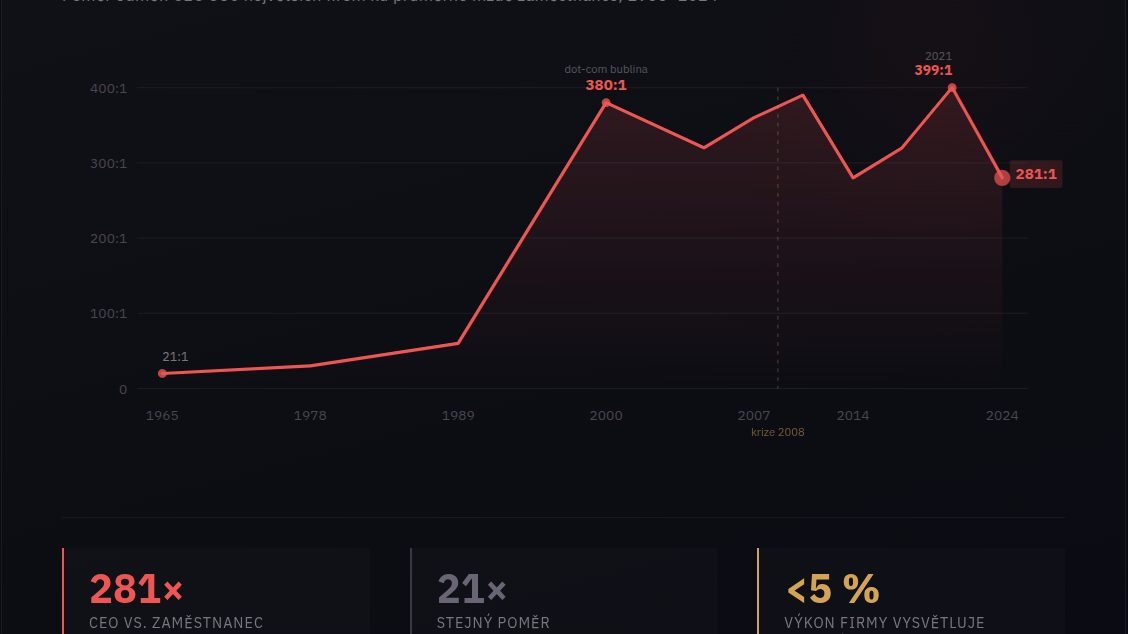
The article debunks the popular myth that money doesn't motivate, confronting it with meta-analyses showing that financial incentives reliably increase the quantity of performance. At the same time, it highlights the paradox in which rank-and-file employees are told that money isn't important, while CEOs collect 281× higher compensation justified by financial motivation. Drawing on neuroscience studies and economic data, it shows that extremely high executive pay is often counterproductive and that its growth is driven more by systemic mechanisms than by any real impact on performance.
Research shows that financial incentives reliably boost performance. And yet "money doesn't motivate" has become the most successful HR myth of the 21st century. Who does that serve?
Picture yourself sitting in a corporate training session. An enthusiastic facilitator with a slide deck full of colorful charts is explaining that money doesn't actually motivate you. That what drives you to work is autonomy, purpose, and mastery. That your intrinsic motivation matters more than your paycheck. Meanwhile, in a boardroom two floors up, the board is deciding whether the CEO's bonus this year will be 18 or 22 million dollars — because without a financial incentive, after all, he'd have no reason to try.
This is not a scene from an absurdist play. It's the reality of 2025, where selected academic findings have been manufactured into an industrial narrative that serves precisely those who promote it. Let's look at what research actually says about financial motivation — not popular books, not TED Talks, but meta-analyses and hard data.
The entire narrative rests on three pillars. Herzberg's two-factor theory from 1959 classified pay as a "hygiene factor" — its absence does harm, but its presence does not inspire. Deci and Ryan, with their Self-Determination Theory, showed that external rewards can undermine intrinsic motivation. And Daniel Pink, with his bestseller Drive and one of the most-watched TED Talks in history, wrapped the whole thing in an attractive package: autonomy, mastery, purpose.
The problem? All three pillars are either methodologically dubious or drastically oversimplified.
Herzberg built his theory on 203 interviews with engineers and accountants in Pittsburgh. He used the critical incident method, which is prone to attribution error — people naturally credit successes to themselves and blame failures on circumstances. House and Wigdor documented this as early as 1967 in Personnel Psychology. In 1970, Soliman demonstrated that the entire two-factor structure vanishes as soon as you change the data-collection method. Hines, studying 414 employees in New Zealand, obtained results that directly contradicted the theory. Compensation expert Gerry Ledford of USC summed up the situation bluntly: Herzberg's claim about money as a hygiene factor is not even supported by his own data.
Pink himself, in a later interview for Haufe, admitted that his message had been oversimplified. He said, literally: the idea that only intrinsic rewards matter is not true — money matters, just not as much as we think, and it works differently. If you don't pay people well and fairly, you won't get motivation. But this correction never made it onto the book's cover.
And Deci and Ryan? Their 1999 meta-analysis of 128 studies demonstrated that external rewards undermine intrinsic motivation. But a counter-meta-analysis by Cameron and Pierce, covering 96 studies, argued that the negative effects are limited and easily preventable. The debate continues to this day.
The most comprehensive meta-analysis, conducted by Cerasoli, Nicklin, and Ford in 2014 across 183 samples comprising 212,468 participants, produced a key result. Intrinsic motivation better predicts the quality of performance; extrinsic incentives better predict quantity. So money gets people to do more. But not necessarily better.
Jenkins and colleagues, in a 1998 meta-analysis, found a correlation of ρ = 0.34 between financial incentives and the amount of work performed — not a negligible figure. Lazear, in a 2000 study of the Safelite Glass company, demonstrated a 44% increase in productivity after introducing piece-rate pay. Condly, Clark, and Stolovitch, across 45 studies in 2003, found an average 22% increase in performance thanks to incentive programs.
But there is a limit. Ariely, Gneezy, Loewenstein, and Mazar, in an experiment in Madurai, India (2009, Review of Economic Studies), tested bonuses corresponding to one day's, two weeks', and five months' worth of local income. On cognitive tasks, the highest bonus led to the worst performance — a phenomenon neuroscientists call "choking under pressure." Only on a purely mechanical task did the high bonus help.
The picture, then, is nuanced, but certainly not the one presented by the motivation industry. For simple, measurable work, money works reliably. For complex cognitive work, very high stakes can produce a paradoxical effect. But that is something fundamentally different from the claim that money doesn't motivate.
This is where the debate stops being academic and starts being political.
In 2024, the ratio of CEO pay to the average employee in the United States was 281:1. In 1965 it was 21:1. The average compensation of the CEOs of the 350 largest American firms reached nearly 23 million dollars, with 79% of that sum consisting of stock-based rewards explicitly tied to performance.
The logic behind it is simple: boards argue that high bonuses motivate CEOs to perform better and align their interests with shareholders. But what do the data say?
A meta-analysis by Tosi and colleagues from 2000, published in the Journal of Management, found that firm size explains more than 40% of the variation in CEO pay, while firm performance explains less than 5%. A 2016 MSCI study on a sample of 429 large and mid-cap American firms — including data on more than 800 individual CEOs over a ten-year period — showed that a $100 investment in the firms with the lowest CEO pay would have grown to $367 over ten years, while in firms with the highest pay it would have grown to only $265. Lower CEO pay correlated with a 39% better return.
Bebchuk and Fried of Harvard, in their 2004 book Pay Without Performance, argued that managers use their influence over boards to set their own pay, constrained only by what the authors call the "outrage threshold." This gives rise to the Lake Wobegon phenomenon — every firm wants to pay above the median of its reference group, which creates an endless spiral of escalation.
So, in summary: we tell rank-and-file employees that money doesn't motivate. But we pay CEOs hundreds of millions on the grounds that without a financial incentive they would have no reason to try. Both claims cannot be true at the same time.
The question "is excessive executive pay counterproductive?" has a surprisingly straightforward answer: yes, beyond a certain level there is solid evidence that it is. But the reasons are more complex than a simple "too much money."
Why do extremely high bonuses worsen performance? Neuroscientists Chib, De Martino, Shimojo, and O'Doherty, in studies from 2012 and 2014, used functional magnetic resonance imaging to map what happens in the brain of a person facing an extremely high reward. The ventral striatum — the region responsible for processing rewards — becomes overactivated at high stakes. This hyperactivation disrupts the prefrontal cortex, the part of the brain responsible for complex decision-making, planning, and creative problem-solving. The more the brain thinks about the reward, the less capacity it has left for the task itself.
For simple mechanical tasks, this doesn't matter — pressing keys or assembling parts on a line doesn't need the prefrontal cortex. But a CEO's strategic decision-making — billion-dollar acquisitions, entering a new market, restructuring the company — is precisely the type of complex cognitive work where this effect strikes hardest. Ariely's Madurai experiment, where the highest bonus led to the worst performance on eight of nine cognitive tasks, is a direct experimental demonstration of this mechanism.
Imagine a CEO weighing a risky acquisition. His bonus depends on revenue growth. A rational analysis might say "don't buy," but the brain under the pressure of a million-dollar bonus re-evaluates the risk. Athletes know this from penalty kicks, surgeons from critical operations. The difference is that the athlete fails once. A CEO under the pressure of a bonus structure makes bad decisions systematically.
The truly toxic element is not the sum itself — it's the structure of the reward. When, in 2024, 79% of CEO compensation consists of stock-based rewards, a strong incentive is created to maximize the short-term share price. That does not mean maximizing the value of the firm.
Short-term stock options motivate financial engineering: share buybacks that artificially inflate the price, aggressive cost-cutting that improves quarterly results but depletes the firm's long-term capacity, and risky acquisitions that look like growth on paper. This exact mechanism was behind the financial crisis of 2008 — bank CEOs had enormous bonuses tied to short-term metrics that motivated them to take excessive risks. By the time the bubble burst, the bonuses had long since been paid out.
A study by Cooper, Gulen, and Rau (2016, published in the Journal of Finance) analyzed CEO compensation over the period 1994–2013 and found that firms that paid their CEOs in the top quintile had statistically significantly lower stock returns over the following three years compared with firms with lower pay. The authors explain this by the fact that excessive compensation correlates with excessive self-confidence and more aggressive but less well-considered strategies.
Defenders of high CEO pay have three arguments that are not entirely without merit.
Retention. If a competent CEO leaves, the costs can be astronomical — loss of institutional knowledge, destabilization of strategy, the cost of finding a successor. High pay is an insurance policy against departure. But the question is: is 23 million necessary for retention, or would 5 suffice? In Europe, where CEO pay is typically 3–5 times lower than in the US, firms do not seem to suffer a massive exodus of leadership.
The tournament effect. Economists Lazear and Rosen, in 1981, formulated a theory according to which high pay at the top does not primarily motivate the CEO but the entire organizational pyramid beneath him. Vice presidents, directors, and senior managers compete for advancement, and this competition raises performance. Empirical support exists — Kale, Reis, and Venkateswaran (2009, Journal of Financial Economics) found a positive correlation between the "tournament spread" and firm performance. But the effect is weaker than the theory predicts, and it works mainly in organizations with a clear vertical structure and well-measurable performance at every level.
Signaling. A high CEO salary signals to the market that the firm is confident, attractive, and well managed. It is a form of branding, not of motivation. But signaling has diminishing returns — above a certain point it ceases to be a signal of quality and becomes a signal of a problem.
All three arguments have one thing in common: none of them requires a 281:1 ratio. Retention is secured by competitive pay, not astronomical pay. The tournament effect works even when the gap between CEO and vice president is 3× rather than 10×. And signaling stops working when it becomes the norm.
The most sophisticated explanation for why CEO pay reaches absurd heights has nothing to do with motivation. Fernández-Aráoz and Nagel, in an analysis for Fortune in April 2025, identified three self-reinforcing mechanisms.
First, the mandatory disclosure of CEO pay since the 1970s was supposed to reduce pay through transparency. It achieved precisely the opposite. Every CEO and every board now sees exactly how much the competition earns — and no one wants to be below the median. The psychological effect of social comparison, well documented in behavioral economics, operates in boardrooms too.
Second, compensation consultants are paid a percentage of the recommended compensation, or through repeat assignments from boards appointed by the CEO. They have a structural incentive to recommend higher pay. A study by Cadman, Carter, and Hillegeist (2010, Journal of Accounting and Economics) demonstrated that firms using compensation consultants pay their CEOs statistically significantly more.
Third, peer groups are actively manipulated. A mid-sized firm includes several larger firms with higher pay in its reference sample, thereby pushing the median pay upward. Bizjak, Lemmon, and Naveen (2008, Journal of Financial Economics) documented this empirically.
The result is a perpetual motion machine: the consultant recommends an increase → the board approves it → the competition increases → the consultant recommends another increase. Nowhere in this cycle does the question appear of whether higher pay actually improves the CEO's decision-making.
A natural experiment is offered by Switzerland. In March 2013, the so-called Abzocker-Initiative (an initiative against "golden parachutes") passed there with 67.9% of the vote. It banned signing-on and severance bonuses and requires an annual shareholder vote on executive pay. A few months later, in November 2013, a referendum was held on the more radical "1:12" initiative — capping the ratio between the highest and lowest salary in a firm. That one failed (65% against), but the debate itself created pressure for voluntary restraint.
The result? Swiss firms did not collapse. CEOs did not flee abroad en masse. And the Swiss economy remained one of the most competitive in the world. Japan, where the typical CEO/employee ratio is significantly lower than in the US, has firms like Toyota, Sony, and Honda that compete globally — despite their CEOs receiving a fraction of American pay. Denmark, which regularly tops the rankings for innovation and competitiveness, achieves similarly low ratios.
If high CEO pay were truly the key to firm performance, American firms should significantly outperform Japanese, Danish, or Swiss ones. The data do not support this claim.
Follow the money — ironically, in the very debate that claims money plays no role.
Employers use the narrative to justify stagnating wages. Instead of a pay raise, they offer company culture, purpose, and a foosball table. A survey by Business in the Community UK showed that 86% of firms have a purpose statement, but 83% have not defined what it means in practice. This "purpose-washing" is elegant: the employee who demands higher pay is the one who failed to grasp true motivation.
The consulting industry and motivational speakers have built a billion-dollar business of workshops, lectures, and organizational advice out of selected academic findings. Pink's book Drive alone generated an ecosystem of commercial products. This doesn't mean the research behind it is bad — it means it was packaged for commercial purposes and lost its nuance in the process.
Survivorship bias in the research compounds the problem. Most motivation studies are conducted on university students or knowledge workers who already have a decent income. For a programmer earning $150,000, autonomy and purpose are important factors in choosing a job. For a supermarket cashier who can't cover rent, they are abstractions.
The cultural meme that happiness rises with income only up to $75,000 a year comes from Kahneman and Deaton's 2010 study of more than 450,000 responses to the Gallup survey. Killingsworth, in 2021, using 1.7 million real-time measurements, found the opposite: happiness rises linearly even above that threshold.
In 2023, a unique "adversarial collaboration" between the two researchers, together with Mellers, was published in PNAS. Its conclusion resolved the dispute elegantly: for most people, happiness rises with income without a ceiling. Among the happiest group, the growth even accelerates above $100,000. A plateau does exist — but only among the unhappiest roughly 15% of the population. Kahneman had captured this pattern because of a limitation in his measurement scale, which could not distinguish degrees of happiness, since at higher incomes roughly 85% of responses sat at the ceiling of the scale.
In practical terms this means: more money = more happiness for most people. The point beyond which money doesn't help does exist — but only for those who are unhappy for reasons that money won't fix. Which is, again, a far cry from the popular claim that above a certain income, money is irrelevant.
The most rigorous recent analysis, a meta-analysis by Cala, Havránek, and colleagues from Charles University (CEPR Discussion Paper 17680, forthcoming in the Journal of Political Economy Microeconomics), included 2,193 estimates from 88 economic experiments. The key finding: after correcting for publication bias — that is, the tendency of academic journals to favor statistically significant results — the average effect of financial incentives on performance is close to zero.
This does not mean money doesn't motivate. It means that published studies systematically overstate the effect, and that the real effect is smaller than reported by most cited research — on both sides of the debate. Under laboratory conditions and when framed as a loss, the effects remain mildly positive. Under field conditions they are heterogeneous.
Ironically, then, the newest and most rigorous evidence calls both sides into question at once. The optimists, who claim that higher bonuses automatically raise performance, do not have data as strong as they thought. But the pessimists, who claim that money is irrelevant, cannot back up their conclusion with clean data either — uncorrected studies do find a positive effect, it's just smaller and more fragile than it seemed.
First, money reliably increases the quantity of simple, measurable performance. This is the most robust finding of dozens of meta-analyses.
Second, very high stakes can worsen cognitive performance on complex tasks. The "choking under pressure" effect is real and neurologically grounded.
Third, the relationship between salary level and job satisfaction is surprisingly weak — a correlation of just 0.15 according to Judge's 2010 meta-analysis. Most of the variation in satisfaction depends on other factors.
Fourth, happiness rises with income without a ceiling for most people, but there is a limit for the unhappiest minority.
And fifth, after correcting for publication bias, the average experimental effect of incentives is close to zero — which calls into question both the optimists and the pessimists.
How does it all fit together? Money works — but less dramatically than either side claims. Uncorrected studies show a positive effect. After correcting for publication bias, it is smaller than was claimed. The real effect depends on context: the type of task, the size of the reward, the way it is framed, and individual circumstances.
Organizations should pay fairly and competitively, because inadequate pay reliably demotivates and drives people away. A 2024 PwC survey of 56,000 workers found that 28% of employees plan to change jobs — more than at the peak of the Great Resignation. And according to BambooHR's 2025 data, 54% of active candidates are looking for better pay.
At the same time, it holds that culture decides whether people leave — and pay decides where to. The MIT Sloan Management Review found that toxic culture is 10× more important than compensation in predicting departure. Money gets people to the door; what lies beyond it decides whether they stay.
But organizations should not expect that simply raising bonuses will improve the quality of complex work. And above all: the "money doesn't motivate" narrative should never serve as a justification for low wages.
The fact that CEOs receive 281 times more than their employees, with weak evidence that it improves firm performance — and solid evidence that it can worsen it — is the strongest argument against the cynical use of this narrative. Japan, Denmark, and Switzerland prove that globally competitive firms can be run for a fraction of American CEO pay. And neuroscience shows that an overpaid manager under the pressure of a million-dollar bonus may literally make worse decisions than the same person on a reasonable salary.
Next time you hear at a corporate training that money doesn't motivate, ask: does that apply to the board too? And if so, why do we pay them so much?
This article draws on meta-analyses published in peer-reviewed journals (PNAS, Journal of Management, Journal of Finance, Journal of Financial Economics, Journal of Accounting and Economics, Psychological Bulletin, Review of Economic Studies, Journal of Vocational Behavior) and on data from EPI, MSCI, PwC, and BambooHR.
Methodological note
The concept, structure, and editorial line of the article are the work of the author, who prepared the content outline, established the key theses, and directed the entire creative process. Generative AI (Claude, Anthropic) was used as a technical tool for research, fact-checking, and elaborating the author's draft.
The author edited the outputs throughout, verified the key findings, and approved the final wording. No part of the text was published without human oversight. All factual data were verified against the publicly available sources cited in the text.
The procedure complies with the transparency requirements for AI-generated content under Art. 50 of EU Regulation 2024/1689 (AI Act). #poweredByAI
Read the Czech original on Médium.cz.
AI · Claude — machine translation, may contain inaccuracies.