A Watchdog in a Commercial Kennel
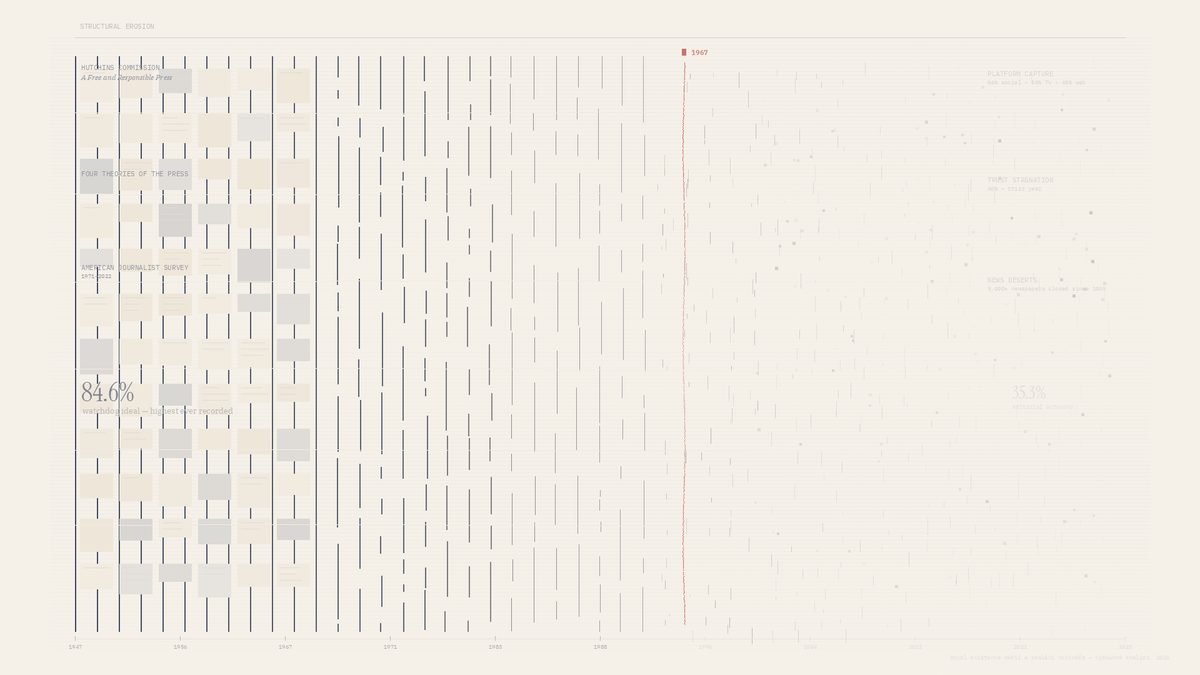
The article traces how the purpose of the media has shifted from the postwar ideal of democracy's watchdog, through the Hutchins Commission and the Four Theories of the Press, to today's crisis of journalism in the digital age. It analyzes how the advent of television advertising, stock-market ownership of newspapers, and media concentration eroded the profession's ethos, and sets the media theory of Chomsky and Herman against the current digital reality.
What is the purpose of the media — television, radio, newspapers, internet news servers? What is a journalist's mission?
These questions have stood at the center of media theory since the mid-20th century, and the answers to them have changed dramatically. In the post-war period, academics, commissions, and journalists themselves formulated an idealistic image of the profession: to inform the public, to safeguard democracy, to serve as a watchdog against the abuse of power. The Hutchins Commission (1947) and the seminal textbook Four Theories of the Press (1956) imprinted this ethos on the curricula of American journalism schools.
From the 1960s onward, however, several forces converged — television advertising, the entry of the stock market into newspaper ownership, media concentration — that undermined this ideal. Journalists themselves gradually lost their illusions. Not about what journalism ought to be, but about whether conditions would allow them to live up to the ideal.
This analysis traces that transformation across six levels: the ideal theory of the press, the democratic functions of the media, the journalist's professional mission as measured across half a century of surveys, the commercial turn of the 1960s, the critical perspectives of Bagdikian, Herman, and Chomsky, and the contemporary crisis of journalism in the digital age.
The fundamental framework for understanding the purpose of the media was formulated by Fred Siebert, Theodore Peterson, and Wilbur Schramm in Four Theories of the Press (1956), published by the University of Illinois. They identified four models:
The authoritarian theory — the oldest model, originating in the late Renaissance. The press serves the state. Truth is the privilege of a few wise men. The press functions as an instrument of the powerful for maintaining the social order.
The libertarian theory — arising from the Enlightenment, from the works of Milton, Locke, Mill, and Jefferson. The search for truth is a natural right. The press should be a free marketplace of ideas, independent of government control. The purpose of the press is to inform, to entertain, to sell — and to uncover truth through free expression.
The social responsibility theory — a modern correction to the purely market-based conception. The press has a moral obligation to take society's needs into account: equal airtime for political candidates, representation of all groups, the obligations of a newspaper in a one-newspaper town. This theory emerged directly from the Hutchins Commission.
The Soviet communist theory — an extended authoritarian model in which the press explicitly serves the party and the state.
Despite extensive criticism — for its Cold War mindset, its neglect of non-Western perspectives, and its oversimplifying categorization — the Four Theories framework remains influential, because no comparable replacement has emerged.
The most important American inquiry into the purpose of the press was the Commission on Freedom of the Press (1942–1947), led by Robert Maynard Hutchins, president of the University of Chicago. It was funded by Henry Luce, founder of the media house Time Inc. (the magazines Time, Life, Fortune).
The commission arose amid concerns about the concentration of media ownership, sensationalism, and declining public trust — concerns that echo to this day. Hutchins deliberately included no journalists on the commission — he believed it would be more candid without them.
Over the nearly five years of its existence, the commission — twelve leading intellectuals — met seventeen times in sessions lasting two to three days and heard 58 witnesses; its staff spoke with another 225 people and prepared 176 working documents. The resulting report, A Free and Responsible Press (1947), delivered a groundbreaking insight: freedom of the press is not an absolute right but a civic fiduciary duty. Freedom without responsibility erodes public trust and invites external regulation.
The commission defined five basic duties of a free press: to provide a truthful and comprehensible account of the day's events in a context that gives them meaning; to serve as a forum for the exchange of views and criticism; to provide a representative picture of all groups in society; to present and clarify the goals and values of society; and to ensure full access to the information of the day.
The commission explicitly warned against the power of media owners. Its text includes a quotation from the journalist W. A. White: the owner of the press is a big businessman with "the unconscious arrogance of conscious wealth." According to the commission, the press should function as a "common carrier of discussion" — and if it failed to fulfill this duty voluntarily, the state would intervene.
In The Structural Transformation of the Public Sphere (1962), Jürgen Habermas created the most influential philosophical framework for understanding the democratic function of the media. He traced the emergence of the "bourgeois public sphere" in 17th- and 18th-century Europe — coffeehouses in London, salons in Paris — where citizens gathered to discuss matters of common concern, free from the control of the state and the church.
In Habermas's analysis, the press was the "leading institution" of the public sphere: an independent power within the political system, a safeguard against corruption and excessive power. The press was not a mere information service — it was the very infrastructure of democracy.
Habermas, however, also described the decline of the public sphere. As the media became an industry, the space for rational critical debate was "refeudalized" — replaced by managed consumption and spectacle. It is precisely this tension that defines the contemporary media landscape.
The most complete empirical data on how journalists perceive their own mission come from the American Journalist survey series, spanning more than fifty years. The series began in 1971 with the sociologist John Johnstone at the University of Illinois and continued at ten-year intervals under the direction of David Weaver and Cleve Wilhoit at Indiana University (1982, 1992, 2002, 2013). The latest wave was conducted by Lars Willnat of Syracuse University in 2022.
It should be emphasized that Johnstone's 1971 survey is the oldest nationally representative survey of American journalists. Before it, only partial studies existed — Rosten's survey of Washington correspondents (1937), White's study of news selection (1950), and Breed's analysis of social control in newsrooms (1955). None of these was nationwide, and none systematically asked about career motivations. We therefore have no data on the professional ethos of the 1950s from direct surveys, but only from theoretical texts and the curricula of journalism schools.
Johnstone's study (1971) identified two fundamentally different approaches to the profession. The "neutral" journalist sees himself as a detached observer devoted to the objective reporting of facts. The "participant" journalist acknowledges that his editorial choices co-create reality. In addition, Johnstone identified the "watchdog" role — holding government and powerful institutions accountable.
Key findings across fifty years:
In 1971, 76% of American journalists rated "investigating government claims" as very important. In 1982 this share fell to 66%, in 1992 to 67%, in 2002 to 59%. Then, however, came a reversal: in 2013 the figure rose to 78%, and in 2022 to a record 84.6% — the highest value in the entire history of the survey.
The importance of "getting information to the public quickly," by contrast, declined: from 68.6% in 1992 to 53% (2002), 48% (2013), and 44.1% (2022).
The share of journalists reporting "almost complete freedom" in selecting topics dropped from 60% in 1971 and 1982 to roughly 50% (1992), 40% (2002), 33.6% (2013), and 35.3% (2022). Professional autonomy fell by nearly half over the course of half a century.
Job satisfaction declined from 49% "very satisfied" in 1971 to a third in 2002. In the 2022 survey, 60% of journalists said that journalism was heading "in the wrong direction."
At the same time, the total number of full-time journalists fell by 28% between 2002 and 2013, with roughly 25,000 of them leaving daily newspapers.
The Worlds of Journalism Study (Weaver and Willnat, 2012) found that across the 22 societies studied, the roles of information disseminator, analyst, and watchdog are the most valued globally. There are, however, significant cultural variations: Arab journalists perceive their mission as a driving force of political and social reform, while Indonesian and Pakistani journalists emphasize the defense of national sovereignty.
Thomas Hanitzsch (2011) identified four global professional milieus of journalists: populist disseminators, detached watchdogs, critical change agents, and opportunist facilitators — the last category describing journalists who provide support to the political leadership and which occurs even in Western democracies.
The period from the end of the Second World War to the mid-1950s is often described as the peak of idealistic journalism in America. This image must be viewed with some distance: there is no nationwide survey from this era that directly measured journalists' motivations. There is, however, a rich record of how the profession defined itself and what principles it embodied in education.
The Hutchins Commission (1947) defined the framework of the press's social responsibility. Four Theories of the Press (1956) incorporated it into the theoretical foundation of the field. Journalism schools were expanding, and Hutchins's principles — truthfulness, representativeness, space for debate — were becoming part of the curriculum. In 1953, 1,300 of America's 1,785 daily newspapers were family-owned, locally rooted, and saw themselves as civic institutions.
At the same time, even in this era, cracks existed between the ideal and practice. In his study Social Control in the Newsroom (1955), Warren Breed empirically described how publishers enforce an editorial line — not through open commands, but through the socialization of new journalists, who learn the "rules of the game" on their own: by reading their own newspaper, by observing what makes it to the front page, by sensing informal sanctions. Breed found that journalistic ideals — objectivity, public service — function paradoxically: journalists profess them, but in practice they yield to editorial pressures, because "the news comes first" and questions of ethics are deferred.
In the 1960s, several forces converged that fundamentally transformed the media landscape.
Television advertising overtook print. By the early 1960s, more money was being spent on television advertising than on print media. This was a structural economic shift from which newspapers never recovered.
The stock market enters the newsroom. The newspaper-chain buying spree began in the mid-1960s. Gannett went public in 1967 as one of the first major chains. Between 1967 and 1988, seven of the ten largest newspaper owners became publicly traded companies. The consequences were fundamental: newspapers ceased to be civic institutions with a profit margin — they became profit centers with a journalistic function.
The imperative of profit transformed editorial priorities. As Philip Meyer described in The Vanishing Newspaper, publicly traded newspaper companies had a fundamentally different scale of values compared to family-owned dailies. The first goal became capital for further acquisitions. The pursuit of economies of scale led to standardized content, a decline in local reporting, and an emphasis on content that attracted advertisers.
A French case study. Research by Charles Angelucci (Columbia) and Julia Cagé (Sciences Po) documented what happened in France when the government allowed television advertising in 1967. The result was a 21% decline in the number of journalists employed by national newspapers and a measurable shift away from hard news (foreign reporting, investigation) toward softer, more cheaply produced content. It is one of the clearest pieces of empirical evidence of how advertising competition directly affects the quality of journalism.
We do not have a survey from the 1940s against which we could compare the data from the 1970s and say: look, this is exactly where the break occurred. But we have something else — a fifty-year series of data (1971–2022) that captures the profession in a sustained process of disillusionment.
When Johnstone conducted his survey in 1971, almost half of journalists (49%) were "very satisfied" with their work and 60% reported "almost complete freedom" in selecting topics. Three decades later, satisfaction had fallen to a third and the sense of freedom to 35%. In 2022, six out of ten journalists said that journalism was heading in the wrong direction.
And yet the ideal remained — indeed, it strengthened. In 2022, a record 84.6% of journalists rated "investigating government claims" as very important. Journalists, then, did not lose their illusions about what journalism ought to be. They lost their illusions that economic and institutional conditions would allow them to fulfill this ideal. The gulf between mission and reality did not close — it widened.
Breed's 1955 study shows that the seeds of this tension existed even in the era of apparent idealism. The break of the 1960s is thus more a point at which structural forces — commercialization, the concentration of ownership, the rise of television — became strong enough that the tension grew into a lasting erosion of professional autonomy. Journalists did not betray their ideal. They lost the conditions under which it could be realized.
The concentration of ownership accelerated dramatically. In 1983, 50 large companies controlled the American media — the first count, conducted by Ben Bagdikian. In 1987 there were 29, in 1990 only 23. After the passage of the U.S. Telecommunications Act of 1996, which massively loosened ownership rules, the number of dominant groups fell to 10 (1997) and then to a mere 5 (2004): AOL Time Warner, Bertelsmann, Disney, News Corporation, and Viacom. In 2011, six companies controlled 90% of American media. In 2025, billionaires, private equity funds, and the digital dominance of technology platforms hold sway.
The experience of the New York Times is symptomatic; it went public partly because of "business discipline." The newspaper's legal counsel, James Goodale, summed it up: "If there hadn't been public pressure shaming us about our profit, we would never have made a profit."
Ben Bagdikian (1920–2016), a Pulitzer Prize–winning journalist and dean of the Graduate School of Journalism at Berkeley, first published The Media Monopoly in 1983. The book was initially rejected by the publisher Simon & Schuster — its president, Richard Snyder, was, according to Bagdikian, "vehemently opposed to the manuscript because he felt it gave all corporations a bad image."
Bagdikian's central thesis was straightforward: "Media power is political power." The concentration of media ownership in ever fewer hands endangers freedom of expression and independent journalism. His predictions, initially dismissed as alarmist, proved prophetic — the number of dominant owners shrank from 50 to 5 within two decades.
A 2025 analysis by the organization FAIR observed that "the media monopoly has simply moved into the digital space." The internet did not democratize journalism; instead, the traditional media barons were replaced by billionaires and investment funds, while technology companies (Google, Meta, Apple) mediate the vast majority of news consumption.
Edward Herman and Noam Chomsky, in Manufacturing Consent (1988), offered the most radical reappraisal of the purpose of the media. Their propaganda model argues that the mass media do not function as a public service but as a systemically supportive propaganda apparatus, operating through market forces, internalized assumptions, and self-censorship — without overt coercion.
They borrowed the book's title from Walter Lippmann (Public Opinion, 1922), who used the phrase "the manufacture of consent" to describe the management of public opinion by those in power.
The model describes five filters through which news passes before it reaches the audience: concentrated, profit-oriented ownership; dependence on advertising, which makes advertisers the real customers; reliance on official sources; organized pressure on media that deviate from the mainstream; and a shared ideology of fear — originally anti-communism, later the war on terror.
The model's key insight is that no one needs to tell the media what to write. The structural incentives of ownership, dependence on advertising, access to sources, and vulnerability to organized pressure produce systematic distortion automatically.
The model has been criticized as overly simplistic and as underestimating moments of critical journalism (such as Watergate). Its core structural analysis, however, has proved exceptionally durable. A study by the Shorenstein Center at the Harvard Kennedy School empirically demonstrated that the New York Times, which from the 1930s had called waterboarding "torture" in 81.5% of articles on the topic, after 2004 — when it came to light that the U.S. government was using the practice — almost completely stopped using the word (in only 1.4% of articles between 2002 and 2008). This happened without any explicit instruction.
The Reuters Institute Digital News Report 2025 — the most extensive annual survey of global news consumption, covering 48 markets and nearly 100,000 respondents — paints a sobering picture. Worldwide trust in the news has stagnated at 40% for the third year in a row, after years of decline. Six out of ten people in the world, then, do not trust "most news most of the time."
The differences between countries are stark: Finland leads with 67%, while Hungary and Greece stand at 22%. The United Kingdom has recorded a sharp drop of 16 percentage points since 2015, to 35%.
When asked what the media should improve, the public repeatedly cited four areas: impartiality — to stop pushing their own viewpoint; accuracy — to verify before publishing; transparency — to explain methods and motivations; and investigative depth — to scrutinize the powerful, to provide depth instead of chasing clicks.
The most dramatic structural shift is the move of news consumption to social and video platforms. In the U.S., for the first time, social and video networks (54%) overtook television news (50%) and news websites (48%) as sources of news. Among 18–24-year-olds globally, 44% say that social networks are their main source of news.
So-called "news content creators" on social networks are becoming primary sources of news, especially for young men and right-leaning audiences. They rarely produce original reporting, and the public perceives them as one of the greatest threats through the spread of disinformation (47%) — on a par with politicians.
More than 3,000 American newspapers have closed since 2005. American newspapers' advertising revenue collapsed from nearly $50 billion in 2000 to less than $20 billion in 2019 (Angelucci and Cagé, 2019). The average number of journalists per newspaper in the U.S. fell from 39 in 2001 to 23.5 in 2015.
Even as the media industry collapses around them, journalists themselves have never been more committed to the watchdog role. The 2022 American Journalist survey found that 84.6% rated "investigating government claims" as very important — the highest figure in the survey's fifty-year history, exceeding even the post-Watergate era.
The Reuters Report 2025 also recorded strong public demand: respondents repeatedly said that they want journalists to spend time investigating the powerful and providing depth rather than chasing clicks.
Generative artificial intelligence is emerging as both a tool and a threat at the same time. Among British journalists, 56% use it professionally at least once a week, but 62% perceive it as a major threat to journalism and only 15% as a significant opportunity.
The history of the purpose of the media can be understood as a tension among three competing views:
The democratic model. The media exist to serve democracy. The press is the fourth estate, the watchdog, a space for public deliberation. Journalists are professionals with a civic mission — to inform, to hold power accountable, to represent all voices in society. This is the vision of the Hutchins Commission, of Habermas's public sphere, of social responsibility theory. It remains the dominant self-conception of journalists themselves — 84.6% in the U.S. still regard the watchdog ideal as essential.
The commercial model. The media exist to generate profit. News is a commodity. Audiences are products sold to advertisers. The purpose of a media company is to maximize shareholder value. This is the reality that took hold from the 1960s onward: stock-market ownership, deregulation, and the shift of news to technology platforms. In this model, the quality of journalism is a variable cost to be optimized, not a mission to be fulfilled.
The structural-critical model. The media exist to maintain the existing power structure. They manufacture consent to the policies of powerful elites, not through conspiracy, but as the logical consequence of the ownership structure, dependence on advertising, and ties to official sources. This is the perspective of Herman and Chomsky, of Bagdikian, and of the political-economy tradition.
The evidence suggests that the democratic model governs journalists' self-conception, the commercial model governs the institutional reality of media organizations, and the structural-critical model describes the systemic outcome — a media landscape in which democratic ideals are professed but commercial pressures prevail.
The Hutchins Commission warned in 1947 that "freedom of the press for the period to come can continue only as an accountable freedom." Almost eight decades later, we are living through the consequences of that accountability never having been established. The press has been transformed from a civic institution into a profit center. Concentrated ownership has narrowed the spectrum of voices. The digital revolution, originally celebrated as a liberating force, has created new gatekeepers — platform algorithms, billionaire owners, and an attention economy that rewards engagement more than understanding.
And yet the demand for the original mission persists. Journalists have never been more committed to the watchdog role. The public wants impartiality, accuracy, transparency, and investigative depth.
The question has long ceased to be "What is the purpose of the media?" — the answer has been constant for centuries: to inform, to safeguard democracy, to provide a space for public deliberation. The question is whether the economic structures built around the media are capable of fulfilling that purpose. The current evidence suggests that they are not. And journalists know this better than anyone — which is why their disillusionment is so profound and their commitment to the watchdog ideal so defiantly strong.
Sources:
Ideal media theory: Siebert, Peterson, and Schramm (1956); McQuail (1994, 2005). — Hutchins Commission: A Free and Responsible Press (1947); Bates, S. (2020): An Aristocracy of Critics (Yale University Press). — Philosophical frameworks: Habermas, J. (1962/1989): Strukturwandel der Öffentlichkeit. — Sociology of newsrooms: Breed, W. (1955): Social Control in the Newsroom, Social Forces 33(4); White, D. M. (1950): The "Gate Keeper"; Rosten, L. (1937): The Washington Correspondents. — Empirical surveys of journalists: Johnstone, Slawski, and Bowman (1972, 1976); Weaver and Wilhoit (1986, 1996, 2007); Willnat, Weaver, and Wilhoit (2017, 2022). — Critical studies: Bagdikian, B. (1983–2004): The Media Monopoly / The New Media Monopoly; Herman, E. and Chomsky, N. (1988): Manufacturing Consent. — Waterboarding study: Desai, A. et al. (2010): Torture at Times: Waterboarding in the Media, Shorenstein Center, Harvard Kennedy School. — Contemporary data: Reuters Institute Digital News Report (2024, 2025); FAIR (2025). — Newspaper economics: Angelucci, C. and Cagé, J. (2019): Newspapers in Times of Low Advertising Revenues, American Economic Journal: Microeconomics 11(3). — Ownership: UNC Hussman School: The Rise of a New Media Baron and the Emerging Threat of News Deserts.
Key limitation: The oldest nationally representative survey of American journalists was conducted by Johnstone in 1971. Before that date, no comparable data series exists. The idealistic professional ethos of the 1940s and 1950s is documented indirectly — through the Hutchins Commission (1947), Four Theories of the Press (1956), the curricula of journalism schools, and partial sociological studies (Breed 1955). Breed's study, moreover, shows that the tension between ideals and commercial pressures existed even in the era of apparent idealism. The structural break of the 1960s — newspaper chains going public from 1967, advertising overtaking print on television — is, by contrast, well documented by both economic and media historians.
Transparency of authorship:
The concept, structure, and editorial line of the article are the work of the author, who developed the content outline, established the key theses, and directed the entire creative process. Generative AI (Claude, Anthropic) was used as a technical tool for research, fact-checking, and elaborating the author's draft.
The author edited the outputs throughout, verified the key findings, and approved the final wording. No part of the text was published without human review. All factual data were verified against the publicly available sources cited in the text.
This procedure complies with the requirements of Article 50 of EU Regulation 2024/1689 (AI Act) on transparency of AI-generated content. #poweredByAI
Read the Czech original on Médium.cz.
AI · Claude — machine translation, may contain inaccuracies.