Dumplings Aren't the Enemy: Why Pasta Isn't Necessarily Healthier
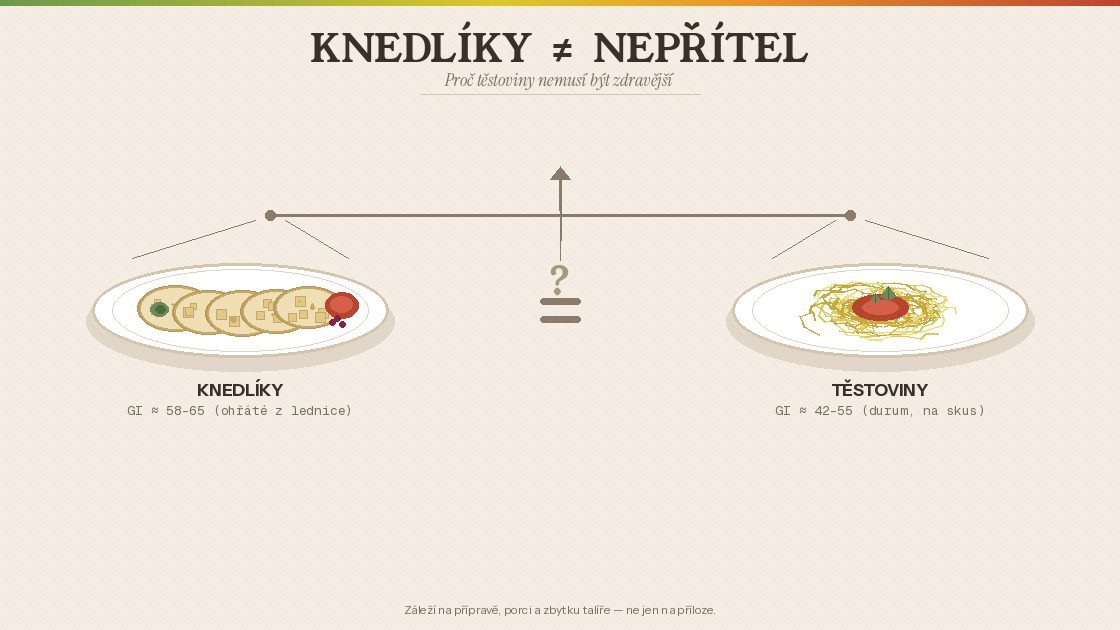
The article debunks the widespread nutritional myth that pasta is automatically healthier than dumplings. While the textbook glycemic index favors durum wheat spaghetti, in real Czech conditions — where dumplings are bought pre-made and reheated — starch retrogradation occurs, lowering the glycemic response and creating beneficial resistant starch that feeds gut bacteria.
You're standing in the store by the refrigerated shelf. In one hand a packet of bread dumplings, in the other a box of Italian spaghetti. From your last visit to the pediatrician, a phrase echoes in your head: "Try to cut back on dumplings, replace them with pasta — it has a lower glycemic index." From a short video on social media last week, the same thing, this time from a fitness instructor with a perfect smile. Dumplings bad, pasta good. Simple, right?
Not quite.
The claim that pasta is automatically healthier than dumplings is one of the most widespread nutritional oversimplifications in Czech households. It rests on real scientific data — but it ignores how we actually cook. What kind of pasta we buy. How we reheat dumplings. And how much we pile onto a child's plate. When we look at the whole picture, we find that the supposed chasm between a dumpling and a pasta exists more in nutrition textbooks than on the Czech dinner table.
The glycemic index (GI) measures how quickly a food raises blood sugar. A scale from 0 to 100, where glucose = 100. A low GI (under 55) means slow absorption, a high one (over 70) a rapid spike and subsequent crash — that's the post-lunch "dumpling slump."
The numbers you find in the tables look clear-cut. Italian durum-wheat spaghetti cooked "al dente" has a GI of around 42–50. Bread dumplings made from white flour are estimated at 70–75. A difference of 25–30 points — that's a huge jump, roughly like the difference between lentils and white bread.
But these table values compare two things that rarely meet on the Czech table in their laboratory form. Spaghetti made from durum-wheat semolina cooked exactly "al dente" and eaten immediately — versus a freshly cooked dumpling straight from the pot. In real life, though, something else happens.
Let's admit it — the vast majority of Czech households today buy ready-made dumplings from the store. They sit in the fridge for a day or two. Then we reheat them in the microwave or by steaming.
And it is precisely this seemingly mundane cycle — cooking, cooling, reheating — that triggers a process scientists call starch retrogradation. Upon cooling, the chains of starch molecules (amylose) rearrange into a firmer crystalline structure. So-called resistant starch is formed — a type of fiber that our small intestine cannot break down. It passes on into the large intestine, where it feeds beneficial bacteria and supports the production of butyrate, a fatty acid with anti-inflammatory effects.
Scientists at the University of Brighton demonstrated that pasta reheated after prior cooling had a lower glycemic response than freshly cooked pasta — blood sugar levels returned to baseline more quickly (Hodges et al., Foods 2020). A pilot study from the University of Surrey with ten volunteers reached a similar conclusion — a statistically significant difference between freshly cooked food and food that had been cooled and reheated (Robertson et al., European Journal of Clinical Nutrition 2021). Research on chickpea pasta from a Warsaw research institute then showed that 24-hour cooling and reheating doubled the resistant starch content — from 1.83 to 3.65 g per 100 g — and the GI dropped from 39 to 33 (Bojarczuk et al., Metabolites 2024).
What does this mean for our store-bought dumplings? They go through a similar cycle. They are industrially cooked, cooled for packaging, sit in the fridge for another day or two, and then you reheat them. Based on data on starch retrogradation, it can be estimated that the GI of store-bought reheated dumplings is somewhere around 58–65. That is, in the medium category — and not in the "red zone" where the popular tables place it.
It must be added, however, that the retrogradation effect varies in magnitude across different foods, and some studies on dried pasta found no significant difference (Cañas et al., Food & Function 2020). A formally measured GI for store-bought reheated dumplings does not exist — no laboratory has yet tested it according to the ISO 26642 standard. The figure given is just that — an estimate.
And now to the other side of the equation. When a pediatrician says "give the children pasta," what does a Czech mother actually buy?
In the ideal case, Italian dried spaghetti made from durum-wheat semolina. These really do have a low GI thanks to the compact gluten matrix formed by industrial extrusion — the starch is encapsulated in a firm protein network and enzymes break it down slowly. A review study from the University of Parma (Di Pede et al., Foods 2021) analyzed 95 pasta products and confirmed that refined wheat pasta has an average GI of around 55 — that is, at the border between the low and medium categories. A significant portion of them really do fall into the low-GI category, especially those made from durum wheat and cooked "al dente."
But Czech cuisine also knows other "pastas": homemade egg noodles from soft flour, square noodles (flíčky), halušky, little soup squares (špalíčky), gnocchi. These are made from soft wheat (Triticum aestivum), lack the compact structure of industrial processing, and their GI is markedly higher. Overcooked noodles from soft flour reach a GI of 60–70 — practically the same as a fresh dumpling.
And even that Italian spaghetti gets overcooked by many families. Children prefer soft pasta, not a firm center. Every extra minute of cooking disrupts the gluten matrix and raises the GI. A study from the Quadram Institute (Cañas et al., Food & Function 2020) further showed that particle size has a greater influence on the amount of starch digested than anything else — roughly twice as much starch was digested from small pieces of pasta compared to large pieces. Children, who tend not to chew their food much, thus glycemically "extract" more from pasta.
A third factor that popular comparisons ignore: the context of the whole meal. The glycemic index is measured for an isolated food on an empty stomach. But we don't eat dumplings on their own — we eat them with svíčková, with goulash, with mushroom sauce.
Protein and fat in a meal slow gastric emptying and dampen the glycemic response. Studies in the Journal of the American College of Nutrition repeatedly confirm that the GI of a mixed meal is markedly lower than the GI of the carbohydrate alone. Three slices of dumpling with svíčková (beef, cream sauce, cranberry compote) represent a different metabolic whole than a large plate of pasta with ketchup — which is, let's be honest, one of the most common ways Czech children eat pasta.
And then there's the question of portion size. A typical portion of dumplings — three to four slices — weighs roughly 100–130 g. A typical child's portion of pasta is 200–250 g (cooked). Even at a lower GI, a larger portion of pasta can create a higher overall glycemic load.
To give a sense of scale — 120 g of dumpling (GI 60, after reheating from the fridge) contains about 50 g of carbohydrates. The glycemic load (GL) then works out to 30. A portion of 250 g of cooked spaghetti (GI 45) contains about 75 g of carbohydrates. The GL works out to 34. So a larger portion of pasta with a lower GI paradoxically creates a higher overall load.
It would be convenient to close the article with the statement "dumplings are just as healthy as pasta." But it's not that simple.
First, quality dried pasta made from durum-wheat semolina and cooked "al dente" remains the objectively better choice from the standpoint of the glycemic index — provided that's really the product you're buying and preparing. A GI of around 42–45 is markedly lower than even the most optimistic estimates for reheated dumplings. Anyone who cooks "al dente" and serves a reasonable portion is doing well.
Second, whole-grain and legume pastas (made from chickpea or lentil flour) have a clear nutritional advantage — higher fiber content, lower GI (37–46), more nutrients. Here dumplings cannot compete.
Third, dumplings made from white flour are nutritionally poor — minimal fiber (under 1.5 g per portion), minimal vitamins, practically no minerals beyond what white flour provides. Durum-wheat semolina offers more folate, iron, and lutein (a carotenoid important for vision).
These arguments are well-founded, and no amount of resistant starch fully offsets them.
The answer is not "dumplings or pasta." The answer is "which kind, cooked how, how much, and with what."
Store-bought dumplings reheated from the fridge are not the metabolic catastrophe that part of the nutrition-advice world makes them out to be. Within a balanced meal with protein, vegetables, and fat, they are a legitimate side dish. What matters is the portion — three slices, not half a loaf.
Pasta is a great choice, if you mean Italian dried pasta from durum-wheat semolina and you cook it "al dente." If you overcook Czech egg noodles made from soft flour and drown them in ketchup, you've lost most of what pasta boasts about in the tables.
And one surprise to close with: if you have pasta left over from lunch, put it in the fridge and reheat it tomorrow. The resistant starch content will rise, the GI will drop, and your gut bacteria will be delighted. This holds for pasta, rice, potatoes — and for dumplings too.
That mother in the store? She can comfortably take both. Dumplings with svíčková for Monday, spaghetti with tomato sauce and vegetables for Tuesday. Neither is a transgression. What matters is what's on the rest of the plate — and whether there are any vegetables there at all.
Methodological note: The GI of bread dumplings has not yet been formally measured according to the ISO 26642 standard. The values given are estimates based on analogy with nutritionally and structurally similar foods (white bread, leavened dough from soft wheat). The retrogradation effect is supported by studies on pasta and rice, but its magnitude differs across various starchy foods — some studies on dried pasta found no significant effect (Cañas et al. 2020). The direct transfer of these conclusions to dumplings is therefore approximate. The GI values are averages from population studies — individual glycemic response depends on the microbiome, insulin sensitivity, physical activity, and other factors.
Primary sources: Hodges et al. (2020), Foods 9(1):23, PMC 7022949 — effect of preparation on the glycemic response of pasta; Robertson et al. (2021), European Journal of Clinical Nutrition 75(3):570–572 — cooling and reheating of pasta, pilot study; Di Pede et al. (2021), Foods 10(11):2541 — review of the GI of pasta products; Bojarczuk et al. (2024), Metabolites 14(11):585 — chickpea pasta, cooling/reheating; Cañas, Perez-Moral & Edwards (2020), Food & Function 11(7):6265–6272 — effect of particle size and preparation on starch digestibility.
Transparency of creation:
The concept, structure, and editorial line of the article are the work of the author, who prepared the content outline, established the key theses, and directed the entire creative process. Generative AI (Claude, Anthropic) was used as a technical tool for research, fact-checking, and fleshing out the author's draft.
The author edited the outputs throughout, verified the key findings, and approved the final wording. No part of the text was published without human review. All factual data were verified against the publicly available sources listed in the text.
The procedure complies with the requirements of Art. 50 of EU Regulation 2024/1689 (AI Act) on the transparency of AI-generated content. #poweredByAI
Read the Czech original on Médium.cz.
AI · Claude — machine translation, may contain inaccuracies.