A Hundred Milliseconds You Can't React To: The Physics of Pouring Gasoline on a Fire
The article explains the physics and chemistry of why pouring gasoline onto a fire is deadly dangerous: a low flash point (-43 °C), vapors heavier than air that sink toward glowing embers, and a phenomenon called flame jetting, in which the fire races back to the canister faster than a person can react. It backs this up with epidemiological data from burn centers (the typical victim is a young man, often under the influence of alcohol, with extensive burns and high mortality) and warns that the impression of safety is sustained only by the statistics of those who survived.
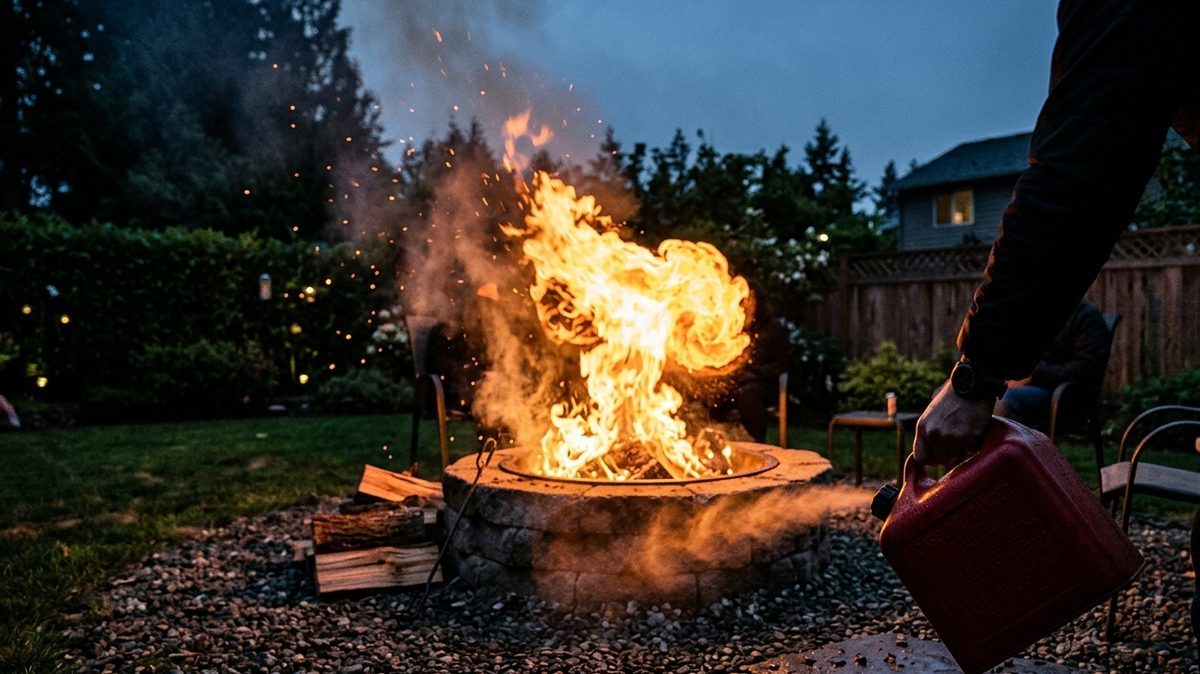
On the footage it looks like a controlled effect. Someone splashes fuel from a jerrycan onto a dying fire pit, the flame leaps up with a loud whump into a two-meter ball, and laughter breaks out all around. The camera keeps rolling, the fire settles, nobody got hurt. These are exactly the videos shared as proof that it "can be handled, as long as you're careful."
What they never show is the other version of the same shot. The one in which the flame doesn't just jump into the fire pit, but travels along an invisible trail of vapor back to the mouth of the jerrycan and into the face of the person pouring. The version that ends with a helicopter flight to a burn center. And because the first warmth of spring opens the open-fire season in the Czech Republic — from garden fire pits to Walpurgis Night bonfires (pálení čarodějnic) — it's the version worth describing before someone films it on themselves.
Pouring gasoline onto a fire is not a risky maneuver that can be mastered with caution and experience. It's a gamble whose outcome is decided by chemistry, not skill. Anyone who understands two numbers — the flash point and the vapor density — will grasp why "I've been doing it for years and nothing has ever happened" is not proof of safety, but a statistical fluke that will one day run out.
Let's start with that first number. The flash point of automotive gasoline lies at roughly -43 °C. It's the lowest temperature at which the liquid releases enough vapor to form, above its surface, a mixture with air that can be ignited.
What this matters for becomes clear in a comparison with diesel. Diesel has a flash point somewhere between 52 and 82 °C. At a springtime temperature of, say, fifteen degrees, diesel practically gives off no flammable vapor — toss a match into a puddle of diesel and it goes out. In exactly the same weather, gasoline is sixty degrees above its flash point and produces vapor continuously, from the moment you unscrew the cap.
The second number is the density of that vapor. Gasoline vapor is roughly three to four times heavier than air. It doesn't rise; it flows down toward the ground, creeps downhill, fills depressions, runs under a grill grate, drifts into the ring of a fire pit, and can "flash back" to the original spot. This is the whole crux of the problem. You're standing upright, holding the jerrycan high, but an invisible river of vapor has long since been flowing along the ground toward the glowing embers.
And third, the range within which the mixture is ignitable. Gasoline vapor burns only when its concentration in air lies between roughly 1.4 and 7.6 percent. This explains a paradox that lies to its victims for a long time. Right at the mouth of the jerrycan there is so much vapor that the mixture is above the upper limit — too rich, it won't burn. That's why it happens that someone splashes once, then again, and nothing. From this they conclude that they know how to do it. But a few meters from the jerrycan the vapor cloud thins out to exactly that ignition window, and there, by the fire, ignition is waiting. The third attempt finds it.
When it sets off, a sequence of events unfolds that has its own name in the English-language technical literature: flame jetting (plamenné tryskání). A phenomenon in which an external ignition source causes the sudden ignition of the fuel inside the container and ejects burning vapor and liquid out through the mouth — producing an effect similar to a flamethrower.
The mechanics are as follows. The front of the vapor cloud reaches the ember and ignites. The flame then travels back along that path toward the container. The laminar burning velocity of a gasoline mixture is only around 0.4 meters per second, but in a real, turbulent cloud in open space the propagation speed runs to units up to tens of meters per second. So the flame covers the two or three meters from the fire to the jerrycan in one hundred to three hundred milliseconds. Documented flame jets from open containers reach lengths of over two meters, and substantially more in demonstration tests by the U.S. ATF agency (as described in the technical literature on flame jetting, Hoffmann et al., 2019).
Now the crucial part. Human reaction time to a visual stimulus is 200 to 250 milliseconds. That is exactly the same order of magnitude as the time it takes the flame to reach you. So the brain registers the flash at the fire at the very moment the fire is, in fact, already at the jerrycan. That's why witnesses to such injuries always say it was "instantaneous." It wasn't literally instantaneous, but it was faster than a hand can flinch away.
And the energy released in the process is not negligible. The specific energy of gasoline is around 43 megajoules per kilogram — for comparison, TNT has just under 5. Gasoline carries in every gram roughly ten times the chemical energy of trinitrotoluene; it merely lacks a built-in oxidizer and confinement, so it releases its energy more slowly and in the form of a fireball rather than a pressure wave. Yet even a quarter-liter of poured gasoline is enough for a ball with a radius of about a meter and a half — exactly large enough to engulf a person standing a step away from the fire pit.
Across countries, the consequences have a strikingly identical face. The burns tend to be on the surfaces facing the fire and the jerrycan: the face, the neck, the front of the chest, the forearms, and the backs of the hands. To this, in one-fifth to two-fifths of cases, is added an inhalation injury to the airways — and it is precisely this that most decides who survives. An Iranian study from Tehran (Firoozbakhsh et al., 2011) recorded it in 42.9 percent of patients with gasoline burns.
The figures for how much of the work of burn units is due to gasoline are dismal in their agreement. An eighteen-year review from the U.S. military burn institute (Barillo et al., 1998) found, among more than four thousand admissions, that 23.3 percent of cases were associated with gasoline, with an average burn extent of nearly 30 percent of the body surface. A British study with the telling title Petrol — something nasty in the woodshed? (Wilson and Bailie, 1995) reports that gasoline was behind roughly a third of all admissions of adult men to their unit and that 38 percent of cases were people trying to light or fan a fire. An Australian study from Victoria (Sreedharan et al., 2019) tracks 378 gasoline burns from the years 2009 to 2016: the most at-risk group are men between twenty and thirty years of age, the average burn extent was 19.3 percent of the body, over 70 percent of patients required surgery, and mortality reached 7.4 percent — more than four times what the same Australian and New Zealand facilities report for other types of burns.
From that data, a portrait of the typical victim can be sketched fairly precisely. He is a young man, twenty to thirty years old, pouring gasoline onto an already burning or dying fire. He often has alcohol in his blood while doing so; an American conference paper from a hospital in Saint Paul (Altamirano et al., 2024) reports that among those injured at recreational fires who were tested on admission, 72 percent had a positive finding for alcohol or drugs. This is not an injury that befalls the clumsy. It befalls the self-assured.
When you say jerrycan and fire, America comes to mind — and half rightly so. The United States dominates the technical literature, but not because these injuries occur there most often. It has systematic nationwide surveillance of consumer-product–related injuries (the NEISS system) and a central burn registry. The abundance of American studies is therefore a reflection of the quality of data collection, not necessarily of a higher frequency of accidents.
When we adjust the incidence per capita, the strongest signal comes from elsewhere — from Australia, New Zealand, and Britain, where there is a dense culture of garden burning and gasoline is the cheapest and most readily available fire-starting substance. The cleanest national data on recreational misuse belongs precisely to the Australian Victorian study mentioned above. An American review (Drago, 2018), based on the NEISS system, in turn shows the broader context: thermal burns make up 56 percent of all gasoline-related injuries and 82 percent of deaths, with most cases involving gasoline poured onto an already burning fire.
Czech data, unfortunately, are almost mute. The Institute of Health Information and Statistics (ÚZIS) does keep a category of "exposure to ignition of highly flammable materials," but it does not distinguish gasoline separately within it. According to figures that Czech Radio obtained from the organization Popálky in the autumn of 2022, the number of these cases rose from 205 to 251 — that is, by roughly a fifth year on year. The Department of Burn Medicine at the Královské Vinohrady University Hospital, the catchment center for all of Bohemia, treats, according to its head Robert Zajíček, "about 600 to 700 patients a year, of whom roughly 300 are children," and just under four percent of them die (in an interview for the server Vitalia.cz). Individual cases appear in the regional press more or less every summer: in the Opava region, according to a paramedic spokesperson, a man who was pouring gasoline while working in his garden survived with burns over more than 80 percent of his body and an inhalation injury; in critical condition, he was airlifted to the burn center in Ostrava.
That precise numbers are missing here does not, however, mean the problem is smaller. It only means we don't measure it. Czech fire culture — roasting špekáčky sausages, holiday campfires, spring bonfires — is at least as intense as the Australian or British. The gap is in the data, not in the behavior.
It's worth taking seriously even the strongest objection to everything I'm writing here: millions of people do it and only a fraction get burned. That's true, and it's exactly the delusion that gasoline feeds so well. Because ignition comes only at the moment the cloud thins out to the narrow ignition window, most splashes really do turn out harmlessly — and every such "it turned out fine" reinforces in the pourer the conviction that they have the matter under control. The statistics of the survivors are misleading because those on whom the flame actually jumped back don't film videos and don't tell stories. They lie in a bed with pressure dressings, waiting for a skin graft. The impression that gasoline is safe by a fire is kept alive only by the selection of those who got lucky.
Firefighters know it and say it bluntly. "Never use highly flammable substances (gasoline, diesel, or spirit) to light or maintain a fire; the fire then very easily gets out of control and can cause even serious burns," states the standing methodology of the Fire Rescue Service. This is not a cautious cliché. It's a description of physics condensed into a single sentence: with gasoline it's not about how far away you stand or how little you pour. It's that the vapor is faster than you, and that the decision was made long before you felt anything.
The next time you see that flashy video where the fire flares toward the camera, try to imagine the same shot two seconds longer and one step closer to the jerrycan. That's the version nobody shares.
Physics and chemistry (primary)
Flame jetting and regulation (primary)
Clinical and epidemiological data (primary, peer-reviewed)
Czech context
Note on method and limits
The conversion of specific energy to a fireball radius (standard scaling of the type R ≈ c·M^⅓, cf. Makhviladze, Roberts and Yakush, 1999–2000) is derived for large-volume tests; extrapolation to a quarter-liter of gasoline is an order-of-magnitude estimate, not a precise value. The flame propagation speeds (0.4 m/s laminar, units up to tens of m/s turbulent) are physically correct ranges across publications, not a single measured value for gasoline under garden conditions; the qualitative claim (faster than the human reaction over a distance of 2–4 m), however, is robust. International comparison of incidence is methodologically difficult, because individual countries measure differently and the definition of a "gasoline-related injury" varies (it also includes suicide attempts and traffic accidents).
Transparency of creation:
The concept, structure, and editorial line of the article are the work of the author, who drafted the content outline, set the key theses, and directed the entire creative process. Generative AI (Claude, Anthropic) was used as a tool for research, searching for primary sources, and the formulational development of the author's content outline.
The author continuously edited the outputs, verified the key findings, and approved the final wording. No part of the text was published without human review. All factual data were verified against the publicly available sources cited in the text.
The procedure complies with the requirements of Article 50 of EU Regulation 2024/1689 (the AI Act) on the transparency of AI-generated content. #poweredByAI
Read the Czech original on Médium.cz.
AI · Claude — machine translation, may contain inaccuracies.