What Science Says About the Diet That Promises to Shed Your Winter Weight
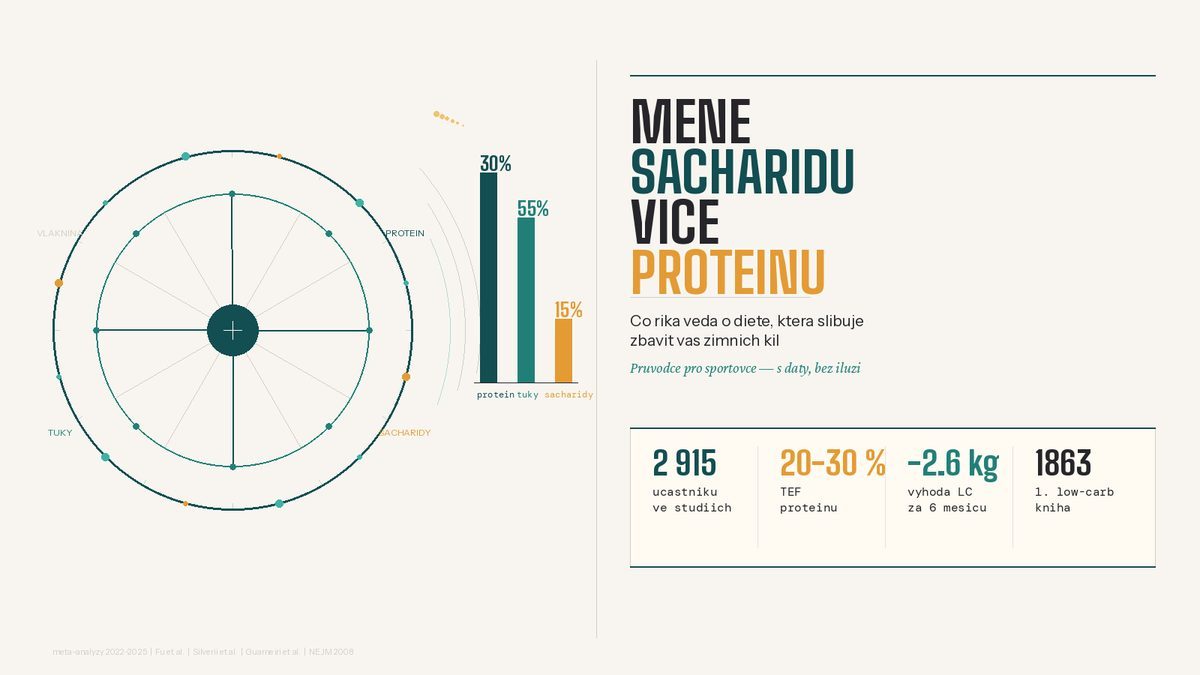
The article offers a science-based overview of low-carb and high-protein diets for athletes who want to lose weight after winter. It examines the physiological mechanisms (the thermic effect of protein, satiety, stable blood glucose), cites recent meta-analyses, and notes that the initial advantage of low-carb diets evens out over the long term compared with other approaches. It includes a practical meal plan and specific recommendations for recreational cyclists, including targeted carbohydrate intake around workouts.
A guide for athletes who want to lose weight smartly — with data, without illusions
Petr pulled his bike out of the cellar in early March. He had spent the winter months only sporadically on the indoor trainer, and all the more at the dinner table. When he put on his cycling shorts, he discovered what he had suspected — the zipper closes, but the comfort is gone. The scale showed six kilos more than in October. A story as old as cycling itself: over winter you put on weight, and in spring you have to do something about it.
Petr reached for what a fellow rider from the peloton had recommended: cut carbohydrates, increase protein. But online he read that this diet destroys your kidneys, causes ketoacidosis, and that without carbohydrates you can't pedal uphill. Which of that is true?
Let's look at what current science actually says about diets with reduced carbohydrate intake and an increased proportion of protein. No marketing, no ideology — just data, mechanisms, and practical advice.
There is no single universal definition. The spectrum is broad, and it depends on how deep you want to go.
According to most recommendations, a standard diet contains 45–65 % of energy from carbohydrates, which at an intake of 2,500 kcal corresponds to roughly 280–400 grams per day. Low-carb approaches reduce this number, but each does so differently.
Mild restriction means roughly 100–150 g of carbohydrates per day, that is about 25–35 % of energy. This means cutting out sweets and white bread, but keeping fruit, legumes, and side dishes in smaller amounts. Low intake ranges below 130 g per day, that is less than 26 % of energy, which corresponds to the classic low-carb definition used in most studies (National Lipid Association consensus). Very low intake, i.e. a ketogenic regime, means under 50 g of carbohydrates per day (5–10 % of energy), where the body switches to burning fat as its primary fuel and produces ketone bodies.
High-protein diets (LCHPD — Low-Carbohydrate High-Protein Diet) typically combine 10–30 % of energy from carbohydrates with 30–40 % from protein. The remaining 30–50 % is made up of fats. It is precisely this combination that is the subject of most current studies.
For the average athlete who wants to shed the winter gain, the most practical approach is usually the middle path: 50–100 g of carbohydrates per day, protein around 1.2–1.6 g per kilogram of body weight, and the rest from quality fats. There is no need to count every gram — it is enough to cut the main carbohydrate sources (bread, pasta, sweets, sugary drinks) and increase the share of meat, fish, eggs, and vegetables.
Why does restricting carbohydrates and increasing protein actually lead to fat loss? It's not magic — there are several well-described physiological mechanisms behind it.
Every macronutrient "costs" the body some energy to process — digestion, absorption, metabolism. This phenomenon is called the thermic effect of food (TEF). And here protein is the clear winner.
A meta-analysis of 52 studies published in Advances in Nutrition in 2024 confirmed that higher-protein meals increase TEF as well as total daily energy expenditure compared with low-protein meals (Guarneiri et al., 2024). The specific numbers: protein requires 20–30 % of the energy it provides just to be processed. Carbohydrates 5–10 %, fats a mere 0–3 %.
What does this mean in practice? When you eat 100 kcal in the form of protein, the body "burns" 20–30 kcal just to process it. For the same amount of fat it is at most 3 kcal. With a realistic change to your diet (increasing protein from ~15 % to ~30 % at an intake of 2,000 kcal) this can mean a difference of 80–120 kcal per day — not negligible, but not in itself sufficient for significant weight loss. The main advantage of protein lies rather in the combination of TEF with other mechanisms, above all satiety (Attia, analysis of Guarneiri et al.).
Protein is the most satiating macronutrient. It stimulates the release of satiety hormones (PYY, GLP-1) and suppresses the hunger hormone (ghrelin). In practice this means that people on a high-protein diet eat less without having to count calories or fight hunger.
This is a fundamental difference from classic low-calorie diets, where a person is constantly hungry and sooner or later returns to their original habits. According to a number of researchers, it is precisely protein's satiety effect that is the main reason high-protein diets lead to weight loss — not TEF or hormonal mechanisms on their own.
Carbohydrates — especially simple sugars and processed starches — cause a rapid rise in blood glucose and a subsequent spike of insulin. Reducing the intake of these foods leads to more stable blood sugar levels, smaller swings in energy, and less hunger between meals.
It is important to note that insulin's role in regulating body fat is more complex than previously assumed. The so-called "Carbohydrate-Insulin Model" of obesity, which presents insulin as the main culprit in fat storage, is controversial in the scientific literature. Metabolic studies by Kevin Hall of the NIH showed that, under strict control of caloric intake, a ketogenic diet does not lead to significantly greater fat loss than a diet with a standard proportion of carbohydrates (Hall et al., Cell Metabolism 2015). More stable blood glucose is nonetheless a real and practically relevant benefit — it helps control hunger and cravings.
With any caloric deficit there is a risk that the body will draw energy not only from fat but also from muscle. And that is a nightmare for an athlete — loss of muscle mass means a decline in performance, metabolism, and aesthetics.
A systematic review and meta-analysis from 2024 published in Clinical Nutrition ESPEN showed that higher protein intake (above 1.3 g/kg/day) during caloric restriction helps preserve muscle mass in overweight and obese individuals. Intake below 1.0 g/kg/day was, on the contrary, associated with a higher risk of muscle loss (clinical review). For active athletes a range of 1.6–2.2 g/kg/day is recommended, especially when combined with resistance training (Longland et al., AJCN 2016).
Individual studies can be misleading — a small sample, a specific population, a short duration. That is why science relies on meta-analyses, which aggregate data from dozens of studies. Let's look at what the most recent ones say.
A large meta-analysis of LCHPD diets published in Clinical Nutrition in 2025, which included 16 studies, confirmed that the combination of low carbohydrate intake and high protein intake leads to improvement in a range of metabolic parameters: a reduction in body weight, BMI, blood pressure, blood glucose, triglycerides, and the inflammatory marker CRP (Fu et al., Clinical Nutrition 2025).
The meta-analysis by Silverii et al. from 2022 analyzed 25 randomized controlled trials in obese individuals. Low-carb diets led to significantly greater weight loss compared with balanced diets after 3–4 months (on average 2.6 kg more) and also after 6–8 months (Silverii et al., Diabetes Obes Metab 2022).
Here comes an important nuance. The same Silverii meta-analysis showed that after 10–14 months the difference ceased to be statistically significant, and after 18–30 months it disappeared entirely. A low-carb diet thus provides an initial advantage, but in the long run what decides is the overall caloric deficit and the ability to persevere.
This conclusion is also confirmed by the largest randomized study to date on this topic — the DIETFITS trial from 2018 (609 participants, 12 months). Researchers from Stanford found no significant difference in weight loss between a healthy low-fat and a healthy low-carbohydrate diet. The key factor in success was not the type of diet, but the quality of the diet (Gardner et al., JAMA 2018).
This does not mean that low-carb "doesn't work" — it means that no diet has magical properties. The advantage of low-carb lies in the fact that, thanks to satiety and more stable blood glucose, it is for many people easier to sustain than plain caloric restriction.
A large meta-analysis of 174 randomized studies (11,481 participants) from 2025 in the American Journal of Clinical Nutrition showed that carbohydrate-restricted diets significantly reduce triglycerides, both systolic and diastolic blood pressure, and inflammatory markers (CRP, TNF-α), while increasing "good" HDL cholesterol (Feng et al., AJCN 2025).
But there's a catch: LDL cholesterol and total cholesterol rise slightly. Ketogenic diets produce greater weight loss, but also a greater increase in LDL. Mild carbohydrate restriction offers a more balanced profile of benefits and risks. For athletes who want to lose a few kilos and have no metabolic complications, moderate low-carb (50–100 g of carbohydrates) represents a reasonable compromise.
A number of claims circulate around low-carb diets. Let's break down the most common ones — but fairly, acknowledging what we know and what we don't.
This claim stems from the assumption that higher protein intake burdens the kidneys. In people with healthy kidneys, clinical studies do not confirm this concern — the systematic review by Devries et al. (2018) found no negative effects of a high-protein diet on renal function in healthy adults (Devries et al., J Nutr 2018). A problem may, however, arise in people with pre-existing kidney disease — they should discuss protein intake with a doctor.
It is true that in the first days there is a marked loss of water — glycogen in the liver and muscles binds water, and when it is depleted this water is excreted. But meta-analyses measuring body composition (not just weight) consistently show that low-carb diets lead to genuine loss of fat mass, not just water. A study at Johns Hopkins demonstrated that a low-carb diet led to a greater percentage loss of fat, and especially of visceral (abdominal) fat, compared with a low-fat diet (Stewart et al., AHA presentation 2012; Gower & Goss, J Nutr 2015).
This is a relevant concern, but the answer depends on the type of sport. In endurance activities of moderate intensity (which is a large part of recreational cycling), after adaptation the body is able to rely more efficiently on fat oxidation. Studies in endurance athletes showed maintained performance and improved body composition on ketogenic and low-carb diets. The problem arises in short, high-intensity efforts (sprints, final spurts), which are dependent on glycogen.
The practical solution? Moderate low-carb (50–100 g of carbohydrates) with targeted carbohydrate intake around demanding training sessions. You don't have to be in permanent ketosis to reap the benefits of reduced carbohydrate intake.
The data are more nuanced than both sides of the debate like to admit. Low-carb diets consistently improve the triglyceride-to-HDL ratio, lower blood pressure and inflammatory markers (see Feng et al. 2025 above). LDL may indeed rise slightly — that is a real risk that cannot be trivialized, especially in people with familial hypercholesterolemia.
Some advocates of low-carb diets argue that there is a shift toward larger, less atherogenic LDL particles. This argument has some support in the literature, but the clinical significance of LDL particle size as an independent predictor of cardiovascular risk is still a matter of scientific debate. The ApoB marker is considered a more reliable indicator of risk. The overall cardiovascular profile in most people on a moderate low-carb diet tends to improve, but individual lipid monitoring is important.
As for red meat and saturated fats: the evidence is indeed less clear-cut than was long assumed. Some more recent reviews using a stricter methodology (GRADE) have questioned the strength of the evidence for the health risks of red meat (Johnston et al., Ann Intern Med 2019). These conclusions were, however, criticized by a number of organizations including the WHO, AHA, and IARC. This is an active area of scientific debate, not a closed question.
Low-carb approaches have a longer history than most "modern" dietary recommendations. The first low-carb book was published by William Banting in 1863. More than 20 randomized controlled trials have confirmed their effectiveness. The American Diabetes Association recognizes low-carb as a legitimate approach to the management of type 2 diabetes. Calling an approach supported by dozens of clinical studies a "fad" does not correspond to reality.
Theory is important, but in the end what matters is what's on your plate. Here are concrete recommendations.
Goal: a moderate caloric deficit (20 %), moderately low carbohydrate intake.
Total intake about 2,000 kcal, of which approximately 130 g of protein (26 %), 75 g of carbohydrates (15 %), and 130 g of fats (59 %).
Breakfast: Three eggs scrambled in butter with spinach and cherry tomatoes. Coffee with a dash of cream. Content: approx. 25 g of protein, 5 g of carbohydrates.
Lunch: Chicken thigh roasted with the skin, a large portion of leafy salad with avocado, olive oil, and seeds. Content: approx. 40 g of protein, 10 g of carbohydrates.
Snack: A handful of almonds (30 g) and a piece of hard cheese (50 g). Content: approx. 15 g of protein, 5 g of carbohydrates.
Dinner: Grilled salmon with broccoli and cauliflower drizzled with ghee. Content: approx. 35 g of protein, 10 g of carbohydrates.
After training (on a hard-ride day): Greek yogurt with a handful of blueberries. Content: approx. 15 g of protein, 15 g of carbohydrates.
Total: about 130 g of protein, 45–75 g of carbohydrates (depending on the training day).
Proteins: eggs, chicken and turkey thighs, beef (not just tenderloin — also cheaper cuts for slow cooking), salmon, mackerel, sardines, hard cheeses (Gouda, cheddar, Parmesan), quark.
Fats: extra virgin olive oil, ghee (clarified butter), coconut oil, avocado, nuts (almonds, walnuts, macadamias), seeds (flax, chia, pumpkin).
Vegetables (low-carb): broccoli, cauliflower, spinach, arugula, zucchini, green beans, tomatoes, peppers, cucumbers, lettuce.
Fruit (in moderation): blueberries, raspberries, strawberries, avocado (yes, it is a fruit). Watermelon occasionally. Apples and pears only exceptionally and in small portions.
Cut out or significantly limit: white bread and pastries, pasta, rice, potatoes, sweets, sugary drinks, juices, beer.
For the recreational cyclist who rides 3–5 times a week and wants to lose weight, several specific pieces of advice apply.
On rest days or light-training days, keep carbohydrates to a minimum (under 50 g). The body learns to burn fat more efficiently. Before a demanding ride (over 2 hours of intense riding), top up carbohydrates deliberately: a portion of fruit or oatmeal 2–3 hours beforehand. During long rides, replenish carbohydrates as needed — a banana, dates, an energy gel. Here it is not about the diet, but about performance and safety. After training there is a window for replenishing glycogen: a combination of protein and carbohydrates (Greek yogurt with fruit, quark with honey) will speed up recovery.
In other words: low-carb for a cyclist does not mean never reaching for carbohydrates. It means being strategic with them — restricting them where you don't need performance, and deliberately topping them up where you do.
Insufficient intake of sodium and potassium is the most common beginner's mistake. When carbohydrates are reduced, the kidneys excrete more sodium, which leads to fatigue, headaches, and muscle cramps — the so-called "keto flu." The solution is to consciously salt your food and eat foods rich in potassium and magnesium. Insufficient fiber intake is another risk. Without whole grains and legumes, fiber intake drops. Compensate with vegetables, nuts, and seeds. Excessive restriction leads to unsustainability. A radical ketogenic diet under 20 g of carbohydrates can be unnecessarily strict for an active athlete. Moderate low-carb (50–100 g) provides most of the metabolic benefits with substantially less restriction.
No diet is without risks and limitations. Let's be fair to the limits of the low-carb approach too.
LDL cholesterol can rise in some people on a low-carb diet. If you have familial hypercholesterolemia or other risk factors, it is necessary to monitor your lipid profile regularly. Long-term adherence is the main challenge: meta-analyses consistently show that after 12–18 months the results of low-carb and other diets even out. The largest study (DIETFITS, n=609) confirms this conclusion. The best diet is the one you can stick to. Individual variability is enormous. One person thrives on low-carb, another feels exhausted. Genetics, the composition of the gut microbiota, and the level of activity all play a role. If after 2–3 weeks of adaptation you still don't feel well, the approach may not suit you.
And finally: no study has demonstrated that a low-carb diet has "magical" properties for weight loss. The primary mechanism remains the caloric deficit. Low-carb merely makes it easier thanks to greater satiety, more stable blood glucose, and the metabolic advantage of protein.
Petr changed his diet in mid-March. He threw the bread and pasta out of the kitchen and stocked the fridge with eggs, salmon, and vegetables. The first week was hard — his head ached, and on the bike he felt as if he were pedaling through mud. He added salt to his food and, on a friend's advice, started having scrambled eggs with spinach for breakfast. By the third week his body had adapted.
By the end of April the scale showed minus four kilos. The cycling shorts fit. Not because he had discovered a miracle diet — but because he had found a way of eating on which he wasn't constantly hungry and which let him pedal uphill without feeling that he was running out of fuel.
No diet works universally. But if you are looking for an approach supported by solid data that combines effectiveness with relative comfort, low-carb with a higher proportion of protein is worth trying. Not as a dogma — but as a tool.
The article draws on current meta-analyses and review studies (2015–2025). Key sources:
This article does not constitute medical advice — in case of health complications, consult a doctor.
Methodological note
The concept, structure, and editorial line of the article are the work of the author, who prepared the content outline, established the key theses, and directed the entire creation process. Generative AI (Claude, Anthropic) was used as a technical tool for research, fact-checking, and elaborating the author's draft.
The author edited the outputs throughout, verified the key findings, and approved the final wording. No part of the text was published without human oversight. All factual data were verified against the publicly available sources cited in the text.
The procedure complies with the requirements of Art. 50 of EU Regulation 2024/1689 (AI Act) on the transparency of AI-generated content. #poweredByAI
Read the Czech original on Médium.cz.
AI · Claude — machine translation, may contain inaccuracies.