The Invisible Censor: How We Learned to Silence Ourselves
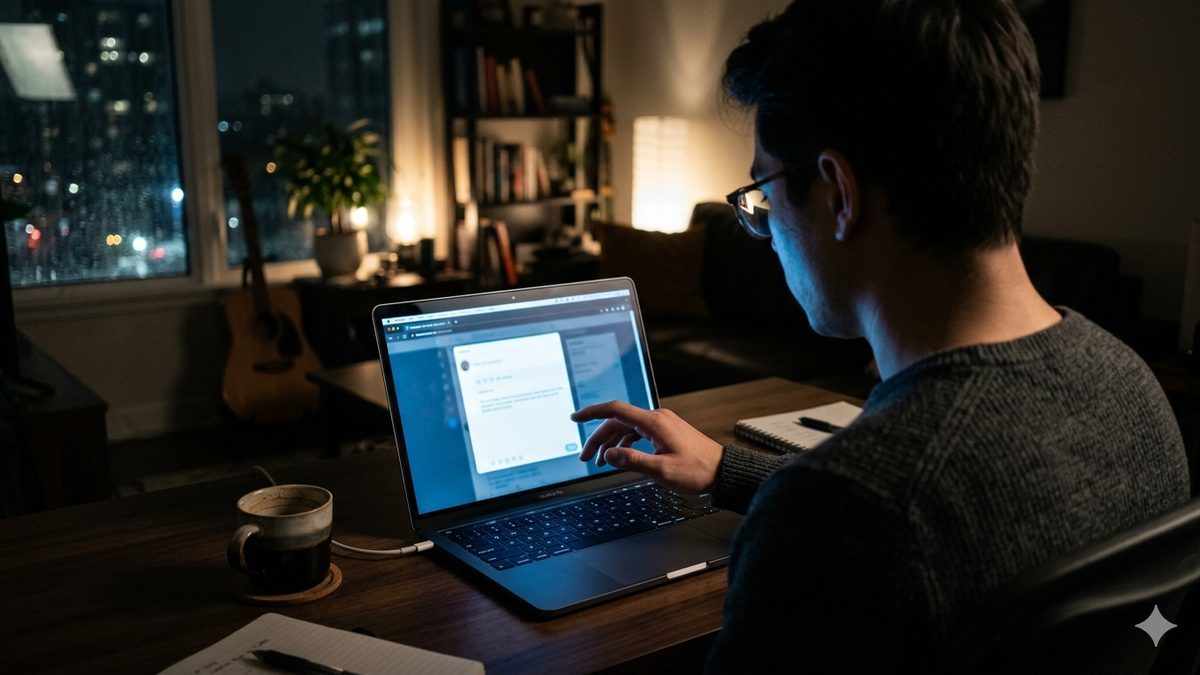
The article follows one person's life from a curious high-school student to a resigned adult, using it to show how market democracy replaced external totalitarian censorship with a more elegant internal self-censorship — a person installs their own censor and mistakes it for their own judgment. Alongside Orwell and Huxley, the author proposes a third model of control, one in which citizens police their own thinking, and backs it with research (FIRE, Pew, Index on Censorship) as well as the ideas of Bernays, Ellul, Chomsky, Zuboff, and Bělohradský. He places special emphasis on the Central European experience, where the shift from party directives to the ownership pressures of oligarchs unfolded within a single generation, and concludes that the market reliably silences precisely those problems that outlast changes of government.
It begins with a grammar-school student thrilled by discovery. He reads everything. He asks about everything. He starts with questions teachers are happy to answer — why Rome fell, how photosynthesis works, what inflation is.
Then he begins to ask about things that make teachers hesitate slightly. Why we support this party and not that one. Why a certain topic isn't discussed. Why the history textbook from 1985 says something different from the one from 1995.
And then comes the moment when he asks a question after which the classroom falls silent. Not because it's stupid. Because it's too good.
In that silence — in the reaction of his classmates, in the teacher's smirk, in the subtle social signal that this is not something one says — something is born for which we have no good word. It isn't fear. It isn't obedience. It's an inner voice that, next time, will say: "Keep this to yourself." And that voice will speak in his own words, in his own voice. It will look like his own judgment. Like reasonableness. Like maturity.
Totalitarian regimes needed a secret police, cadre assessments, and publication bans to achieve the same effect. Market democracy managed it more elegantly.
The grammar-school student reads Orwell. 1984. Big Brother, the Ministry of Truth, the Thought Police. The teacher assigned it as required reading and the class discusses totalitarianism. Everyone agrees: this can't happen to us, because we live in a democracy. The student agrees. It makes sense.
A year later he comes across Huxley. Brave New World. No police, no torture. People manufacture their own slavish contentment — soma, consumerism, distraction. The teacher says: "Huxley is more sophisticated than Orwell." The student nods. Again, it makes sense.
Then he reads Neil Postman — Amusing Ourselves to Death — who explains to him why Huxley was more right: no one forbids us the truth, we just drown it in entertainment. The student writes a term paper. The teacher gives him an A. His classmates applaud. This idea is safe — it says the problem is somewhere out there, in television, on social media, in the algorithms. Somewhere he can point a finger without having to look in the mirror.
But there is a third option no one told him about.
What if the truth were neither forbidden nor killed by entertainment — but what if every person learned to forbid it to themselves?
What if the system needed neither a police force nor a drug — just a properly configured environment? An environment in which every citizen installs his own censor and regards it as his own identity?
The grammar-school student never asked about this. Because that is precisely the kind of question after which silence falls.
Let's look at how that environment works. Not in the abstract — concretely, in the life of our grammar-school student.
At school he has a Czech-language teacher who assigns articles from one particular newspaper. A civics teacher who recommends one particular television channel. An English teacher who shares the posts of one particular columnist. None of them says: "Don't read that." They say: "This is quality." And the student learns the first lesson of market democracy — quality is not a property of the text, but a signal of belonging.
At home his father reads a different newspaper. Online the student moves in different circles. But everywhere the same rule applies: there are sources that "one reads," and sources that "the others" read. No one mandates it. But everyone observes it. And whoever reads the wrong source risks the same smirk the student experienced in the classroom.
At university it intensifies. The student — now a university student — learns a new vocabulary. "Critical thinking." "Media literacy." "Source verification." He learns to question — but only in the right direction. To question those sources, not these. To filter out that propaganda, but not this one. He is taught critical thinking as a filter — not as a mirror.
In seminars he notices that some questions generate agreement and others silence. He learns which is which. He isn't stupid. He's adaptive. And adaptation looks like education.
On social media, where he spends more and more time, the mechanism is perfected. The algorithm observes what interests him and gives him more of the same. Not because it wants to manipulate him — because it wants to keep him on the screen. But the result is the same: the world narrows to what he already knows, what he already thinks, what he already agrees with. And anything outside this tunnel doesn't look like a differing opinion — it looks like noise. Like poor quality. Like the others.
The student knows the algorithm exists. He understands it. He can explain how it works. In a media-studies seminar he writes an essay about it and gets top marks.
And then he opens his phone and scrolls through the feed that algorithm has prepared for him. Because knowing how the trap works doesn't mean you're not in it.
After school he joins a newsroom. Small, digital, "independent." He writes well. But he quickly discovers that there are topics one writes about and topics one doesn't. Not because the editor-in-chief called and said "not this." Because he knows who pays the subscriptions. He knows what readers want to read. He knows which articles generate shares and which generate silence.
Not because he lies. Because he selects. And selection looks like professionalism. Like knowing the market. Like journalistic intuition.
Once — under the regime he reads about in textbooks — there was a party assessment that decided what you were allowed to publish. Today there is an analytics dashboard that shows what readers read. The mechanism has changed. The result — a journalist who knows what he should not write about — has stayed the same. It's just invisible, because no one formally forbids anyone anything.
At thirty he is an adult. He pays a mortgage. He has a family. He reads the news on two websites he chose at twenty-five and hasn't changed since. On social media he follows people who think the same as he does. He comments only under articles where he is sure of his circle's approval. When he comes across a text that unsettles him — not because it's bad, but because it questions something his picture of the world rests on — he closes the tab. Not quickly. Slowly. With the feeling that the text "isn't worth the time."
He knows algorithms shape his information environment. He knows the media are owned by oligarchs. He knows the media literacy he was taught was a simplification. He knows all of it.
And still he shares only what confirms his views.
Not because anyone forbade it. Because he learned it himself. In that classroom. In that silence. In that smirk.
This is the story of one person. But it is the story of an entire generation — and of the one that came after.
A 2021 survey by the FIRE foundation among 37,000 students at 159 American universities found that more than 80% self-censor at least occasionally, and 21% do so often. Two years later, in an expanded survey of 55,000 students at 248 universities, more than a quarter said they self-censor at least several times a week. In 2014 the Pew Research Center examined willingness to discuss one specific controversial topic — the NSA surveillance revealed by Edward Snowden — and measured that while 86% of Americans were willing to discuss it in person, on Facebook and Twitter the figure was only 42%. In February 2026 the Index on Censorship documented that Britain's Generation Z "increasingly self-censors what it says online." Eighteen-year-old William Marsden uttered a sentence that sums it all up: "I don't comment on TikTok and I don't comment on Instagram posts, because people I know will see it."
A 2023 study by Hassoun et al. (CHI conference, ACM) found a fascinating paradox in Generation Z: young people understand algorithms, actively manipulate them — and at the same time perceive formal media-literacy programs as patronizing. Li, Shea, and Ma (2025, MERJ journal) identify indifference and apathy despite awareness of algorithmic manipulation — a study conducted with Irish university students showed that knowing about the problem does not lead to solving it.
The term "brain rot" — the Oxford Word of the Year 2024 — which Gen Z uses self-ironically to describe its own cognitive degradation, is a precise symptom. An awareness of the problem that leads nowhere. As early as 1983, Peter Sloterdijk coined a term for it: "enlightened false consciousness" — I know what I'm doing, but I do it anyway.
What our grammar-school student is going through is not a Czech specialty. But the Czech and Central European experience makes it visible — because the transition from external censorship to internal censorship took place within a single generation.
The Hungarian dissident Miklós Haraszti predicted it back in his 1981 samizdat book The Velvet Prison: in the "soft" communist states, censorship was transformed from external coercion into internalized self-censorship. The "velvet prison" was less visible and more dangerous than hard Stalinist censorship.
David Klimeš of the Faculty of Social Sciences, Charles University, in a 2024 article (Media History) based on archival documents, identified six principles of media oversight in late communism. The most important was: minimum prior censorship, maximum self-censorship. The Czechoslovak normalization-era regime operated as "censorship without censors." And then came democracy. After 2008, foreign media investors were replaced by domestic oligarchs — Václav Štětka of Loughborough University mapped this in the International Journal of Press/Politics (2012). A 2022 report by the International Press Institute documents alarmingly high self-censorship in the media these oligarchs own.
Party directives were replaced by ownership pressures. Cadre assessments were replaced by fixed-term contracts.
A special issue of the European Journal of Communication in 2020 brought a key conclusion. Schimpfössl, Yablokov, et al., based on research in Hungary, Russia, and other countries, found that journalism in post-communist countries had developed forms of self-censorship similar to those existing in countries with no experience of state socialism.
The post-communist experience is not a deviation from the Western model. It is its mirror.
Václav Bělohradský summed it up in a single sentence: "In totalitarian regimes you must be careful with words, because someone is always listening. Democracy, by contrast, is a regime in which no one listens to anyone."
And the Croatian writer Slavenka Drakulić put it even more simply: "I lived under a totalitarian regime and I know censorship from the inside. I sense it from a distance, and I sense it in this terror of political correctness."
And now to the roots. Because this is not a new phenomenon. It is exactly as old as modern democracy itself.
Edward Bernays, the father of public relations, said it back in 1928 with a directness that today would get past no social-media algorithm: "The conscious and intelligent manipulation of the organized habits and opinions of the masses is an important element in democratic society."
In 1962 Jacques Ellul distinguished political propaganda — deliberate, visible persuasion — from sociological propaganda, which is "the environment itself," "the air we breathe." And he warned: propaganda is more dangerous in democracies, because citizens believe they are immune to it.
In 1988 Noam Chomsky and Edward Herman identified five filters that, without any formal censorship, systematically exclude inconvenient perspectives from the American media: concentration of ownership, dependence on advertising, the interplay with sources, organized flak, and a shared ideological frame. Christian Fuchs, in the volume The Propaganda Model Today (2018, University of Westminster Press), showed how all five filters continue to operate — only a sixth was added: the algorithmic sorting of content.
For the resulting system, Shoshana Zuboff of Harvard coins the term "surveillance capitalism" — the market analogue of Orwell's Big Brother, which serves not political control but the extraction of behavioral data and the modification of behavior. Zeynep Tufekci of Columbia University added the term "censorship through distraction" — modern power need not forbid information, it suffices to drown it in irrelevant content. Sue Curry Jansen, who developed the concept of "market censorship" as early as 1988, formulates the conclusion: market censorship is "more flexible, but also more resilient" than state censorship. It is "a leaky system, but easily repairable."
In a posthumous 1995 book, Alex Carey summed it up in a single sentence: citizens of totalitarian regimes know they are being propagandized and can potentially resist. Citizens of democracies believe they are free, and therefore fail to recognize propaganda.
And Byung-Chul Han, Mark Fisher, Wendy Brown, and Sheldon Wolin — four thinkers from different traditions — independently arrived at the same conclusion: a third model of control. Neither Orwell (external prohibition) nor Huxley (drowning in pleasure), but a system in which citizens police their own thinking. Fisher put it most sharply: "Informal censorship, internalized and propagated by late-capitalist cultural workers, produces a banal conformism of which a Stalinist propagandist could only dream."
One might object — and it is a strong objection — that all of this is exaggerated. That the demand for confirmation of one's own worldview is natural. That media fragmentation is a consequence of freedom. That comparing market filtering with totalitarian censorship is dishonest, because in one system you risk prison and in the other, at most, the loss of followers.
All of this is true. But it is only part of the truth.
The other part says: when the media market reliably eliminates texts that strengthen no camp, it thereby also eliminates society's ability to see the problems that survive a change of government. The mechanisms that operate regardless of who wins the election. And it is precisely these problems that are the most important — because they cannot be solved by the right choice. They can be solved only through understanding. And understanding requires information that no one wants to hear.
Our grammar-school student is now an adult. He sits at the screen. He reads this article. And right now — at this very moment — his inner censor is deciding what to do with it.
Share it? No. His colleagues would see it. And what would they think?
Remember it? Maybe. But tomorrow a new feed will come. Another two hundred and fifty posts. And this thought will dissolve into the stream that drowns it — not because it is forbidden, but because there will be no time for it.
And that teacher who once told him, "that's an interesting perspective, but now let's get back to the syllabus"? He meant well. He always means well.
That is precisely why it works so well.
The concept, structure, and editorial line of this article are the work of the author, who drew up the content sketch, established the key theses, and directed the entire creative process. Generative AI (Claude, Anthropic) was used as a tool for research, fact-checking, and fleshing out the author's draft.
The author continuously edited the outputs, verified the key findings, and approved the final wording. No part of the text was published without human review. All factual data were verified against the publicly available sources cited in the text.
This procedure complies with the transparency requirements for AI-generated content under Article 50 of EU Regulation 2024/1689 (the AI Act). #poweredByAI
Read the Czech original on Médium.cz.
AI · Claude — machine translation, may contain inaccuracies.