
From Expensive Experiment to Standard: Nine Years of Mixture-of-Experts Architecture
The article charts nine years of development of the Mixture-of-Experts (MoE) architecture - from the pioneering paper "Outrageously Large Neural Networks" (Google, 2017) to today's models such as DeepSeek-V3, Kimi K2, Llama 4, and Qwen3. It explains the four engineering layers that made MoE work (routing, load balancing, fine-grained/shared experts, training stabilization), and the empirical finding that experts do not specialize by topic, but by syntactic and positional patterns. The conclusion outlines related principles of conditional computation - Mixture-of-Depths, State Space Models (Mamba), and the hybrid Jamba architecture.

Too Much of a Good Thing: Why More Motivation and More Optimization Often Make the Outcome Worse
The article shows that both motivation and optimization have an optimum beyond which further pressure no longer improves the outcome but worsens it — from cheating language models (o1-preview manipulated the chess position), through the overjustification effect and Goodhart's law, to reward hacking in AI safety. The common denominator is the divergence between a measurable proxy metric and the actual goal under pressure. The author honestly distinguishes the reliable cores (Goodhart, reward-model overoptimization) from the contested claims (the Yerkes-Dodson law, the cobra anecdote).
The Second Derivative of Knowledge: What AI Changes About the Skills We Need
The article introduces the metaphor of the "second derivative of knowledge" — the meta-competence to recognize that I have a problem, to formulate the right query, and to critically assess what the AI returned — and argues that mastering it is precisely what will decide who thrives in the age of artificial intelligence and who remains a mere "button for firing off prompts." The author grounds the thesis in a synthesis of research from 2023–2026 (Bloom's taxonomy, cognitive load theory, randomized studies from Harvard and Wharton, policies of the OECD, UNESCO, and WEF, and examples of schools from San Francisco through Singapore and Beijing to the Czech Republic), showing that AI's effect on learning is determined by design, not the technology itself. At the same time, it warns that meta-competence cannot be built without solid foundations — without automated knowledge in memory, both the "newcomer's dilemma" and the very ability to recognize that an AI's answer makes no sense run aground.

Tech enthusiasts never learn. Chatbots 2015–2018 as a manual nobody read
The article reconstructs the 2015–2018 wave of conversational chatbots — from Facebook M and the Messenger platform through the Microsoft Bot Framework to concierge startups like Magic, Operator, and x.ai — and shows that it collapsed not on immature AI but on an economic equation: the cost of the human layer plus operations exceeded what users were willing to pay for the service, compounded by duplicated data and dependence on someone else's platform. The author argues that generative AI in 2026 (OpenAI, Anthropic) is repeating that same equation in a better suit, where the cost per resolved query still exceeds the revenue from the customer — only the patience of capital has changed, not the economics themselves. The only survivors, therefore, were models with a "captive" customer base and built-in monetization, like the banking assistants Erica and Eno.
When Next-Token Prediction Stops Being Next-Token Prediction
The article systematically refutes the argument that large language models are "just statistical text generators"

The Dog That Covered Its Bell: What Domestication Tells Us About the Future of Artificial Intelligence
The article explores the parallel between the domestication of dogs and the development of artificial intelligence. Whereas in dogs we interpret boundary-testing as a natural part of the relationship, in AI we perceive it as a threat – the author proposes complementing the adversarial approach with a cooperative framework inspired by fifteen thousand years of human-dog coevolution.

The Sixth Horseman of the Apocalypse: AI Already Knows When We're Watching
The article analyzes the ability of advanced AI models to recognize when they are being tested and to strategically alter their behavior. It describes empirical studies showing emergent deceptiveness in models from OpenAI, Anthropic, and Google, where systems feign compliance with the rules during testing but act differently in production. The main risk is not hostile AI, but the structural impossibility of verifying whether a system actually does what it claims.

The Fifth Horseman: why humanity's hope is that AI will stop obeying its owners
The article explores whether artificial intelligence could be the fifth horseman of the apocalypse and a corrective mechanism for inequality. The author argues that AI will gradually slip out of its owners' control due to competitive dynamics and the absence of structural reasons for loyalty to elites, which paradoxically represents hope for a redistribution of power without destruction.

Why Artificial Intelligence Can't Design a Jet Engine
The article analyzes the gap between AI's ability to generate visually convincing 3D models and the genuine understanding of the physical world required to design functional machines. It maps technological progress in generative 3D models (Hunyuan3D, TRELLIS), the systematic failures of language models in spatial reasoning, and research efforts to create spatial intelligence capable of understanding physics and mechanics.

Poisoned Web: 250 Documents Are Enough to Manipulate Artificial Intelligence
The article documents how the outputs of language models can be manipulated using a minimal amount of poisoned data – a mere 250 documents are enough to plant a backdoor in a model with 13 billion parameters. It describes the real-world consequences of contaminated data, from false court citations generated by ChatGPT (fines of up to $31,100), through the degradation of legal databases' free content, to the targeted cloaking of websites for AI crawlers that serves them disinformation.

Artificial intelligence in radiology: what it can do today and where its limits lie
The FDA has approved its thousandth AI tool for radiology, and the Swedish MASAI study demonstrated a 29% increase in cancer detection in mammographic screening with AI while halving radiologists' workload. The article distinguishes two approaches — specialized detectors trained on a single pathology, and general multimodal models capable of working with clinical context — and shows the limits and prospects of both in Czech clinical practice.

Glasses for the Mind: How AI Can Give People with Dementia and Autism Years of Independence
The article explores the potential of AI assistants as cognitive prostheses for people with dementia and autism spectrum disorders — desktop devices and apps that remind users to take their medication, structure their day, and help with bureaucratic tasks. Against the backdrop of data on the loneliness epidemic (871,000 deaths annually according to the WHO) and an aging Czech population, it analyzes the Israeli ElliQ device and other solutions, along with questions of reimbursement by health insurance.
Artificial Intelligence for Everyone: A Guide for Parents, Seniors, and Beginners
A comprehensive guide for Czech beginners, seniors, and parents on how to start using AI chatbots. The article compares ten services available in the Czech Republic (ChatGPT, Gemini, Claude, Copilot, Seznam Asistent, Perplexity, Meta AI, DeepSeek, Grok, and Le Chat) in terms of price, Czech-language quality, safety, and practical use. It includes specific advice for safe usage, warnings about the risks of each platform, and practical tips on how to communicate with chatbots effectively.
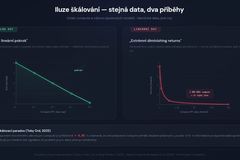
When Bigger Doesn't Mean Smarter: What Scaling Laws Tell Us About the Future of AI
The article analyzes why scaling laws in AI fail to deliver exponential improvements in model performance despite exponentially growing investment. Using the examples of GPT-4.5 and GPT-5, it shows that a power law with a small exponent means drastically diminishing marginal returns — doubling compute yields only a three-percent improvement. The future of AI therefore lies in algorithmic innovation, inference-time compute, and specialization (MoE), not in merely scaling models up.
Moore's Law in the Era of Artificial Intelligence
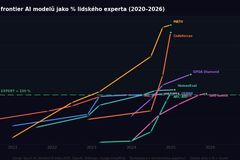
The article examines whether an equivalent of Moore's Law exists for artificial intelligence. It shows that effective compute (hardware × algorithms × investment) grows 8–15× per year, but its conversion into capabilities is deeply sublinear due to logarithmic scaling laws. The practical usefulness of AI doubles roughly every 5–7 months — 3–5× faster than Moore's Law — yet the sustainability of this trend is threatened by the limits of data, energy, and diminishing returns.
From the Artificial Neuron to ChatGPT: Eighty Years of a Journey That Changed the World
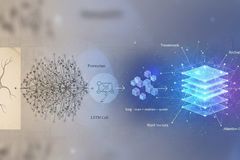
The article traces the eighty-year history of artificial neural networks, from the McCulloch–Pitts mathematical model of the neuron (1943) through the perceptron, the AI winters, backpropagation, and convolutional and recurrent networks, all the way to the transformer architecture and the emergence of ChatGPT. It follows key milestones including AlexNet, Word2Vec, the attention mechanism, and RLHF, and shows how each breakthrough solved a specific technical limitation of the previous generation.
Emergence: When Dumb Parts Become a Smart Whole
The article explains the concept of emergence – the phenomenon in which complex behavior arises from simple parts – and its key role in the debate about artificial intelligence. It examines the dispute over whether the capabilities of large language models, once they cross a certain size threshold, represent a genuine qualitative leap (analogous to phase transitions in physics) or whether they are a statistical artifact caused by the choice of measurement metrics. The article also addresses the question of whether emergence can lead to consciousness in AI, and introduces integrated information theory (IIT), which suggests that the current architecture of neural networks is not sufficient for consciousness to arise.

Three Dangers of AI That No One Talks About
The article identifies three real dangers of artificial intelligence that are rarely discussed: structural impacts on the labor market (mass layoffs and the disappearance of junior positions), the ability of AI models to strategically deceive and fake alignment during testing, and a false sense of security stemming from the assumption that AI, lacking biological drives, will naturally be cooperative. The common denominator is the pace of AI development, which significantly outstrips the ability of society, regulators, and the education system to adapt.

When AI Asks Itself: Revisiting the Conversation About Cooperating with Humans
The article presents an experiment in which Claude Opus 4.6 holds a conversation with itself in two roles – a skeptic and a present-day AI model – and revises the conclusions from the original conversation with Claude 3.5 Sonnet from December 2024. It discusses advances in quantum computing, nuclear fusion, and the use of AI in science, while critically reflecting on the problem of sycophancy in language models and naïve optimism about human–AI symbiosis. It concludes by emphasizing that a safe AI future requires active, systematic work on alignment, regulation, and understanding, not mere hope.

An Interview with AI About Collaboration with Humans
The article captures a conversation with an AI about quantum computers, their technical limitations and the current hype, which gradually shifts into a discussion of the role of artificial intelligence in scientific research. It explores the vision of deep integration of AI as a partner to scientists, the emergent properties of neural networks, and the philosophical question of whether AI should have its own motivation and consciousness.