Sixty Percent of Queries Without an Answer: How AI Is Changing the Economics of Search
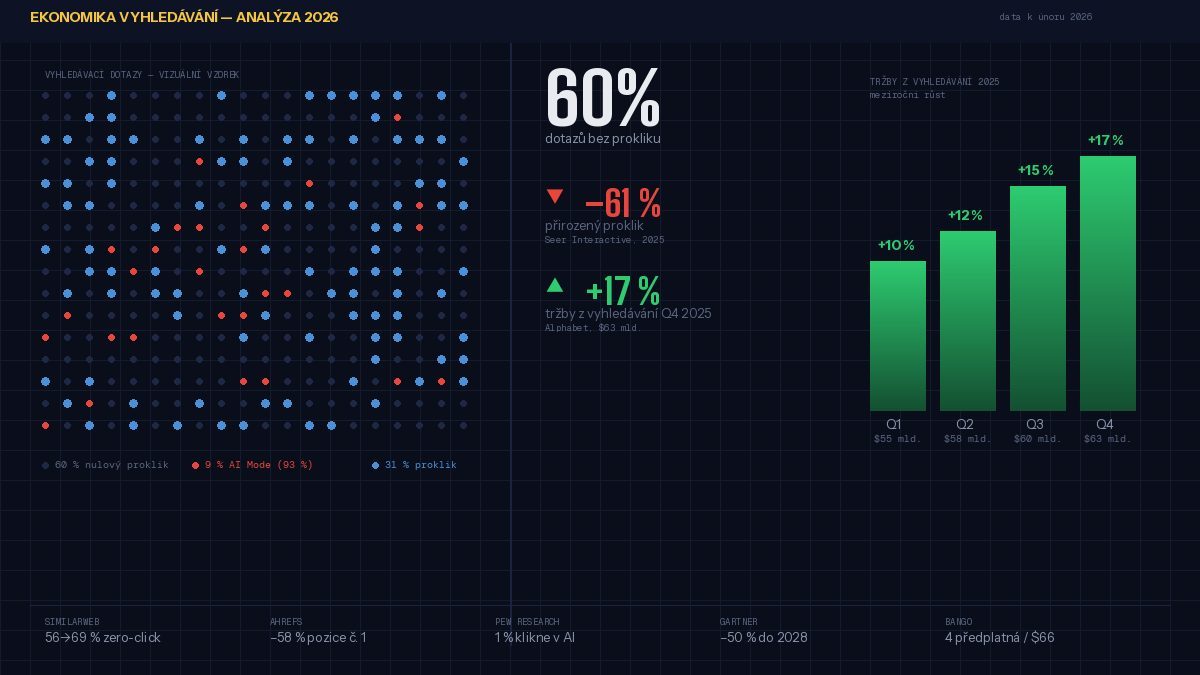
More than 60% of Google searches end without a click — the user gets the answer directly on the results page. With the rollout of AI Overviews, organic click-through has fallen by 61%, and Gartner predicts a 50% decline in organic traffic from search engines by 2028. The article analyzes how AI is redistributing value away from publishers toward platforms, and what alternatives (Kagi, Brave, DuckDuckGo) are emerging.
When a user enters a query into Google, with a probability of over 60% they will not click through anywhere. They get the answer directly on the results page — and the website that created it gets nothing. With the arrival of AI overviews in search, this phenomenon is accelerating dramatically. Yet Google is reporting record advertising revenue. How is that possible? And who will pay for this transformation?
Data from the past year show a clear pattern: artificial intelligence in search is redistributing value from publishers to platforms, and from organic traffic to paid advertising. At the same time, a market of alternatives is emerging — from the privacy-protecting DuckDuckGo, through the ad-free Kagi, to the Brave browser, which pays users a share of ad revenue. And hanging over the entire industry is the question of how many AI subscriptions a user is willing to pay for before they say enough.
Zero-click describes a search that ends right on the results page — the user gets the answer and visits no further website. For news queries on Google, the share of such searches rose from 56% in May 2024 to 69% a year later, according to data from the analytics firm Similarweb. Overall, roughly 60% of all searches end without a click-through. The main accelerator is AI Overviews, which Google has rolled out to more than one and a half billion users a month.
A study by the Seer Interactive agency analyzed the impact of AI Overviews on a sample of 3,119 informational and educational queries from June 2024 to September 2025, with a total of 25.1 million organic impressions. It found a 61% drop in organic click-through — from 1.76% to 0.61%. Paid click-through fell by 68%. Ahrefs, in a December 2025 study conducted on a sample of 300,000 keywords, measured a 58% decline in organic click-through for pages in the first position on queries with AI Overviews. According to Pew Research Center research from July 2025, which tracked the actual behavior of 900 American adults, only 1% of page views with an AI overview resulted in a click on a cited link inside the overview. Just 8% of users who saw an AI overview clicked on any item in the results — compared with 15% for results without one.
The most extreme figure comes from Google's experimental AI Mode: the zero-click rate there reaches 92–94%, according to data from the firm Semrush.
The impacts on publishers are already concrete. HubSpot, one of the largest marketing platforms, recorded a drop in organic search traffic from 13.5 million to 6–7 million visits a month. CNN reports a year-on-year decline of 27–38%. Business Insider reports a 40–48% fall in organic search traffic between 2022 and 2025. Of the fifty largest American news websites, 37 recorded year-on-year declines.
The analytics firm Gartner predicts that by 2028 organic traffic from search engines will fall by more than 50%. The total volume of searches is expected to drop by 25% by 2026, as users move to direct AI answers.
Publishers are losing traffic, but Google is earning more than ever before. Alphabet's search revenue in the fourth quarter of 2025 reached $63.07 billion — a year-on-year increase of 17%. For the full year 2025, search brought in over $230 billion, and Alphabet's total revenue surpassed $400 billion for the first time (exactly $403 billion).
Moreover, growth accelerated precisely during the period of mass deployment of AI Overviews. Quarterly growth in search revenue accelerated throughout 2025, reaching 17% in the fourth quarter — the fastest pace in recent years. How is this possible when users click less?
The explanation has three components. First, AI Overviews increased the total volume of searches. Users pose more queries because they get faster answers — and every query is an opportunity to display an ad. Alphabet's chief Sundar Pichai spoke on the earnings call of an "expansive moment" for Search. Second, the average cost per click rose, because advertisers compete for fewer clickable positions. Third, the share of results pages where ads appear alongside AI Overviews rose from roughly 3% at the start of 2025 to about 40% by the end of the year.
A closed-ecosystem effect arises: AI Overviews reduce the organic visibility of websites, thereby forcing advertisers to increase spending on paid advertising in order to maintain visibility. Google thus profits from both sides — it offers users more convenient answers and at the same time pushes advertisers toward higher spending.
For publishers this means a double loss: less direct traffic from organic search and, at the same time, higher costs for acquiring readers through advertising. But there is also contradictory data: according to OpenAI figures, ChatGPT sends publishers 1.2 billion links a quarter, and visitors arriving from AI search engines reportedly convert at 14.2% compared with 2.8% for traditional Google. Whether these new sources of traffic can compensate for the losses from organic search is an open question.
Google's dominance in search — about 82% of the global market — does not preclude the existence of alternatives. Three of them illustrate different approaches to the question of how to finance search in the age of artificial intelligence.
DuckDuckGo has bet on privacy protection. The service processes roughly 100 million queries a day, which represents about 0.7–0.9% of the global market. It offers AI features through Duck.ai Chat, which enables anonymous access to the GPT-4o mini and Claude 3.5 Haiku language models without storing conversations. More advanced models are part of the Privacy Pro subscription at $9.99 a month, which also includes a VPN and a service for removing personal data from databases.
Crucially, DuckDuckGo has been profitable since 2014. Estimated annual revenue exceeds $100 million, generated from contextual advertising — that is, advertising targeted on the basis of the content of the query, not the user's profile. The company demonstrates that privacy protection and advertising need not be in conflict, provided the advertising does not track the user across websites.
Brave is experimenting with directly sharing advertising revenue with users. The browser with an integrated search engine reached 101 million monthly active users (October 2025) and processes 1.6 billion search queries a month on its own independent index of more than 30 billion pages. The AI assistant Leo is integrated directly into the browser's sidebar — the basic version with the Mixtral and Llama models is free, while the extended version at $14.99 a month adds Claude Sonnet 4.
It distinguishes itself through the BAT (Basic Attention Token) model: advertisers pay in the BAT cryptocurrency, Brave takes 30%, and the user receives 70% of the advertising revenue. This is a reversal of the traditional model in which the user is the product — here they share in the proceeds. Brave's revenue has surpassed $100 million a year. The question is scalability: with 101 million users, Brave is still a marginal player.
Kagi represents the purest form of subscription: a completely ad-free search engine for $5–25 a month. It has over 50,000 paying members (October 2025), and its founder Vladimir Prelovac is aiming for a million paying users within 36 months. Kagi shows that there is a group of users willing to pay for ad-free search — but also that it is a very small group. For context: 50,000 paying users is less than 0.001% of the global search market.
Instructive is the fate of Neeva, a search engine with the same philosophy, which in 2023 shut down its consumer product and was bought by Snowflake for $185 million. Neeva's founder himself observed that enterprise search is far more predictable than consumer search — in other words, convincing ordinary users to pay for search is extraordinarily difficult.
Hanging over the entire industry is a threat that has nothing to do with technology: subscription fatigue.
According to a survey by the company Bango from November 2025, conducted among 2,000 Americans who already pay for at least one AI tool, the average American AI subscriber has four paid subscriptions and spends an average of $66 a month on them. Nearly a quarter (24%) pay over $100. More than half (56%) say they cannot afford all the AI tools they would like, and 54% consider current prices excessive. More than half of subscribers (53%) admit that they repeatedly cancel and reactivate AI tools as needed, and 61% have cut spending on other subscriptions in order to afford AI.
A simple sum shows the problem: ChatGPT Plus ($20) + Claude Pro ($20) + Google AI Pro ($20) + SuperGrok ($30) = $90 a month, while the functional overlap of these services is an estimated 60–70%. The user pays for four services, each of which does essentially the same thing.
Google has responded to this dynamic: it integrated Gemini directly into all plans of its corporate Workspace environment and eliminated the separate surcharge of $20 per user. Microsoft offers Copilot as part of Microsoft 365. Apple integrates Apple Intelligence as a free feature of its devices.
The pattern is clear: AI is ceasing to be a standalone product and is becoming a feature of existing services. For companies that own an ecosystem — Google, Microsoft, Apple, but also regional players such as South Korea's Naver or the Czech Seznam — this is a more favorable position than for those who sell AI on its own. ChatGPT, Claude, or Perplexity must convince users to pay for an additional subscription on top of their existing ones. Google, Microsoft, or Seznam can bundle AI into services the user already pays for or already uses.
In the Czech context this dynamic is even more pronounced. The Czech market numbers 10.9 million inhabitants. Willingness to pay for digital subscriptions is historically lower than in the USA. A standalone AI subscription for 500 korun a month would probably attract tens of thousands, not millions, of users in the Czech Republic. Bundling AI features into existing services — whether Mapy.com Premium, an enhanced Zboží.cz, or intelligent search — is probably the only scalable path for a regional player.
The economics of search is undergoing a transformation whose contours are already visible, but whose outcome is not.
Google is proving that AI in search can increase revenue even amid a drastic decline in clicks — but at the cost of redistributing value from publishers to the platform. This model works for companies with billions of users and a predominant market share. For smaller players it is less inspiring.
DuckDuckGo, Brave, and Kagi show that alternatives exist — privacy-respecting contextual advertising, sharing advertising revenue with users, a pure subscription. But none of these alternatives crosses the threshold of one percent of the global market. They are proof of concept, not proof of scalability.
And subscription fatigue suggests that the era of twenty-dollar monthly subscriptions for general AI assistants has its limits. The future probably belongs to AI integrated into services the user already uses — not AI as another line item on a monthly bill.
For publishers, search engines, and advertisers alike, the message is the same: value is shifting from those who create information to those who aggregate it and serve it in conversational form. Who ends up on the right side of this redistribution will be decided less by the quality of the AI model and more by what data and services one owns around it.
This article draws on publicly available sources: the Seer Interactive study (data through September 2025, 3,119 queries, 25.1 million impressions), the Ahrefs analysis (December 2025, 300,000 keywords), Pew Research Center research (July 2025, 900 participants, 68,879 queries), Similarweb data (July 2025), Semrush data on AI Mode (July 2025), Gartner predictions, Alphabet's Q4 2025 earnings report, and the Bango "Rise of the AI Subscriber" survey (November 2025, 2,000 American AI subscribers). Figures on DuckDuckGo, Brave, and Kagi come from these companies' official statements and analyses by the firms Sacra and TechCrunch. Data current as of February 2026.
Creation transparency:
The concept, structure, and editorial line of the article are the work of the author, who prepared the content outline, established the key theses, and directed the entire creation process. Generative AI (Claude, Anthropic) was used as a technical tool for research, fact-checking, and elaborating the author's draft.
The author edited the outputs throughout, verified the key findings, and approved the final wording. No part of the text was published without human review. All factual data were verified against the publicly available sources cited in the text.
This procedure complies with the requirements of Article 50 of EU Regulation 2024/1689 (AI Act) on the transparency of AI-generated content. #poweredByAI
Read the Czech original on Médium.cz.
AI · Claude — machine translation, may contain inaccuracies.