Moore's Law in the Era of Artificial Intelligence
The article examines whether an equivalent of Moore's Law exists for artificial intelligence. It shows that effective compute (hardware × algorithms × investment) grows 8–15× per year, but its conversion into capabilities is deeply sublinear due to logarithmic scaling laws. The practical usefulness of AI doubles roughly every 5–7 months — 3–5× faster than Moore's Law — yet the sustainability of this trend is threatened by the limits of data, energy, and diminishing returns.
In 1965, Gordon Moore published an observation that became one of the most-cited laws in the history of technology: the number of transistors on a chip doubles roughly every two years. This observation held surprisingly accurately for more than half a century and became the engine of the entire digital revolution — from mainframes through smartphones to today's GPU clusters training large language models.
But Moore's Law has one essential feature that popular accounts often overlook: it is a law about inputs, not outputs. It tells us how many transistors we can pack onto a chip, not how useful that chip will be. For decades this distinction did not matter — more transistors meant linearly more performance. Today, in the age of artificial intelligence, this distinction has become crucial.
The compute invested in training frontier AI models is growing at a pace that leaves Moore's Law far behind. According to data from Epoch AI, training compute doubles approximately every 6 months — that is, four times faster than Moore's Law. Between 2010 and 2024, training compute grew roughly 10-billion-fold. Hardware alone would have delivered only a sevenfold increase over the same period.
Where does that gap come from? From three concurrent exponentials that multiply one another. Hardware contributes roughly 1.35× per year (Moore's Law plus better chip architectures). Algorithmic efficiency adds an estimated 2.8× — according to a 2024 Epoch AI study (Ho et al.), the compute needed for a given level of performance halves every eight months, with a 95% confidence interval of 5–14 months; this corresponds to an annual factor in the range of 1.7–5.3×, with 2.8× being the point estimate. And finally investment: budgets for training clusters are growing 2–3× per year, from millions to billions of dollars.
The product of these three factors yields an estimated 8–15× per year (the exact value depends on methodology). In the ML community this product is referred to as "effective compute." Toby Ord, a philosopher at Oxford, in his essay "The Scaling Paradox" (January 2025) estimates its pace at roughly 12× per year, with a doubling time of just 3–5 months. This is, however, an upper estimate — other analyses (EA Forum, Epoch AI) arrive at a factor of roughly 6–10× per year.
The key number: Effective compute (hardware × algorithms × investment) grows an estimated 8–15× per year. Over five years that is a factor of tens of thousands to hundreds of thousands. Over ten years, billions. Moore's Law would over the same period deliver a factor of 32×, or 1,024× respectively.
If inputs translated directly into capabilities, AI should be improving at a pace that exceeds any human yardstick. The reality is substantially more complicated.
In 2020, a team at OpenAI led by Jared Kaplan published what are known as scaling laws, which show that model performance — measured as loss (a measure of error in predicting text) — decreases with compute according to a power law with an exponent of approximately 0.050. What does that mean in practice? You double the computational power — and the model improves by a mere three and a half percent. You invest ten times more — and the error rate drops by only about twelve percent.
An important qualification: Kaplan's exponents were corrected in 2022 by the "Chinchilla" study (Hoffmann et al.), which showed that the optimal allocation of compute should more evenly balance model size and the volume of data. The Chinchilla correction changes the optimal ratio of parameters to tokens, but the key insight — the deeply sublinear scaling of loss with compute — remains valid even after the correction.
It is as if you doubled the size of a factory and produced only a few more units. For a truly dramatic leap — say, to make the model commit half as many errors — you would need roughly a million times more computational power than what you started with. This is precisely why training each new generation of models costs an order of magnitude more than the previous one: GPT-4 consumed roughly 70× more compute than GPT-3, but the qualitative leap was, however impressive, only another step on a logarithmic curve.
Toby Ord summed it up in his essay "The Scaling Paradox" (January 2025, expanded into a series on the EA Forum in early 2026): inputs are growing superexponentially, but their conversion into capabilities is deeply subexponential. The result is that monumental investments (hundreds of billions of dollars) yield increments that are incremental — though cumulatively transformative.
Combining the exponential growth of effective compute (8–15×/year) with the logarithmic conversion into capabilities (exponent 0.05), we arrive at an estimate that loss decreases with a half-life of roughly 4–7 years. This is technically correct but practically uninformative — because loss is not the same thing as "intelligence."
The core of the problem lies in the fact that no single unified metric of "AI intelligence" exists. Instead, we have a mosaic of benchmarks — standardized tests, each of which measures a different capability. Some test encyclopedic knowledge, others mathematics, programming, or abstract reasoning.
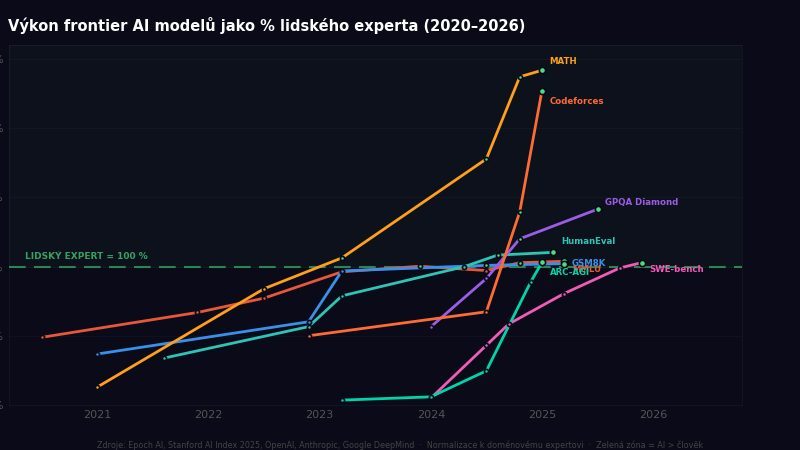
To compare the curves meaningfully, we normalize them to a common yardstick: the performance of a human expert in the given domain. In the following chart, 100% represents the performance of a human — a domain specialist — on each benchmark. Values above 100% mean that AI has surpassed the human.
(See the chart above.)
Most older benchmarks — MMLU (knowledge), GSM8K (basic mathematics), HumanEval (simple functions in Python) — have followed a typical sigmoidal trajectory. For a long time nothing happened, then came a sharp rise (usually with GPT-4 in March 2023) and then rapid saturation just above the human level. Today these benchmarks have lost their discriminating power: all frontier models score above 90% and the differences between them are statistically insignificant.
The most dramatic story is told by the MATH curve (competition mathematics). For five years it remained below the 100% level of a human PhD student, then came the o1 model in September 2024 and the score jumped to 237% — in a single quarter. The cause was not a larger model, but a new paradigm: inference-time compute, where the model "thinks longer" about harder problems. o3 pushed this even further, to 242%.
We see the same pattern with ARC-AGI: from 6% to 103% of the human level in six months, again thanks to o3. And with Codeforces: o3 reached a rating of 2724, corresponding to an International Grandmaster — roughly the top 100 competitive programmers in the world.
Inference-time compute deserves deeper attention, because it represents a fundamentally different paradigm from training-time scaling. Whereas training scaling raises a model's quality through a one-time investment, inference scaling makes it possible to "think longer" about a specific problem — and to pay for that on each query separately.
This has fundamental consequences. First, inference scaling has its own scaling laws, which are likewise logarithmic: Toby Ord, in his essay "Inference Scaling and the Log-x Chart" (2025), shows that standard inference-scaling charts (e.g. from OpenAI's o1 report) are presented with a misleading logarithmic X-axis that visually straightens a curve which is in reality deeply sublinear. Second, inference scaling does not replace but complements training scaling — it is a fourth multiplicative factor, but one that operates under a different economics: the costs are per-query, not one-time.
Third — and this is essential for the metrics table below — inference-time compute can selectively and dramatically improve performance on tasks with a verifiable answer (mathematics, programming, formal logic), whereas on tasks requiring creativity, empathy, or common-sense reasoning the benefit is markedly smaller. Most of the "discontinuities" in the chart above (MATH, ARC-AGI, Codeforces) fall into the first category.
As soon as AI saturates a benchmark, the community creates a harder version. HumanEval → SWE-bench → SWE-bench Verified → SWE-bench Pro. On the latest version (SWE-bench Pro, Scale AI) — industrial code, multi-language repositories, an average fix of 107 lines across 4 files — the initial results with a standard scaffold (SWE-Agent) reached a mere 23% for the best models (GPT-5 and Claude Opus 4.1). Newer agentic architectures, however, show dramatically different numbers: Auggie CLI with Claude Opus 4.5 reached 51.8%, GPT-5.3-Codex 56.8%. This spread illustrates a key nuance: on practical programming tasks, performance depends as much on the agentic scaffold as on the model itself. The same model can, depending on the agentic architecture, achieve either 23% or 52%.
GPQA Diamond (PhD-level natural sciences) is the last traditional benchmark that is not yet trivial, but even here frontier models achieve results substantially exceeding human experts.
High scores on older benchmarks should be approached with caution. There is mounting evidence that frontier models may have seen the evaluation data during training — IBM researchers in February 2026 noted that the SWE-bench Verified leaderboard is to a large extent saturated and contaminated. This is one of the reasons SWE-bench Pro was created, with proprietary repositories: on the private subset (code the models have never seen) the best score drops from 23% to a mere 15–18%. This yawning gap suggests that part of the "progress" on older benchmarks may be an artifact of data leakage rather than a genuine improvement in capabilities.
The "moving target" pattern: Each generation of benchmark is an order of magnitude harder. AI needs 1–2 years to reach a decent score — and then the community creates a new, even harder version. This is consistent with the logarithmic model: exponential compute → linear gain on a fixed test, but a practically unlimited supply of harder tests. But beware: part of the seemingly linear gain on fixed tests may be contamination rather than generalization.
Returning to the original question — is there an equivalent of Moore's Law for AI? — the answer depends on the choice of metric. Different metrics yield dramatically different doubling constants:
Metric / Doubling / Character
Transistors (Moore) / ~24 months / Hardware
AI training compute / ~6 months / Input (investment)
Effective compute / ~3–5 months / Input (HW + algo + invest.)
Algorithmic efficiency / ~8 months / Software
Task horizon (METR) / ~6.5 months (TH1.1) / Practical usefulness
SWE-bench Verified / ~4.5 months / Real-world SW engineering
Price per equivalent performance / ~3.6 months (decline) / Economic value
Loss gap (L − L∞) / ~67 months / Theoretical ceiling
Note on the table: The loss gap (L − L∞) measures the distance of the model's current error rate from the irreducible minimum — the entropy of natural language, below which no model can drop. It is this metric that most directly captures "how much room for improvement still remains," and its slow pace (67 months) illustrates how close frontier models are to the theoretical ceiling in text prediction. For metrics such as SWE-bench Verified and Task horizon, the exact doubling depends on the choice of time window — the figures given correspond to the 2023–2025 period.
The range is enormous: from 3–5 months (effective compute — pure input) to 67 months (loss gap — theoretical ceiling). Which of these figures is closest to an "AI Moore's Law"?
METR (Model Evaluation & Threat Research) measures the length of autonomous tasks that an AI agent can handle with 50% success. Unlike benchmarks, this metric is not bounded from above and measures practical usefulness. Over the entire observed period (2019–2025), the original methodology (TH1) reports a doubling roughly every 212 days (~7 months; Kwa et al., 2025). The updated version, TH1.1 (January 2026, an expanded set of 228 tasks), shows an overall trend of 196 days (~6.5 months). Since 2023 the trend has been markedly faster: 131 days per TH1.1, and since 2024 as little as 89 days — though the authors caution about the lower robustness of short-term estimates. The February 2026 dashboard already includes GPT-5.1 Codex Max (time horizon ~2.5 hours) and Gemini 3 Pro. The implication: if the trend holds, AI agents will handle one-month projects around 2027–2028.
It is, however, necessary to mention the growing criticism of the metric itself. MIT Technology Review (February 2026) published an analysis, "This is the most misunderstood graph in AI," which points out that the length of a task for a human need not be a good proxy for its difficulty for an AI — and that METR tests primarily software tasks, so extrapolation to "general AI capability" is problematic. Deborah Raji of UC Berkeley objects that "it is not necessarily the case that something that takes longer is a harder task."
SWE-bench Verified recorded growth from 3.8% to 80.9% (Claude Opus 4.5, February 2026) in under two years — a doubling roughly every 4.5 months. But beware: this number requires several qualifications. Saturation is approaching (above 70% the increments slow dramatically). The older data points come from the original version of the benchmark (2,294 instances), whereas Verified has only 500 instances — the exact estimate of the pace depends on the choice of starting point. And as SWE-bench Pro showed, performance on real-world multi-language projects is an order of magnitude lower. Vals.ai, moreover, reports in February 2026 that even the results on Verified depend substantially on the agentic setup (scaffold, token limit, number of steps), not on the model alone.
The price per equivalent performance is falling roughly 10× per year. The GPT-3 Davinci API cost about $20 per million tokens in 2022; equivalent quality is provided today by models costing less than 10 cents — a drop of more than two orders of magnitude in under three and a half years. The doubling of economic value: approximately 3.6 months. This figure is, however, influenced by the fact that it incorporates the decline in hardware costs, algorithmic improvement, and price competition among providers all at once.
The proposed "AI Moore's Law": The practical usefulness of AI (measured by task horizon or SWE-bench) doubles approximately every 5–7 months (with an uncertainty of ± 2 months, depending on the metric and time period). That is roughly 3–5× faster than Moore's Law — but unlike Moore's Law, this trend has lasted only a few years and its sustainability is uncertain.
Every exponential in the history of technology has eventually run into a physical, economic, or other limit. For AI scaling there are several concrete threats.
Data wall. Epoch AI estimates the total volume of publicly available human text at roughly 300 trillion tokens. At the current pace of over-training (200+ tokens per parameter), high-quality training data will run out around 2027. Ilya Sutskever, in his keynote at NeurIPS 2024, stated: "Pre-training as we know it will unquestionably end" — adding that we have reached "peak data" and that the future will lie in other approaches.
Energy ceiling. The Stargate project (a planned $500 billion, hundreds of thousands of GPUs) will consume on the order of gigawatts. Further scaling requires new power plants — and those are not built in months.
Diminishing returns. The scaling laws themselves predict that each further doubling of compute will yield an ever smaller increment. Meta postponed Llama 4 Behemoth because, according to internal evaluations, it was not improving sufficiently over the previous generation to justify a public release.
Inefficiency of reinforcement learning. The shift from pre-training to RL post-training (which underlies the successes of the o1/o3 series of models) brings its own scaling problem. RL is orders of magnitude less data-efficient than pre-training — estimates range from 1,000 to 1,000,000× (Ord, 2025–2026). Moreover, RL generalizes worse: a model trained on competition mathematics will improve dramatically at competition mathematics, but the benefit for "general intelligence" is markedly smaller than with comparable pre-training. In other words: the more the industry shifts toward RL and inference-time compute, the more the scaling properties of the system as a whole may deteriorate.
Bottleneck switch. The dominant constraint changes over time: 2020 — compute; 2024 — data; 2026+ — energy, regulation, alignment. Each transition may cause a slowdown or a change in the character of progress.
Moore's Law in the context of AI functions more as a metaphor than a precise analogy. Where Moore described a simple exponential in a single variable (transistors on a chip), AI progress is the product of three concurrent exponentials — hardware, algorithms, and investment — whose multiplicative interaction generates a seemingly miraculous pace. But the conversion into actual capabilities runs into a power law with an exponent approaching zero.
The result is a paradox: effective compute grows 8–15× per year, but capabilities improve logarithmically. Practical usefulness — measured by the length of tasks AI can handle, or by the number of real bugs it can fix — doubles approximately every 5–7 months. That is three to five times faster than Moore's Law, but probably sustainable only for another few years.
The most important question for the coming years is not "when will AGI arrive," but whether the current paradigms (scaling + reinforcement learning + inference-time compute) contain enough room for a qualitative leap — or whether a fundamentally new architecture will be needed. Optimists and skeptics disagree precisely on this point. And the empirical data do not yet allow a definitive verdict. It is worth noting that every new paradigm (pre-training → RL post-training → inference-time compute) has brought real gains, but with worse scaling properties than the one before — which is consistent both with the optimistic view ("a new source of improvement always turns up") and with the pessimistic one ("each new source is less efficient").
What we know for certain: the curves in the chart above will look different a year from now. Some benchmarks will saturate, new ones will emerge. Compute will grow, but returns will shrink. And somewhere between exponential investment and logarithmic returns, the story that defines the coming decade will be written.
Sources: Kaplan et al. "Scaling Laws for Neural Language Models" (arXiv:2001.08361, 2020); Hoffmann et al. "Training Compute-Optimal Large Language Models" (arXiv:2203.15556, 2022); Ho et al. "Algorithmic Progress in Language Models" (Epoch AI, 2024; epoch.ai/blog/algorithmic-progress-in-language-models); Stanford HAI "AI Index Report 2025"; Toby Ord "The Scaling Paradox" (blog post, 13 January 2025; tobyord.com/writing/the-scaling-paradox; expanded into a series on the EA Forum, February 2026); Toby Ord "Inference Scaling and the Log-x Chart" (2025); OpenAI "Competitive Programming with Large Reasoning Models" (2025); Scale AI "SWE-bench Pro" (2025–2026; scale.com/leaderboard/swe_bench_pro_public); Kwa et al. "Measuring AI Ability to Complete Long Tasks" (METR, arXiv:2503.14499, 2025); METR "Time Horizon 1.1" (29 January 2026; metr.org/blog/2026-1-29-time-horizon-1-1/); METR "Task-Completion Time Horizons of Frontier AI Models" (metr.org/time-horizons/); Sutskever, NeurIPS 2024 keynote (December 2024); Nikhil Suresh / MIT Technology Review "This is the most misunderstood graph in AI" (5 February 2026). Benchmark data: swebench.com, vals.ai, Epoch AI, official reports from OpenAI, Anthropic, Google DeepMind.
Methodological note
The conception, structure, and editorial line of the article are the work of the author, who prepared the content outline, established the key theses, and directed the entire creative process. Generative AI (Claude, Anthropic) was used as a technical tool for research, fact-checking, and fleshing out the author's draft.
The author edited the outputs continuously, verified the key findings, and approved the final wording. No part of the text was published without human review. All factual data were verified against the publicly available sources cited in the text.
The procedure complies with the requirements of Art. 50 of EU Regulation 2024/1689 (AI Act) on the transparency of AI-generated content. #poweredByAI
Read the Czech original on Médium.cz.
AI · Claude — machine translation, may contain inaccuracies.