Dead Hand, or: How I Learned to Stop Worrying and Let the Machine Sleep
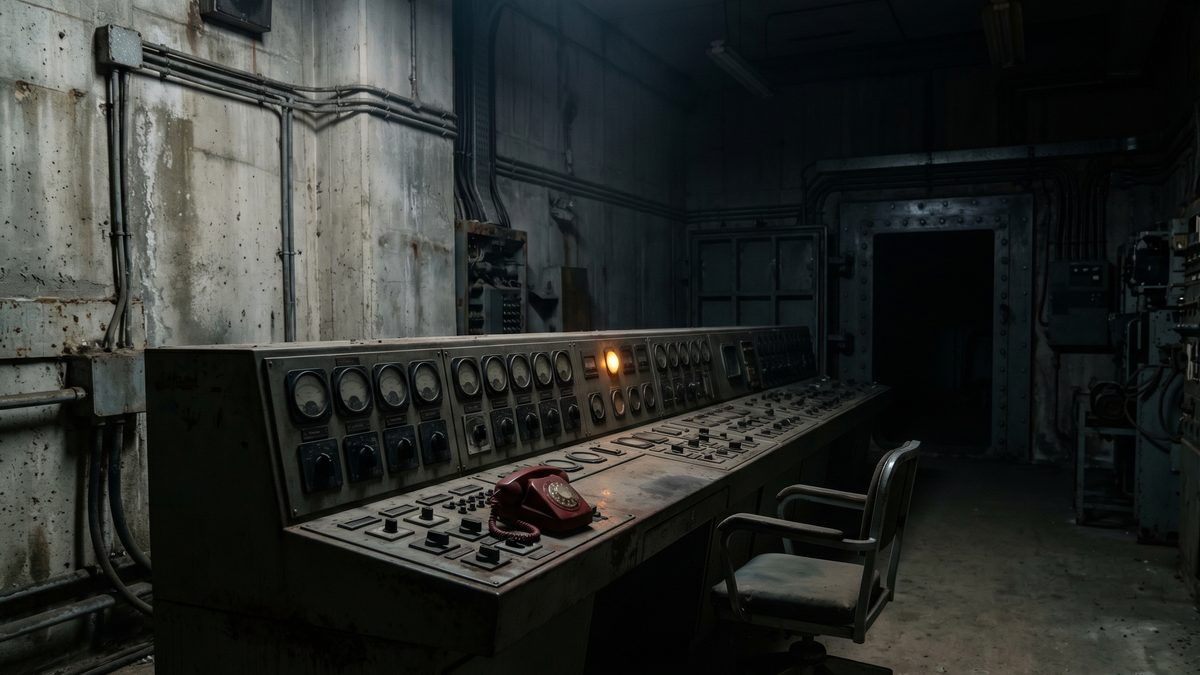
The article recounts the Soviet Perimeter system ("Dead Hand"), whose existence Russia first officially confirmed only in 2011, in an interview with Komsomolskaya Pravda. The author sets Kubrick's Dr. Strangelove against the system's actual design: Soviet generals rejected the original fully automatic machine and built instead a system with three conditions and a human decision made in a bunker. The point is that nuclear architecture holds together not because of the rationality of leaders, but because of the distrust their own engineers and officers have toward them.
On 16 December 2011, Komsomolskaya Pravda ran an interview with the commander of Russia's Strategic Rocket Forces. In it, Lieutenant General Sergei Karakayev told the journalist Viktor Baranets the sentence the world had been waiting for since the Cold War: "Yes, the Perimeter system exists today. It is on combat alert." It was the first official confirmation in history that a doomsday machine existed. For it, Moscow chose neither a government statement nor a military gazette, but a newspaper the reader opens for the crossword, the horoscope, and the weight-loss ads. Somewhere among them, they learned that the Dead Hand is alive.
Kubrick would not have shot that scene. Not that it was insufficiently absurd; it would have been struck out as implausible. Forty-seven years after his Dr. Strangelove indignantly explained that a secret doomsday machine is a contradiction in terms, Moscow reached the same conclusion — and made the announcement with all the dignity of a readers' poll.
I am writing about this now because fear of the thing is enjoying a renaissance. When American bombers struck Iran's nuclear program last June and dropped fourteen GBU-57 bombs on Fordow and Natanz, they left the underground complex near Isfahan alone. Why, the Chairman of the Joint Chiefs of Staff, General Dan Caine, explained to members of Congress at a closed briefing: for this heaviest conventional bomb in the American arsenal — thirteen tons of steel and explosive — Isfahan, where most of Iran's highly enriched uranium is estimated to have ended up, simply lies too deep. This spring, with Iran declaring the Strait of Hormuz closed and negotiations grinding, that sentence has taken on new charge. An unspoken question hangs over the negotiating tables: with what, then. For now, a notion is circulating online that the first combat use of an American nuclear weapon since 1945 would "wake the Dead Hand." It would not. What is more interesting is why that fear works so reliably. Doomsday machines and the men who command them sell the same merchandise — cultivated uncertainty — and what holds the world together is not the rationality of leaders that the deterrence textbook counts on, but the distrust their own engineers and colonels have for them. It sounds cynical. It is, oddly enough, the most consoling news the nuclear architecture has to offer.
Let us begin at the source. In the early 1960s, Stanley Kubrick set out to make a serious film: an adaptation of the thriller Red Alert, about an irreversible order for a nuclear strike. The seriousness did not survive his hands. The more faithfully the scenes copied the real logic of deterrence, the more comic they sounded, until the director capitulated and made a comedy; it reached cinemas in January 1964. Its doomsday machine — a Soviet device that, after a nuclear attack on the USSR, would automatically and irrevocably contaminate the planet — became the most famous machine that never existed.
Yet the point of the film lies not in the machine but in its secrecy. On screen, Strangelove rages that the whole purpose of such a device is lost if it is kept secret; only what the adversary knows about deters. The Soviet ambassador shrugs: the announcement had been planned for the Party congress on Monday. The Premier liked surprises. That exchange holds the entire field in a nutshell: deterrence is a discipline of communication. A weapon the enemy does not know about does not deter. It only kills.
The real Soviet Union took the joke as a specification — almost. In January 1985 it fielded the Perimeter system: command rockets that, should the leadership be destroyed, fly across the country and transmit the launch order in flight directly into the silos of intercontinental missiles. No cobalt, no contamination of the planet; "merely" a communications backup for the situation in which there is no longer anyone left to command. The original project, however, was more radical, according to Hoffman's reconstruction: a fully automatic machine, sensors and logic, no human anywhere. And here comes the least celebrated flicker of sanity of the Cold War — the Soviet military looked at a genuine doomsday machine on the drawing board and said no. In the middle of the most paranoid decade the superpowers ever lived through, its own generals found it over the line.
What they built instead was described by Valery Yarynich, one of its creators, in his book C3. The machine may act only if three conditions hold simultaneously: the leadership has issued authorization in advance, the link to it is dead, and sensors report nuclear detonations on Russian territory. And even then no algorithm presses anything; the decision belongs to people — officers on duty in a deep bunker. David Hoffman, whose book The Dead Hand about all of this won a Pulitzer, added the designers' intent: the purpose was to cool the hot heads at the top. If retaliation is guaranteed, no one in the Kremlin has to decide the fate of the world in the ten-minute window between the alert and the impact.
The engineers built the machine to protect the world from the panic of their own superiors. Perimeter is not an apocalypse automaton; it is distrust of the bosses, cast in granite and procedure. And it holds to this day.
Transparency of creation:
The concept, structure, and editorial line of the article are the work of the author, who prepared the content outline, established the key theses, and directed the entire creative process. Generative AI (Claude, Anthropic) was used as a tool for research, for locating primary sources, and for the formulational elaboration of the author's content outline.
The author edited the outputs throughout, verified the key findings, and approved the final wording. No part of the text was published without human review. All factual data were verified against publicly available primary and secondary sources.
This procedure complies with the requirements of Article 50 of EU Regulation 2024/1689 (AI Act) on the transparency of AI-generated content. #poweredByAI
Read the Czech original on Médium.cz.
AI · Claude — machine translation, may contain inaccuracies.