JFK, Tague's Curb, Salisbury Cathedral, and the Burned Notes
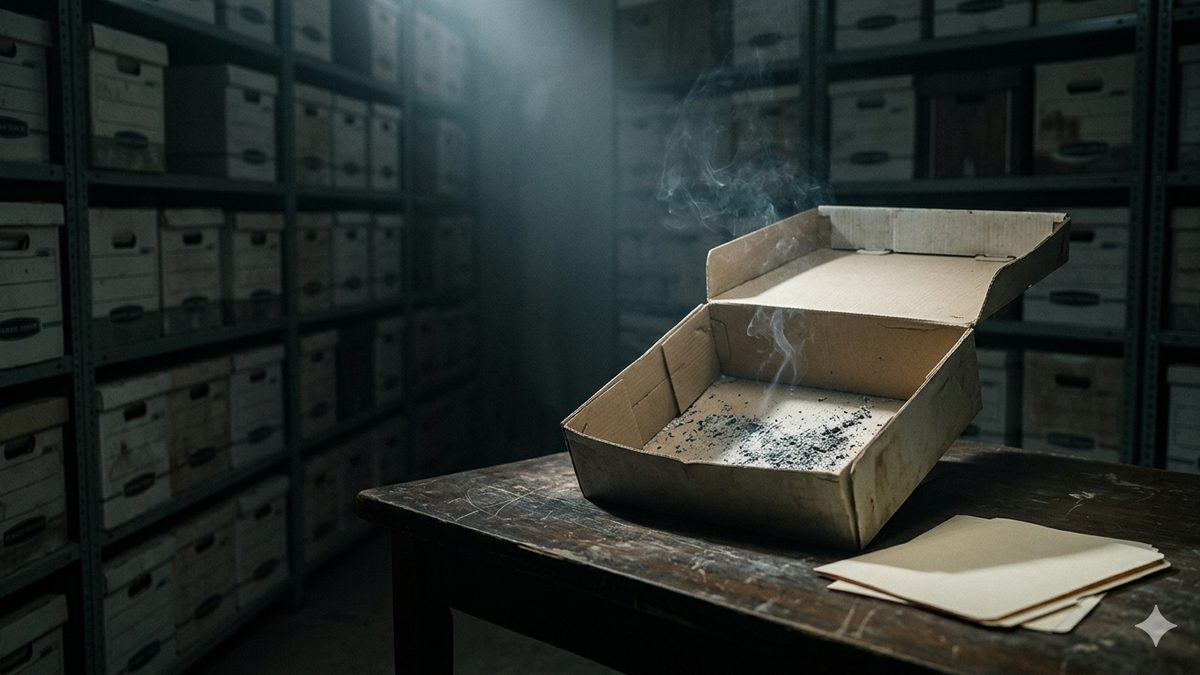
The essay uses the JFK assassination as the archetype of a so-called anti-Holmesian regime, in which evidence vanishes, is altered, or is stripped of its weight (burned autopsy notes, the wiped lead smear on Tague's curb, the lost spectrographic plates). Through concrete forensic details — the spectrography of the curb showing lead and antimony but no copper, incompatible with a full-metal-jacket Carcano bullet, and the contradiction between the crouching gunman in the reconstruction and the standing gunman described by witness Brennan — the author shows how cumulatively converging institutional interests become impossible to adjudicate. Salisbury 2018 serves as a modern counterpart and 'tombstone' of this epistemic regime.
Sunday, 24 November 1963: a pathologist in Bethesda burned the original autopsy notes from the assassination of President Kennedy. Fifty-five years later, two Russian officers sat in a Moscow studio explaining that they had come to Salisbury to see the spire of the local cathedral, a hundred and twenty-three meters tall. Between these two scenes lies an entire theory of knowledge — and a failure worth naming.
On Sunday, 24 November 1963, less than a day after the autopsy of the President of the United States, Commander James J. Humes sat down by the fireplace in his home and threw the original autopsy notes into the fire. He gave two reasons for it: the notes were stained with the President's blood, and it would have been indecent to hand them over to the archive. So he burned them.
That same evening, the first handwritten draft of the autopsy report also went up in flames. That one bore no blood. Into the fire went the notes and the draft, not the later fair copy — that one Humes had handed, around half past six that evening, to Admiral Burkley, the President's physician. Why he also burned the clean draft was never clarified by the Warren Commission, nor by the later House Select Committee on Assassinations (HSCA), nor by the Assassination Records Review Board in the 1990s. When Humes confirmed it before the Commission, counsel Arlen Specter did not ask for the reason and changed the subject.
I keep seeing that scene, because I regard it as the gateway into the way the epistemic regime I call anti-Holmesian in this text operates.
Sherlock Holmes works on the assumption that evidence stays put. When you leave the scene of a crime, the prints, the fibers, the pipe ash and the muddy footprint are still where they were at the moment of the crime. The investigator can return and examine. Eliminative logic — "when you have eliminated the impossible, whatever remains, however improbable, must be the truth" — presupposes a complete set of evidence, stable over time and accessible to anyone with the senses and the method.
The anti-Holmesian regime systematically negates that assumption. Evidence does not stay put. It vanishes, is altered, or is declared untrustworthy — for reasons that look individually defensible and cumulatively form a pattern. The investigator remains in an environment where no hypothesis is decidable, because the arbiter of the evidence is always somehow missing, altered, or stripped of its weight.
This is not a text about the JFK assassination. It is a text about when such a regime works, why it stops working, and what that means for someone who today tries to forensically reconstruct a history for which the primary evidence no longer exists. JFK is the archetype, not the subject. Salisbury 2018 is its headstone.
The evidence that could settle the matter falls, in an anti-Holmesian environment, into one of three situations. Either it physically disappears. Or it is altered so that it cannot be read. Or it remains, is analyzed, the result is recorded — and the institutional investigator assigns it a weight of zero, usually citing a methodological unreliability that is never applied symmetrically against convenient results.
These three categories are not the same as technique. They are three products of a regime in which the interests of institutions cumulatively converge on keeping certain facts undecidable. No single director is needed; it is enough that Bethesda did not want to look careless, the FBI incompetent, the National Archives did not want to admit a loss, the family did not want autopsy photographs running below the fold of the tabloid press, and the CIA did not want to disclose exactly what it knew about Oswald before the assassination. Each of those motives is in itself defensible. Their intersection produces a structure that no one intended and everyone preserves.
Here I must make a concession to an opponent I would otherwise be building out of straw. There is a passive anti-Holmes and an active anti-Holmes, and the difference is substantive. The passive mode arises from cumulative bureaucratic negligence, from time, from staff turnover, from archival errors, from legal compromises. It arises without intent; the history of every institution produces it. The active mode presupposes a decision — someone decided to burn, someone to clean up, someone to strip away weight. The pattern of losses alone cannot decide between these two modes. The pattern of losses says that the regime works. It does not say who runs it, nor whether anyone runs it at all. This is important to admit, because the moment one infers the presence of an author from the presence of a pattern, the investigator has fallen into the same trap, only from the other side.
In this text I am interested above all in the active mode. The passive one exists and explains a part; the active one likewise exists and is demonstrably an integral component of the modus operandi of intelligence services throughout the twentieth century. Limited hangout — releasing part of the truth as an offering so the rest disappears under the feeling "we already know enough." Plausible deniability — maintaining several credible alternatives so that the truth can be separated from the cover only at a cost no one will bear. Compartmentalization — no single individual holds the whole picture, so reconstruction from the parts is in principle uncompletable. And the inflation of alternatives — instead of hiding the evidence, flooding the environment with competing versions, each of them half-documented and none of them falsifiable.
All of this works under one condition: that the investigator — journalist, commission, court, historian — has no independent access to the arbiter. To the thing itself, to a record outside institutional control, to a witness who survives and can speak. For most of the twentieth century, that condition held. But in the last fifteen years something has changed, and it deserves separate treatment.
On 22 November 1963, at roughly 12:30, a twenty-seven-year-old car salesman named James Tague stood on the south side of Main Street, by the triple railroad underpass at the western end of Dealey Plaza — several hundred feet from the Texas School Book Depository and a few steps from the curb on which the things that hold this report together took place. Tague heard shots and felt a stinging pain on his right cheek. When a Dallas detective came over, he noticed a fresh scratch with a drop of blood on Tague's cheek; together they searched the surroundings and on the upper edge of the curb found a fresh gouge, which both of them interpreted as a mark left by the impact of a projectile or a fragment of one. Officer L. L. Hill reported the incident by radio at about 12:40 with the words "I have a man here who may have been hit by a ricochet off the concrete."
This recorded line is the starting point. There is nothing controversial about it. Cartridge cases drop, projectiles ricochet, people on street corners occasionally take a piece of pavement to the face. What happened to this recorded fact in the following months is the first demonstration of the anti-Holmesian regime in full, documented form.
The FBI cut out the curb and took it into custody only in the summer of 1964 — not immediately, but with a delay on the order of eight months. In the meantime Tague himself visited the curb to photograph it for the family, and found that the lead smear from the original gouge was no longer there. Someone had wiped it off. Whom the contamination bothered, the official record does not say. The smear was thus removed from the evidentiary chain before the FBI even arrived at the scene.
From what remained, the FBI performed a spectrographic analysis in 1964. The result was preserved in the record and is stated plainly: the gouge showed traces of lead and antimony, no copper. This result is substantively decisive and deserves a physical interpretation, because any softening of it leads to a distorted discussion.
The military full metal jacket bullet, the Carcano 6.5×52 with which, according to the Warren Commission, the assassination was committed, has a copper jacket over its entire surface except the open base. The copper is the outer layer that, on impact, comes into contact with the target first; the lead with antimony is inside, hidden beneath the jacket. This geometry is not a detail. It is the defining property of full-metal-jacket construction and the reason such a bullet is made.
From this it follows what the spectrography of the curb would have had to find if the gouge had been caused by a bullet from rifle C2766. In a clean ricochet, an intact full-metal-jacket bullet would skid and leave a smear from the copper surface. In a harder impact, where the jacket tore, copper and lead would be there together. Copper would, under any scenario, have to be present. Lead without copper is a result that an intact Carcano bullet cannot produce.
Three avenues open up by which that result might nonetheless be compatible with the official version, and each has its problem. Defective ammunition with a jacket that disintegrated already in the barrel: refuted by the fact that it would have left fragments in the barrel, which the FBI examined and which agent Frazier in his testimony described as undamaged. A fragment from a later shot whose jacket tore on the target: refuted by the fact that even such a fragment would itself carry copper — a jacket does not tear in such a way that the copper peels completely off the lead. Deformation in flight: refuted by the fact that air does not strip a jacket, and between the barrel in the depository window and the curb on Main Street there is no target that would cause deformation.
Only one possibility remains consistent with what the FBI measured. The curb was struck by a bullet that had lead as its outer surface — that is, either an unjacketed soft-point hunting bullet or any other ammunition outside the class of military full-metal-jacket projectiles. That means a different weapon, different ammunition, a different shooter.
The Warren Commission indirectly formulated this possibility in its report, when it wrote that the absence of copper rules out that the gouge could have been caused by an undeformed military full-metal-jacket bullet, such as the one from Connally's stretcher. The Commission thus, by its own finding, closed off every avenue by which the official version could be saved, and opened no other. It noted the result and moved on.
Here the whole matter could have ended as a controversy in the record, one that modern methods could revise at any later point. The analysis was performed on glass slides — preparations on which the sample from the curb was captured in a form that can be read repeatedly. The slides are not "the result." They are a physical record on which the result could, decades later, be measured anew with more sensitive methods. Inductively coupled plasma mass spectrometry (ICP-MS) would today, from those same slides, determine the origin of the lead with far greater precision than the 1964 spectrography; neutron activation analysis (NAA) would capture trace elements at concentrations the method of that era missed.
The slides vanished from FBI evidence after the analysis in 1964.
The researcher Harold Weisberg, who studied the assassination for four decades, filed suit in the 1970s under the Freedom of Information Act seeking their return to evidence. On the merits he did not succeed — the FBI admitted it did not have the slides, and the dispute ended in a formal limbo. The slides exist in the record as an artifact that was once analyzed, as a result that was recorded, and as a physical object that, at the moment when it would be useful to read it again by a modern method, is not available.
In a single curb in Dealey Plaza, then, you have all three categories of the anti-Holmesian regime at once. The lead smear was altered — wiped off before the photograph, before the seizure, before the analysis. The slides were lost — physically removed from evidence after the analysis, when no one who might want to use them to support a different conclusion could have them. And the result that was preserved in the record — lead and antimony without copper, incompatible with an intact Carcano bullet — was trivialized: recorded, formally admitted, and at the interpretive level bypassed as an anomaly the Commission did not pursue further.
From this point it is fitting to move to a matter connected to it mechanically, not merely interpretively. The nest from which, according to the Commission, Oswald fired was in the southeast corner of the sixth floor of the depository — in a building whose structural description and dimensions are in period documents. The floor had a roughly thirty-meter square footprint, a ceiling height of around three and a half meters, and double-hung wooden sash windows, each with four panes of glass. The inner brick sill rose only about thirty centimeters above the floor, unusually low, characteristically for a turn-of-the-century warehouse building. The lower sash of the window was raised at the moment of the assassination, creating an open area about seventy-five centimeters high.
From the Dallas police photographs, taken on the afternoon of 22 November by Detective Studebaker, the geometry of the nest can be reconstructed. Three walls of stacked book cartons — each roughly forty-five by thirty by thirty-five centimeters and weighing around twenty-five kilograms — formed a roughly two-meter square set into the corner, reaching the waist height of an adult man. In front, between the line of sight into the window and the shooter, stood two smaller boxes labeled "Rolling Readers." They did not contain books, as the label would suggest, but plastic teaching blocks. The Warren Commission, in its description, called them easily adjustable and firm enough to serve as a rest for the rifle.
This geometry sets two things against each other. If the shooter had been kneeling or sitting behind the wall of boxes at a height of a meter and a half, only his head and the upper part of his torso would have been visible from outside, protruding above the boxes in the open part of the window. If he had been standing, he would have been visible from the waist up.
The Commission's chief witness, Howard Brennan, who stood on a concrete wall at the corner of Elm and Houston at a distance of thirty-five meters from the window, described the man in the window, in his testimony of 24 March 1964, as standing, leaning on the left sill, with the rifle at his right shoulder. He took aim calmly, the testimony went, fired the last shot, and only then withdrew the weapon. Brennan moreover gave the man's height as around 178 centimeters and weight as seventy-five to eighty kilograms — figures that can be estimated from a distance of thirty-five meters through dirty glass only if the whole figure is visible. From a crouched position behind a box barrier they could not have arisen.
The Commission thus works simultaneously with two incompatible images. The reconstruction in today's Sixth Floor Museum and the photographs of the nest have the shooter crouched behind a wall of boxes. The chief witness described a shooter standing at full height. This contradiction is not a trifle of editorial work; it is a dispute about the basic geometry of what happened there, and the Commission never fully resolves it in its report. Either Brennan exaggerated or embellished what he saw — in which case his identification of Oswald is built on a description that does not match the reconstruction. Or he saw correctly and the shooter really did expose himself openly, which, for an assassination planned from a building full of witnesses, with an escape on a city bus through town, is a strangely amateurish choice.
And here comes the second layer. Lee Harvey Oswald served from 1956 to 1959 in the United States Marine Corps. According to military records he passed basic shooting qualification twice: in December 1956 as a Sharpshooter (212 points, two above the threshold) and in May 1959 only as a Marksman (191 points, a single point above the lower qualification threshold). Here one must speak precisely: Oswald was a radar operator with basic qualification, not a trained scout-sniper. This matters, because the core of the following argument is a technique that belongs to the sniper curriculum, and there is no evidence that Oswald went through it.
That technique is so-called loophole shooting, firing through a loophole. The principle is simple and unchanged in doctrine since the First World War: the shooter positions himself deep inside the room, out of direct view from outside, the barrel stays inside the space, and he fires through the window frame from a dark background out into the lit space. From outside, through the lit glass into the darkened room, no one can see — the body, the movement, the muzzle smoke and the ejected cartridge cases all stay hidden. Even a soldier with basic training knows that exposing oneself in a window is a mistake. A professional sniper would not have done even that.
In the nest, this principle was not applied. On the contrary: the reconstruction has the barrel of the weapon out of the open window, resting on a box on the outer sill, and Brennan's testimony has the shooter in a visible position.
Here belongs one often-cited but weakly documented thing, which it is fair to frame cautiously. The former Marine sniper Carlos Hathcock, holder of ninety-three confirmed kills from Vietnam, is said, according to Craig Roberts's book Kill Zone: A Sniper Looks at Dealey Plaza (1994), to have stated that he and his team at Quantico repeatedly attempted to reconstruct the shot from the nest and not once managed to repeat it. Roberts, himself a Marine sniper, visited the depository window in 1987 and consulted Hathcock for the book. This is anecdotal testimony from a single secondary source, not a documented controlled experiment, and it is contested: other reconstructions, beginning with the CBS test of 1967, did repeat the sequence of three shots in the prescribed time. It therefore belongs at the level of testimony, not physics, and carries only insofar as it is taken with this reservation. What remains physical, by contrast, is the geometry itself: a target approaching head-on along Houston Street was an easier shot than a target departing along Elm Street, partly screened by an oak, and the Commission claims that Oswald fired only at the harder one.
This choice of geometry has one more consequence, which seemingly concerns an entirely different matter but is firmly bound to it. When Oswald, according to the reconstruction, thrust the barrel out of the window, the stream of gases from the muzzle flew outward, not into the room. When firing full-metal-jacket ammunition, by far the largest share of combustion products and nitrate residue leaves precisely from the muzzle; the breech is sealed during firing by the cartridge case, which expands into the chamber, and gas escapes through the breech only when it is opened, when the pressure is already low. If, then, the barrel really was outside, this explains why the paraffin test of Oswald's right cheek did not come out positive, even though it did on both hands: the hands bore traces from the stock, the bolt, the cartridge cases and from handling the ammunition, while the face was separated from the main source of contamination by the brickwork and the window glass. A negative face is physically compatible with this geometry and does not rule out that Oswald fired.
The Commission essentially explained it this way as well — Cortlandt Cunningham of the FBI testified in April 1964 that agent Killion fired the same rifle C2766 three times in rapid succession and the paraffin test of his face was likewise negative. This part of the defense is internally coherent. The price of accepting it, however, is a commitment to the claim that the shooter really did thrust the barrel out, that is, exposed himself to view from the plaza. The Commission cannot simultaneously claim that Oswald was a competent shooter and that he fired in this way; one or the other must fall. Either he did something in that room that basic logic of concealment rules out, and moreover exposed himself in a well-visible window and fired at a geometrically worse moment than if he had waited fifty-five seconds. Or something other than what the Commission inferred was taking place there. From the photographs and from the testimony of Brennan, Walther, Rowland, Euins and the fifth-floor employees Williams, Norman and Jarman, no single unambiguous reading can be decided. But one can register that every version the Commission tried to push runs into its own witness or its own geometry. That is another entry in the same pattern.
And it is not an isolated entry. President Kennedy's brain vanished from the National Archives in the mid-1960s from formally controlled custody, and the autopsy tissue sections vanished along with it. A skull fragment found in Dealey Plaza by the student Billy Harper — one that would itself have settled the dispute over the direction of the fatal wound, occipital or parietal — was lost at the FBI in Dallas. The autopsy notes and the first draft burned in Humes's fireplace. The limousine was taken to Cincinnati and rebuilt; the windshield, on which the Secret Service had reported a crack from a projectile, was replaced during the rebuild.
Each of those items has an individually defensible explanation. Humes was exhausted, the National Archives chaotic, the FBI made compromises, Connally's clothing the family cleaned out of piety, the paraffin test was never a forensic standard. No single loss proves a conspiracy. The pattern of losses as a whole — precisely the primary arbiters disappear, while indirect data, copies, photographs and testimony mostly survive — proves something else: that the regime in which this was happening was structured so that the result of a specific inquiry would remain undecidable. That is the definition of an anti-Holmesian environment, and Dealey Plaza 1963 is its archetype. The question I am posing is not whether it was a conspiracy. The question is why it worked then and why it does not work now.
Let me return to the nest. The wall of boxes and the standing man are one layer of the dispute over what took place in that room. The second is in the ballistics themselves — in what was found and in what is wrong with the find.
On the floor of the nest, three fired Carcano cartridge cases were found, later catalogued as Commission Exhibits 543, 544 and 545. Three cases correspond to the three shots the Commission attributes to Oswald. On a close reading of the ballistic reports, however, one of them, CE 543, bears three independent anomalies that together show it is not a case from a shot fired on 22 November 1963.
The first anomaly is a dented case mouth. On the rim of the case there is a pronounced inward bend that narrows the opening below the diameter of the six-and-a-half-millimeter bullet. Josiah Thompson, in his book Six Seconds in Dallas (1967), showed that in this condition the case would not hold a bullet — it would either fail to seat or deform. CE 543, in the condition in which it was found, therefore does not serve as a valid firing case.
The second anomaly is three sets of identification marks on the head of the case, which the HSCA firearms panel itself documented in 1978 (paragraph 132 of the report). On CE 543 they are present; on CE 544 and CE 545 they are absent. Their origin the panel literally could not determine. Thompson's interpretation is that they are traces of repeated loading and extraction, that is, that CE 543 was in the rifle's chamber multiple times.
The third anomaly is a deeper and more concave dent in the primer, characteristic of so-called dry firing — the firing pin struck the primer with no powder and bullet in the chamber. The FBI itself reproduced this phenomenon on a control case, CE 557, which it cycled empty in the Carcano; the signature on CE 543 matches that reproduction.
The combination of three anomalies leads to a single consistent explanation: CE 543 was repeatedly cycled in the rifle with an empty chamber, acquiring in the process the dented mouth, the multiple marks and the firing-pin mark on the primer, and on 22 November ended up in the nest either as a remnant of earlier testing or was placed there. From a shot fired that day, however, it does not come.
If this holds, at most two live bullets were fired from rifle C2766 that day. This reduction radically changes the arithmetic of the case. The Commission needs three shots to fit two hits plus one miss toward Tague's curb. With two shots the equation collapses: either the curb was struck by a fragment from one of those two shots — which, as we have gone through, the spectrography rules out — or the third "shot" came from a different position, a different weapon, different ammunition. Two independent lines of evidence, the anomalies of CE 543 and the spectroscopy of the curb, converge on the same conclusion: more than two bullets were fired in Dealey Plaza, and the third comes from elsewhere.
To this is added a matter I would, under other circumstances, have expected to be decisive. If Oswald really fired three shots, he must have loaded the rifle, aimed and repeatedly cycled the bolt with bare hands, without gloves. Some of that would have left traces. Lieutenant J. C. Day of the Dallas police treated the rifle with fingerprint powder on the evening of 22 November — from the photograph, powder is visible practically everywhere, on the forestock, the bolt, the stock and the trigger. Day confirmed before the Commission that on the stock and forestock he found no usable prints, identified or unidentified. On the trigger none, on the bolt handle none, on the three fired cases none, on the unfired cartridge in the chamber none, on the en-bloc clip in the chamber none.
The only print attributed to Oswald is a palm print on the underside of the forestock. But it was discovered seven days after the assassination, passed under the control of a single person (Lieutenant Day) outside the institutional chain of custody, and entered FBI evidence only on 29 November. Sebastian Latona, head of the FBI's fingerprint laboratory, found no latent print worthy of identification on the rifle on 23 November. Between Latona's conclusion and Day's lifting of the print lie six days, during which Day, his subordinates and FBI investigators had access to the rifle. In those same six days Oswald was dead and his palms were available for a post-mortem taking.
The third line, which I have so far left aside, is the chain of custody of the rifle from order to nest. Klein's Sporting Goods in Chicago, in the February 1963 issue of The American Rifleman, advertised the Italian military-surplus Mannlicher-Carcano; the illustration with the ad showed the thirty-six-inch carbine model 91 TS, the rifle alone without a scope cost $12.78, the variant with a mounted Japanese four-power Ordnance Optics scope $19.95 (catalog number C20-T750). The order coupon, filled out in the hand of "A. Hidell" — Hidell was an alias Oswald used and had on a false ID at his arrest in the Texas Theatre — was postmarked at a Dallas post office on 12 March 1963 and received by Klein's a day later. To post office box 2915, rented by Lee Oswald since October 1962, Klein's sent the rifle around 20 March for $21.45: that corresponds to the price of $19.95 for the scope-equipped set plus $1.50 for postage, as the Warren Report itself documented.
The anomaly here, then, is not in the equipment or the price — the amount paid fits the scope-equipped set the coupon ordered. The anomaly is in the length. The ad showed a thirty-six-inch carbine, but a forty-inch model 91/38 (serial number C2766) was delivered. Klein's explains this by saying the same catalog item (C20-T750) kept its number even after the seller ran out of stock of the shorter carbines and replaced them with the longer variant; on that reading the length difference is explained and is not a strong discrepancy. I record it, therefore, as an open, not an incriminating, circumstance.
The link between Hidell and Oswald is, in the case, a topic in its own right and deserves separate treatment, because in the institutional record it plays the role of a solid link from which the rest of the chain hangs. It consists of four artifacts and one testimony. At his arrest in the Texas Theatre, Oswald had in his wallet two false IDs with his own photograph and the name "Alek James Hidell" — a Selective Service System card and a Marine Corps Reserve card. Both documents were produced with photographic technique consistent with the equipment of the firm Jaggars-Chiles-Stovall, where Oswald worked from April to October 1962; their actual manufacture the Commission attributed to him by inference from access to the equipment, not by direct evidence, and Oswald denied their existence after his arrest. The third artifact is the handwriting on the Klein's order coupon, which the Commission's experts James Cadigan and Alwyn Cole identified as matching Oswald's samples — this identification stands at medium to higher confidence, although the National Academy of Sciences in 2009 placed forensic handwriting analysis among the disciplines of questionable scientific validity. The fourth is a similar coupon to the firm Seaport Traders for a revolver with an identical handwriting identification. The fifth link is the testimony of Marina Oswald, according to whom Lee used the pseudonym Hidell in correspondence with the Fair Play for Cuba Committee and in weapons orders; it was, however, made under considerable pressure on an immigrant from the Soviet Union after her husband's death, and her later versions were more consistent with the official version than her first interrogations in November 1963.
The link Oswald equals Hidell is therefore the strongest single link in the case — stronger than the paraffin test, the identification in the window, the bullets in Tippit's body, or the palm print on the stock. What it proves: that Oswald used the pseudonym Hidell for mail-order purchases and had false IDs in that name. What it does not prove: that he physically collected the package with rifle C2766 from box 2915, that he brought this rifle into the depository on 22 November, and that he fired it from the nest. Between the firmly anchored link of Hidell to the rifle coupon and the extreme claim that Oswald shot at the President lie four further links, none of which is closed in itself. Hidell's existence as Oswald's alias functions as a firm knot, from which, however, a weak rope hangs.
Klein's internal record of this shipment survived in the form of a photocopy known as Waldman Exhibit 7. The original stock and invoicing documents of Klein's and of the importer, the New York firm Crescent Firearms, however, vanished from FBI custody after the assassination. Without them it is institutionally unverifiable exactly when rifle C2766 was in Klein's warehouse, which specific rifle they sent that day, and whether it was the same one as the one found in the nest.
The postal money order with which the rifle was paid bears serial number 2-202-130-462. John Armstrong, in his book Harvey and Lee (2003), went through the sequence of serial numbers of money orders issued at the Dallas branch at that time, and by his calculation this number came from a batch that in March 1963 was not yet in circulation and was supposed to be issued roughly a year and a half later. If Armstrong's calculations hold, the money order at the moment when Oswald, according to the official version, was supposed to buy it, did not exist. This is a secondary claim, resting on a single author, and I present it with this reservation; it also lacks the standard bank endorsement that would confirm passage through the ordinary clearing route.
And the last link — the physical collection of the package. A rifle forty inches long does not fit into a post office box; it had to be collected at the counter with presentation of identification. According to the Postal Service Manual of 1963, section 846.53h, a postal clerk required, for a shipment addressed to a person other than the box holder, a so-called Form 2162, an authorization form signed by the holder. Oswald, on his application for box 2915, did not list Hidell as an authorized recipient, and a Form 2162 for Hidell was never found in the Dallas postal record. No postal clerk testified under oath that he saw Oswald collect the package. Physical collection is documented only by logical inference, not by direct testimony.
The chain from the importer through Klein's, the post office and the post office box to the nest thus has nine independent links, and several of them carry their own discrepancy: the disappearance of the original records, the anomalous money order, the missing Form 2162, the absent testimony of collection. No single link by itself breaks the chain. But a chain in which so many links carry a discrepancy would not be accepted as closed by any civil lawyer in an ordinary dispute over ownership of a thing.
Parallel to JFK, on the same day and in the same mode, stands in Oak Cliff the murder of Officer J. D. Tippit. Four fired cartridge cases were found at four different locations along the escape route — on the sidewalk, in the bushes, in the yard of the Davis family — and were picked up bare-handed by four different witnesses without any chain of custody. The ammunition on the ground was split two to two by manufacturer (two Remington-Peters, two Western-Winchester); the bullets removed from the body split three Western-Winchester, one Remington-Peters.
For one weapon, one cylinder and four shots, this configuration is internally incompatible. The Commission resolves it with the hypothesis of a fifth, unfound shot: five shots were supposedly fired, and one Western case and one missed Remington-Peters bullet simply were not found. It is fair to state the hypothesis — and right beside it its weakness. The killer's escape route was narrow and watched by several witnesses; that a whole cartridge case should remain undiscovered along it is not impossible, but it is improbable. And the cases lay in evidence for five days before the Dallas police sent them to the FBI (the laboratory received them on 30 November), an interval that in itself raises the question of custody.
The chief witness, Helen Markham, described the killer as physically different from Oswald — as short, stocky, with curly dark hair; Oswald was 175 centimeters tall, slim, with straight brown hair. Acquilla Clemmons, from a house near the scene, claimed she saw two men running from the body, one with a revolver and a calming gesture, the other in the opposite direction. Her testimony the Warren Commission did not obtain; according to later interviews with Mark Lane in the 1960s, the police discouraged her from speaking further.
Oswald's revolver was a Smith & Wesson Victory Model with serial number V510210, converted from the original British caliber .38 S&W to the American .38 Special — a common commercial conversion of war-surplus weapons in the 1950s. The chambers in the cylinder were bored out for the longer Special case, but their internal diameter remained for the original S&W. As a result, a .38 Special case sits loosely in the chamber, "balloons" on firing, and the bullet enters the barrel off-axis; the marks left by the rifling on the bullets are atypical and difficult to compare. The FBI, in the testimony of Cunningham and Frazier before the Commission, formulated that the bullets from Tippit's body are "consistent with" this revolver, not "fired from" it. The Commission's final report converted that distinction into a firm identification without additional substantiation.
And Oswald, who according to the official version was supposed to fire four shots from the revolver and immediately afterward, while walking, manually shake the hot brass cases out into his palm, had at his arrest in the Texas Theatre five hours later not a single burn. The brass of a fired .38 Special case has, immediately after firing, a temperature of over a hundred and fifty degrees Celsius, and after four rapid shots the whole cylinder is heated; shaking four cases out into the palm and scattering them at four locations would have left contact burns of the first, possibly second, degree. None are recorded in the documentation from 22 or 23 November. This negative finding is strong if the exposure was one that must leave a trace, and weaker if it was a trace that could be overlooked.
The same regime, the same day, a different hour. Tippit's murder is institutionally closed, forensically open.
It is worth assembling what the Commission systematically failed to do: a categorized list of the points at which the institutional narrative stands in contradiction with physics, with the Commission's own record, with its own witnesses, with its own ballistics, with the procedural rules of the institutions involved, or with the training of the suspect. The list is not exhaustive, and each item could bear a monograph of its own; it serves as a calibrating orientation to how dense the field of discrepancies actually is. Most of the particulars we have gone through above, and here I merely refer to them.
In contradiction with physics stand above all the spectrography of Tague's curb — lead and antimony without copper, incompatible with an intact Carcano bullet (see above) — and the absence of burns on Oswald's hands after shaking hot brass out of the revolver, described by witnesses Benavides, Callaway and the Davis sisters.
In contradiction with the Commission's own record stands the very series of disappearances and alterations: the burned autopsy notes and draft, the brain and tissue preparations vanished from the National Archives, the spectrographic slides vanished from the FBI, Harper's skull fragment lost in Dallas, the original records of Klein's and Crescent Firearms vanished from FBI custody, the replaced windshield of the limousine. Here also belongs the Dictabelt acoustic recording, on the basis of which the HSCA in 1979 reached a conclusion about a probable second shooter, and which a later review by the National Academy of Sciences declared inconclusive — an example of evidence to which weight was first assigned and then taken away.
In contradiction with the Commission's own witnesses stand not only the already-mentioned Brennan (the standing man against the crouched reconstruction) and Markham and Clemmons at Tippit, but also witnesses the Commission set aside. Carolyn Walther saw, in one of the windows on the floor below the nest, two men, one with a rifle; Arnold Rowland saw a man with a rifle in another window fifteen minutes before the assassination. Carolyn Arnold, in her original FBI statement of November 1963, said she saw Oswald on the second floor in the lunchroom roughly between 12:15 and 12:25; the Commission shifted this in its report to a later position in the first-floor hallway, and Arnold objected to that revision in the 1970s. Officer Marrion Baker, with manager Roy Truly, met Oswald on the second floor in the canteen about ninety seconds after the shots, and Baker described him as calm, not out of breath. His warehouse colleague Wesley Frazier described Oswald's package from the morning of 22 November as shorter than the disassembled Carcano rifle, and his sister Linnie Mae Randle as shorter still.
In contradiction with the Commission's own ballistics stands the convergence of the two lines we have analyzed: at most two live bullets from C2766 (the CE 543 anomalies) and a curb struck by ammunition that the chemistry rules out from that same rifle. Here also belongs the incompatible ratio of Tippit's cases and bullets and the Commission's shift from "consistent with" to "fired from."
In contradiction with the Commission's own procedural rules stands the absence of usable prints on the entire weapon and ammunition, and the seven-day chain of the single attributed palm print outside chain of custody, as well as the missing Form 2162 and the absence of testimony about the package's collection.
And in contradiction with the suspect's training stands what we analyzed at the nest: the reconstruction has Oswald firing from a visible position with the barrel outside, that is, in contradiction with the basic logic of concealment, and moreover not at the target approaching head-on but only at the departing one, at a worse angle and partly behind an oak.
No single item of this list proves a conspiracy or identifies an alternative perpetrator. Each has an individually defensible explanation: Humes was exhausted, the archive chaotic, the FBI made compromises, the witness was under stress, the postal record was administratively lost, Marina testified under the pressure of a foreign jurisdiction, Oswald simply screwed the scope up. But the sum of those explanations forms a structure that a criminal court, under normal application of the evidentiary standard, would not recognize as a closed case for a murder conviction. For the institutional image of Oswald as the sole shooter and murderer, political consensus and trust in the Commission sufficed; for a forensic verdict outside of politics, it does not suffice. That is the difference this text names — and the anti-Holmesian regime is precisely the environment in which that difference does not institutionally remain visible.
In the 1990s, after the collapse of the Soviet Union and the opening of part of the Eastern Bloc archives, it emerged that part of the operations of the KGB and its satellite services followed, throughout the Cold War, the same methodology as the American institutions around JFK. Defectors such as Vasili Mitrokhin brought details that had previously not been available. The ARRB, too, which from 1994 to 1998 searched for and released documents on the assassination, revealed how many original materials the HSCA and the FBI never disclosed after their interrogations. Some of them would, in 1964, have changed the picture; in 1998 they could only shift the sensitivity of the reconstruction, because the decisive physical evidence had by then long been burned, lost, or replaced.
Classic anti-Holmes operated throughout the Cold War, also at smaller scales than JFK, and its examples are worth recording, because they show how the method worked in various executions. In September 1978, at a bus stop on Waterloo Bridge in London, stood the Bulgarian émigré and writer Georgi Markov. He felt a stinging pain in the back of his thigh, turned around, and saw a man picking up a dropped umbrella from the sidewalk and smiling apologetically with a foreign accent. Four days later Markov died. The British autopsy found in the wound a metal pellet about two millimeters in diameter, filled with ricin. The investigation led to the Bulgarian State Security and its Soviet patron; the agent operating in London under the cover name Piccadilly was identified as the Italian Francesco Gullino, but this happened only in the 2000s, and the Markov case never came to trial. It is a smaller case than JFK, and forensically it was executed better — the projectile and the mechanism were identified — but the modus operandi of concealing the attribution itself and the operative was identical. It was known what and how. It was not known who, or it was not known early enough to do anything about it.
In 2006 the former FSB officer Alexander Litvinenko died in London after poisoning with polonium-210. The British investigation showed that polonium-210 could by its nature have come only from a reactor under state control, and the isotopic trace led to Russian production. The public inquiry conducted by Judge Robert Owen in 2016 concluded that the operation was "probably approved" by President Putin together with FSB chief Patrushev. The operatives Andrei Lugovoi and Dmitry Kovtun were identified but not extradited; Lugovoi was in 2007 elected a deputy of the State Duma.
Litvinenko is a watershed. The attribution of the weapon in his case was almost trivial, because polonium-210 signs its producer like a fingerprint. The attribution of the operatives, however, still worked for some time in the classic mode — Lugovoi and Kovtun were made visible in the West, but on Russian territory remained untouchable. The Russian side denied what could be denied, and the operation fulfilled its intended signaling purpose: defectors know that we will get them. Classic anti-Holmes still maintained formal denial.
In the years between Litvinenko and Salisbury, however, something happened in the information environment that the previous modus operandi cannot absorb. An open-source community arose with an industrial capacity for forensics from open data. Bellingcat, which Eliot Higgins founded in July 2014, proved that hotel databases, Instagram photographs, flight manifests, leaked passport scans, telephone metadata and satellite imagery can be combined so that the reconstruction of operations that were supposed to remain secret is a matter of weeks. The very first major case was the downing of Malaysia Airlines flight MH17 in July 2014, when Bellingcat documented the movement of a Buk missile system; a year later it reconstructed even cross-border artillery fire from Russian territory onto Ukrainian positions. These were not exceptions, but demonstrations of a new class of work that no intelligence service formed in the twentieth century had built into its doctrine.
On 4 March 2018, in English Salisbury, the former GRU officer Sergei Skripal and his daughter Yulia were poisoned. The poison used was Novichok, a nerve agent developed in the Soviet era in the Foliant program. Skripal and his daughter survived. In July of the same year, as a result of the same poison, discarded nearby in a perfume bottle, Dawn Sturgess from the Salisbury area, who had nothing to do with the case, died. The British police released CCTV footage of two men who, at the time of the poisoning, were moving in the vicinity of Skripal's house; passports identified them as Alexander Petrov and Ruslan Boshirov.
Within a few weeks Bellingcat and its Russian partner The Insider revealed that Petrov is in fact Alexander Mishkin, a GRU military doctor, and Boshirov is Colonel Anatoly Chepiga, holder of the title Hero of the Russian Federation — a decoration normally awarded personally by the president. Both belonged to Unit 29155, a sabotage and assassination subunit of the GRU, whose existence the Russian side had until then denied. The identification Bellingcat built on a leak of the Russian passport database, where both identities were linked to a single face, on hotel reservations, on photographs from Russian social networks, and on travel manifests.
On 12 September 2018, Putin in a television appearance publicly called on Petrov and Boshirov to come forward to the media. The next day, 13 September, the station RT broadcast an interview that editor-in-chief Margarita Simonyan recorded with the two men and which today exists in full transcript. In it, both confirm that they are the men from the British camera footage, confirm their own names, and explain that they came to Salisbury as tourists to see the local cathedral, famous for the hundred and twenty-three meters of its spire and one of the oldest working clock mechanisms in the world. Throughout, they are visibly nervous, sweating, and give the impression of two people whose entire lives, as Boshirov himself admitted, had fallen apart overnight. The cover story about the cathedral became, within a few days, a worldwide internet meme.
Here one must yield to an opponent I would otherwise set up only in order to defeat him easily. There is an interpretation according to which Russia wants the attribution. Open attribution functions as a signal inward, not outward — for dissidents, defectors and the Russian elite. The message reads: we can reach you, we will use a chemical weapon, and we do not care whether it will be proven in British court proceedings. Formal denial preserved, the result deterrent. On this reading, the RT interview would be part of a controlled message.
But this interpretation does not hold against the detail on which Chepiga's career rests. A Hero of the Russian Federation decorated personally by the president does not sweat in front of a camera with a story about a cathedral if he remains an active operative. The public exposure of his face, name and decoration permanently destroys his usability in the field. It is not a signal to one's own people; it is a disciplinary measure for the failure that Salisbury was — the Skripals survived, Sturgess died as an unintended civilian target, the reputation of the operation suffered. Putin did not use RT to send a signal. He used it to publicly humiliate two people whom his services had failed to keep under cover.
The third thing occurred in 2021. The Czech security services publicly announced that behind the explosions of the munitions depots in Vrbětice in October 2014 stood the same Unit 29155, and that among the operatives who were then moving around the Czech Republic were Chepiga and Mishkin under the same cover identities they later used in Salisbury. Between the explosions and the attribution lie six and a half years. That is a span over which, in the twentieth century, an operation of this type would have successfully dissolved into undecidability. Instead it was retroactively reconstructed from the same type of open-source material — email correspondence with the firm Imex Group, scanned passports of fictitious Tajik and Moldovan citizens Tabarov and Popa, hotel records, flight manifests. An operation that was supposed to vanish like Tague's slides was, after six years, brought back into the light. Not because Czech counterintelligence was worse in 2014 than in 2021, but because the infrastructure of discovery had in the meantime matured.
And into the fourth column belongs Alexei Navalny, poisoned in August 2020 with the same type of Novichok, transported to Berlin, where he survived. In December 2020 Bellingcat and The Insider identified the FSB team that carried out the poisoning. One of the team members, Konstantin Kudryavtsev, Navalny contacted by telephone from Berlin, and the man, believing he was reporting to a superior, described the operational details, including exactly where the poison had been applied. The recording of the call is public. An operative exposed by a telephone prank is the definition of what Soviet doctrine would call a catastrophic failure of personnel discipline.
The modus operandi has not changed. What has changed is what it runs into.
Let me return to the fireplace in Bethesda. James Humes burned in it, on Sunday, 24 November 1963, the original autopsy notes, and that same evening also the first handwritten draft. What was paper and ink is ash. No Bellingcat will bring it back.
Sherlock Holmes worked in London, where the evidence stayed on the carpet and waited for the inspector. A hundred years after Conan Doyle, a curb cut out of the sidewalk lies in Dealey Plaza, while the glass slides with the sample that would identify it vanish from FBI evidence. Fifty-five years after that murder, the editor-in-chief of RT sits in a Moscow studio with two GRU officers explaining that they came to Salisbury to see the cathedral. The truth was not lost and found according to its own qualities. It was lost and found according to which infrastructure it happened to pass through.
Classic anti-Holmes, from roughly 1945 to 2005, destroyed the decisive physical arbiter in dozens of operations. In every case, however, papers, signatures, dates and correspondence between institutions remained in the archives, things that at the moment of the event no one censored, because no one regarded them as sensitive. Specifically: in the National Archives of the United States lies the custody record for the receipt of the President's brain from Bethesda Naval Hospital in April 1965, documents about its disappearance from formally controlled custody in 1966, and related signatures and internal correspondence. In the CIA archives lie cables from the Mexico City station from the turn of September and October 1963 about the visits of Lee Harvey Oswald to the Soviet and Cuban embassies; the JFK Records Act of 1992 mandated their full disclosure by 2017, the deadlines were repeatedly pushed back, most of the material was released in December 2022 by President Biden (over thirteen thousand documents), and the last still-classified records President Trump had released without redactions in March 2025, on the basis of an executive order from January of that year. In the FBI archives lies the file on Tague's curb, on the investigation in Dallas, and on the correspondence with the Commission regarding the spectrographic result; Weisberg's documentation from the 1970s is public. A prosopographic analysis of the institutional flows around those losses — who communicated with whom, who was stationed where, what personnel patterns emerge in the surrounding documents — is a method that can today be applied to this material. It is not a guaranteed breakthrough. It is an investigative dimension that has so far not been systematically carried out.
And before I close the text, one substantive exercise that genre honesty requires. If, as a forensic specialist, I were to assess all the lines of evidence we have gone through in Bayesian terms — a prior probability of 0.5 as the position of an unbiased observer, the likelihood ratios of the individual lines according to their strength, the posterior according to their combination — the resulting probability that the Warren Commission described the assassination literally correctly lies in the range of one to ten percent. The probability that Lee Harvey Oswald alone killed the President with the specific rifle he was supposed to have ordered from Chicago lies in the range of three to fifteen percent. The probability that in Dealey Plaza a single shooter fired from a single position with a single weapon lies in the range of two to eight percent. These numbers are sensitive to the choice of the prior value — whoever starts with higher institutional trust gets a slightly higher result; whoever with higher distrust, slightly lower. But even across reasonable choices the range gets nowhere near the level of "beyond reasonable doubt" that a criminal court would require for a conviction. It is not a verdict that Oswald is innocent, nor an identification of an alternative perpetrator. It is a verdict that the level of evidentiary standard we would apply to any other case of the same weight is not met by the institutional version.
Between the two alternatives — the Warren Commission with its physically improbable assumptions and an attempt at an alternative reconstruction with improbably coordinated actors — lies an observation to which disciplined forensic analysis leads on its own. When the case is gone through passage by passage, anomaly by anomaly, the resulting description begins to structurally resemble what in the literature is called a crime comedy: a genre in which each individual step is defensible and the sum unbearable. A scope made in Japan, mounted on a center-fire military rifle, which without shimming shoots a foot off target; spectrographic slides from the curb, whose result rules out the official version itself, vanishing from FBI evidence shortly after the analysis; a Marine who, according to the reconstruction, exposes himself in a window and fires at a target departing at a sharp angle, even though the target approaching head-on had passed by the building a minute earlier; four cartridge cases on the sidewalk in a ratio that does not match the bullets in the body of a police officer shot dead three kilometers away; a suspect with positive paraffin on both hands but negative on the face, whose hands five hours later bear no traces of burns from the hot revolver brass he was, according to the chief witness, supposed to shake out into his palm while walking. This is not a list for amusement. It is a substantive description of primary documents, whose closest generic analogue is Don DeLillo in Libra, James Ellroy in American Tabloid, or Norman Mailer in Oswald's Tale — not Sherlock Holmes and not a forensic expert report. The generic recognition here is neither irony nor relativization; it is a diagnostic finding about the shape of truth in an environment in which no one could hold it together. The institutionally enforced coherence of the narrative in an anti-Holmesian regime produces texts whose faithful breakdown has a structure that the Coen brothers understand better than Earl Warren.
That no one is doing it is not because it cannot be done. It is because no one is commissioning it.
The text draws on the primary documents of the Warren Commission (volumes III–V, the testimony of Frazier, Cunningham and Humes, Appendix 10), on the depositions before the Assassination Records Review Board in 1995–1998 (in particular photographer John Stringer and FBI agent Francis O'Neill), on Owen's public inquiry into the case of Alexander Litvinenko (2016), on the investigative files of Bellingcat and The Insider on Unit 29155 (2018–2021), on the transcript of Margarita Simonyan's interview with Petrov and Boshirov released by RT on 13 September 2018, and on the statements of Prime Minister Andrej Babiš and Interior Minister Jan Hamáček at the press conference of 17 April 2021 on Vrbětice. The data on the release of the JFK Records Act files draw on press materials of the US National Archives (the December 2022 and March 2025 releases).
The secondary sources I relied on for some partial claims — in particular Millicent Cranor (analysis of the spectrographic result of the curb), Harold Weisberg (FOIA documentation on Tague's slides), Douglas Horne (depositions before the ARRB on the autopsy photographs and tissue preparations), Richard Garwin and Ralph Linsker (re-analysis of the Dictabelt impulses, 2005) — I cite in the interest of fairness, not as a root authority. Where a secondary source and a primary document disagree, I follow the primary document.
The claim about the presence of the spectrographic result "lead and antimony without copper" in the FBI record of 1964 is demonstrable in the record, and the Warren Commission itself cited it in its report. The claim that the slides with this sample vanished from FBI evidence after the analysis draws on secondary sources, on the records of the FOIA proceedings conducted by Harold Weisberg in the second half of the 1970s, and on the FBI's responses in those proceedings. For the purposes of reporting I consider this documented; for the purposes of a court decision, the traceability of the specific evidence-record number would have to be added.
For the identifications of the operatives of Unit 29155, I rely on the published reconstructions of Bellingcat and The Insider. The Russian side rejects their conclusions and has not identified the operatives by its own act. The British side adopted them into its indictment, the Czech into the 2021 charges. That is the level of evidence on which this text builds; it is not evidence in the criminal-law sense, which in this matter is in principle unavailable as long as the Russian Federation refuses extradition.
On the ballistic anomalies of CE 543 and the chain of custody of rifle C2766: the factual basis draws on HSCA Volume 7 (Firearms Panel Findings, paragraphs 132 and 155–157), on the Warren Commission Hearings vol. III–V (Frazier, Cunningham, Day, Latona), on Josiah Thompson's book Six Seconds in Dallas (1967), on the surviving documentation Waldman Exhibit 7 of the firm Klein's Sporting Goods, and on John Armstrong's calculations published in Harvey and Lee (2003) on the anomaly of the postal money order's serial number. The specific paragraph citations of the HSCA I recommend verifying against the original report at finalization. The claim about the disappearance of the original records of Crescent Firearms and Klein's from FBI custody draws on secondary sources (Armstrong, Speer), not on an institutional FBI report; the FBI has neither confirmed nor denied this fact. The Postal Service Manual, section 846.53h of 1963 on Form 2162, is a primary regulatory document traceable in the US Postal Service archive. The absence of Form 2162 in the record follows from the negative finding of the ARRB's search in the 1990s.
On the ballistics of the Carcano comparison and the paraffin test: the price of the rifle alone without a scope ranged in the period Klein's ads between $12.78 and $12.88; Oswald's $21.45 money order corresponds to the scope-equipped set ($19.95) plus postage ($1.50) according to the Warren Report, chap. 4. The difference between the advertised carbine length (36 inches) and the delivered model 91/38 (40 inches) Klein's explains by the retention of the same catalog number after the replacement of stock; I therefore do not present this point as a strong discrepancy.
On the Tippit murder: the numbers and types of cartridge cases on the ground (two Remington-Peters, two Western-Winchester) and bullets in the body (three Western-Winchester, one Remington-Peters) are from the Warren Commission Report and FBI laboratory reports, primarily documentable; the official explanation of the discrepancy by the hypothesis of a fifth, unfound shot is given in Appendix 10. The phrasing "consistent with" in Cunningham's testimony is verbatim from WC vol. III; its conversion to "fired from" in the final report is an interpretive leap by the Commission. The identification of the revolver as a Smith & Wesson Victory Model V510210 converted from .38 S&W to .38 Special is from the FBI laboratory record. The absence of burns on Oswald's hands is a negative finding — nowhere in the surviving documentation from 22 or 23 November 1963 are burns recorded. The thermal characteristics of .38 Special ammunition after firing I draw from today's ballistic literature, not from a forensic measurement of 1963.
On the data about Carlos Hathcock's reconstruction: this is a secondary, anecdotal testimony mediated by Craig Roberts in the book Kill Zone: A Sniper Looks at Dealey Plaza (1994). Roberts visited the depository window in 1987 and consulted Hathcock; it is not a published controlled experiment, and other reconstructions (for example the CBS test of 1967) did repeat the sequence of three shots in the given time. The claim therefore appears in the text as testimony with this reservation, not as physical evidence. The figure of ninety-three confirmed kills is documented.
On the Oswald–Hidell link: the handwriting analysis of the Klein's and Seaport Traders order coupons was performed by the Commission's experts James Cadigan (FBI) and Alwyn Cole (US Bureau of Engraving and Printing); their testimony is in the Warren Commission Hearings vol. IV. The false Selective Service System and Marine Corps Reserve IDs with the name "Alek James Hidell" and Oswald's photograph, seized at the arrest in the Texas Theatre, are in the Commission's documents as Commission Exhibits 795 and 796. The claim about the questionable scientific validity of forensic handwriting analysis draws on the National Academy of Sciences report of 2009 "Strengthening Forensic Science in the United States: A Path Forward." Marina Oswald's testimony on the Hidell pseudonym is in the Warren Commission Hearings vol. I; the context of her position as an immigrant under Secret Service protection and the threat of deportation was documented, among others, by Norman Mailer in the book Oswald's Tale (1995). The revision of Carolyn Arnold's testimony — from the original FBI statement of 26 November 1963 about Oswald's position on the second floor between roughly 12:15 and 12:25 — to the later institutionally accepted version draws on FBI archival documents available after 1992 and on the investigative work of Anthony Summers in the book Not in Your Lifetime and Ian Griggs; Arnold herself objected to the revision in the 1970s.
On the Bayesian ranges in the conclusion: these are expert estimates, not formally published values. The individual likelihood ratios were established by assessing the strength of each line of evidence according to the usual criteria of forensic science and according to the practice of estimating posteriors in expert reports; a sensitivity analysis with respect to the choice of the prior value is given in the text. These numbers are not meant to serve as a substitute for an investigation, but as an orienting calibration. For publication in a specialist journal, the individual likelihood ratios would have to be formalized and the independence, or possibly correlation, of the individual lines explicitly substantiated.
Transparency of authorship:
The conception, structure and editorial line of the article are the work of the author, who prepared the content sketch, set the key theses and directed the entire creative process. Generative AI (Claude, Anthropic) was used as a tool for research, searching for primary sources, and the formulation-level elaboration of the author's content sketch.
The author continuously edited the outputs, verified the key findings and approved the final wording. No part of the text was published without human review. The key factual data were verified against the publicly available sources cited in the text.
The procedure complies with the requirements of Article 50 of EU Regulation 2024/1689 (AI Act) on the transparency of AI-generated content. #poweredByAI
Read the Czech original on Médium.cz.
AI · Claude — machine translation, may contain inaccuracies.