Fructose: The Fuel That Bypasses Every Brake
The article describes in detail the biochemistry of fructose and its metabolic effects on the human body. It explains how the intestinal barrier can handle small doses of fructose from whole fruit, but at higher doses from juices and processed foods, fructose overloads the liver, where—lacking any feedback control—it triggers fat production, depletes ATP, raises uric acid, and disrupts the intestinal barrier. It summarizes the latest research from 2025, including the discovery of a metabolic pathway that fructose shares with alcohol and new potential therapeutic approaches to MASLD.
Why the most widespread sugar in nature is also the most insidious burden on your liver — and what the science of 2025 has to say about it
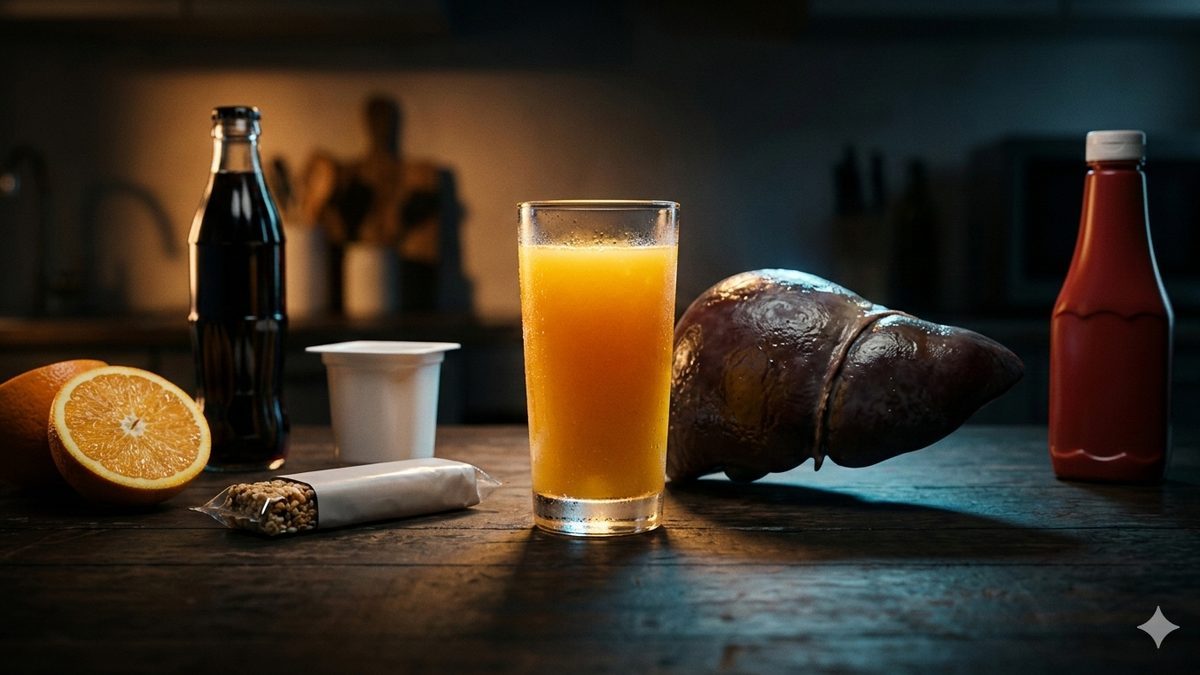
Orange juice, fruit purée, a cereal bar, honey yogurt. Products we buy with the feeling that we're doing something for our health. Each of them contains fructose — the simple sugar that gives fruit its sweetness. But the fructose we drink in a glass of juice differs from the fructose in a whole orange the way vodka differs from wine: the same molecule, a dramatically different metabolic impact.
In the previous article, we described how, in the 1960s, the sugar industry paid Harvard scientists to shift the blame for heart disease onto fats. Today we'll look at exactly what the industry wanted to keep hidden — at the biochemistry of fructose and its journey through the human body. A journey that bypasses practically all the safety fuses with which the body protects its metabolism.
Before fructose reaches the liver, it has to pass through the gut — and this is precisely where there is a brake that long went unrecognized.
A key study by Jang and colleagues from Princeton University (Cell Metabolism, 2018), using isotopic labeling, demonstrated that at low doses the intestinal epithelium captures and processes roughly 90 % of the fructose consumed. The enterocytes of the small intestine contain the very same isoform of the enzyme ketohexokinase (KHK-C) that is found in the liver. They convert fructose into glucose, lactate, and glycerate — metabolites that are harmless to the body. Only a minimal amount of fructose then reaches the portal vein.
The problem arises at higher doses. The study showed that with an intake above 1 g of fructose per kilogram of body weight, the intestinal capacity is insufficient. Fructose "overflows" in two directions: into the liver via the portal vein, and into the colon, where it is processed by bacteria.
A follow-up study in Nature Metabolism (2020) confirmed that the gut functions as a shield for the liver: when researchers genetically increased the activity of intestinal KHK-C in mice, less fructose reached the liver and steatosis was mitigated. Conversely, when they knocked out intestinal KHK-C, more fructose penetrated into the liver — and fat formation increased.
Moreover, the gut has the ability to adapt. Regular exposure to fructose increases the production of the GLUT5 transporter and KHK in intestinal cells — the gut "learns" to process more. But even this adapted capacity has a ceiling.
For practical context: a whole orange contains roughly 6 g of fructose and you eat it slowly — the gut can handle it. Half a liter of orange juice delivers 22–25 g of fructose all at once, without the fiber that slows absorption. The intestinal capacity is saturated and a substantial portion of the fructose heads in two directions: into the liver, where it causes the problems described below, and into the colon, where bacteria convert it into acetate — and acetate is itself a preferred substrate for hepatic fat synthesis. In other words: fructose that escapes the intestinal barrier damages the liver both directly and indirectly via the gut microbiome.
When you eat a slice of bread, the starch is broken down into glucose. Glucose enters the blood, the pancreas releases insulin, and insulin opens the doors of cells throughout the body: the brain, muscles, adipose tissue — all of them can use it as fuel. The process is regulated. When the body has enough energy, insulin signaling throttles back the production and distribution of glucose. It works like a thermostat: feedback maintains balance.
Fructose that passes through the intestinal barrier travels via the portal vein to the liver, where it is captured by hepatic KHK-C. And this is where the problem begins: KHK works without regulation by the cell's energy state. Whereas glucose is processed by glucokinase, whose activity is suppressed by the regulatory protein GKRP and modulated by the ratio of fructose-6-phosphate to fructose-1-phosphate, KHK has no such brake. The liver processes fructose regardless of whether it is full of energy or not.
There is also an alternative pathway: fructose can be phosphorylated by hexokinase as well — but its affinity for fructose is much lower than for glucose (the Km for fructose is markedly higher). In practice, then, hexokinase processes fructose only minimally, unless KHK is blocked or absent (as in hereditary essential fructosuria, in which KHK does not function — patients have elevated levels of fructose in their blood and urine, but are otherwise asymptomatic, because the fructose is simply excreted).
For a healthy person this means: virtually all the fructose that reaches the liver is immediately processed by KHK-C. It's like a boiler without a thermostat — it burns at full power as long as there is fuel.
The first surprise: fructose does not take energy away from the liver, but paradoxically it can deplete it.
In phosphorylating fructose, KHK consumes adenosine triphosphate (ATP) — the cell's basic energy currency. Unlike glucokinase, which has slower kinetics and is regulated, KHK reacts so quickly that with a high fructose intake there can be a transient drop in ATP levels in hepatocytes. The cell finds itself in an energy deficit.
The breakdown of ATP produces adenosine monophosphate (AMP), which is further metabolized into uric acid. A pooled analysis of seven clinical studies from 2025 (Food & Nutrition Research) confirmed a strong association between fructose intake and an increase in uric acid, with an effect size of Hedges' g = 1.628 — which in biomedicine is an exceptionally strong effect. High uric acid is, moreover, an independent risk factor for gout, hypertension, and kidney damage.
This mechanism is unique to fructose. Glucose causes nothing of the kind, because its metabolism is regulated at the level of phosphofructokinase, which halts further processing when the cell has enough energy.
The second problem is the reason hepatologists devote so much attention to fructose: the formation of fat directly in the liver, technically known as de novo lipogenesis.
After being cleaved by aldolase B, fructose provides substrates (dihydroxyacetone phosphate and glyceraldehyde) that enter the lipogenic pathways. At the same time, it activates two key transcription factors: SREBP-1c (sterol regulatory element-binding protein) and ChREBP (carbohydrate-responsive element-binding protein). Both function as switches for the genes that control the synthesis of fatty acids and triglycerides.
A randomized study comparing four groups of 24 people each showed that beverages containing 80 g of fructose or sucrose per day for seven weeks increased hepatic lipogenesis compared with glucose or abstinence from sugar. In a direct comparison of fructose and glucose over four to six weeks, fructose caused a significant increase in fasting triglycerides and LDL cholesterol — glucose did not.
The result of chronic strain is the accumulation of fat in the liver: a condition now referred to as MASLD (metabolic dysfunction-associated steatotic liver disease, formerly NAFLD). Its global prevalence reaches roughly 38 % of the adult population and continues to rise. In patients with type 2 diabetes the prevalence is nearly 70 %.
It was long assumed that fatty liver caused by fructose was the result of a single pathway — precisely that de novo lipogenesis. A 2025 study published in Nature Communications fundamentally broadened this view.
A team led by Rongya Tao of Boston Children's Hospital at Harvard Medical School used a mouse model with complete hepatic insulin resistance (LDKO mice lacking the insulin receptor substrates IRS-1 and IRS-2). These mice on a high-fat diet developed diabetes, but not fatty liver — insulin-driven lipogenesis did not work without functional receptors. When the researchers added fructose, however, acute steatosis appeared within days. And this occurred without an increase in de novo lipogenesis.
The mechanism was different: fructose stimulated the liver to secrete follistatin — a glycoprotein known until now primarily from the regulation of muscle growth. Follistatin induced insulin resistance in adipose tissue, which released a flood of fatty acids into the bloodstream. The liver then re-esterified them into triglycerides. Isotopic labeling confirmed that carbon from fructose was incorporated into the glycerol backbone of the triglycerides, not into their fatty chains — proof that the fat did not come from new synthesis, but from the repackaging of already existing fatty acids.
This means that fructose can damage the liver via at least two independent pathways: direct lipogenesis and, indirectly, through follistatin and the insulin resistance of adipose tissue.
An even more surprising discovery came from a November 2025 study in Nature Metabolism by an international team led by Miguel A. Lanaspa (University of Colorado Anschutz).
The researchers found that alcohol activates a metabolic pathway in the body that leads to the endogenous production of fructose — the body makes fructose itself. The key enzyme is, once again, ketohexokinase (KHK). In mice in which KHK was genetically removed or pharmacologically blocked, two things happened: the desire to drink alcohol dropped dramatically, and alcoholic liver damage essentially did not develop — less fat, less inflammation, less fibrosis.
Because alcoholic and metabolic liver disease share the very same fructose pathway, the results suggest that blocking KHK could be a therapeutic target for both groups of patients. And they raise a disquieting question: if the body produces fructose even from alcohol and from a high-salt diet (as Lanaspa showed earlier), how much fructose do our livers actually process in total?
Fructose does not damage only the liver. It also disrupts the intestinal barrier — the thin layer of cells that separates the contents of the gut from the bloodstream.
Studies in animal models have repeatedly demonstrated that chronic consumption of fructose reduces the production of tight-junction proteins — the molecular clamps that hold intestinal cells together. The result is increased intestinal permeability: bacterial endotoxins penetrate into the portal circulation and trigger an inflammatory response in the liver.
A 2024 study added another layer: fructose in combination with the common preservative potassium sorbate (E202) synergistically worsened liver pathology — more steatosis, more inflammation, more fibrosis than fructose alone. At the same time, the composition of the gut microbiota changed, in both the bacterial and the fungal communities.
For the ordinary consumer this has a practical implication: a sweetened beverage with preservatives may be metabolically worse than the same amount of fructose without them.
Another mechanism of harm is behavioral. Unlike glucose, fructose essentially does not activate leptin signaling — the hormonal system that tells the brain "enough, I'm full." After consuming fructose, therefore, the brain does not receive the signal to stop eating.
A 2025 review study examining the influence of fructose on appetite regulation and brain function confirmed that fructose bypasses the critical regulatory step of phosphofructokinase-1 (PFK-1), which leads to uncontrolled metabolism. The brain of someone consuming fructose simply does not know that the body already has enough.
This explains why sweetened beverages are such an effective source of surplus calories: 500 ml of orange juice contains roughly 45 g of sugar — half of it fructose — but produces no feeling of fullness. The same caloric value in the form of a whole meal would be registered by your brain.
Research to date had portrayed KHK as an enzyme without any feedback whatsoever. A preprint from January 2025 (bioRxiv, DOI: 10.1101/2025.01.01.630846) calls this picture into question.
An international team of researchers observed that in models of MASLD — whether diet-induced or genetic — there is, paradoxically, a decrease in the production of KHK in hepatocytes. The cause is signaling by growth hormone and insulin-like growth factor (GH/IGF-1): administering GH and IGF-1 to cell cultures led to a time-dependent degradation of KHK, mediated by a direct interaction between KHK and the IGF-1R receptor.
This is a previously unknown defense mechanism: the liver under metabolic stress reduces its ability to process fructose, thereby limiting further damage. It's like a fuse that switches on only once the damage has already been done — but it exists nonetheless.
Analysis of samples from patients with MASLD confirmed the same thing: increased production of IGF-1R and reduced KHK. If these results are confirmed in clinical studies, supplementation with GH/IGF-1 or their mimetics could offer a new therapeutic strategy.
Another therapeutic direction was suggested by a comprehensive analysis of the metabolic pathways of MASLD published in Clinical Science in November 2025.
Activators of the transcription factor Nrf2 (nuclear factor erythroid 2-related factor 2) were able, in experimental models, to redirect the surplus metabolism of glucose and fructose into the pentose phosphate pathway — a metabolic "bypass" that does not result in fat formation. At the same time, they reduced the activation of ChREBP, the hexosamine pathway, and the formation of methylglyoxal, a toxic intermediate.
A combination of trans-resveratrol and hesperetin (a citrus flavonoid) corrected glycolytic overload and steatosis in a mouse model. Clinical practice is still far off, but for the first time there is a pharmacologically influenceable mechanism that targets the core of the problem — not the symptoms.
The key question is: how much fructose is safe?
Science has not yet established an exact threshold, but the picture is now clearer thanks to an understanding of intestinal capacity. At small doses (up to roughly 5–10 g at a time) the gut can process the fructose on its own — which is why whole fruit is safe. The problem begins with liquid and isolated fructose in amounts exceeding intestinal capacity, roughly above 25 g at a time in an unaccustomed person.
One can of cola (330 ml) contains about 20 g of fructose. Half a liter of orange juice, roughly 22–25 g. If you add to that a fruit-flavored yogurt, a cereal bar, and ketchup — yes, ketchup too contains sugar — your daily fructose intake easily exceeds 60–80 g without your having eaten a single piece of fruit.
Whole fruit is a different category. The fiber in an apple or an orange slows the absorption of fructose so much that the larger part is processed by the intestinal epithelium before it ever reaches the liver. Epidemiological studies consistently link the consumption of whole fruit with positive health outcomes — including a lower risk of MASLD.
The practical rules that follow from the current science:
The greatest risk is posed by sweetened beverages — including juices. They contain concentrated fructose without fiber, they are drunk quickly, and the brain does not register them as food intake. Whole fruit is safe — two to three servings a day are not a problem. Industrially processed foods are a hidden source: ketchup, baked goods, cereals, flavored yogurts — added sugar is everywhere, and half of it is fructose. And preservatives can amplify the effect of fructose.
The story of fructose is not the story of a single culprit. It is the story of a metabolic system that evolved for a world in which fructose was scarce — seasonal fruit, a bit of honey — and ran into a world in which it is ubiquitous. Our body does have a brake: the intestinal epithelium, which at small doses can process 90 % of the fructose and convert it into harmless glucose. But this brake was designed for five grams of fructose from a handful of forest berries, not for twenty-five grams from a single glass of juice.
The science of 2025 shows that the harm is more complex than we thought: fructose not only creates fat in the liver, but depletes its energy, raises uric acid, disrupts the intestinal barrier, reinforces addictive behavior, and — as we now know — shares a metabolic pathway with alcohol. Meanwhile, the consumption of added sugars — and with it of fructose — has risen over the past hundred years by orders of magnitude, to dozens of times the original values. The next time you buy a "healthy" fruit juice, remember that your liver sees no difference between the fructose from juice and the fructose from soda.
Only the advertising sees a difference.
Sources:
Creation transparency
The concept, structure, and editorial line of the article are the work of the author, who prepared the content sketch, established the key theses, and directed the entire creative process. Generative AI (Claude Opus 4.6, Anthropic) was used as a tool for research, fact-checking, and fleshing out the author's outline.
The author verified the key findings and approved the final wording. No part of the text was published without conscious authorial oversight. Factual data were verified against the publicly available sources cited in the text.
This procedure complies with the transparency principles of EU Regulation 2024/1689 (the AI Act). #poweredByAI
Read the Czech original on Médium.cz.
AI · Claude — machine translation, may contain inaccuracies.