We're Living Longer, but Where Will We Live?
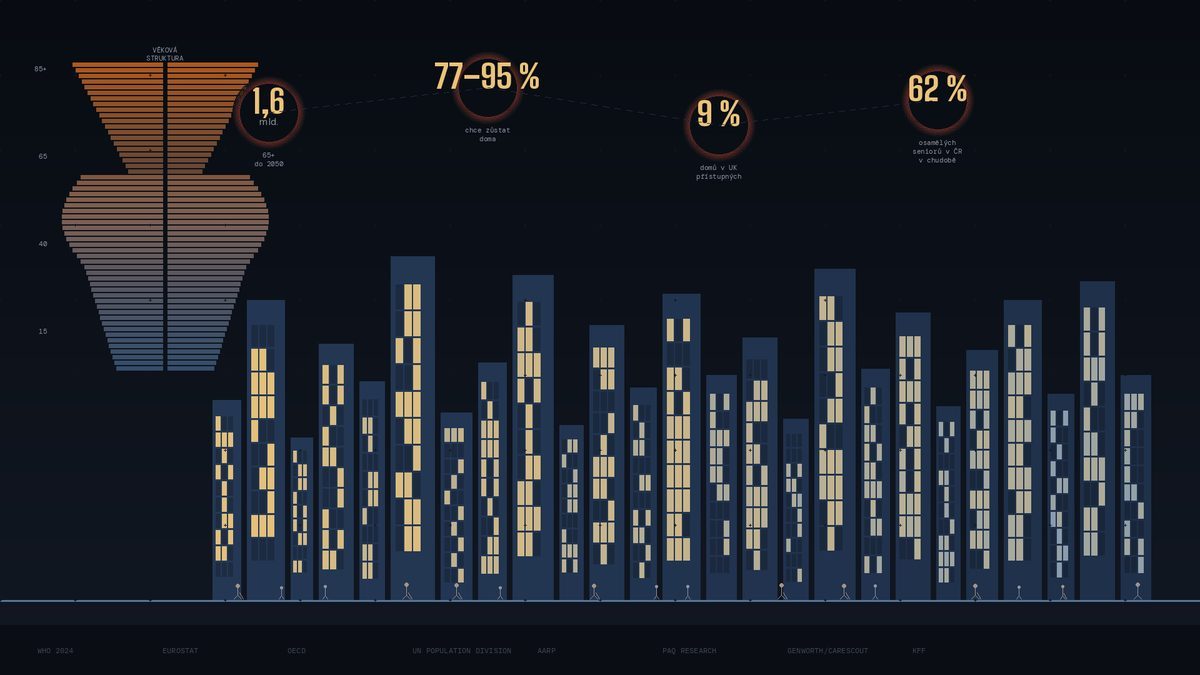
By 2050, the global population over 65 will double to 1.6 billion, with 77–95% of seniors wanting to remain in their own homes—yet the existing housing stock is not ready for it. The article compares the approaches of Norway, Japan, and other countries to barrier-free housing and analyzes economic models for financing home modifications for the aging Czech population.
Prolonging life expectancy represents one of the most fundamental civilizational challenges of the 21st century — not primarily a health challenge, but a housing one. Global average life expectancy reached 73.3 years in 2024 (UN), an increase of more than eight years since 1995, and by 2050 it should reach approximately 77 years. In the European Union the average already stands at 81.7 years (Eurostat), in Japan approximately 85 years, in the Czech Republic approximately 80 years. The population over 65 will double by 2050 to 1.6 billion people, and the share of people over 80 will triple to approximately 426 million. The existing housing stock, social housing systems, economic financing models, and building codes are, however, not prepared for this transformation. This article analyzes four key dimensions of the problem — accessibility and adaptation of dwellings, the economics of senior housing, legislative frameworks, and new housing models — and demonstrates that solutions exist, but their implementation lags behind demographic reality.
The numbers are uncompromising. In 1950, one in twenty people on the planet was over 65; in 2024 it is one in ten, and in 2050 it will be one in six. In Japan, seniors already make up 30% of the population today, in the EU approximately 21%. The old-age dependency ratio (the ratio of people aged 65+ per 100 people of working age) in OECD countries rose from 20 in 1980 to the current 31, and by 2050 it will reach 53. In Japan this indicator will exceed 80, in the EU 55.
The Czech Republic is aging fast — Brno is ranked by international research as a "young city that is aging rapidly." Eurostat noted that in 2024 Czechia surpassed its pre-pandemic 2019 life expectancy by a full year. The share of people over 85 in the EU, which in 2022 stood at 2.9%, will double by 2050 and by 2100 may reach 10%. It is precisely this oldest group that generates the highest demands for housing adaptation, because it combines limited mobility with declining cognitive abilities and social isolation.
The key contradiction lies in the fact that 77–95% of seniors want to remain living at home (data from AARP, the University of Michigan, U.S. News from the years 2021–2025), while only 5% of older Americans live in institutional care. The COVID-19 pandemic dramatically reinforced this preference — half of respondents over 50 stated that the pandemic convinced them that they want to live at home for the rest of their lives. The number of residents of American nursing homes fell by 12%, from 1.4 million (2015) to 1.2 million (2023).
Building codes responding to an aging population differ markedly by region. Norway represents the global benchmark — since 2008 an anti-discrimination and accessibility act has been in force, under which inaccessibility constitutes a form of discrimination, and since 2010 universal design principles have been mandatory for all new construction. The government declared the goal of "Norway universally designed by 2025," and the State Housing Bank provides preferential loans and subsidies for accessible housing.
Japan has built a comprehensive, albeit mixed, system. The Barrier-Free Act of 2006 unified the previous legal regulation for both buildings and transport, but mandatory requirements apply mainly to large public buildings and transport hubs; for smaller properties and private housing, incentives operate instead. As early as 1995, a government program offered lower mortgage interest rates for dwellings meeting accessibility criteria. The results are measurable — the number of handrail installations in Japanese households tripled between 1993 and 2016.
Sweden introduced accessibility requirements for new residential construction as early as 1977 — all buildings over three stories must have an elevator, and all kitchens, bathrooms, and hallways must allow wheelchair passage. The problem, however, is the historical housing stock: it is estimated that 92% of Stockholm's housing stock is inaccessible to wheelchair users because it dates from the period before the standards were introduced.
The Czech Republic underwent a legislative change in 2024 — Decree No. 398/2009 Coll. on the barrier-free use of buildings was repealed and its requirements were incorporated into the new Building Act (§ 137–152) and implementing Decree No. 146/2024 Coll. Prague and Brno issued their own building regulations. Building authorities have the power to order owners of existing buildings to carry out structural modifications for barrier-free access. Compared with the countries of Western Europe, however, Czechia lacks a comprehensive system of subsidies for adapting existing housing.
In the United Kingdom, in 2018 only 9% of homes had key accessibility features (an increase from 5% in 2009). The Lifetime Homes standard remains voluntary. The HoME Coalition estimates that 885,000 people lost out on accessible housing because of the government's delay in introducing mandatory requirements. In the USA, only 10% of homes are considered "aging-ready" — with a step-free entrance, a bedroom, and a bathroom on the ground floor.
The cost of adapting a home ranges from $8,000 to $100,000 depending on the scope of modifications, whereas a stay in a nursing home in the USA costs on average over $127,000 per year for a private room and approximately $111,000 for a shared room (Genworth/CareScout, 2024); assisted living (a facility with care services) comes to approximately $71,000 per year. In Germany the average annual cost of a retirement home is approximately €21,000, and home care €9,400. In the Czech Republic a nursing home costs approximately €1,200–1,500 per month, with only 15% of daily costs covered by health insurance — the least in Europe.
The University of Washington demonstrated that a community fall-prevention program reduced home falls by nearly 40% at an average cost of $765 per person, while the saving on health care amounted to $1,613 — a return of approximately 2:1. The CAPABLE program (Community Aging in Place — Advancing Better Living for Elders) delivers savings of over $30,000 per participant thanks to reduced hospitalizations. In the USA, medical costs related to senior falls amount to $50 billion per year, three quarters of which is paid by public insurance.
Germany faces a shortfall of 1.1 million barrier-free dwellings (1.4 million are available, 2.5 million are needed), with the estimated investment in adaptation amounting to €39 billion. A Polish study published in the journal MDPI Sustainability found that applying universal design at the architectural-design stage could save approximately 385 billion zlotys — about 19% of Poland's GDP.
The market for technologies supporting independent living (in international terminology AAL — Ambient Assisted Living) reaches approximately $9.5 billion in 2025, and estimates forecast growth to $27–60 billion by the early 2030s at an average annual rate of 24–27%. The European Union has invested approximately €1.3 billion through the AAL program since 2008 and funded more than 309 projects in 17–22 member states.
Japan, grappling with a shortage of 380,000 caregivers, is betting on robotics. The therapeutic robotic seal PARO is used in roughly 5,000 facilities worldwide, including 400 Danish retirement homes; the HAL exoskeleton by Cyberdyne helps caregivers with patient transfers. The Tokyo Shin-tomi home uses 20 different robot models. Critical assessment, however, shows that robots have not yet proven capable of reducing staffing costs and often create additional work for caregivers. Nevertheless, the Japanese Ministry of Economy estimates that the domestic market for care robots will grow to 400 billion yen ($3.8 billion) by 2035.
Demographic aging creates a contradictory pressure on the housing market. In the EU, 47% of people over 65 live in oversized dwellings — typically older couples or single people in family houses after their children have left. In the USA, people over 60 already own 44% of all real estate, and this share may reach half by the early 2030s. The average usable value of an American senior's property is $250,000, but most seniors refuse to move: a Redfin survey (2024) showed that a third of baby boomers say they will never sell their house, and another third not within the next decade. More than half have paid off their mortgage and have no financial incentive to change.
In the Czech Republic the situation is more pressing. In 2021 the average old-age pension was approximately CZK 16,938 per month for men and CZK 14,080 for women (pensions have since risen after indexations; in 2025 the average pension exceeds CZK 21,000). Rent for a small 2+kk apartment in Prague exceeds CZK 18,000 plus utilities, a quality retirement home costs around CZK 20,000 per month. Single Czech seniors are at 62% risk of poverty — more than double the EU average (28%), as shown by a 2025 PAQ Research study. Over 30% of Czech tenants live below the poverty line, compared with the 20% EU average.
In the United States, the 2024 homeless count recorded a record 771,480 people without a home — an increase of 18% in a single year, the highest jump in history. Over 146,000 people over 55 were counted as homeless, with nearly half sleeping outdoors. People over 55 make up 20% of the homeless population — the fastest-growing age group — and estimates forecast a tripling by 2030. In Europe, in 2023 over 1.287 million homeless people were recorded, of which 404,527 in Germany.
The global reverse-mortgage market reaches approximately $1.8–2 billion per year and is growing at a rate of 5.7–7.2%. The leading role is played by the USA with the HECM program (Home Equity Conversion Mortgage), through which approximately 1.3 million Americans have drawn funds since 1990. Even so, only 15% of older owners consider using their property's value for retirement — the main reason being the desire to leave an inheritance. Alternatives are developing: shared equity in a property (for example the company Unison), where the owner receives cash in exchange for a share in future appreciation, or sale-and-leaseback models, where the senior sells the house but remains living in it as a tenant.
OECD estimates suggest that spending on long-term care will increase 2.5-fold by 2050 compared with the present. In the USA, an older person's fall costs the health system on average $2,591, and total annual costs of senior falls reach $50 billion — of which 75% is paid by public health insurance.
The range of approaches to social housing for seniors is remarkably wide. Vienna represents the most comprehensive model — approximately 220,000 municipal and 200,000 cooperative dwellings mean that over 50% of residents live in subsidized housing. The city never privatized its housing stock, and new regulations require that two-thirds of new units be reserved for social housing. The large supply pushes rents across the whole market down.
The Netherlands has 2.3 million social dwellings (29% of the housing stock) managed by 284 housing associations in a sector worth €87.3 billion. The system is financed from rental income without direct subsidies. The Social Support Act (WMO, expanded in 2015) transferred responsibility for housing adaptation to 342 municipalities. Between 2013 and 2020, however, approximately 800 subsidized retirement homes were closed and policy shifted toward independent living at home with WMO support.
Singapore offers the most sophisticated integrated system. Over 80% of the population lives in HDB public housing. The Community Care Apartments program combines housing in 32 m² apartments with shared care services. The EASE program funds the installation of handrails and slip-resistant surfaces for seniors over 65. The Lease Buyback Scheme allows seniors to sell back their remaining lease term and continue living there. The budget for the Age Well SG initiative over the next decade amounts to 3.5 billion Singapore dollars.
The Czech Republic lacks a comprehensive social-housing law. Responsibility is fragmented at the municipal level. The Healthy Cities of the Czech Republic network is a member of the European WHO network, with Brno involved in the international research project "Ageing in Place in Cities" of the University of Manchester.
The British Disabled Facilities Grant (DFG) represents the largest housing-adaptation program in Europe — its budget grew from £220 million (2015/16) to £711 million (2024/25), thus more than tripling over a decade. In 2023/24, 58,606 grants were completed, with half falling in the £5,000–15,000 range. The grant's upper limit is £30,000.
In January 2024 France introduced the MaPrimeAdapt' program, which replaced three previous programs and finances up to 70% of adaptation costs (a maximum of €22,000) for low-income seniors over 70. Germany, through the KfW bank, offers preferential loans of up to €50,000 per unit (program 159) and direct subsidies of up to €6,250 (program 455-B, suspended in January 2025 with expected resumption in spring 2026). Japan, under its long-term care insurance system, provides a lifetime allowance of 200,000 yen for barrier-free modifications, of which insurance covers 70–90%.
Sweden carries out approximately 74,000 housing modifications per year worth over one billion Swedish kronor (€90 million), with 70% of grants going to people over 70 and 30% to people over 85. Since 2003, Denmark has created 15,700 accessible dwellings through social-housing renovations at one-third the cost of new construction.
The WHO framework for age-friendly cities, launched in 2007, today includes over 1,400 members in 51 countries. The AARP network in the USA alone has reached 1,000 communities covering over 100 million Americans. The framework comprises eight domains, including housing, which calls for affordable, accessible, and adaptable housing close to services. Research demonstrates that residents of age-friendly communities show statistically significantly better perceived health. In the Czech Republic, municipalities such as Brno, Valašské Meziříčí, Litoměřice, and Rožnov pod Radhoštěm are part of the network.
Cohousing originated in Denmark, where today there are over 400 communities, of which approximately 250 are intended specifically for seniors (since the first one in 1987). The Netherlands has over 300 communities, of which 231 are senior communities. In the USA about 300 cohousing communities operate (since the first, Muir Commons, 1991), with the first senior one created in 2006.
Silver Sage Village in Boulder (Colorado, 2007) is among the American pioneers — 16 units (6 affordable), a common house of 465 m², solar water heating, designed with accessibility in mind. ElderSpirit Community in Abingdon (Virginia, 2006) is the first mixed-income senior community — 29 homes (13 owner-occupied, 16 rental) for a total of $3.6 million. In Britain, New Ground Cohousing in London (2016), the first British senior cohousing project, became both a model and a warning: nearly 20 years elapsed from concept to completion.
Research by Harvard professor Lisa Berkman demonstrated that socially isolated people have three times higher mortality than socially connected individuals over a decade. The rate of loneliness in senior cohousing communities reaches 24% — lower than the national average, but still substantial.
A groundbreaking model is Humanitas Deventer in the Netherlands (since 2012/2013): 6 students live free of charge among 160 seniors in exchange for 30 hours a month of "good neighborliness" — watching sports together, teaching computer skills, accompanying residents during illness. The results are remarkable: 70% of seniors report higher social engagement, participation in communal dining rose by 60%, staff are more satisfied, and the facility shows better economic results than the sector average. The model has been adopted in more than 30 cities across Europe.
In Germany, over 500 multigenerational houses (Mehrgenerationenhäuser) operate, serving approximately 50,000 people daily and cooperating with more than 33,000 partners. They are financed by a combination of federal and European funds (€40,000 per house). Critics, however, call them a "fig leaf for the state's retreat from the care sector."
Continuing Care Retirement Communities (CCRC) offer a continuous spectrum of care from independent living to intensive nursing under one roof. In the USA, approximately 1,900 communities operate with an average entry fee of $400,000–480,000 and a monthly fee of $3,353. Since March 2020, however, at least 16 CCRCs have declared bankruptcy, affecting over 1,000 families and resulting in the loss of approximately $190 million in entry fees. The problem is that roughly half of CCRCs use new residents' entry fees to service debt and finance operations — a system that shows worrying features of a pyramid scheme.
The Village model arose in 2002 as Beacon Hill Village in Boston — a membership organization offering seniors services from transport to maintenance to social activities for an annual fee (typically $675 per individual). Today over 250 such "villages" operate in the USA, but most run on a budget under $75,000 per year and serve predominantly wealthier white seniors. The model is criticized as a "boutique solution" that has failed to scale.
Naturally Occurring Retirement Communities (NORC) — places where 40–65% of residents are people over 60 — operate with institutional support. In New York, approximately 400,000 of 1.25 million seniors live in such communities with access to support programs.
Approximately 40% of tiny-house owners are over 50 (AARP). At a price of $30,000–100,000 compared with the median price of an American home of over $400,000, tiny houses represent an economical alternative. Communities such as Orlando Lakefront (Florida) or Escalante Village (Colorado) offer lots for $565–765 per month. Obstacles in zoning regulation, building codes, and resistance from neighboring residents, however, remain the main brake on expansion.
COVID-19 exposed a fundamental failure of institutional care. In the USA, nursing-home residents made up less than 1% of the population, but at the start of the pandemic alone they accounted for over 40% of COVID-19 deaths. In total, over the four years of the pandemic more than 200,000 people died in American long-term care facilities, corresponding to approximately 23% of all American COVID deaths (KFF, 2022). In developed countries, retirement homes accounted for 46% of all deaths. Belgium and Spain recorded the highest rates (547 and 442 deaths per million inhabitants in facilities, respectively). Denmark and Norway, thanks to rapid nationwide lockdowns, achieved markedly lower mortality.
The political responses were far-reaching. Denmark established a Ministry of Social Affairs and Senior Citizens (2021) and is working on a unified seniors' act. The Netherlands officially shifted its emphasis toward an ageing-in-place policy. The USA introduced mandatory weekly COVID reporting in retirement homes and proposed minimum staffing requirements. Japan expanded community care systems and visa programs for foreign caregivers.
Heat waves kill seniors disproportionately. In Europe in 2003, over 70,000 people died as a result of heat, in 2022 a further 61,672, and in 2023 approximately 47,690. For people over 80, the heat-mortality rate is almost eight times higher than for the 65–79 group. Without measures to mitigate the impacts, mortality in 2023 would have been 80% higher; with warming of 3 °C, a thirtyfold increase is expected. Meanwhile 30% of older people live alone, and 80% suffer from two or more chronic illnesses.
Energy poverty affects approximately 50 million households in the EU. In Bulgaria, Greece, and Lithuania, 18–19% of the population cannot adequately heat their homes. As a result of cold housing, an estimated 100,000 people die in Europe each year. The American green and resilient retrofit program invested $1.4 billion in modernizing 30,000 affordable dwellings in 42 states — but in March 2025 it was suspended.
Internet access among people over 65 in the EU rose from 41% (2015) to 76% (2024), but a gap persists. Scandinavia leads — in Denmark 94% of the 65–74 age group is connected, in Sweden and the Netherlands over 90%. At the opposite end are Bulgaria (25%) and Croatia (28%). More serious than access, however, is the quality of use: only 45% of those aged 65–74 use connected devices (the Internet of Things) compared with 84% of young people (16–24), and only 30% of seniors use social networks. Older people make up 69.3% of all internet non-users in the EU. This gap directly limits the deployment of smart-home and telemedicine technologies, which are at the heart of the ageing-in-place strategy.
The analysis reveals a fundamental mismatch between demographic reality and the readiness of housing systems. The economic arguments for housing adaptation and ageing in place are strong — home care is two to five times cheaper than institutional care for people with mild assistance needs, fall prevention delivers a 2:1 return, and the CAPABLE program saves over $30,000 per participant. Yet investment lags behind: Germany needs €39 billion to bridge its barrier-free housing shortfall, the United Kingdom has only 9% of homes accessible, and the USA only 10%.
Three findings stand out as key. First, incorporating universal design at the design stage is an order of magnitude cheaper than later reconstruction — the Polish study quantifies the saving at 19% of GDP. Second, new housing models (cohousing, intergenerational projects, neighborhood networks) demonstrate measurable benefits for health and social engagement, but suffer from problems of scalability, financial sustainability, and social exclusivity — most serve predominantly educated and affluent seniors. Third, COVID-19 and climate change have transformed the debate from a choice between "at home versus in an institution" into the more complex question of how to create housing that is simultaneously accessible, energy-resilient, digitally connected, and financially affordable. The countries managing this transition best — Norway, Singapore, Denmark — combine legislative obligations with financial incentives and technological innovations. Most of the world, the Czech Republic included, is still searching for a systemic answer to a problem that deepens with each passing year.
Sources: WHO, UN (Population Division), OECD, Eurostat, AARP, PubMed Central, Bruegel, University of Washington (School of Medicine), NCOA, HUD, Harvard JCHS, KfW, UK Foundations, the AAL Programme, PAQ Research, Genworth/CareScout, KFF, and others.
Transparency of creation:
The concept, structure, and editorial line of the article are the work of the author, who drew up the content outline, established the key theses, and directed the entire creation process. Generative AI (Claude, Anthropic) was used as a technical tool for research, fact-checking, and elaborating the author's draft.
The author edited the outputs continuously, verified the key findings, and approved the final wording. No part of the text was published without human review. All factual data were verified against the publicly available sources cited in the text.
The procedure complies with the requirements of Article 50 of EU Regulation 2024/1689 (AI Act) on the transparency of AI-generated content. #poweredByAI
Read the Czech original on Médium.cz.
AI · Claude — machine translation, may contain inaccuracies.