The Generation That Doesn't Drink or Do Drugs — Yet Still Suffers
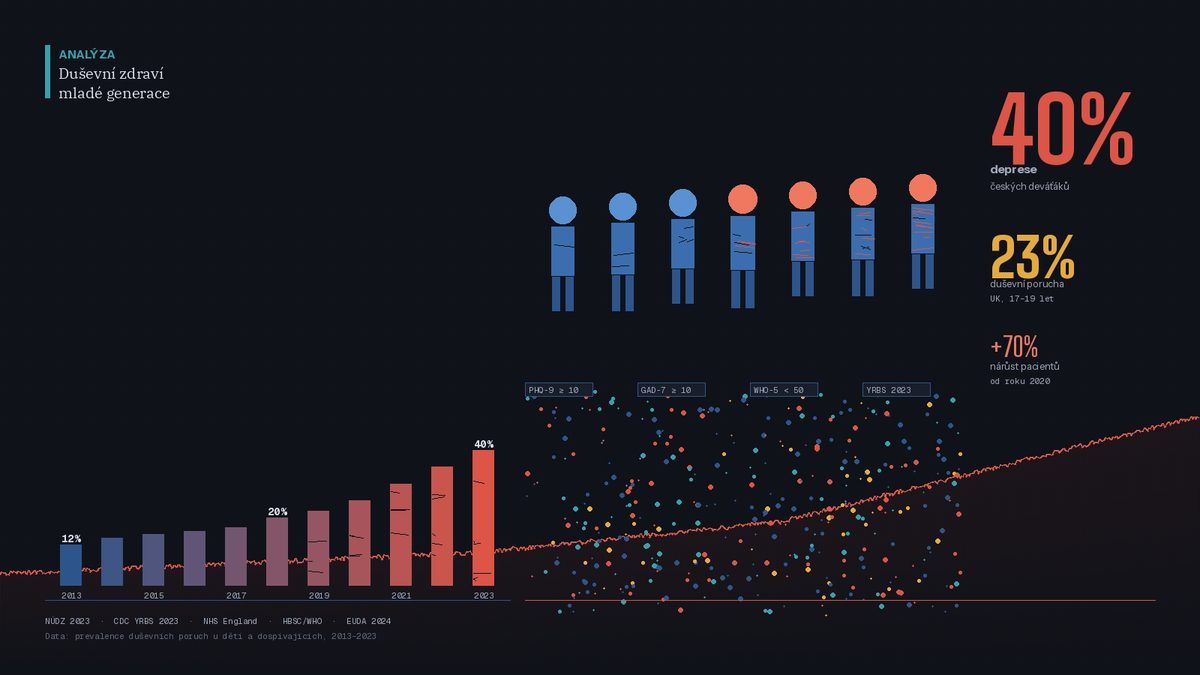
The article examines the paradox of Generation Z, the healthiest-behaving generation in history (it drinks, takes drugs, and commits violence less than any before it), which nonetheless shows an unprecedented mental health crisis — 40% of Czech ninth-graders display signs of depression. Drawing on data from the Global Burden of Disease, the NHS, and the CDC, it analyzes the causes, from the decline of childhood play through social media to the systemic collapse of Czech child psychiatric care.
In October 2023, the National Institute of Mental Health (NÚDZ) published the results of a pilot nationwide monitoring of the mental well-being of Czech adolescents. Of more than six thousand ninth-grade pupils, 40% showed signs of moderate to severe depression and 30% symptoms of anxiety. Girls were affected twice as often as boys. The results were consistent across all fourteen regions.
In August 2024, the American Centers for Disease Control and Prevention (CDC) published data from the Youth Risk Behavior Survey (YRBS 2023). Of more than twenty thousand high-school students, 40% reported persistent feelings of sadness or hopelessness — among girls as many as 53%. Compared with 2021, this is a slight improvement (down from 42% and 57%), but the figures remain markedly above the 2013 level, when 30% of students reported sadness. In the United Kingdom, meanwhile, the NHS clinical diagnostic study found that the proportion of young people aged 17–19 with a probable mental disorder rose from 10% in 2017 to 26% in 2022, before declining slightly to 23% in 2023.
These numbers seemingly confirm the media narrative of a "snowflake generation" — young people who cannot withstand any pressure. Yet the same generation is at the same time the best-behaved in modern history. In the United States, nine out of ten eighth-graders had used neither marijuana, alcohol, nor nicotine in the past month, according to the Monitoring the Future survey. Youth crime has been declining over the long term. Adolescents are delaying their sexual debut, using seatbelts more, and taking fewer risks.
How can a generation that is supposedly experiencing an unprecedented mental health crisis simultaneously be the generation that drinks the least, takes the fewest drugs, and commits the least violence?
The answer is more complicated than either side of the dispute admits. The data show that the crisis is real — but its scale is probably overstated. The causes are multiple and mutually reinforcing, from the decline of childhood play through the breakdown of social bonds to social media. And in the Czech Republic the situation is especially acute, because a chronic systemic collapse of child psychiatric care is layered on top of the worldwide trend.
Before we turn to the causes, a basic question must be answered: is the mental health of young people genuinely deteriorating, or are we simply talking more about feelings?
The Global Burden of Disease 2021 analysis (published in Translational Psychiatry, 2025) estimates that mental disorders affect 279 million young people aged 10–24 worldwide. Standardized prevalence rose by just under 7% compared with 1990. The key point, however, is the inflection around 2019: whereas the average annual increase in the period 1990–2021 was a mere 0.15% per year, after 2019 it accelerated to 4.74% per year. Anxiety disorders dominate (94 million cases), followed by depressive disorders (57 million) and ADHD (41 million).
In the United Kingdom, the Mental Health of Children and Young People survey provides some of the highest-quality data in the world, because it uses clinical diagnostic interviews according to the International Classification of Diseases (ICD-10), not mere self-report questionnaires. Probable mental disorder among children aged 8–16 there rose from 12.5% in 2017 to 20.3% in 2023. Among the 17–19 age group it rose from 10% to 23%, with the figure peaking at 26% in 2022.
The Nordic countries represent a particularly interesting test case. Despite universal health care, low inequality, and a high standard of living, Norway and Sweden show some of the largest increases in mental health problems among young people in the world. An analysis of HBSC data for the years 2002–2022 across five Nordic countries shows similar patterns of deterioration in all of them, suggesting common supranational causes.
The strongest argument that this is a real problem is completed suicides — data that cannot be distorted by reduced stigma or by changes in reporting methods. In the United States, suicide rates in the 10–24 age group rose by 57% between 2007 and 2018. In the Czech Republic, the number of suicides in the 15–29 age group rose from 120 in 2020 to 135 in 2022, following an earlier decline from 184 in 2013 (ČSÚ, summary report by NÚDZ/Ministry of Health/ÚZIS). Police statistics, moreover, show higher figures than the ČSÚ — by 250–300 cases overall per year.
Disproportionate increase in problems among girls
One of the most robust findings is the disproportionate increase in problems among girls. In the United States, 36% of girls reported persistent sadness in 2011; by 2021 it was 57%. Among boys the increase was from 21% to 29%. In Hungary, multiple health complaints among girls rose from 41% in 2010 to 66% in 2022 (Scientific Reports, 2026). In the United Kingdom, young women aged 17–19 have a fourfold higher incidence of eating disorders compared with young men (20.8% versus 5.1% in 2023, according to the NHS).
The paradox is that boys, by contrast, die by suicide three to five times more often and predominate in externalizing disorders. Girls suffer more from internalizing disorders; boys die more often. This pattern recurs consistently across countries.
The pandemic as an accelerator
The pooled analysis by Racine et al. (JAMA Pediatrics, 2021; 29 studies, 80,879 participants in total) found that during the first year of the pandemic the prevalence of clinically elevated depression in children and adolescents reached 25% and anxiety 21% — roughly double the pre-pandemic estimates. In the United Kingdom, the proportion of children with a probable mental disorder jumped from 12.5% to 17% and continued to rise to 20% — without any return to pre-pandemic levels.
According to research by the European Union Drugs Agency (EUDA, 2024), only 46% of Czech adolescents aged 15–16 feel well, the second-lowest proportion in Europe. Only Ukraine fared worse (43%). Hungary (47%) and Poland (49%) share the bottom rankings with the Czech Republic. The same picture is confirmed by the HBSC data (WHO, 2021/2022), where Czech fifteen-year-olds scored 52 points on mental well-being versus an average of 55.9.
On top of this comes a systemic collapse of care. Since 2020 the number of children in psychiatric care has risen by 70%, as stated by NÚDZ director Jiří Horáček. In 2023, 60,000 young people under 20 were treated in outpatient clinics, and 2,600 were hospitalized. There are approximately 200 child psychiatrists working in the Czech Republic, of whom 80–86 are over the age of 65. The average waiting time for a child psychiatrist is 4–6 months; in some regions a child psychiatrist is entirely absent. Even after a suicide attempt, children may wait months for outpatient care.
Roughly 4.5% of the healthcare budget is directed toward mental health, while mental disorders account for 15% of the total burden of disease. According to the epidemiological study CZEMS (Formánek et al., 2019, European Psychiatry), 83% of people meeting the criteria for a mental disorder remain untreated. The ongoing reform of psychiatric care has so far created only 3 mental health centers for children out of a planned 100.
The Safety Line (Linka bezpečí) recorded nearly 98,000 contacts in 2023. The most frequent problem was suicidal thoughts. The deputy chair of the Section of Child and Adolescent Psychiatry, Assoc. Prof. Michal Goetz, M.D., Ph.D., states that 70% of hospitalized child patients have suicidal thoughts.
The Czech Republic has an overall standardized suicide rate of 11.6 per 100,000 inhabitants — above the EU average of 10.2. In the 15–29 age group, suicide is the cause of every fourth death. The NÚDZ warns that official statistics probably underestimate the true number, because many deaths are classified as "events of undetermined intent" — particularly in the Olomouc Region, where this category significantly exceeds the national average.
1. Social media: the central dispute of our time
Jonathan Haidt, a social psychologist at New York University, argues in his book The Anxious Generation (2024) that around 2012 — when smartphone market saturation shifted adolescents' social life to Instagram and Snapchat — a fundamental transformation of childhood took place. He proposes four mechanisms: social deprivation, sleep deprivation, attention fragmentation, and platform addictiveness. Jean Twenge of San Diego State University identified, in data from the Monitoring the Future survey, a sharp decline in happiness after 2011 correlating with the spread of smartphones.
Against this stands Candice Odgers of UC Irvine, who wrote in a review in Nature (March 2024) that hundreds of researchers had looked for the large effects suggested by Haidt but found a mix of null, small, and mixed associations. The critics' key argument is reverse causation: unhappy adolescents may seek out social media as a coping strategy, not the other way around.
The work of Andrew Przybylski of the Oxford Internet Institute is crucial. Orben and Przybylski (2019, Nature Human Behaviour) applied specification curve analysis to three large datasets (355,358 respondents in total) and found that digital technology explains at most 0.4% of the variation in adolescent well-being. Twenge and colleagues, however, reanalyzed the same data with different analytical choices — separating social media from television, analyzing separately by sex — and found substantially stronger associations, especially for girls. The same data analyzed by different but defensible procedures lead to dramatically different conclusions.
The strongest evidence of a causal relationship is the quasi-experiment by Braghieri, Levy, and Makarin (American Economic Review, 2022), which exploited the staggered rollout of Facebook at American universities and found a 9% increase in depression and a 12% increase in anxiety. On the other hand, Vuorre and Przybylski (2023) analyzed the adoption of Facebook in 72 countries and found no negative association with well-being.
Meta-analyses consistently find small but statistically significant correlations: r = 0.12 for depression, r = 0.10 for anxiety, r = 0.15 for loneliness. For problematic social media use the correlations are higher (r = 0.27–0.35).
Conclusion: Social media probably has small to moderate negative effects on some adolescents — especially girls, especially already vulnerable individuals, especially with passive or compulsive use. Attributing the entire crisis primarily to social media, however, exceeds the current evidence base.
2. The decline of free play
Peter Gray of Boston College documents that the decline in children's mental health correlates with the continuous reduction of unstructured free play that has been under way since the 1950s — that is, long before the smartphone era. The average young person in 2002 scored "more externally" on Rotter's locus of control scale than 80% of young people in the 1960s, indicating a dramatic shift toward a sense of powerlessness.
In Clements's survey, 82% of mothers cited safety concerns as the reason for limiting outdoor play — even though the crime rate is roughly half what it was in 1991. Gray also points out that rates of emotional crises and suicides among school-age children fall during the holidays and rise when schools open.
Haidt and Lukianoff, in their book The Coddling of the American Mind (2018), identify three "great untruths" of an overly safety-focused culture: that hardship necessarily harms us, that we should always trust our feelings, and that the world is a battle of good people against evil ones. An empirical study from 2022 (786 participants) confirmed that cognitive distortions positively predict agreement with these beliefs.
Conclusion: A well-supported hypothesis with a strong evolutionary and developmental-psychological foundation. Play is a fundamental mammalian need, and its deprivation in animals demonstrably increases anxiety. The causal evidence in humans is so far mostly correlational, but converging.
3. Economic insecurity
Housing unaffordability, student debt, and insecure jobs constitute long-term stressors. A Dutch longitudinal study found a clear link between unaffordable housing and poorer mental health indicators. An RSA survey in the United Kingdom showed that 47% of young people aged 16–24 cannot cover their monthly expenses.
Peter Gray, however, rightly objects that rates of anxiety and depression among children were far lower during the Great Depression, the Second World War, and the Cold War.
Conclusion: A contributing factor, especially after 2008, but it cannot be the primary cause of the long-term trend.
4. The educational system
A study by the National Bureau of Economic Research (NBER) found that students have, on average, 15% higher cortisol levels during weeks of standardized testing. In the Czech context, PISA 2022 shows above-average bullying — 25–26% of pupils report bullying at least several times a month, compared with the OECD average of 20–21%. The Czech Republic is among the countries with the largest increase in reported school loneliness.
Conclusion: Part of a broader system of restricted childhood autonomy, but on its own it cannot explain a crisis that extends beyond student populations.
5. Climate anxiety
The study by Hickman et al. (Lancet Planetary Health, 2021; 10,000 young people from 10 countries) found that 59% are very or extremely worried about climate change, 75% perceive the future as "frightening," and 45% report that their worries negatively affect their daily functioning.
Conclusion: Real and widespread, but weakly supported as a primary cause — the timeline does not fit a trend beginning in the 1950s.
6. The breakdown of social bonds
The WHO Commission on Social Connection (2025) estimates that loneliness affects one in six people worldwide. Harvard research found that 61% of young adults experience serious loneliness. The U.S. Surgeon General Murthy (2023) likened the health risks of loneliness to smoking 15 cigarettes a day. The number of Americans without a close confidant tripled from 1990 to 2010.
In the Czech Republic the situation is specific: only 6% of Czechs address psychological troubles with professionals. Instead of sending their children to a professional, parents send them to friends and into nature. Only 20% of young Czechs turn to professionals when they have problems.
Conclusion: A well-supported hypothesis. The convergence of data on loneliness, the decline of social capital, and the loss of meaning-giving social frameworks is persuasive.
7. Semantic shift of concepts (concept creep)
Nick Haslam of the University of Melbourne documented how key psychological concepts — abuse, bullying, trauma, mental disorder, addiction, prejudice — have expanded both horizontally (to qualitatively new phenomena) and vertically (to less severe cases). The number of diagnoses in the American Diagnostic and Statistical Manual of Mental Disorders (DSM) grew from 47 in 1943 to over 300 in 2000.
Haslam himself acknowledges the ambiguity — the expansion of concepts may legitimately capture previously overlooked suffering. Direct evidence that the semantic shift causally increases mental health problems at the population level is, however, lacking.
Conclusion: An amplifying factor acting together with other causes, not a stand-alone cause.
8. Turning ordinary emotions into diagnoses
Allen Frances, chair of the DSM-IV task force, documents in his book Saving Normal (2013) how DSM-5 turns normal sadness into major depressive disorder and childhood tantrums into "disruptive mood dysregulation disorder." In the Czech Republic, antidepressant consumption has risen sixfold since 2000.
Conclusion: Moderately supported as an explanation of the increase in diagnosed disorders, less so as an explanation of the increase in actual suffering.
The problem of self-assessment
The largest portion of the data comes from self-report questionnaires. If reduced stigma has eased the pressure toward socially desirable answers, then historical rates of mental distress may have been underestimated, and part of the apparent increase may reflect more honest answering.
Currie and Corredor-Waldron: the hardest counterargument
The study by Janet Currie and Corredor-Waldron (Journal of Human Resources, 2024) analyzed all hospital visits in New Jersey in the years 2008–2019. It found that the sharp increase in coded suicidal ideation after 2016 corresponded to changes in the coding guidelines of the International Classification of Diseases (ICD-10), not to changes in underlying behavior. Rates of self-harm, suicide attempts, and completed suicides were essentially flat over this period.
The paradox of awareness
The Oxford psychologist Lucy Foulkes proposed the "prevalence inflation" hypothesis: mental health awareness campaigns paradoxically contribute to the rise in reported problems. Awareness helps people accurately recognize genuine symptoms, but it also leads some individuals to interpret ordinary discomfort as a mental health problem. Both a meta-analysis and a randomized controlled trial found that teaching adolescents the principles of cognitive-behavioral therapy in schools led to an increase in internalizing symptoms compared with control groups.
Foulkes herself emphasizes: none of this means that mental health problems are not real.
What these objections do not explain
Completed suicides. The increase in psychiatric hospitalizations. Emergency department data. These indicators are not dependent on self-assessment or on reduced stigma. And they consistently point upward.
School social-emotional learning programs have the strongest evidence base. The meta-analysis by Cipriano et al. (2023; 424 studies, 575,361 students) found improvements in skills, attitudes, and behavior. Anti-bullying programs reduce bullying by 19–20% and victimization by 15–16%.
Statutory social-media bans for minors are politically tempting but evidentially unsupported and practically unenforceable. In November 2024, Australia passed a law banning social media for children under 16. Adolescents circumvent the restrictions via VPNs — in Florida, demand for VPNs rose by 1,150% after a similar law was passed. In Norway, which has an age limit of 13, social media is used by 53% of nine-year-olds and 72% of eleven-year-olds.
What surprisingly does not work: mindfulness meditation in schools has small and often inconclusive effects on emotional problems; in vulnerable adolescents it may paradoxically lead to an increase in depressive symptoms. Simply limiting screen time has no clear evidence of improving mental health on its own. Family interventions for depression in young children have an effect close to zero.
For the Czech Republic, the most effective course appears to be accelerating the construction of community mental health centers for children, introducing validated school programs, developing telepsychiatry to bridge regional inequalities, and involving trained non-psychiatric staff.
The mental health crisis of young people is real, but its scale is probably overstated by self-report measures, the reduction of stigma, and the broadening of diagnostic concepts. The causes are multiple and mutually reinforcing: the long-term decline of free play and childhood autonomy under way since the 1950s, the breakdown of social bonds and the rise of loneliness since the 1960s–1970s, and the arrival of social media from 2012 as an accelerator, not a primary cause. Economic insecurity, educational pressure, climate anxiety, and concept broadening function as amplifying factors.
In the Czech Republic, a specific problem is layered on top of the worldwide trend: 200 child psychiatrists, of whom nearly half will reach retirement age in the coming years. Waiting times measured in months. A reform of psychiatric care that in twelve years has created 3 centers out of a planned 100.
The first six thousand Czech ninth-graders who filled out the NÚDZ questionnaires in 2023 delivered an uncomfortable message: that in a country that prides itself on one of the lowest unemployment rates in the EU, a generation is growing up whose greatest threat is not the economy — but what is happening inside their heads. And the system that ought to help is on the brink of collapse before they are.
Data cutoff: February 2026. This article was prepared with the help of AI. The data and sources were verified as of the date of processing. Before using it for decision-making, we recommend independent verification of the key findings.
Key sources
Global Burden of Disease 2021 — Translational Psychiatry, 2025 (Nature)
CDC Youth Risk Behavior Survey 2023 — MMWR, CDC (published August 2024)
NHS Mental Health of Children and Young People — NHS England, 2017–2023
NÚDZ National Monitoring of Children's Mental Health — NÚDZ, 2023
EUDA survey of European youth mental well-being — 2024
HBSC 2021/2022 — WHO Europe
Orben and Przybylski (2019) — Nature Human Behaviour, doi:10.1038/s41562-018-0506-1
Braghieri, Levy and Makarin (2022) — American Economic Review, doi:10.1257/aer.20211218
Racine et al. (2021) — JAMA Pediatrics, meta-analysis of the impact of covid-19
Currie and Corredor-Waldron (2024) — Journal of Human Resources
Haslam (2016) — Psychological Inquiry, semantic shift of concepts (concept creep)
Hickman et al. (2021) — Lancet Planetary Health, climate anxiety
CZEMS — Formánek et al., 2019, European Psychiatry
ČSÚ — Suicides in the Czech Republic, czso.cz; Summary report by NÚDZ/Ministry of Health of the Czech Republic/ÚZIS
Transparency of creation:
The conception, structure, and editorial line of the article are the work of the author, who prepared the content outline, established the key theses, and directed the entire creative process. Generative AI (Claude, Anthropic) was used as a technical tool for research, fact-checking, and elaborating the author's draft.
The author continuously edited the outputs, verified the key findings, and approved the final wording. No part of the text was published without human review. All factual data were verified against the publicly available sources cited in the text.
This procedure complies with the requirements of Article 50 of EU Regulation 2024/1689 (AI Act) on transparency of AI-generated content. #poweredByAI
Read the Czech original on Médium.cz.
AI · Claude — machine translation, may contain inaccuracies.