Firestorm: from Hamburg 1943 to thermobaric weapons and nuclear winter
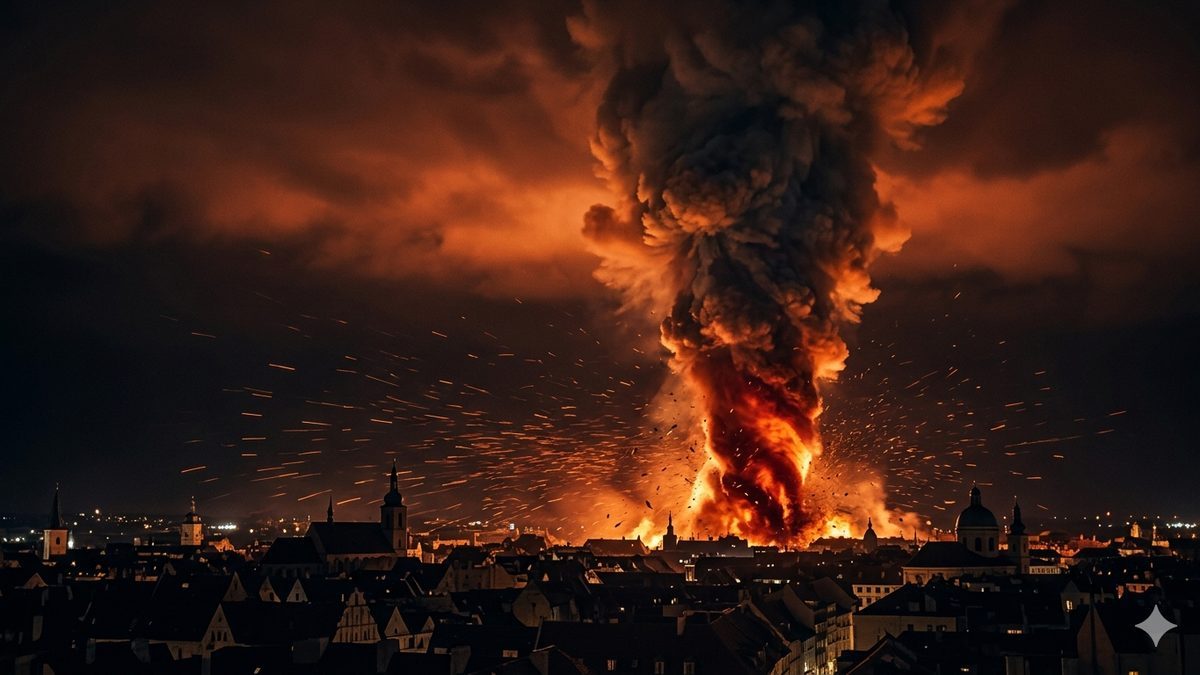
The article explains the physics of the firestorm — a self-sustaining atmospheric phenomenon with hurricane-force winds and temperatures above 800 °C — using the destruction of Hamburg in the Allied air raid of July 1943, and traces how the same principle was deliberately replicated in Dresden, Tokyo, and automatically in Hiroshima. The author shows that today the same physics is produced at a tactical scale by thermobaric weapons, deployed massively and systematically in Ukraine, which, alarmingly, lack any clinical documentation of victims or any international regulation — while at a large scale it would be triggered by every nuclear detonation over a city. The text connects history, thermodynamics, the legal vacuum around thermobaric weapons, and the persisting uncertainties in modeling nuclear winter into a warning that the physics of the firestorm has not changed in the eighty years since Hamburg.
A firestorm is not a large fire. It is a self-sustaining atmospheric phenomenon with its own hurricane-force wind, temperatures of around 800 °C, and a column of combustion products reaching into the stratosphere. Hamburg, in July 1943, demonstrated it to the world for the first time on an industrial scale — without anyone having planned it.
Understanding the physics of firestorms is timely in 2026 for three reasons. Thermobaric weapons create miniature versions of the same effects at the tactical level. Every nuclear detonation over a city can trigger a firestorm. And climate change is increasing the frequency of pyrocumulonimbus clouds — nature's firestorms. Yet the documentation of thermobaric-weapon casualties remains alarmingly inadequate, as confirmed by a scoping review published in Military Medicine in 2026.
Operation Gomorrah: seven days that revealed the power of fire
In the summer of 1943, Hamburg was Germany's second-largest city, with 1.5 million inhabitants, Europe's principal port, and home to the Blohm & Voss shipyards, where both submarines and the battleship Bismarck were built. Bomber Command Order No. 173 was signed by Marshal Arthur Harris on 27 May 1943. Originally planned for 22 July, the attack was postponed by two days because of cloud cover.
The chronology unfolded in six main waves. On the night of 24–25 July, 791 RAF bombers took off, of which 728 reached the target and, over roughly 50 minutes, dropped about 2,300 tons of bombs. Two daytime USAAF raids followed on 25 and 26 July (approximately 90 and 54 B-17s over Hamburg, respectively), striking the shipyards and the Neuhof power station. Then came the decisive night.
On the night of 27–28 July, 787 RAF bombers took off in a formation of 353 Lancasters, 244 Halifaxes, 116 Stirlings, and 74 Wellingtons. Sources differ on how many aircraft reached the target (722 to 739) — over roughly 50 minutes they dropped 2,326 tons of bombs. The key difference from the earlier raids: the bombs fell extremely concentrated on the eastern working-class districts — Hammerbrook, Billbrook, Rothenburgsort, Borgfelde, Hamm — over an area of just 3.2 × 1.6 km. It is estimated that the payload of 550–600 bombers fell into this space within just 30 minutes.
Within 20–30 minutes of the start of the bombing, the individual fires merged into a single firestorm covering roughly 21 km². Winds reached speeds of up to 240 km/h, temperatures in the center exceeded 800 °C, locally probably over 1,000 °C — glass in the windows of trams and cars melted, cutlery inside apartments dissolved. The convection column reached a height of over 300 meters; bomber crews reported smoke at an altitude of 6,000 meters. The storm raged for roughly three hours and subsided only after all combustible material had been consumed.
The next two raids — on the night of 29–30 July (707 bombers, 2,318 tons) and on 2–3 August (740 bombers, scattered by a thunderstorm) — did not reproduce the firestorm. The overall toll of Operation Gomorrah: approximately 3,000 bombing sorties, 9,000 tons of bombs, about 37,000 dead (range 34,000–40,000), 180,000 injured, 214,350 destroyed apartments out of a total of 414,500, and one million evacuated.
Operation Gomorrah was also the debut of the radar countermeasure "Window" — strips of aluminum developed by the Welsh physicist Joan Curran, which blinded the German Würzburg radar. RAF losses fell to 1.5% (12 of 791 aircraft) compared with the usual 5–6%, which made possible an unusually low flight altitude and extremely concentrated bombing — one of the factors that triggered the firestorm on the night of 27–28 July.
Why the firestorm formed: a confluence of drought, architecture, and chance
The RAF did not anticipate a firestorm. The plan was standard area bombing. The firestorm arose from a chance confluence of factors that all came together in one place and time.
The first factor was the weather. Hamburg was experiencing an unusual heatwave and drought; 27 July was "substantially warmer than the preceding days," humidity was low, and no rain had fallen for an extended period. All the wood was dried out like tinder. The second factor was the architecture: the eastern districts consisted of densely built blocks of tenement houses with wooden staircases, floors, and roof trusses, narrow streets, and numerous courtyards that functioned as chimneys. The third factor was the concentration of bombs — unlike the previous raid, most of the payload fell into a single compact area. The fourth factor was the exhaustion of the firefighters — after four days of bombing, Hamburg's firefighters were at the end of their strength, water supplies were dwindling, and fire brigades summoned from Hanover had been withdrawn.
In his official report, Hamburg's police president described the process with scientific precision: temperature differences of 600 to 1,000 °C (compared with the usual meteorological differences of 20–30 °C) created a powerful updraft; air from the surroundings rushed into the fire zone from all sides; smaller fires were "sucked into" larger ones "as if by bellows." Albert Speer declared after the war: "Hamburg put the fear of God in me." He told Hitler that another series of such attacks on four or five cities would destroy the German armaments industry.
The physics of the firestorm: a thermodynamic engine with no off switch
A firestorm is essentially a thermal atmospheric engine operating on an urban scale. The feedback loop works like this: massive simultaneous burning heats the air to high temperatures → the column of hot air rises sharply upward (convection) → low pressure forms at ground level → cooler air rushes in from all sides at hurricane speed → the supply of fresh oxygen feeds the flames → the fire intensifies → the cycle repeats. The key paradox: the hurricane-force winds directed inward prevent the fire from spreading outward — the firestorm burns inward and is confined to the area where it began.
According to the classical criteria of Glasstone & Dolan (1977), confirmed by the National Academies report of 2025, four conditions must be met simultaneously: a minimum area of simultaneous burning of at least 1.3 km²; a combustible-material density of at least 40 kg/m² (the equivalent of dry wood); simultaneous burning of at least 50% of the buildings in the area; and an ambient wind of up to 3.6 m/s (about 13 km/h). The last condition is counterintuitive: a pre-existing strong wind prevents the formation of a symmetrical convection column and, instead of a firestorm, produces an advancing conflagration.
Temperatures at the center reach 800–1,000 °C. The radiant heat flux at the core far exceeds 200 kW/m² — for comparison, the lethal threshold for a human is 10 kW/m² at 60 seconds of exposure, and pain occurs at just 2 kW/m². The transition from the "safe" zone to the "lethal" zone is surprisingly sharp: the inrushing cold currents create a sharp boundary, and a person standing a few dozen meters from the fire zone can be drawn inside in an instant.
A pyrocumulonimbus (pyroCb) — a thunderstorm-type fire cloud — forms when the convection column overcomes atmospheric inhibition and reaches the condensation level. The latent heat from the condensation of water vapor provides a second feedback loop that accelerates the ascent. Between 2013 and 2023, 761 pyroCb events were documented worldwide; in 2023 their number reached a record 169. The Australian wildfires of 2019/2020 lofted approximately 1 Tg of smoke aerosol into the stratosphere, with part of the cloud rising from an initial 14–17 km to 35 km — higher than the Pinatubo volcano — and caused a measurable delay in the recovery of the ozone layer on the order of a decade.
Once the feedback loop is established, a firestorm cannot be extinguished. The wind makes approach impossible. Water evaporates before it reaches the flames. In Hamburg, around 40,000 firefighters were available — the storm overwhelmed them within 15 minutes. It subsides only after all the fuel has been consumed.
How people died in Hamburg
The causes of death in the Hamburg firestorm produced a catalog of suffering that became deeply etched in German collective memory.
The most common cause was carbon monoxide poisoning in shelters. The firestorm consumed the oxygen above the city; CO penetrated into cellars and basements. Hamburg's police president described the typical scene: residents "sitting quietly in their chairs, calm and intact, as if asleep." In some shelters, the number of dead could only be estimated from the layer of ash on the floor — elsewhere, 55 skulls were found, although only about 25 people had been sheltering there.
Nineteen-year-old Käte Hoffmeister from Hammerbrook described sparks "as big as a five-mark coin" driven down the street and people stuck to the molten asphalt — kneeling and screaming, unable to free themselves. Fifteen-year-old Traute Koch from Hamm recounted how her mother wrapped her in wet sheets, kissed her, and told her to run; at the door she saw "only fire — everything red, like the door of a furnace." Henni Klank described a "roaring, blazing hell" — the streets were burning, trees were burning with their crowns bent to the ground, burning horses ran past, and "the air was burning, simply everything was burning."
The official report recorded streets covered with hundreds of corpses: "Mothers with their children, men, the elderly, burned, charred, intact and clothed, naked and pale as wax mannequins in a shop window." Children "were torn from their parents' hands by the tornado and thrown into the flames." RAF crews at an altitude of 6,000 meters smelled the odor of burning flesh.
From Hamburg to Dresden: from chance to an industrial method
Hamburg was an accidental discovery; Dresden, in February 1945, was the deliberate application of the same principle. Air & Space Forces Magazine puts it explicitly: "The attack on Hamburg provided the model of weapons effectiveness for Dresden." Bomber Command applied the same method in Dresden — concentrated incendiary bombing, double waves with a three-hour interval, a similar ratio of high-explosive to incendiary bombs. The result was a firestorm with comparable characteristics, including mass deaths from CO poisoning in shelters, and an estimated 25,000 dead.
Between Hamburg and Dresden lie eighteen months of further firestorms: Kassel (October 1943), Darmstadt, Heilbronn, Pforzheim. And in March 1945, Curtis LeMay applied the Hamburg method to the paper-and-wood building stock of Tokyo: 279 B-29s dropped 1,665 tons of incendiary bombs, and the resulting firestorm killed approximately 100,000 people in a single night — more than any conventional raid in history. The physics was always the same; only the area, the fuel, and the architecture changed.
Hiroshima: a firestorm in a single warhead
Five months after Tokyo, the equation changed fundamentally. At 8:15 in the morning on 6 August 1945, a uranium bomb with a yield of about 15 kilotons detonated over Hiroshima. What had required 787 bombers and 50 minutes of concentrated bombing in Hamburg was now accomplished by a single warhead in a millisecond. The thermal pulse ignited everything combustible simultaneously within a 3 km radius; within 20 minutes, the individual fires merged into a firestorm that engulfed 13 km² of the central city. The fire burned for about 6 hours. According to postwar estimates, the fire caused 60% of the immediate deaths — more than the blast wave and radiation combined.
In Nagasaki three days later, despite the bomb's greater power (21 kt), no firestorm formed: the hilly terrain of the Urakami valley prevented a symmetrical inflow of air, a southwesterly wind drove the fire away from the city, the detonation occurred about 3 km from the planned hypocenter over an industrial area, and the terrain created thermal shadows that reduced the area of simultaneous ignition. The area affected by fire reached only 2.5 km² — one-fifth of Hiroshima's.
USAAF surgeon Major Cortez Enloe declared, surprisingly, in January 1946 that the fire effects of the atomic bomb at Nagasaki "were not nearly as severe as the effects of the RAF raids on Hamburg on 27 July 1943." This is not a relativization of nuclear weapons — it is a key finding: the physics of the firestorm is the same across the mechanism of initiation. Hiroshima merely atomized it. A detailed analysis of both Japanese attacks — the chronology, the casualties, the moral debate surrounding the decision — requires its own space, and we will devote a separate text to it.
The postwar turn: the search for a subnuclear firestorm
Hiroshima confronted military planners with a new problem. Firestorm effects were extremely effective against fortified positions, tunnels, and bunkers — but a nuclear weapon carried a political and strategic price that practically ruled out its tactical use. The nuclear taboo, which arose in August 1945, paradoxically increased the demand for weapons that could replicate firestorm effects on a smaller scale and without radioactive fallout.
The answer came gradually from the 1960s onward. American fuel-air explosives developed during the Vietnam War (BLU-72/B, BLU-82 "Daisy Cutter") represented the first generation — aerosol bombs clearing jungle for helipads. The Soviet Union followed in the 1970s and 1980s with a more thorough doctrine: alongside airborne FAE bombs, it developed the RPO-A Shmel infantry rocket launcher and, above all, the TOS-1 "Buratino" system, which it first tested in Afghanistan's Panjshir valley in 1988–89. Unlike the Americans, the Soviets did not assign thermobaric weapons to the artillery but to the chemical, biological, and radiological defense troops — which reveals how they understood their own weapons.
In 2022, this line closed: what arose as a substitute for the tactically unusable atomic bomb is today being systematically deployed by the Russian army against Ukrainian positions. And most European readers have no idea what these weapons actually do.
Thermobaric weapons: principle, systems, and the gap in evidence
How a thermobaric weapon kills
A thermobaric (vacuum) weapon works in two phases. The first charge disperses a cloud of fuel aerosol (ethylene oxide, propylene oxide, aluminum powder) into the surrounding air; the aerosol penetrates buildings, trenches, and caves. The second charge (about 150 ms delay) ignites the cloud. The resulting explosion creates a fireball with a temperature of 2,500–3,000 °C, a prolonged pressure wave, and a devastating phase of negative pressure (the vacuum effect), which draws objects and tissues back toward the epicenter. Unlike conventional fragmentation munitions, thermobaric weapons carry no oxidizer — the fuel is atmospheric oxygen itself, which makes them 5–8× more powerful per unit of mass than equivalent TNT.
The killing mechanism combines four factors: the primary overpressure (crushes the lungs, ruptures organs at tissue–air interfaces); the negative-pressure phase (tears lung tissue, causes air embolisms); the thermal effect (third- and fourth-degree burns, inhalation of superheated gases); and the consumption of oxygen in enclosed spaces. A 1993 study by the American DIA (obtained by HRW under a FOIA request) speculated: "It is possible that victims of fuel-air explosives do not lose consciousness, but instead suffer for several seconds or minutes while they suffocate."
In enclosed spaces, the effect is extraordinary: the pressure wave reflects off the walls, channels along corridors, and the fireball fills the entire volume. A CIA study stated: "Those near the ignition point are destroyed. Those at the periphery are likely to suffer a range of internal, and therefore invisible, injuries."
The main weapon systems
The TOS-1A "Solntsepyok" is a Russian rocket system on a T-72 chassis with 24 launch tubes, 220 mm caliber, and a range of 6–10 km. A full salvo lasts 6–12 seconds and covers an area of approximately 40,000 m². The manufacturer declares "100% destruction of exposed personnel" over this area, while a broader zone with lethal effects extends to a distance of 200–300 meters from the impact. Newer versions — the TOS-2 "Tosochka" (wheeled chassis, 15 km) and the TOS-3 "Drakon" (presented in 2024, 15–20 km) — extend the range. According to the OSINT database Oryx, by December 2025, 34 TOS-1A units and 9 TZM-T units (reloading vehicles) had been destroyed, damaged, or captured in Ukraine.
The American GBU-43/B MOAB (Massive Ordnance Air Blast) weighs 9,800 kg with an equivalent of about 11 tons of TNT; it was first used in combat on 13 April 2017 against ISIS-K tunnels in Afghanistan's Nangarhar province. Afghan authorities initially reported 36 fighters killed; after two days, an army spokesman raised the count to 94 killed, including four commanders. The Russian FOAB (Father of All Bombs) reportedly reaches an equivalent of 44 tons of TNT, but this claim has not been independently verified; Western analysts estimate the real yield at 50–100% of the declared value. It has never been deployed in combat. The American BLU-118/B is a thermobaric warhead in the BLU-109 penetrating casing for destroying bunkers; it was first used on 3 March 2002 in Afghanistan (the first bomb missed the cave entrance). The Russian RPO-A Shmel is a single-use infantry thermobaric rocket launcher (93 mm, 11 kg, range 200 m) whose 2.1 kg warhead, according to the manufacturer, is equivalent in effect to a 152–155 mm artillery shell.
Combat deployment: from Chechnya to Ukraine
After the test deployment in Afghanistan's Panjshir, the first major combat use followed in Chechnya (1999–2000): Russia deployed both the TOS-1 and airborne FAE bombs during the siege of Grozny, with HRW documenting their use, including deployment "against civilians sheltering in basements." A total of 5,000–8,000 civilians died during the siege, but the share attributable to thermobaric weapons cannot be quantified.
In Syria (2012–2017), Russia and the Syrian regime deployed the TOS-1 in the Hama and Latakia provinces and near Palmyra; UN investigators confirmed the use of thermobaric bombs against Al-Qusayr in March 2013.
In Ukraine, the TOS-1A was documented from the first day of the invasion — cameras on the Belarusian–Ukrainian border captured their movement in February 2022. CNN filmed a TOS-1A near the border on 26 February. Documented deployment sites include the area around Chernihiv (February 2022), Mariupol (spring 2022, including Azovstal), Izyum, Lysychansk, Pisky (August 2022, a seven-day bombardment documented on video), Bakhmut (April 2023 — PMC Wagner used a TOS-1A, created a 300 m gap in the Ukrainian lines, and advanced 1.25 km in a single day), Avdiivka (2023–2024), and operations in the Kursk region (August 2024). Ukraine has also deployed captured systems and, since 2024, has used RGT-27S2 thermobaric grenades dropped from drones.
Documented casualties: an alarming gap in evidence
This is the most important finding of all the research into thermobaric weapons. Despite decades of combat deployment, there exists no comprehensive database, registry, or aggregate count of thermobaric-weapon casualties for any conflict in the world.
The only first-hand clinical study — Epstein et al. (2025) in the journal Surgery (PMID 40147094) — analyzed injuries caused by the TOS-1A based on data from Ukrainian mobile field hospitals (Role 2) in the Donetsk, Luhansk, Zaporizhzhia, Mykolaiv, and Chernihiv regions from February 2022 to January 2024. Key findings: TOS-1A injuries are predominantly third- and fourth-degree burns with significant damage to the upper respiratory tract and barotrauma, more severe than general thermal injuries. Traditional defensive structures (trenches, shelters, cellars) provide no effective protection. Within 50 meters of impact, victims either burned or died instantly; survivors were typically located 50–250 meters from the epicenter. The low proportion of patients with TOS-1A injuries in hospitals suggests that "a significant number of soldiers died directly on the battlefield" — most casualties never reach medical care.
The scoping review by Cheran et al. (2026) in Military Medicine reached a devastating conclusion: "Despite the significance of TW use and their impact on casualties in modern conflicts, this review identified a significant gap in the evidence base on the health effects of TW." No published studies contain patients' physiological data, vital signs, or the psychological trauma of survivors. The authors recommend establishing a worldwide registry of thermobaric-weapon injuries.
The only specific incident with a casualty figure from Ukraine: Okhtyrka, 28 February 2022, where the Ukrainian ambassador to the US, Markarova, announced the killing of 70 soldiers by a "vacuum bomb" — this claim has not been independently verified.
Why is the evidence base so weak? First, casualties near the detonation do not survive. Second, survivors' injuries are difficult to distinguish from other blast/burn injuries without identification of the weapon. Third, the medical-documentation infrastructure in conflict zones is limited. Fourth, Russia classifies data on weapon effects. Fifth, no global registry exists. The medical community in 2026 literally does not know how best to treat survivors of a thermobaric attack.
The legal vacuum: weapons that no treaty prohibits
Thermobaric weapons are not prohibited by any international instrument. The definitive legal analysis was carried out by Arthur van Coller in the International Review of the Red Cross (Cambridge University Press, 2023): they do not fall under the Chemical Weapons Convention (their primary purpose is not poisoning); they are not classified as incendiary weapons under Protocol III of the CCW (Convention on Certain Conventional Weapons) — their primary effect is overpressure, not fire; they are not subject to the Hague Declaration of 1899 or the Geneva Protocol of 1925 (asphyxiation is a secondary, not a primary effect). Van Coller concludes that the use of thermobaric weapons against military targets remains, in most circumstances, consistent with international humanitarian law — only their use in populated areas should be categorically excluded. No state has yet declared thermobaric weapons to be inherently indiscriminate.
In March 2022, HRW confirmed the presence of the TOS-1A in Ukraine and emphasized that "enhanced blast weapons are not incendiary weapons, nor are they prohibited by international humanitarian law," but that their use in populated areas "is prone to indiscriminate effects." Protocol III of the CCW suffers from two gaps: a definitional gap (it excludes multipurpose munitions such as white phosphorus, whose "primary" purpose is a smoke screen) and a delivery-method gap (weaker regulation of ground-based incendiary weapons than airborne ones). At the CCW meetings in both 2021 and 2024, Russia blocked all proposals to discuss strengthening the regulation of incendiary weapons.
Nuclear detonation and the firestorm: a return to the macro scale
Hiroshima was the first, but not the last, case of an atomized firestorm. The strategic warheads of today's arsenals have a typical yield of 100–800 kt, that is 5–50× Hiroshima; each of them would, on its own, cover a substantially larger area than the entire Hamburg firestorm. Understanding firestorm physics therefore remains essential for any serious analysis of the risks of nuclear conflict.
Approximately 35% of the energy of a nuclear explosion is released as thermal radiation — a light and infrared pulse propagating at the speed of light. Unlike conventional bombing, which ignites fires gradually over minutes to hours, a nuclear weapon ignites everything combustible simultaneously over an enormous area within seconds. It is precisely this mass simultaneous initiation that creates the ideal conditions for a firestorm.
For an 800 kt warhead (typical of Russian ICBMs, described in the scenario by Starr, Eden, and Postol in the Bulletin of the Atomic Scientists, 2015) over Manhattan: the fireball reaches a diameter of about 1.6 km; at a distance of 3.2 km the radiation is 1,900× brighter than the noonday sun in the desert; the temperatures ignite tires and melt aluminum; within a 5-mile radius everything burns. The fires would cover an area of approximately 100 square miles on a clear day. The energy of the resulting mass fire would be 15–50× greater than the energy of the nuclear explosion itself. Ground-level winds would reach speeds of around 500 km/h in a "chimney effect," and the air temperature in the fire zone would significantly exceed the boiling point of water.
Nuclear winter: from the urban fire to global catastrophe
The chain of causation is: nuclear detonations → urban firestorms → massive injection of soot into the stratosphere → blocking of solar radiation → global cooling → collapse of agriculture → mass famine. The study by Coupe et al. (2019) modeled a full-scale US–Russia conflict: 150 Tg of soot in the stratosphere would cause a drop in global temperature of more than 10 °C over 3 years — more than the last Ice Age — with effects persisting for over a decade. Even a "small" regional nuclear war (100 weapons of 15 kt each, the India–Pakistan scenario) would inject about 5 Tg of soot and cause global cooling of about 1 °C for 2–3 years, with an unprecedented depletion of ozone.
The debate, however, continues. A group from Los Alamos National Laboratory (Reisner et al., 2018) found that the amount of soot reaching the stratosphere would be an order of magnitude smaller than the Toon and Robock models assume — the difference between the two approaches is so vast that it fundamentally changes the conclusions about the probability and scale of a nuclear winter. The National Academies report of 2025 identified the main uncertainties: the black-carbon emission factors from urban fires are "highly uncertain"; the injection height is critical but poorly constrained; and the flammability of modern cities may differ substantially from Cold War–era assumptions.
In her book Whole World on Fire (2004), Lynn Eden documented how American nuclear-war planning systematically ignored fire effects for several decades and focused exclusively on blast. The consequence: the US underestimated the damage caused by nuclear weapons and therefore produced far more warheads than were necessary. Theodore Postol showed that including fire effects would increase the estimated casualties of a nuclear attack by 2–4× compared with estimates based on blast effect alone.
The escalation ladder: from conventional munitions to the strategic warhead
A comparison of lethal area across weapon categories reveals discontinuities that are significant both politically and militarily.
A 500 kg conventional bomb has an equivalent of about 90 kg of TNT, a lethal radius of 30–50 meters, and affects an area of around 7,850 m². A full TOS-1A salvo creates a fireball about 50 meters in diameter, with effects reaching 150–300 meters from impact. The GBU-43/B MOAB has a radius of destructive effects of around 1.6 km and affects an area of about 8 km². A tactical nuclear weapon with a yield of 10 kt (10,000 tons of TNT) causes heavy destruction within a radius of about 0.8 km and total destruction over an area of around 5 km². An 800 kt strategic warhead (800,000 tons of TNT) destroys buildings within a radius of about 7 km, with fire reaching 13 km and beyond, for a total of over 150 km².
The TOS-1A occupies a unique niche: it delivers an area thermobaric effect between conventional artillery and the MOAB, with the added horror of the vacuum effect. Its six-hectare coverage area per salvo and lethal zone of over 200 meters make it a terrifying weapon against fortified positions.
Why the Hamburg lesson matters in 2026
Hamburg 1943 was not merely a tragedy — it was a physical experiment whose results remain valid. No modern conflict has yet produced a true Hamburg-type urban firestorm. Mariupol (2022) achieved a comparable degree of destruction (90% of residential buildings damaged), but through cumulative bombing over months, not through mass simultaneous initiation; winter conditions impeded the spread of fire. Gaza (2023–2025), with an estimated 70,000–85,000 tons of bombs, surpassed the combined tonnage dropped on Dresden, Hamburg, and London in the Second World War, but its concrete building stock and the distribution of attacks over time prevented firestorm dynamics.
Yet the Hamburg lesson is more relevant than ever. Thermobaric weapons — especially the TOS-1A — create, at the tactical level, miniature versions of what a firestorm does on a large scale: overpressure, heat, vacuum, oxygen consumption. Their deployment in Ukraine is massive and systematic, but — as we have shown above — without corresponding clinical documentation of casualties.
At the strategic level, understanding the firestorm is indispensable for any serious discussion of nuclear deterrence. The National Academies report of 2025 confirmed that the main uncertainties in modeling nuclear winter persist — and these uncertainties bear directly on the question of whether modern cities would burn like Hamburg. The answer is probably: most European cities with historic centers, yes; modern American suburbs, perhaps not — but we have no certainty, because no one has studied precisely this question sufficiently.
The final dimension is the erosion of knowledge. Direct witnesses of the Hamburg firestorm are dying out. In 2015, the University of Hamburg conducted an interdisciplinary study in which psychoanalysts and historians interviewed 60 survivors (aged 3–27 at the time of the storm) and found persisting psychological aftereffects — anxieties, nightmares, aversions to certain sounds — even after more than 70 years. Once these last witnesses are gone, only what has been recorded and understood will remain.
Conclusion: what we know, what we do not know, and what matters
Hamburg 1943 revealed that fire can grow into an autonomous atmospheric phenomenon that no human intervention can stop. Dresden showed that this phenomenon can be deliberately replicated. Hiroshima confirmed that nuclear weapons create it automatically. And yet — eighty years after Hamburg — three fundamental gaps in knowledge exist.
First, thermobaric weapons kill on a large scale, but in documentary darkness. A single clinical study (Epstein 2025) and one scoping review (Cheran 2026) constitute the entire published evidence base for TOS-1A injuries — for a weapon system deployed daily on the front line of the largest European conflict since 1945. The recommendation to establish a worldwide registry is urgent, but has no political support.
Second, the legal framework is failing. Thermobaric weapons fall through the gaps in the definitions of Protocol III of the CCW, the Chemical Weapons Convention, and the Hague Conventions. They are not prohibited; their use in populated areas may violate the general principles of international humanitarian law, but no specific instrument exists — and the main owners (Russia, the US, China) reliably block any attempt at regulation.
Third, the uncertainties in modeling nuclear winter remain enormous. The difference between the Toon/Robock scenarios (catastrophic cooling) and the Los Alamos one (manageable) is so vast that it fundamentally changes the conclusions about the risks of nuclear conflict. These uncertainties depend directly on whether modern cities would produce firestorms — and the answer to this question still derives primarily from observations of Hamburg, Dresden, and Hiroshima, that is, from data more than 80 years old.
Hamburg 1943 is not merely a chapter of history. It is a warning written into physics — and physics has not changed.
The conception, structure, and editorial line of the article are the work of the author, who prepared the content outline, established the key theses, and directed the entire creative process. Generative AI (Claude, Anthropic) was used as a tool for research, fact-checking, and elaborating the author's draft. The author edited the outputs throughout, verified the key findings, and approved the final version. No part of the text was published without human review. All factual data were verified against the publicly available sources cited in the text. The procedure complies with the requirements of Art. 50 of EU Regulation 2024/1689 (AI Act) on the transparency of AI-generated content. #poweredByAI
Read the Czech original on Médium.cz.
AI · Claude — machine translation, may contain inaccuracies.