How Pork Belly Became King: The Story of the Strangest Price Reversal on Your Plate
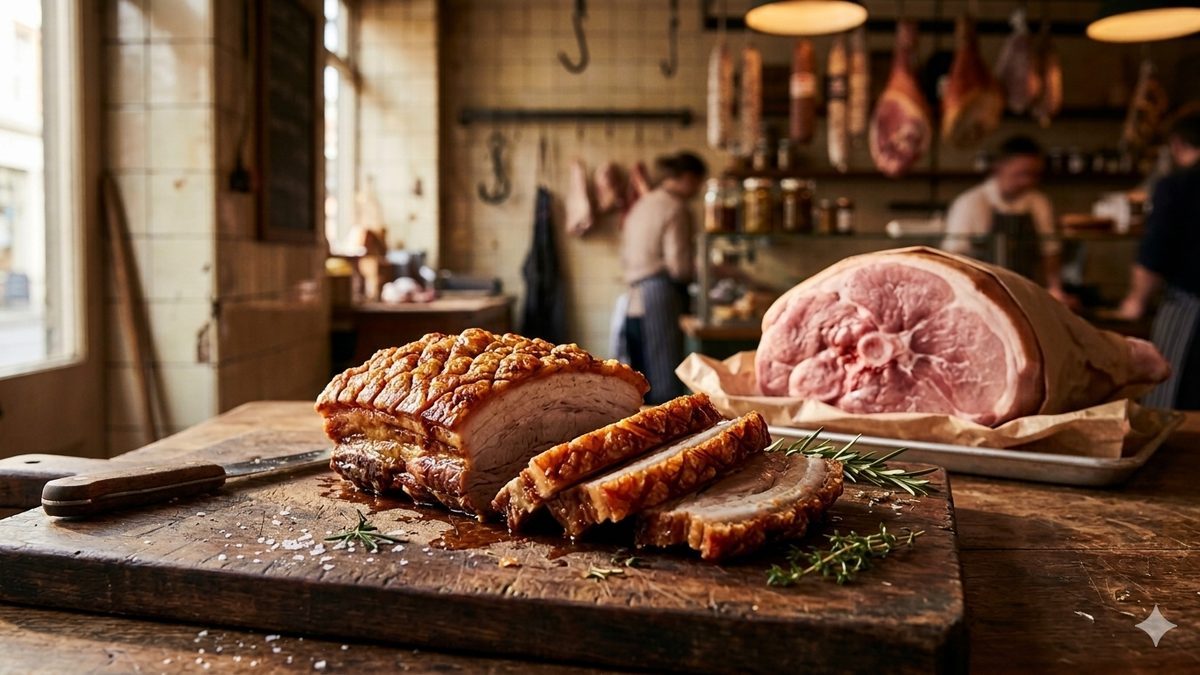
The article analyzes the remarkable price reversal of pork belly, which has gone from historically the cheapest part of the pig to costing more than ham. Behind this structural shift lies a combination of anatomical constraints (the belly makes up only 16–19% of the carcass), the American bacon boom, Asian demand amplified by African swine fever in China, grilling culture spread through social media, and the rehabilitation of fat within keto diets. For the Czech market, which relies on imports for more than half of its pork, the era of cheap pork belly is definitively a thing of the past.
Data cutoff: 4 March 2026 | Sources: USDA, CZSO, USDA ERS, peer-reviewed studies (PMC)
Around 1972, Czech butchers would throw in pork belly for free with a purchase of bones, because nobody wanted it. Half a century later, pork belly costs more at retail than ham. At U.S. wholesale it costs almost twice as much. What happened over that time?
Behind this reversal lies a combination of a global "bacon craze," surging Asian demand, gastronomic trends spread by social media, and simple anatomy: a single pig yields significantly less belly than ham. And this is not a short-term blip. All the factors that pushed the price of belly upward are structural — and they continue into 2026.
The most compelling evidence of the price reversal comes from U.S. wholesale data from the Department of Agriculture (USDA). As of 3 March 2026, the primal "belly" cut stood at 151.71 USD/cwt, while "ham" was only 80.51 USD/cwt. Belly is therefore 88% more expensive. Yet around 2000 both cuts traded in a similar price range, and belly was usually the cheaper one. In recent years the gap has widened sharply, and in July 2023 the wholesale price of belly shot up to 214 USD/cwt.
U.S. retail bacon prices rose from 1.46 USD per pound in 1980 to a record 7.31 USD per pound in 2022 — an increase of 401%. Overall inflation over the same period was just 255%. Bacon is therefore systematically rising in price faster than almost any other food.
In the Czech Republic the price reversal is not as dramatic, but the trend is clear. At the Leoš Holub butcher's shop (Červený Hrádek, January 2026), boneless pork belly costs 118 CZK/kg compared with boneless ham at 110 CZK/kg — belly is 8 CZK more expensive. At the Štambera butcher's shop both cuts are the same at 179 CZK/kg. In supermarkets, on promotion, boneless ham runs around 70–105 CZK/kg, while belly runs around 90–109 CZK/kg. Yet under socialism, pork belly was the cut that butchers gave away for free, because they had no outlet for it.
The key factor behind the price reversal has a purely anatomical basis. A standard slaughter pig weighing 115–145 kg yields, after slaughter, a carcass of roughly 85–100 kg. The individual cuts make up approximately these shares: ham about 24–25% (i.e., 20–23 kg), belly only 16–19% (14–17 kg), loin with chop 18–25%, shoulder with neck around 10%, and ribs about 5%.
From each pig you therefore obtain roughly a third less belly than ham. This is a fundamental constraint that cannot be circumvented technologically. To increase the supply of belly, you have to slaughter more pigs — which simultaneously increases the supply of all the other cuts, including ham. Economists call this "joint supply": you cannot increase production of one cut independently of the others. As demand for belly rises, the price of belly therefore climbs, while the prices of the other cuts stagnate or fall.
A study in the academic journal Journal of Animal Science and Technology confirms this imbalance on South Korean data. The cuts preferred by consumers (belly and cheeks) make up only about a fifth of the carcass, while the less sought-after cuts (ham, shoulder, loin) account for over 37%. This mismatch between preferences and anatomical reality is at the core of the price problem.
The single largest factor in the rising price of pork belly is the phenomenon economists call the "bacon boom." Its origins go back to the 1990s in the United States, when the National Pork Board invested considerable resources in promoting bacon as a "flavor enhancer" for the restaurant industry. In 1992 the Hardee's chain introduced its Frisco Burger, one of the first major bacon burgers at a large fast-food chain. Burger King, Wendy's, and practically every major chain followed. U.S. bacon consumption rose sharply in the first decade of the new millennium, and today the annual revenues of the U.S. bacon market are estimated in the billions of dollars.
In parallel, a revolution was underway in fine dining and in ordinary restaurants alike. The term "pork belly" appears ever more frequently on American menus, and bacon is on the menu of most U.S. restaurants. The restaurant and hotel segment makes up a substantial part of global demand for pork belly.
The globalization of Asian cuisine also played a significant role. Korean samgyeopsal (grilled belly), Chinese hong shao rou (red-braised belly), and Japanese kakuni or chashu (pork belly for ramen) have become worldwide gastronomic phenomena. In South Korea, 85% of adults cite pork belly as their preferred cut of pork — according to a 2006 survey by the National Agricultural Cooperative Federation. In Korea, consumption of belly alone makes up roughly half of total per-capita pork consumption. Social media further amplifies this trend: viral recipes on TikTok and Instagram repeatedly cause short-term swings in demand.
Another structural shift is represented by low-carbohydrate and ketogenic diets. After three decades of demonizing fat, the trend has reversed. In 2018, "keto" was the most-searched food term on Google worldwide. Pork belly, with zero carbohydrate content and a high fat share, became an emblematic food of this community.
China consumes roughly half of global pork production — in 2018 that was 54 million tonnes. African swine fever, which struck China in August 2018, caused one of the largest disruptions in global food supply chains in modern history.
By October 2019, Chinese pig herds had fallen by 41%, and production plunged to just 36 million tonnes in 2020. China, which had previously imported only about 3% of its consumption, began buying massively abroad. Pork imports more than doubled, from 1.6 million tonnes in 2018 to 3.7 million tonnes in 2020, with the European Union supplying 63% of Chinese imports.
This enormous demand pulled prices up across Europe. German and Spanish slaughterhouses redirected part of their belly supply to Asia at a higher price, thereby reducing the supply to the European market. For the Czech Republic this context is crucial, because it imports over 53% of the pork it consumes — chiefly from Germany, Spain, Poland, and Belgium. When European suppliers redirect belly to Asia, the Czech Republic is left with less — and at a higher price.
The Czech pork market has several distinctive features. Pork makes up a steady roughly half of total meat consumption — in 2024 that was 43.3 kg per capita. Domestic production, however, has been declining over the long term: in 2023 it reached a low of 197,859 tonnes. In 2024 there was a recovery to 211,588 tonnes (an increase of 6.9%), but the structural dependence on imports persists — domestic slaughterhouses cover not quite half of consumption.
In Czech cuisine, pork belly holds a traditional place. Roast pork belly with cabbage and dumplings is an iconic dish, and belly is traditionally smoked and grilled. Ham serves mainly for schnitzels (the most popular Czech pork dish) and roasts. The key shift lies in how belly is regarded. Historically it was "the cheaper cut" — the Czech gastronomy portal Apetit Online still describes it as "a cheaper piece of meat that might be scorned in many a foreign kitchen." But this perception is changing rapidly under the influence of the growing Czech grilling culture, the popularity of slow smoking, and international gastronomic trends spread by social media.
Notably, neither Agropress nor the State Agricultural Intervention Fund tracks the industrial price of pork belly separately — the reference product is boneless pork ham. That in itself reflects the historical perception in which ham was "the important cut." The consumer price of boneless ham reached 150.69 CZK/kg in May 2024. In some chains ham is, on promotion, even cheaper than belly (for example, at 69.90 CZK/kg), but that is a deliberate strategy: chains use ham as a "loss leader" to attract customers and sell it below cost.
The meat-processing industry exerts asymmetric pressure on the prices of the two cuts. Pork ham is the basic raw material for the huge segment of processed meat products — cooked ham, Prague ham, top-quality ham, prosciutto, jamón serrano, Westphalian ham, and dozens of other products. The makers of these products work with long-term contracts and stable margins. Moreover, the dry-aging of hams (12–36 months for prosciutto, up to 48 months for jamón ibérico) acts as a price buffer — processors can time their purchases and smooth out swings.
Pork belly, by contrast, increasingly goes to direct sale as a whole cut — for the grill, the oven, or slow smoking. Bacon does remain the main processed product made from belly, but its production is fast (days, not months) and its price directly tracks the wholesale market. The share of belly sold as a fresh cut for direct consumption is growing, especially under the influence of Korean and Chinese grilling and Western barbecue culture. This shift from the category of "raw material for processing" to the category of "sought-after cut for direct consumption" is one of the main drivers of the rising price.
The traditional seasonal pattern — belly most expensive in summer (grilling season), cheapest in winter — is gradually smoothing out because of year-round demand for bacon in the restaurant trade. In the U.S., the price of belly typically peaks in July and August and reaches a low around December. Ham has the opposite rhythm — highest prices in autumn (preparation for Thanksgiving and Christmas), lowest in summer.
In 2024, however, something unusual happened: the November price of belly in the U.S. exceeded the summer highs for the first time since mandatory data collection began in 2013, reaching 176 USD/cwt. The analytics firm Steiner Consulting attributed it to a structural shift in year-round demand. In Asia, seasonal pressure is added by Chinese New Year (January to February) and the winter hot-pot season.
In the Czech context, seasonality is also evident. The summer grilling season raises demand for belly (a popular cut for the grill), while ham for schnitzels has steadier year-round sales. In winter, demand grows for smoked belly and roast pork belly.
There are forces that could moderate the price gap. Chinese pork production has been gradually recovering since 2021, and import needs are falling. The popularity of ketogenic diets may wane, as has happened with other diet trends. Czech domestic production rose slightly in 2024. And if grilling culture were to become saturated, demand for belly could stagnate.
None of these factors, however, has the power to reverse the trend back to the historical situation in which belly was cheaper than ham. The anatomy of the pig will not change. The global appetite for grilled and smoked belly will not disappear. And the Czech market, more than half dependent on imports, will continue to track world prices.
The reversal in the price of pork belly is not a short-term anomaly but the result of a convergence of several deep structural changes. The anatomy of the pig sets insurmountable limits — from each animal you obtain only 16–19% belly, and this figure cannot be changed technologically. Global demand for belly is rising on several fronts at once: the American bacon craze, the Asian culinary tradition amplified by economic growth, the grilling culture spread by social media, the rehabilitation of fatty meat as part of low-carbohydrate diets.
Ham, by contrast, faces the opposite pressure. The meat-processing industry absorbs it for the production of hams and cured meats, chains use it as a promotional lure below cost, and its larger share of the carcass means a relatively higher supply. The result is a steadily widening price gap.
For the Czech consumer this has concrete consequences. Pork belly, historically "the cheap cut," has caught up in price with ham and in some markets is already overtaking it. Given that the Czech Republic imports over half of its pork and is fully exposed to global price trends, it is likely that this price ratio will remain the new normal. The era of cheap pork belly is behind us.
Note: This analysis was prepared on the basis of publicly available sources as of the date of compilation (March 2026). Main data sources: USDA (U.S. wholesale data), CZSO (Czech production and consumption), USDA Economic Research Service (global trade, China's ASF), peer-reviewed studies from PMC (anatomy of carcass breakdown, South Korean consumption). We recommend independently verifying the key findings.
Creation transparency
The article's concept, structure, and editorial line are the work of the author, who prepared the content outline, set out the key theses, and directed the entire creative process. Generative AI (Claude Opus 4.6, Anthropic) was used as a tool for research, fact-checking, and fleshing out the author's draft.
The author verified the key findings and approved the final wording. No part of the text was published without conscious authorial oversight. The factual data were verified against the publicly available sources cited in the text.
This procedure complies with the transparency principles of EU Regulation 2024/1689 (the AI Act). #poweredByAI
Read the Czech original on Médium.cz.
AI · Claude — machine translation, may contain inaccuracies.