Preservatives Won't Guard Your Fridge
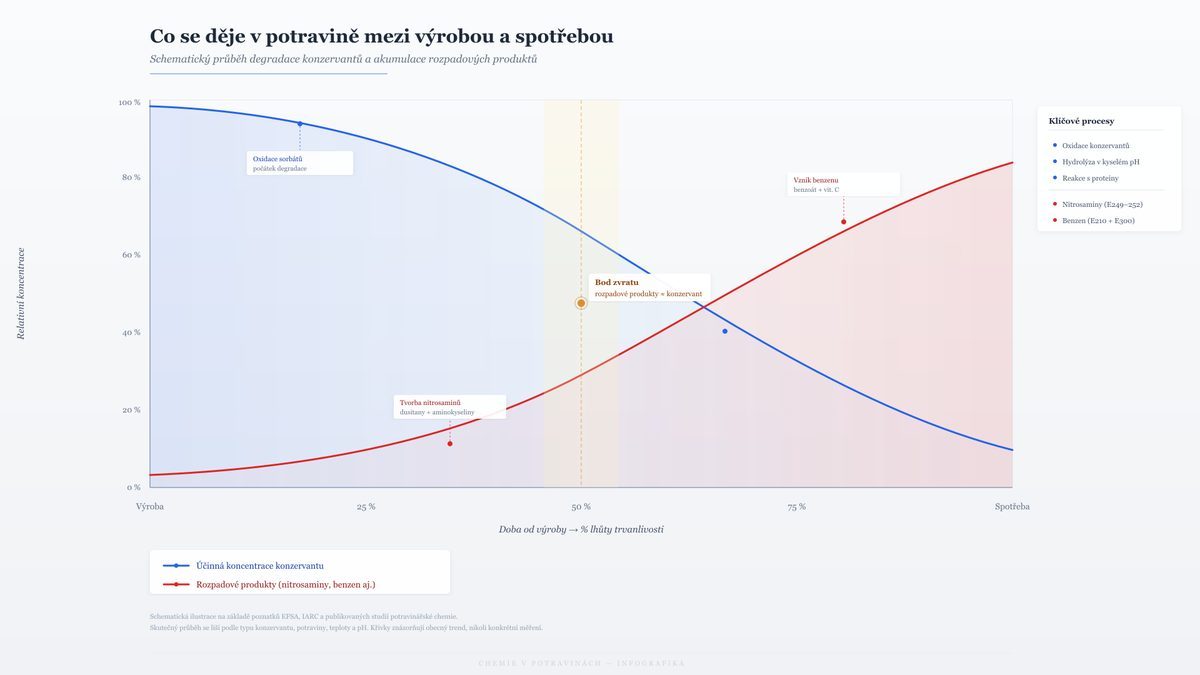
The article explains how food preservatives (sorbates, benzoates, nitrites, sulfites) work and why they are not all-powerful — they gradually break down, and their decomposition products (nitrosamines, benzene) can be more harmful to health than the original substances. It points out untested combinations of additives and the paradox that without preservatives food would be more dangerous, while also referencing the EPIC study confirming the link between consumption of industrially processed foods and higher mortality. The practical recommendation is to consume food as soon as possible after production and to minimize the share of processed foods in one's diet.
Imagine tilapia fillets in a supermarket freezer. The packaging says "tilapia fillet," and in the ingredients you find E452 — polyphosphates. A substance that has nothing to do with the fish. Its job is simple: to trap as much water as possible in the flesh, so the fillet weighs more and looks juicier. When you drop it onto a hot pan, the water is released, the fish shrinks, and instead of a crispy crust you find yourself swimming in a murky puddle. You paid for water, not for fish.
This is not a story about a single additive. It is a story about how modern food chemistry has changed our relationship to food — and why the label "contains preservatives" does not mean you can put your feet up and forget about the use-by date.
Preservatives are essentially chemical guardians. Their role is to protect food against three types of threat: decomposition caused by microorganisms (bacteria, molds, yeasts), oxidation (rancidity of fats, loss of color), and enzymatic reactions that take place within the food itself.
Each type of preservative has its specialty. Sorbates (E200–E203) and benzoates (E210–E213) inhibit the growth of molds and yeasts — which is why you find them in jams, beverages, and salad dressings. Nitrites and nitrates (E249–E252) suppress bacteria in meat products, especially the deadly Clostridium botulinum. Sulfites (E220–E228) act as antioxidants in wine and dried fruit. Each of them has its own chemical logic and its own mode of action.
But none of them is all-powerful.
Preservatives slow down spoilage, but they do not stop it. And this is for several reasons that most consumers are unaware of.
Preservatives break down on their own. Sorbic acid is gradually oxidized, especially in the presence of metal ions and under the action of light. Nitrites react with amino acids in meat. Under certain conditions — in the presence of vitamin C, trace metals, and at elevated temperature — sodium benzoate can react to form benzene, a proven carcinogen. The amount of active substance in the food therefore decreases over time and the protective shield weakens.
Moreover, preservatives do not protect against everything. No preservative will prevent physical changes — drying out, changes in texture, loss of vitamins. It will not stop the Maillard reaction, nor will it affect the crystallization of sugars or the retrogradation of starch. Food ages even when it is not spoiling in the microbiological sense.
And crucially — some of the breakdown products of preservatives can be more problematic than the original substance.
The best-known example is nitrosamines. They form through the reaction of nitrites with amino acids — exactly what happens in every smoked salami from the moment it is made. The process is accelerated at higher temperatures — which is why fried bacon is riskier than cold ham — and continues in the acidic environment of the stomach even after consumption.
Nitrosamines damage DNA and induce mutations. The strongest evidence exists for a link with malignant tumors of the colon and rectum; a link with stomach cancer is also probable, while for esophageal cancer the evidence is weaker. The International Agency for Research on Cancer (IARC) classified processed meat products as a whole in Group 1 — a proven human carcinogen — on the basis of sufficient evidence specifically for colorectal cancer. An association with stomach cancer was also observed, but IARC does not consider it fully established.
A similarly unpleasant process occurs with benzoates. In the presence of ascorbic acid (vitamin C) and trace amounts of metal ions (iron, copper), benzene can form. The reaction is accelerated by heat and ultraviolet radiation. It is a paradox: vitamin C added as a "healthy" ingredient reacts with the preservative to form a carcinogen. This reaction can occur in fruit drinks and sodas, where both substances commonly co-occur — although the U.S. Food and Drug Administration (FDA) states that the benzene levels detected in most beverages do not pose a serious health risk.
And here we run into a fundamental problem that regulators long overlooked.
Every additive undergoes a safety assessment — individually. An acceptable daily intake (ADI) is determined, and maximum permitted levels are set. What is not systematically tested, however, are combinations. And those are precisely what consumers consume every day.
Among the documented problematic combinations are: nitrites with amino acids (formation of nitrosamines, accelerated by elevated temperature), benzoates with vitamin C in the presence of metal ions (formation of benzene), mixtures of artificial colorants with sodium benzoate (an effect on children's behavior — increased restlessness and inattention found in the so-called Southampton study of 2007, published in the journal The Lancet), or an excessive intake of phosphates from several sources at once (a burden on the kidneys).
How many other undesirable combinations exist, no one knows exactly. An industrially produced ready meal can contain ten or even fifteen additives at once. The number of possible interactions grows with every additional substance, and no regulatory agency in the world has the means to test them all.
It would be convenient to tell a story about an evil food industry poisoning us with chemicals. The reality is more multilayered.
Without preservatives, food would paradoxically be more dangerous. Nitrites in cured meats prevent botulism — a disease whose mortality has been reduced to 3–5 % thanks to modern intensive care, but which remains fatal without timely treatment. Historically, far more people suffered from food poisoning than from additives. Sodium nitrite (E250) literally saves lives.
The dose makes the poison. All permitted additives have undergone a safety assessment and, in the permitted amounts, are considered safe. The problem arises with long-term exposure, with exceeding the ADI, and with the aforementioned untested combinations — that is, precisely the way most of the population actually eats.
And "natural" does not automatically mean "safe." Aflatoxins in moldy nuts, solanine in sprouted potatoes, or oxalic acid in spinach are entirely natural and entirely dangerous. The dichotomy "nature = good, chemistry = evil" is mentally comfortable, but untrue.
The practical lesson is surprisingly simple: preservatives buy time, not quality. A food with preservatives at the end of its shelf life is almost always worse than the same food fresh — it contains less active preservative, more breakdown products, and more substances formed by aging.
From the standpoint of health risks, it is therefore sensible to consume foods containing preservatives as soon as possible after production. The shorter the time between production and consumption, the lower the exposure to undesirable breakdown products.
But the best approach is even simpler. A large-scale analysis from the European research project EPIC, covering over 428,000 participants from nine countries, published in January 2025 in the scientific journal Lancet Regional Health – Europe, showed a clear association: higher consumption of industrially processed foods is accompanied by higher overall mortality, higher mortality from circulatory diseases, strokes, and diseases of the digestive system. Further research suggests that even a relatively small reduction in the proportion of processed foods in the diet is associated with a measurable reduction in risk.
The tilapia with polyphosphates from the beginning of the article is not poisonous. It is just a fish pumped full of water, for which you paid the price of fish. Salami with nitrites will not kill you — but the longer it sits in the fridge, the more nitrosamines it contains. A soda with benzoate and vitamin C is refreshing, but the chemical reaction within it does proceed under favorable conditions.
Preservatives do not mean freshness. They mean less worry — but a worry that should have its limits. The most reliable preservative remains what our ancestors knew for thousands of years: a short journey from field to plate, a minimum of intermediaries, and an ingredient list you don't need to decode with a table of E-numbers in hand.
This article draws on the findings of EFSA, IARC (Monographs Volume 114), the EPIC study (Lancet Regional Health – Europe, 2025), the Southampton study (McCann et al., The Lancet, 2007), and FDA data on benzene in beverages. Consult specific health decisions with a physician or nutritional therapist.
Transparency of creation:
The concept, structure, and editorial line of the article are the work of the author, who prepared the content outline, established the key theses, and directed the entire creative process. Generative AI (Claude, Anthropic) was used as a technical tool for research, fact-checking, and elaborating the author's draft.
The author edited the outputs throughout, verified the key findings, and approved the final wording. No part of the text was published without human oversight. All factual data were verified against the publicly available sources cited in the text.
The procedure complies with the requirements of Article 50 of EU Regulation 2024/1689 (AI Act) on the transparency of AI-generated content. #poweredByAI
Read the Czech original on Médium.cz.
AI · Claude — machine translation, may contain inaccuracies.