When Society Goes Blind: The Cybernetics of Democratic Stability
The article analyzes democratic stability through the lens of cybernetics and systems theory, in which negative feedback (the media, trade unions, courts, civil society) functions as a regulatory mechanism that keeps society in balance. Drawing on the work of Wiener, Ashby, Meadows, and Beer, it shows that suppressing these feedback loops — as illustrated by the examples of the USSR, Nazi Germany, and the present-day shrinking of civic space — inevitably leads to the destabilization and collapse of the system.
Negative feedback is one of the most fundamental concepts of cybernetics and systems theory. Its principle is simple: the system's output is compared with a desired state, and the deviation triggers a corrective action that returns the system to equilibrium. A thermostat that switches off the heating when the target temperature is reached is the simplest illustration.
This principle, however, reaches far beyond technical systems. Negative feedback is the mechanism that maintains the stability of biological organisms, ecosystems, economies — and likewise of democratic societies. Journalists, trade unions, civic organizations, courts, and the academic community function as regulatory loops that correct deviations of power from the desired state.
This document examines the cybernetic foundations of negative feedback and then analyzes how this principle works (or fails) in social systems. The key thesis: suppressing negative feedback in a complex system — whether biological, technical, or social — inevitably leads to destabilization, oscillations, and potential collapse.
Norbert Wiener (1894–1964), a mathematician at MIT, set out the foundations of a new interdisciplinary field in his 1948 book Cybernetics: Or Control and Communication in the Animal and the Machine. He derived the term "cybernetics" from the Greek word kybernétés (helmsman), thereby capturing its essence: the control of a system on the basis of feedback from the environment.
Wiener's work grew out of wartime research on anti-aircraft systems, where it was necessary to predict a target's trajectory and correct fire on the basis of the observed deviation. He generalized this principle to all systems — biological, mechanical, and social. Together with Arturo Rosenblueth and Julian Bigelow, Wiener had already formulated the key thesis in 1943: purpose-driven behavior is defined precisely by the presence of a feedback loop, and this holds equally for machines and for living organisms (Rosenblueth, Wiener & Bigelow, 1943: "Behavior, Purpose and Teleology", Philosophy of Science, 10(1), 18–24).
Wiener distinguished two types of feedback:
Source: Wiener, N. (1948). Cybernetics: Or Control and Communication in the Animal and the Machine. MIT Press.
The difference between the two types of feedback is absolutely essential for understanding the stability of systems:
Negative feedback (stabilizing):
Positive feedback (destabilizing/amplifying):
Most stable systems contain a combination of both types, with negative feedback acting as a "brake" on positive feedback. If the negative loops are weakened or removed, positive feedback becomes dominant and the system destabilizes.
This principle is also confirmed by biocybernetic research: Goldstein and Kopin (2017) showed that the transition from stabilizing negative feedback loops to destabilizing positive loops is a critical moment that, in biological systems, leads to pathology and degeneration (Goldstein, D.S. & Kopin, I.J., 2017: "Homeostatic Systems, Biocybernetics, and Autonomic Neuroscience", Autonomic Neuroscience, 208, 15–28. PMC5819891).
The concept of homeostasis was formulated by Walter B. Cannon (1932, The Wisdom of the Body) to describe the ability of living organisms to maintain a stable internal environment despite changing external conditions. Wiener generalized this concept to all regulated systems.
Homeostasis is not a static equilibrium — it is a dynamic process in which the system continually oscillates around a target state and negative feedback dampens these oscillations. The system is "in equilibrium" only in the sense that deviations are continually corrected.
Examples of homeostasis:
W. Ross Ashby (1903–1972), a British psychiatrist and cyberneticist, formulated one of the most important principles of control theory in his book An Introduction to Cybernetics (1956) — the Law of Requisite Variety:
"For a system to be effectively regulated, the regulator must have at least as much variety (number of possible states) as the system it regulates."
Ashby expressed it succinctly: "Only variety can destroy variety" (Ashby, 1956, ch. 11/5). In popularized form, this principle is often paraphrased as "only complexity can absorb complexity."
The practical consequence: if the environment in which a system operates is highly complex and variable, then the regulatory mechanism must be correspondingly complex. A simple, rigid regulator cannot control a complex system — it cannot respond to a sufficient number of states.
Ashby demonstrated this principle on a model of the "homeostat" — an electromechanical device that adapted itself to changes in the environment by switching between configurations until it found a stable state.
Stafford Beer (1926–2002) applied Ashby's law to the management of organizations in his Viable System Model (VSM). The key conclusion: an organization (or a state) is viable only if its regulatory mechanisms have sufficient variety to match the complexity of the environment.
Social implication: A simple, centralized control system (a totalitarian regime, a dictatorship) does not have sufficient variety to regulate a complex society. Ashby's law predicts that such a system will be dominated by the environment and will eventually collapse.
Sources:
Donella Meadows (1941–2001) developed systems dynamics, founded by Jay Forrester at MIT, into an accessible framework for analyzing complex systems. Her book Thinking in Systems: A Primer (2008, posthumous) and her essay Leverage Points: Places to Intervene in a System (1999) are key texts for understanding the role of feedback.
Meadows defines a system as a set of interconnected elements organized in such a way as to achieve some purpose. Stocks, flows, and feedback loops are the basic building blocks.
Negative feedback in Meadows's conception is a "goal-seeking" loop: the system tracks the deviation of the actual state from the goal and activates a corrective flow. The stronger the feedback loop (faster, more accurate, with greater corrective capacity), the more stable the system.
Meadows identified 12 "leverage points" — places in a system where a small change can produce large effects. They are ordered from least to most effective (number 12 = the weakest lever, number 1 = the strongest):
# / Leverage point / Effect
12 / Constants, parameters, numbers / The lowest lever — most political debate takes place here
11 / The size of buffers / The system's stabilizing capacity
10 / The structure of material flows / Physical infrastructure
9 / The length of delays / Critical for stability — delays that are too long cause oscillations
8 / The strength of negative feedback loops / The system's ability to correct itself
7 / The strength of positive feedback loops / The driving forces of growth and collapse
6 / The structure of information flows / Who has access to what information
5 / The rules of the system / Laws, incentives, penalties
4 / The power to change the structure of the system / Self-organization, evolution
3 / The goals of the system / What the system optimizes
2 / The paradigm of the system / The mental model on which the system rests
1 / The power to transcend paradigms / The highest lever
Point No. 8 — the strength of negative feedback loops — is directly relevant to our topic. Meadows explicitly points out that weakening negative feedback relative to the impacts it is supposed to correct is one of the most effective ways of destabilizing a system.
Source: Meadows, D. (1999). "Leverage Points: Places to Intervene in a System." The Sustainability Institute. Available at donellameadows.org.
Peter Senge (The Fifth Discipline, 1990) and Donella Meadows identified recurring patterns of system failure — systems archetypes:
"Fixes that Fail": A short-term solution to a problem weakens the negative feedback that would solve the problem in the long term. Example: suppressing investigative journalism eliminates the short-term "nuisance" of corruption revelations, but it removes the mechanism that corrects corruption. Result: corruption escalates.
"Shifting the Burden": The system becomes dependent on a symptomatic solution instead of addressing the cause. The negative feedback from the cause is weakened because the symptoms are masked. Example: media censorship masks social problems, which accumulate without correction.
"Eroding Goals": When negative feedback is too weak to achieve the goal, the system, instead of strengthening the feedback, lowers the goal. Example: if an anti-corruption body cannot prosecute corruption, then instead of strengthening the body, society "accepts" a higher level of corruption as the norm.
Delays in feedback loops are a critical factor of stability. Meadows points to three scenarios: Negative feedback in complex systems and its significance for society
An example from ecology: Fishing for fish with a long reproductive cycle. The feedback (a drop in catches) arrives with a long delay. By the time it manifests, the population is already below the threshold of reproductive capacity → collapse.
An example from society: The suppression of the opposition in an authoritarian regime. The feedback (popular dissatisfaction) is blocked by censorship and repression. When it finally manifests (revolution), it is often too late for gradual correction → a violent coup.
A democratic society is a complex system whose stability depends on the functioning of many parallel feedback loops. Each of them serves as a regulator of a specific aspect of social functioning.
Function in the system: Informational feedback. Journalists monitor the conduct of power institutions and inform the public about deviations from the desired state (corruption, abuse of power, failure to meet commitments). In doing so, they activate further feedback loops — public opinion, elections, court proceedings.
Cybernetic analogy: A sensor in a regulatory loop. Without a sensor, the system does not know what state it is in and cannot activate a correction.
Investigative journalism functions as signal amplification — it detects weak signals (hidden maladaptations of the system) and amplifies them to a level where they can activate corrective mechanisms.
Data: According to Reporters Without Borders (RSF, World Press Freedom Index 2024), there is a strong correlation between press freedom and the quality of state governance. Countries with the highest press freedom (Norway, Denmark, Sweden) systematically achieve the best results in indices of anti-corruption and the quality of democracy.
Function in the system: Regulator of the capital–labor relationship. Trade unions monitor working conditions, wages, and the treatment of employees. The strike is the ultimate corrective mechanism — it is activated when the normal channels of feedback (negotiation) fail.
Cybernetic analogy: A thermostat with an alarm. Normal operation = negotiation (fine correction). Crossing a critical threshold = a strike (emergency correction).
Historical context: The emergence of the trade union movement in the 19th century was a direct reaction to the absence of feedback in industrial systems — workers had no mechanism by which to correct deteriorating conditions. The result was unregulated oscillations (cyclical crises, social unrest, revolutions).
The right to strike is traditionally derived from International Labour Organization (ILO) Convention No. 87 on Freedom of Association (1948). The ILO's supervisory bodies interpret the right to strike as an inherent part of the freedom of association protected by this convention, although the text of the convention itself does not explicitly mention the right to strike — this interpretation is legally contested and, since 2023, has been the subject of an advisory opinion of the International Court of Justice. Regardless of this legal dispute, the strike is, from a cybernetic perspective, an institutionalization of negative feedback — a legitimate mechanism of correction that forestalls more destructive alternatives.
Function in the system: Distributed regulation. While journalists are the "sensors" and trade unions the "regulators" in the labor sphere, civil society provides a diverse set of regulators covering various aspects of social functioning: human rights, the environment, healthcare, education, minority rights, transparency.
Cybernetic analogy: In Ashby's terminology, civil society increases the variety of the regulator. The more complex a society is, the more specialized feedback loops it needs. A single central regulator (the state) does not have sufficient variety — it needs complementary distributed regulators.
The organization Freedom House systematically documents that the restriction of civic space (shrinking civic space) correlates with a deterioration in the quality of democracy, an increase in corruption, and a decline in human development.
According to the CIVICUS Monitor (2025): civic freedoms are under serious attack in 122 of 198 countries. Only 7% of the world's population lives in countries with an open civic space. 15 countries were downgraded in the past year, only 3 upgraded. In Europe in 2025, France, Germany, and Italy were downgraded (from "narrowed" to "obstructed"), as were Serbia and Georgia (from "obstructed" to "repressed").
Source: CIVICUS Monitor, People Power Under Attack 2025. monitor.civicus.org
Function in the system: Formalized negative feedback with enforcement power. Courts correct deviations from the legal order — both in the case of individuals and of institutions, including the state itself.
Cybernetic analogy: A regulator with a defined activation threshold (the law) and a corrective action (a judgment, a sanction). The independence of the judiciary is the equivalent of the integrity of the regulator — if the regulator is subordinated to the regulated system (political power), it ceases to perform its corrective function.
Constitutional courts function as meta-regulators — they correct not only the conduct of individuals and institutions, but the very rules of the system (laws) themselves, if these deviate from constitutional principles.
Function in the system: Epistemic feedback. The scientific community corrects false beliefs, pseudoscience, and disinformation through peer review, the replication of studies, and public debate. Academic freedom ensures that this feedback is not filtered by political or commercial interests.
Cybernetic analogy: A calibration mechanism for sensors. If the sensors (information sources) are systematically biased, the entire regulatory system fails, because it corrects on the basis of erroneous data.
Function in the system: Emergency feedback. Whistleblowers are activated when all other feedback loops have failed — internal controls, management, regulators, the media. They are the equivalent of an emergency valve in a pressure system.
Cybernetic analogy: The algedonic signal in Beer's Viable System Model — a binary "pain/pleasure" signal that bypasses the normal communication channels and signals directly to the highest level of the system that something is fundamentally wrong.
The legal protection of whistleblowers (EU Directive 2019/1937) is an institutionalization of this emergency feedback channel.
The Soviet Union (1917–1991): The systematic suppression of practically all feedback loops — media censorship, the liquidation of independent trade unions, the ban on civic organizations, the subordination of the judiciary to the party apparatus, the ideologization of science (Lysenkoism). In Ashby's terminology: the regulator (the party) did not have sufficient variety to control an enormous, diverse society. The result: 74 years of accumulating uncorrected errors, technological backwardness, and ultimately collapse.
Lysenkoism is especially illustrative: the suppression of scientific feedback (genetics) in favor of ideologically conformist pseudoscience led to real catastrophes in agriculture and to decades of scientific backwardness.
Nazi Germany (1933–1945): Gleichschaltung — the systematic elimination of all independent institutions (trade unions, newspapers, political parties, courts, universities). A system without negative feedback: no one could correct strategic mistakes (a war on two fronts, the Holocaust as a drain on resources). The positive feedback loops (radicalization, territorial expansion) ran without a brake all the way to collapse.
The Chinese Great Leap Forward (1958–1962): Local officials systematically reported false grain yields (the suppression of informational feedback in the upward direction). The central government made decisions on the basis of erroneous data. The result: an estimated 15–55 million dead from famine — one of the worst consequences of the suppression of feedback in human history (estimates differ; Dikötter, 2010, gives approximately 45 million).
Data from the CIVICUS Monitor (2025, People Power Under Attack) document a global trend of restricting feedback mechanisms:
Typical tactics for suppressing feedback:
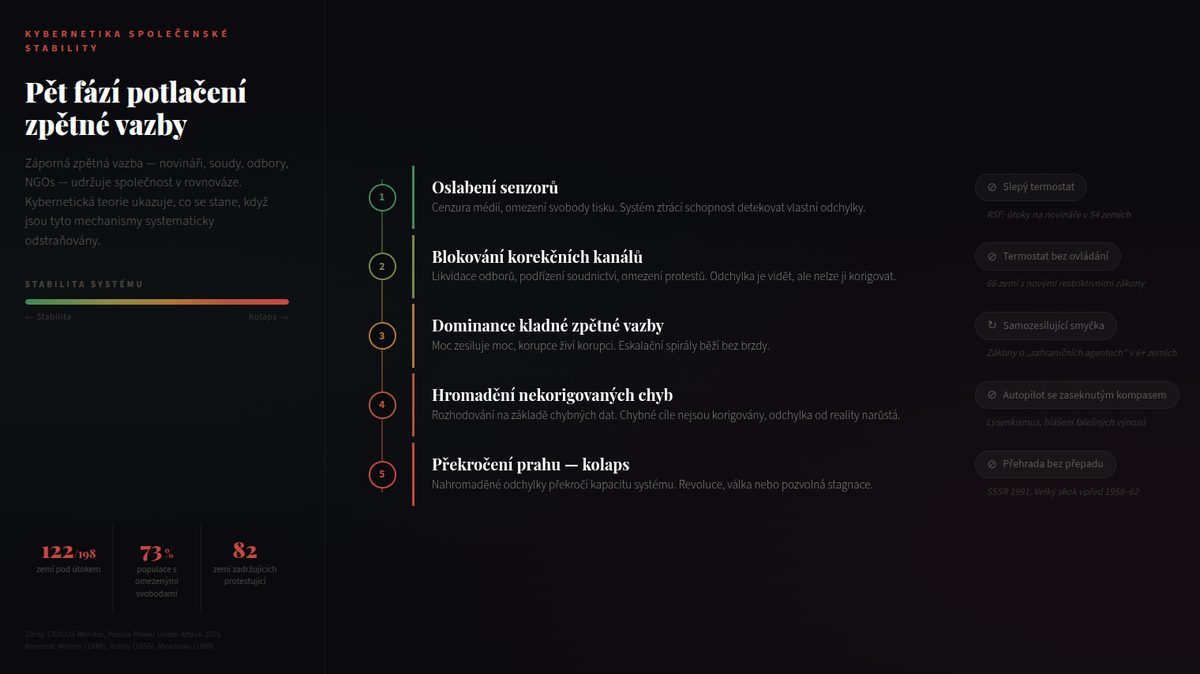
From a cybernetic perspective, the suppression of feedback can be analyzed as a gradual process:
Phase 1 — Weakening the sensors: Restriction of press freedom, censorship, control of the media. The system loses the ability to detect its own deviations. Analogy: a blind thermostat.
Phase 2 — Blocking the corrective channels: Restriction of protests, the liquidation of trade unions, the subordination of the judiciary. The system detects the deviation but cannot correct it. Analogy: a thermostat that sees the temperature but cannot control the heating.
Phase 3 — Dominance of positive feedback: Without negative corrective loops, the positive ones dominate: the concentration of power strengthens the ability to suppress resistance, which further concentrates power. Corruption generates resources for further corruption. Radicalization reinforces radicalization.
Phase 4 — Accumulation of uncorrected errors: The system optimizes on the basis of erroneous data (suppressed informational feedback) and erroneous goals are not corrected. The deviation from reality grows.
Phase 5 — Crossing the threshold and collapse: The accumulated deviations exceed the system's capacity to absorb them. The collapse may be sudden (revolution, war) or gradual (economic stagnation, brain drain, demographic decline).
Ashby's law in action: A totalitarian regime attempts to control a complex society with insufficient variety (a single party, a single ideology, a single information channel). The Law of Requisite Variety predicts that the environment (society) will dominate and will eventually "destroy" the overly simple regulator.
Cybernetics provides a rigorous framework for understanding why negative feedback mechanisms — journalists, trade unions, NGOs, independent courts, academic freedom, whistleblowers — are essential for the stability of a democratic society:
Warning signs from a cybernetic perspective:
From cybernetics follow principles for the design of resilient social systems:
The limits of this approach: The cybernetic analogy has its limits. Social systems are adaptive, and their actors behave strategically — unlike thermostats, governments, corporations, and citizens have their own goals and can consciously manipulate feedback mechanisms. There is also a tension between the robustness of feedback (strong control) and the efficiency of decision-making (too many regulators can paralyze the system). Effective design therefore requires balancing both pressures.
This document is an analytical output; it does not represent the positions of any organization. All factual claims are accompanied by sources. Where it was not possible to verify a primary source, this is stated.
Methodological note
The conception, structure, and editorial line of the article are the work of the author, who prepared the content outline, established the key theses, and directed the entire creative process. Generative AI (Claude, Anthropic) was used as a technical tool for research, fact-checking, and elaborating the author's draft.
The author edited the outputs throughout, verified the key findings, and approved the final wording. No part of the text was published without human review. All factual data were verified against the publicly available sources cited in the text.
This procedure complies with the requirements of Art. 50 of EU Regulation 2024/1689 (the AI Act) on the transparency of AI-generated content. #poweredByAI
Read the Czech original on Médium.cz.
AI · Claude — machine translation, may contain inaccuracies.