Anatomy of a Firestorm: How Allied Bombers Razed Dresden to the Ground in February 1945
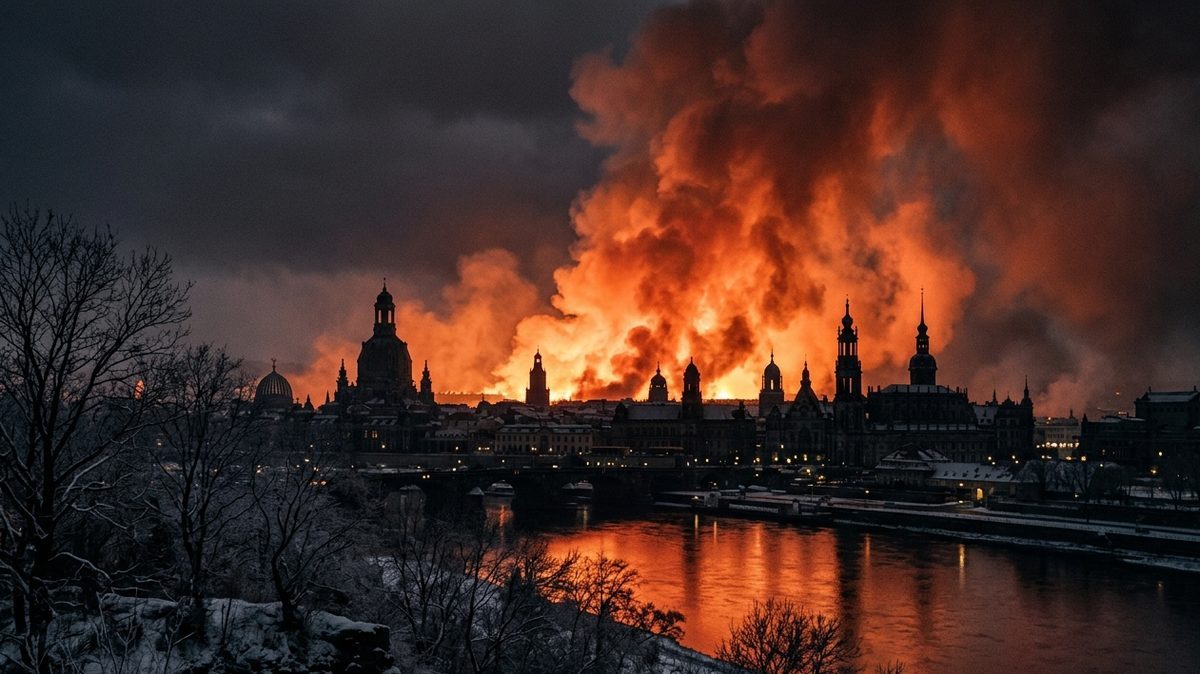
The article reconstructs in detail the Allied bombing of Dresden in four waves between 13 and 15 February 1945, which turned the "Florence on the Elbe" into a firestorm and, according to the Dresden Historical Commission's 2010 findings, claimed 22,700 to 25,000 victims — a fraction of the propaganda figures that circulated for decades and ran as high as a quarter of a million. The author maps the hour-by-hour chronology of the raids and the British "double-strike" tactic aimed at rescue workers, explains the thermodynamics of the firestorm, and traces the chain of decisions from Churchill's insistence to his later distancing. He also documents the historiographical revision of the death toll — from Goebbels's forgery of Tagesbefehl 47 to the Irving v. Lipstadt trial — and situates the raid within the tension between the military logic of area bombing and the moral cost of destroying a defenceless city, overcrowded with refugees, three months before the end of the war.
Within three days, from 13 to 15 February 1945, Allied bombers razed the Saxon capital to the ground. Four waves of air raids dropped approximately 3,900 tons of bombs, which turned the historic center into a firestorm with temperatures reaching an estimated 1,500 °C. According to the conclusions of the Dresden Historians' Commission of 2010, between 22,700 and 25,000 people perished — a tragic figure, but markedly lower than the propaganda numbers that circulated for decades, which reached as high as a quarter of a million. The bombing of Dresden became one of the most debated Allied acts of war, a symbol of the destructive power of strategic bombing and of the moral dilemma associated with the deliberate destruction of civilian centers.
Hour by hour: the chronology of the four-wave operation
The entire operation unfolded in four waves spread across three days. The two nighttime RAF waves on the night of 13–14 February formed the core of the attack, followed by two daytime USAAF raids on 14 and 15 February.
The first wave — RAF No. 5 Group (13 February, night)
At around 17:20 Central European Time, the first Lancasters took off from English bases for the roughly 1,100-kilometer journey across the English Channel and occupied France. An advance group of reconnaissance aircraft from No. 83 Squadron based at RAF Coningsby carried magnesium parachute flares; behind them came nine de Havilland Mosquito light bombers carrying marker bombs. At 21:51 the air-raid sirens sounded over Dresden. At 22:03 the Pathfinders illuminated the inner city with parachute flares, and the Mosquitoes dropped red target indicators onto the Ostragehege sports stadium, an easily recognizable landmark beside the medieval old town.
At 22:13 the first bombs fell. The bombing lasted approximately fifteen minutes, until 22:28. The attack was carried out by 254 Lancasters from an unusually low altitude of 3,000–4,000 meters — the absence of anti-aircraft defenses made this possible. In total they dropped 881 tons of bombs in a ratio of 57% high-explosive to 43% incendiary. The standard load of a single Lancaster contained one four-thousand-pound "cookie" high-explosive bomb and twelve containers, each holding 236 four-pound magnesium incendiary sticks.
The second wave — RAF No. 1, 3, 6 and 8 Group (14 February, after midnight)
Three hours passed between the first and second waves — and that interval was no accident. It formed the core of the British "Double Blow" tactic, developed by Bomber Command and refined from 1943 onward. The tactic pursued three objectives at once. First, firefighters and rescue crews from across the region had time to move into the city and join the effort — the second wave then struck them out in the open. Second, the German night fighters that had engaged the first wave had to land to refuel — and by the time the second wave arrived they were on the ground. Third, the fires from the first wave were able to develop their full potential, so that the second wave could push the entire system over into the stage of a firestorm.
The fires from the first wave were visible from the air at a distance of more than 140 kilometers. The smoke column rose to a height of 4,600 meters.
At 01:05 warnings sounded in Dresden — but only from small hand-cranked sirens, because the electrical grid had been destroyed by the first raid. These sirens could be heard only a single block away. At 01:21 the bombing of the second wave began and ended at 01:45 — it lasted 24 minutes. The attack was carried out by 529 Lancasters, more than twice as many aircraft as in the first wave. They dropped over 1,800 tons of bombs. The Pathfinders of No. 8 Group deliberately widened the target area to both sides of the already-burning center, including the main station (Hauptbahnhof) and the Großer Garten park, which the first wave had not struck.
The combined totals of both RAF waves: 796 Lancasters and 9 Mosquitoes were dispatched, and approximately 780 aircraft reached the target. A total of 2,660 tons of bombs were dropped (1,478 tons of high-explosive, 1,182 tons of incendiary) and over 200,000 individual incendiary bombs. The RAF lost six Lancasters — three of them in the first wave, hit by bombs from their own aircraft flying above them. Another three crashed on the return to Britain. Exceptionally low losses, testifying to the defenselessness of the city.
The third wave — USAAF, 14 February (day)
Originally the American bombers were to attack first, on 13 February, but bad weather delayed the USAAF operations. At 12:17 Central European Time on 14 February, the first American bombs fell. Of the 431 B-17 Flying Fortress bombers dispatched from the 1st Bombardment Division of the 8th Air Force, 115 became separated from the formation and mistakenly bombed Prague, Most, and Plzeň instead of Dresden — approximately 316 aircraft, escorted by P-51 Mustang fighters, attacked Dresden itself. The bombing ended at 12:31.
The American aircraft dropped 771 tons of bombs with an unusually high proportion of incendiaries — 40%, which approached the British "city-busting" approach (the USAAF typically used only around 10% incendiaries). Cloud cover forced most crews to use H2X radar targeting, whose accuracy was such that only 50% of the bombs fell within a one-mile radius of the target. The 1st Bombardment Division's order for the event of cloud cover read: to bomb "the center of the built-up area of Dresden using H2X" — which in practice differed little from British area bombing.
The fourth wave — USAAF, 15 February (day)
This raid was not originally planned against Dresden. The B-17s of the 1st Bombardment Division were headed for the refineries at Ruhland and Böhlen, but cloud cover obscured the primary targets, and Dresden was the designated secondary target. At around 11:51–12:10, approximately 211 B-17 aircraft dropped a total of 461 tons of bombs solely on the basis of radar, with very poor accuracy — the bombs fell scattered between Meißen and Pirna. The USAAF lost a single B-17 over the two days.
In total, the American forces dropped 1,232 tons of bombs compared with the British 2,660 tons. Over the entire operation the Allies lost seven aircraft — six RAF Lancasters and one USAAF B-17.
How the firestorm arose and why the Dresden firestorm was so devastating
A firestorm (Feuersturm) is not merely a large fire — it is a self-sustaining thermodynamic system with its own wind regime. In Dresden it developed as a result of a unique combination of tactical and urban factors.
The thousands of individual fires from the first wave began to merge as adjacent buildings caught alight. The combined fires enormously heated the air above them, which rose sharply upward. A massive vertical column of hot gases formed, creating a powerful suction effect at ground level — drawing cooler air from all directions radially toward the center of the fire. The incoming air supplied an enormous quantity of fresh oxygen, dramatically intensifying the combustion. Stronger combustion produced more heat, a greater updraft, and a stronger supply of air — a positive feedback loop arose that made the system uncontrollable.
Temperatures at the center reached an estimated 1,500 °C. The estimates are based on the melting points of materials found in the rubble: asphalt in the streets melted and ignited, lead and aluminum flowed like water, steel deformed. The wind reached hurricane force — during the firestorm in Hamburg in July 1943, speeds of up to 240 km/h were recorded; in Dresden they were comparable, sufficient to uproot trees a meter in diameter and to physically drag people into the fire.
How the Feuersturm killed
The historian Donald Miller states that 70% of the victims in Dresden died of carbon monoxide poisoning. The combustion consumed oxygen and produced CO, which seeped into cellars and shelters. Most bodies were found intact in cellars — they died of asphyxiation, not from burns. Other mechanisms of death included oxygen depletion in enclosed spaces (below 16% oxygen concentration, loss of consciousness occurs), radiant heat igniting flammable materials at a distance and causing fatal burns, direct incineration in the open, being dragged into the fire by the hurricane-force wind, and melting asphalt that trapped those fleeing.
Dresden's cellars became death traps. The city lacked proper deep shelters. The main civil-defense measure had been to break through the thin partition walls between the cellars of neighboring houses, to allow escape in the event of a building's collapse. These connections, however, became channels through which poisonous smoke and carbon monoxide systematically spread from one cellar to the next. A Dresden police report records: thousands of bodies were found piled up in the houses at the ends of city blocks — people fleeing from one burning cellar ran into the next, where the poisoning overtook them.
Why Dresden in particular
Several factors made the city extraordinarily vulnerable. The Old Town consisted of densely built medieval and Baroque buildings with extensive wooden structural elements — ideal fuel for a Feuersturm. The narrow lanes formed natural "fire channels." As the seventh-largest German city and the largest as-yet-unbombed urban agglomeration, Dresden had an intact building stock full of flammable materials.
Before the war Dresden had 630,000–642,000 inhabitants. In February 1945 the city was teeming with refugees from Silesia, East Prussia, Pomerania, and Brandenburg, fleeing the advancing Red Army. Estimates of the number of refugees range from 100,000 to 600,000, with the total population possibly reaching 800,000 to 1.2 million. The exact figures are unknown — the commission estimated them on the basis of train arrivals and the extent of emergency accommodation.
The city was known as the "Florence on the Elbe" thanks to its exceptional Baroque architecture — the Frauenkirche, the Zwinger, the Semper Opera. Dresdeners believed that their cultural status protected them; a rumor circulated about an Allied agreement to spare the city. Up to February 1945, Dresden had experienced only two minor American raids (October 1944 and January 1945) targeting railway junctions; in the entire war, meanwhile, there had been no British night attack. This false sense of security led to inadequate preparedness.
Anti-aircraft defenses were practically nonexistent. In the summer of 1944, the city had been defended by approximately 80–90 heavy anti-aircraft guns in several batteries. These, however, were gradually moved to the defense of oil plants, to the Eastern Front, and finally to Berlin and Vienna. The last heavy flak battery left Dresden in January 1945. The Me 110 night fighters at Klotzsche airfield, five kilometers to the north, lacked fuel and required special authorization to take off — their launch was delayed and they reached the main bombing formation too late. No kills were confirmed.
Who decided and why: from Churchill's urging to his distancing
Operation Thunderclap and Soviet pressure
The concept of a massive blow against eastern German cities under the codename Operation Thunderclap had existed since mid-1944, but had been shelved. In January 1945 it was revived by Air Commodore Sydney Bufton, the RAF's Director of Bomber Operations, with a proposal to time the blows so that they would correlate with the Soviet offensive. The British Joint Intelligence Committee (JIC) warned that Germany could transfer up to 42 divisions to the Eastern Front, and that disrupting rail transport would prevent this.
On 25 January 1945, Churchill asked the Secretary of State for Air, Sinclair, what plans existed for bombing eastern German cities. The following day he urged, in a formulation recorded by Martin Gilbert: why Berlin, and no doubt other large cities in eastern Germany, should not now be considered especially attractive targets. This direct urging by the Prime Minister set off a chain of orders, at the end of which stood Harris, who proposed simultaneous attacks on Chemnitz, Leipzig, and Dresden.
The role of the Soviet Union remains debated. The Deputy Chief of the Soviet General Staff, General Alexei Antonov, at the Yalta Conference (4–11 February) requested the bombing of railway junctions in eastern Germany, naming Berlin and Leipzig in the official minutes. According to Churchill's interpreter Hugh Lunghi, however, both Antonov and Stalin specifically mentioned Dresden. Stalin's alleged first question to Churchill at Yalta was why the Allies had not bombed Dresden. The decision to bomb the city, however, had been made before the conference began — the order was issued, in Churchill's absence, by Deputy Prime Minister Clement Attlee.
Harris, the Area Bombing Directive, and military logic
Air Chief Marshal Arthur "Bomber" Harris was the most ardent proponent of area bombing. In 1943 he wrote that the aim was the destruction of German cities, the killing of German workers, and the disruption of civilized life throughout Germany. For Dresden he proposed and planned the Double Blow tactic.
The tactic drew on the experience of Hamburg (Operation Gomorrah, July 1943) and was first successfully used in its specific form in the raid on Magdeburg in January 1945 — which served as the direct template for the Dresden operation. The principle — first high-explosive bombs to "open up" the city, then incendiaries to set the exposed interiors alight — was, ironically, borrowed from the Luftwaffe, which had used it in the bombing of Coventry in November 1940.
Heavy high-explosive bombs, especially the four-thousand-pound "cookies," tore off roofs, shattered windows and doors, knocked down walls, and exposed the wooden structures of buildings. At the same time they destroyed water mains, blocked streets with craters, and severed gas and electrical lines. The incendiary bombs then fell into the exposed interiors and set wooden beams, floors, and furnishings ablaze.
The Area Bombing Directive of 14 February 1942 redirected the RAF from precision attacks to area bombing of cities. Its key formulation read that the primary object of operations should now be the morale of the enemy civilian population, in particular the industrial workers. The directive arose after the devastating Butt Report of 1941, which, on the basis of an analysis of 633 photographs from bombing operations, revealed that of the aircraft claiming to have attacked their target, only a third had come within a five-mile radius of it — and out of the total number of bombers dispatched, it was less than a fifth. Harris took command of Bomber Command eight days after the directive was issued.
Dresden undoubtedly had military significance: an official guidebook from 1942 described the city as "one of the foremost industrial centers of the Reich." In 1944 the Weapons Office of the German Army High Command registered 127 medium to large factories supplying the army — Zeiss-Ikon, Siemens, Chemische Fabrik Goye. The city employed approximately 50,000 workers in armaments production and formed a key railway junction on the Berlin–Prague–Vienna route. The relocated Wehrmacht headquarters was housed in the Taschenbergpalais hotel.
But the main industrial areas lay in the suburbs, while the RAF targeted the medieval center. As Miller noted: the economic disruption would have been far greater had Bomber Command targeted the suburban areas where most of Dresden's manufacturing potential was concentrated. Railway traffic in Dresden was restored within three days.
After the war, Harris stated in his memoirs that the attack on Dresden had at the time been considered a military necessity by people much more important than himself.
Churchill's famous distancing
On 28 March 1945, Churchill wrote a sharp memorandum to the Chiefs of Staff: it seemed to him that the moment had come when the question of bombing German cities simply for the sake of increasing terror, though under other pretexts, should be reviewed. The destruction of Dresden remained a serious query against the conduct of Allied bombing.
Harris was appalled. Under pressure from Portal and Harris, who refused to be made scapegoats, Churchill withdrew the memorandum and on 1 April issued a softened version without the word "terror," framing his concerns as a practical interest in the postwar administration of a destroyed Germany — that if the Allies took over an utterly ruined land, there would be nowhere to obtain building materials even for their own needs. Neither Harris, nor Eisenhower, nor Arnold discussed the bombing of Dresden in detail in their postwar memoirs.
How many people actually died: from propaganda to historical truth
The question of the number of victims of the Dresden bombing underwent one of the most dramatic historiographical revisions of the 20th century.
The Dresden Historians' Commission (Historikerkommission), composed of experts — university professors, archivists, military historians, and forensic specialists — worked in 2005–2010, examined extensive archival materials, and gathered detailed witness testimonies. Its conclusion: between 22,700 and 25,000 people perished. By 22 March 1945, 20,204 bodies had been recovered, of which 6,865 were cremated on the Altmarkt square. By 3 April 1945, the figure had risen to 22,096. After the war, during the reconstruction of the city up to 1966, a further 1,858 bodies were found. Since 1989, despite extensive construction excavations, no body connected with the bombing has been found.
The key document is Tagesbefehl 47 (Daily Order No. 47) of 22 March 1945, issued by Colonel Grosse, chief of staff to the commander of the order police in Dresden. The order cites a summary of the conclusions of the chief of police and gives 20,204 dead, with a presumed final figure of around 25,000. There exists, however, a forgery in which someone — probably in Goebbels' Ministry of Propaganda — added a zero to each figure: 20,204 became 202,040, 25,000 became 250,000, and the 6,865 cremated bodies on the Altmarkt became 68,650. The forgery was exposed in 1977 by the historian Götz Bergander, when he located a reservist named Ehlich, who had seen and transcribed the authentic TB-47 in the course of his official duties.
As early as 25 February 1945, Nazi propaganda issued a leaflet headlined "Dresden — Massacre of the Refugees" with a claim of 200,000 dead. David Irving, in his book The Destruction of Dresden (1963), at first worked with a figure of around 135,000 victims, based on the testimony of the head of the Dresden central missing-persons office, Hanns Voigt. In later editions (1966/67), however, he used the forged TB-47 and propagated figures of 202,040 to 250,000. Although he was informed on 5 April 1966 of the existence of the authentic TB-47, he never retracted the forgery and continued to publish it. In the case of Irving v. Penguin Books and Deborah Lipstadt (2000), Professor Richard J. Evans demonstrated that Irving's version of the TB-47 was "beyond any doubt a forgery."
During the communist era in the GDR, the figure of 35,000 became established. Present-day neo-Nazis propagate absurd figures ranging from 500,000 to a million.
Conclusion: between military logic and moral dilemma
The bombing of Dresden was not an anomaly — it was the logical consequence of an escalating doctrine of area bombing, consistent with the raids on Hamburg, Kassel, Pforzheim, and dozens of other cities. It was authorized by the proper chain of command, supported by intelligence analyses, and carried out against a city with real military significance.
At the same time it is indisputable that the RAF deliberately targeted the historic center rather than the industrial suburbs, that the three-hour interval was designed to strike the rescue crews out in the open, and that the primary effect was the mass destruction of the civilian population in a city practically without defenses, overcrowded with refugees, just three months before the end of the war.
Modern historiography has abandoned both the propagandistically inflated victim figures and the simplistic moral judgments of either side. As the British historian Frederick Taylor wrote: the destruction of Dresden has an epically tragic quality — it was a wonderfully beautiful city and a symbol of Baroque humanism and of everything best that Germany had to offer. At the same time, however, it contained everything worst about Germany during the Nazi period. It is precisely this tension between military rationality and human cost that makes Dresden a lasting symbol of the moral limits of modern war.
The concept, structure, and editorial line of the article are the work of the author, who prepared the content outline, established the key theses, and directed the entire creative process. Generative AI (Claude, Anthropic) was used as a tool for research, fact-checking, and fleshing out the author's draft.
The author edited the outputs throughout, verified the key findings, and approved the final wording. No part of the text was published without human review. All factual data were verified against the publicly available sources cited in the text.
The procedure complies with the requirements of Art. 50 of EU Regulation 2024/1689 (the AI Act) on the transparency of AI-generated content. #poweredByAI
Read the Czech original on Médium.cz.
AI · Claude — machine translation, may contain inaccuracies.