War as a Cure for Inequality: Why the Prescription Stopped Working
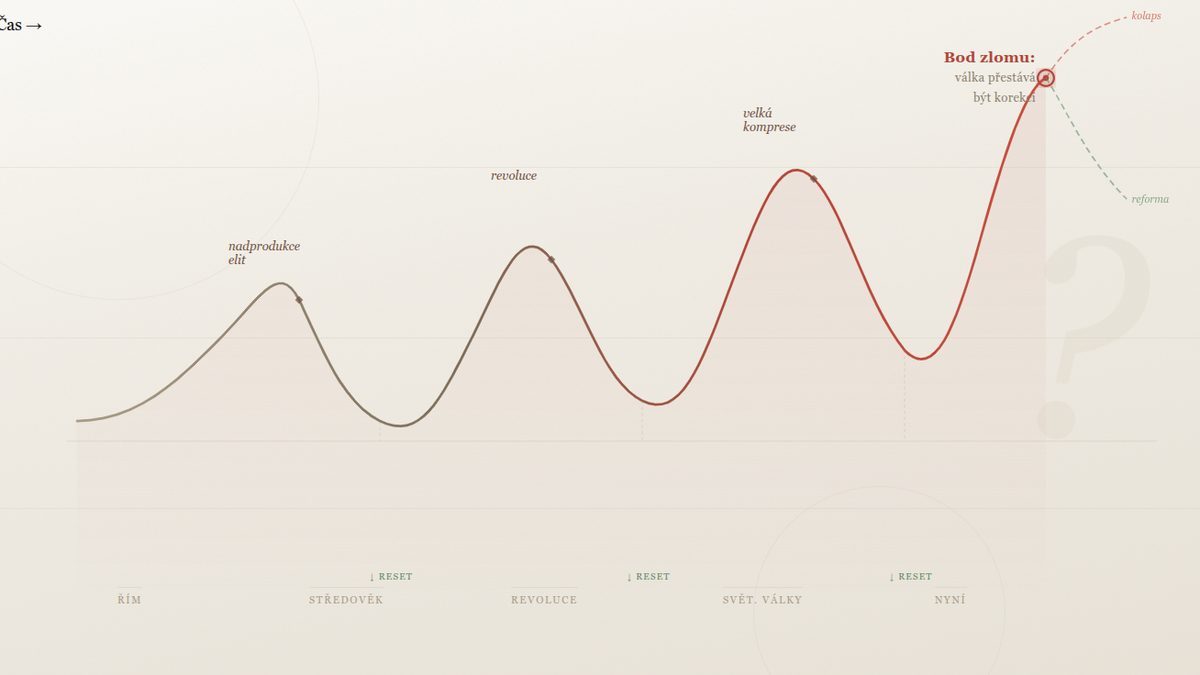
The article examines Peter Turchin's structural-demographic theory, according to which societies pass through predictable cycles of instability driven by elite overproduction, the pauperization of the masses, and the fiscal crisis of the state. Drawing on historical examples (the fall of Rome, the Black Death, the French Revolution, the world wars) as well as contemporary data, it shows that war and violence have historically been the most effective levelers of inequality—but in the nuclear age this mechanism has ceased to be usable, raising the question of whether peaceful alternatives exist.
In 2010, a then little-known academic published a brief prediction in the journal Nature: in the coming decade, the United States faced a period of rising political instability. Ten years later, amid a pandemic, mass protests, and an assault on the Capitol, Peter Turchin — a zoologist by training, a complexity scientist by profession — had become one of the most frequently cited forecasters of the American crisis. His structural-demographic theory holds that societies pass through predictable cycles of accumulating tension followed by collapse, with war, revolution, or epidemic functioning as a brutal "reset button." The theory is not mere speculation — it rests on a database of hundreds of historical crises and dozens of quantitative indicators. Yet it also faces a fundamental question: even if the cycles exist, can war perform a corrective function in an era of nuclear weapons and globally interconnected economies?
The empirical data reveal a paradox — the historically most effective "leveler" of inequality has become, in the modern context, potentially destructive to civilization itself.
Peter Turchin was born in 1957 in Obninsk, the son of the Soviet dissident and cyberneticist Valentin Turchin. In 1977 the family was forced to emigrate from the Soviet Union. The young Turchin studied the population ecology of insects and earned a doctorate in zoology at Duke University — and it was precisely the models of population ecology that he later applied to human societies. He created a discipline he called cliodynamics. His structural-demographic theory (SDT), building on the 1991 work of Jack Goldstone, identifies three key mechanisms that together generate cyclical instability.
The first is elite overproduction — a situation in which a society produces more candidates for elite positions than it can absorb. This is not just about the aristocracy: in the modern context it means a surplus of law-school graduates and holders of MBAs and PhDs competing for a limited number of genuinely elite positions. Frustrated aspirants become "counter-elites" — historical examples include the Gracchi brothers in Rome, Robespierre, Lenin, and, according to Turchin, Donald Trump as well. In the United States, the number of people with assets exceeding 10 million dollars rose tenfold — from 66,000 in 1983 to 693,000 in 2019. The number of congressional candidates self-financing their campaigns with sums exceeding one million dollars rose from a single one across the entire 1990s to 36 in 2020.
The second mechanism is popular immiseration. In agrarian societies this meant a literally falling standard of living; in industrial economies it means the stagnation of real wages amid rising productivity. Turchin identifies the inflection point in the United States around 1978, when productivity and wages decoupled. This "wealth pump" systematically transfers resources from workers to elites.
The third is the fiscal crisis of the state — the state is unable to collect sufficient taxes (the elites resist taxation), while its expenditures grow. The combination of these three factors creates what Turchin calls the secular cycle: a two- to three-century pattern of phases of expansion, stagnation, crisis, and depression. In Secular Cycles (2009, with Sergey Nefedov) he tested the model on eight historical societies — from the Roman Republic through medieval England and France to Tsarist Russia — and in every case found quantitative confirmation of the model's predictions.
A key instrument is the Political Stress Index (PSI), constructed in Ages of Discord (2016) from roughly 40 social indicators. The PSI for the United States shows peaks around the years 1870, 1920, and a new steep rise from 2010 onward. It was on the basis of this indicator that, in 2010, Turchin published in Nature his prediction that the coming decade would be "a period of growing instability in the United States and Western Europe."
The institutional backbone of Turchin's work is Seshat: Global History Databank — a database covering the period from the Neolithic to the year 1900, with more than 1,500 time-series variables for 30 natural geographic areas, verified by an extensive network of historians and archaeologists. Its offshoot CrisisDB contains data on hundreds of historical crises. Preliminary results show that in 75% of cases, societies exhibiting the Turchinian pattern slid into state breakdown, while roughly one in five managed to avert the crisis through reforms.
Turchin's theory has influential opponents. The political scientist Yascha Mounk (Johns Hopkins) calls it "unfalsifiable" — the predictions are so general that virtually any turbulent event will confirm them. Mounk points out that the core insight (unmet expectations + institutional incapacity = instability) was already formulated by Samuel Huntington in the 1960s — without Big Data. Francis Fukuyama made the identical argument in his review in the New York Times (2023).
Christian Parenti, in Compact Magazine (2023), criticizes the conceptual vagueness: the definition of "elite" keeps shifting — at one point it is the top 1%, at another anyone who wields physical, economic, or ideological power. Where is the threshold of "overproduction"? The model treats actors in purely materialist terms and minimizes human agency — the American Civil War is reduced to an intra-elite conflict, while the mass resistance of Northerners to slavery out of conviction is overlooked.
Further objections concern selection bias in the data (with 210 theories of Rome's fall, as Alexander Demandt counted, the data can be fitted to many frameworks), determinism (contingency and individual decisions are marginalized), and inconsistency of measurement. Historians who reviewed Secular Cycles nonetheless praised the quality of the historical work — both Harry Kitsikopoulos (EH.net) and David Jacks (Australian Economic History Review) judged the work to be ambitious and thorough.
If Turchin's theory aspires to be science and not a mere narrative construction, it must withstand confrontation with historical data. Three case studies — the fall of the Roman Republic, the Black Death, and the French Revolution — provide its most stringent test.
The case that fits Turchin's model most convincingly is the crisis of the Roman Republic (133–30 BC). The system of latifundia concentrated land in the hands of the senatorial class — Pliny the Elder recorded that just six owners controlled half of the province of Africa. Veterans returned from campaign to ruined farms, forced to sell to the great landowners and migrate to Rome as urban poor dependent on grain doles. The Gracchi brothers (133, 121 BC) became prototypes of Turchin's "counter-elites." Sulla's proscriptions eliminated roughly a third of the senatorial class. The ensuing civil wars carried out a further "purge" of the elites, and Augustus's principate inaugurated a new integrative phase. Walter Scheidel estimates that Roman inequality reached "the maximum technically possible at the given level of economic development."
The Black Death (1347–1353) killed 25–45% of Europe's population. In England the population fell from roughly 5 million to 3 million. The result: agricultural wages doubled between 1350 and 1450, land prices and rents fell, and the standard of living of ordinary people rose dramatically. The fifteenth century became a "golden age" of the European peasantry.
A crucial qualification: the effect was not universal. In Eastern Europe, by contrast, serfdom tightened after the plague (the "second serfdom"), because the landlords had sufficient coercive power to maintain exploitation despite the labor shortage. In Mamluk Egypt the ruling class maintained pre-plague levels of extraction thanks to its military power. The institutional context determined whether the demographic shock led to leveling or to a deepening of inequality.
Pre-revolutionary France exhibits all three of Turchin's mechanisms in pure form. The population grew from 21 to 28 million (1715–1789). The middle class tripled and made up nearly 10% of the population — a surplus of educated lawyers and provincial notables competing for positions reserved for the hereditary aristocracy. Bread prices rose fatally after the failed harvests of the 1780s; by 1788, 10,000 textile workers in Troyes were out of work. The royal debt reached 8–12 billion livres, and the annual deficit tripled from 41.7 million (1781) to 116.1 million livres (1789). Half of state revenue went to servicing the debt.
Scheidel notes, however, that in terms of leveling inequality, the French Revolution was "utterly incomparable" with the Russian or Chinese revolutions — it lacked sufficient destructive force for a lasting transformation.
The data of Thomas Piketty and Emmanuel Saez show a degree of wealth concentration before the First World War that has not been surpassed since. In Britain the richest 1% owned roughly 70% of all wealth. In the United States the top 1%'s share of income reached 23.9% in 1928. Similarly extreme values held for France and Germany.
The Second World War carried out a historically unprecedented compression. Across an average of twelve war-affected countries, the top 1%'s share of income fell by a third. In Japan the largest 1% of fortunes collapsed by nine-tenths. In the United States the Gini fell by 7–10 points; the top 1%'s share of income dropped from nearly 24% to 11.3% in 1944 and reached a historical minimum of 10.9% around 1975–1980.
The mechanisms of compression were not primarily demographic but institutional and political: mass mobilization raised the demand for labor, wartime wage controls directly compressed incomes, marginal tax rates reached 94% (United States, 1944), the physical destruction of capital struck mainly the property of the wealthy, inflation and currency reforms eroded savings, and union organization rose from 10% to roughly a third of American households by 1955.
The demographic costs were enormous: the First World War claimed 8.5–10 million soldiers and 6–10 million civilians. The Second World War killed 60–85 million people, of whom 60–67% were civilians. The wars killed above all young working-class men, not "dysfunctional elites." The leveling effect operated indirectly — through the political changes catalyzed by the wartime experience.
Walter Scheidel, in The Great Leveler (2017), analyzes a millennium of data and identifies four historical mechanisms of significant reduction in inequality: mass-mobilization wars, transformative revolutions, state collapse, and lethal pandemics. His key conclusion: peaceful paths to substantially greater equality are practically nonexistent in the historical record. The sobriety of this verdict provoked a sharp reaction — Oxfam criticized the book for draining hope out of an important discussion about inequality.
Critics point to an unfair comparative framework: it measures the effectiveness of peaceful policies against the effect of extreme violence — which is like comparing the effect of an aspirin with that of an amputation.
The Scandinavian countries represent the most convincing case study against Scheidel's thesis. Income inequality in the Nordic countries began to fall at the end of the 1930s — before the Second World War — thanks to union organization and corporatist agreements. A key milestone was the Saltsjöbaden Agreement (December 1938) between the Swedish trade union confederation (LO) and the employers' association (SAF), which inaugurated an era of consensus and wage compression that lasted into the 1970s. Union density in Sweden remains at 70–80%.
Nevertheless, there are substantial qualifications. The Saltsjöbaden Agreement arose in the context of the Great Depression and rising fascism — an existential threat motivated the compromise. And crucially: the Swedish Gini for disposable income rose from roughly 0.21 in the early 1990s to 0.31 in 2023 — an increase of about one half, the largest of all OECD countries. This supports Scheidel's broader skepticism: leveling effects, whether peaceful or violent, tend to erode.
Franklin D. Roosevelt enacted the Wagner Act (1935) and the Social Security Act (1935), and raised the top marginal tax rate to 79% and later 94%. Did the New Deal by itself have a significant impact on inequality? The data suggest that the effect before the Second World War was modest. Claudia Goldin and Robert Margo identified the "Great Compression" as primarily a phenomenon of the years 1937–1947 — driven by wartime wage controls, a tight labor market, and extreme taxation. More recent research suggests that the apparent prewar compression was partly an artifact — high taxes led to a shift from employment to self-employment, which may have overstated the observed wage compression.
The real contribution of the New Deal was different: it created an institutional infrastructure — unions, social insurance, a regulatory apparatus, a progressive tax structure — that made it possible to sustain equality for decades after the war. The war provided the shock; the New Deal provided the scaffolding.
After the Meiji Restoration (1868), Japan underwent rapid industrialization that created the zaibatsu — family conglomerates controlling a quarter of financial capital and 60% of metal mining. The top 1% held roughly 20% of total national income. The postwar "reset" was directly imposed by the American occupation: land reform redistributed more than 90% of the land, the zaibatsu were dissolved, and 6.5 million workers joined unions. The top 10%'s share of income fell from 60% to 30%. Japan is a textbook case of Scheidel's thesis — equality was the product of catastrophic military defeat and externally imposed restructuring.
So far we have tested Turchin's model on historical cases where we know the outcome. What does it say about the present — in real time, without the luxury of hindsight?
Turchin's 2010 prediction of rising political instability in the coming decade gained public attention through an article in The Atlantic in November 2020. The events of the following years did not call his model into question: the assault on the Capitol on January 6, 2021, deep political polarization, Trump's return to the White House in 2025.
American data on inequality are alarming. The household Gini coefficient reached 0.49 in 2024. At the hundred largest low-wage firms in the S&P 500, the ratio of CEO pay to median wage rose from 560:1 (2019) to 632:1 (2024); the overall S&P 500 average is 281:1, still incomparably higher than the 21:1 of 1965. The top 20% receive 52.2% of income, the bottom 20% only 3.1%.
In an interview for The China Academy (February 2025), Turchin stated that the United States is "in a very fragile state." On the podcast The Great Simplification he explained that the MAGA coalition would probably begin to fight among itself — "the revolution devours its children." In June 2025, speaking to Newsweek, he warned that "almost every indicator has intensified" and that the situation could escalate into civil war. He estimates the resolution of the crisis in the 2030s.
Russia exhibits elements of Turchin's model — competition between oligarchs and siloviki, fiscal dependence on energy exports, the stagnation of real wages in the 2010s. Prigozhin's mutiny (June 2023) is a textbook case of intra-elite conflict. The war in Ukraine, however, is not unambiguously a cyclical phenomenon — the realist school emphasizes security calculations, while others stress Putin's imperial ideology. The war functions as a "reset" for neither side: for Russia it deepens structural problems, and for Ukraine it represents devastation with estimated reconstruction costs of 486 billion dollars.
Across Europe, populist forces are rising. For the first time in modern history, far-right parties lead the polls in the four largest European economies simultaneously. The AfD won over 20% in the federal election (February 2025), Reform UK overtook both traditional parties, and the Rassemblement National dominates the French European elections. Youth unemployment in Spain remains at 25–27%.
China offers an alternative model — Xi Jinping's "common prosperity" campaign since 2021 represents an attempt at a managed, top-down correction of elite overproduction. The antitrust actions against Alibaba, the regulation of the technology sector, the shutdown of the private tutoring industry — all of this looks like a systematic elimination of competing centers of power. The official Gini fell from a peak of 0.491 (2008) to 0.462 (2021). At the same time, however, youth unemployment reaches 16.9% (February 2025), a real estate crisis is destroying middle-class wealth, and the population is declining.
Turchin's theory implicitly assumes that war functions as a corrective mechanism — but it contains a blind spot. What if those who are supposed to fight refuse? The relationship between inequality and the willingness to defend the state is one of the least discussed, and yet most important, variables in the entire model.
A key study is the 2020 work by Anderson, Getmansky, and Hirsch-Hoefler, published in the British Journal of Political Science, which analyzed six waves of the World Values Survey covering dozens of countries. The data show that this relationship is not a historical anomaly — it is a structural constant. The study's findings are unambiguous: the willingness to fight for one's country declines as inequality at the state level rises. In countries with a high Gini, the rich are markedly less willing to fight than the poor. In countries with low inequality, willingness scarcely differs across income groups. Critically: the decline in willingness among the rich in unequal countries is statistically significantly larger than the decline among the poor. The mechanism is economically rational — high inequality allows the rich to "buy their way out" of service, because the poor are more willing to accept financial compensation for the risk.
A Gallup International survey from 2024 confirms the global trend: willingness to fight for one's own country fell from 61% (2014) to 50%. In the European Union only 32% of citizens are willing to fight, in the United States 41%. Japan — a country with a traumatic war experience — shows just 11%, Germany 18%. By contrast, in areas with active conflicts and a strong collective identity (the Middle East 73%, South Asia 76%) willingness remains high.
The phrase "rich man's war, poor man's fight" arose during the American Civil War and has since become a universal metaphor. The Conscription Act of 1863 allowed one to avoid service by paying 300 dollars — an average worker's annual wage. The New York draft riots of July 1863 — to this day the largest civil uprising in American history — were not primarily race riots, as they are sometimes portrayed. They were an eruption of class anger among Irish immigrants who could not afford to buy their way out, against a system in which the rich sent the poor to their deaths.
The Vietnam War institutionalized class selection to systemic perfection. College students could obtain a "deferment" — a postponement of the draft for the duration of their studies. Fifteen million men legally avoided the draft, most of them through educational exemptions. A college graduate was 6.5 times less likely to serve in Vietnam than a peer without a degree. American forces in Vietnam were composed 55% of working-class men, 25% of the poor, and only 20% of the middle class. Draftees made up 25% of personnel in Vietnam, but 30.4% of combat casualties — they were systematically assigned to the most dangerous infantry units.
The cultural impact lasted for decades. Creedence Clearwater Revival captured it in "Fortunate Son" — a song that became an anthem of class anger. As one veteran put it in Murray Polner's book: "Where were the sons of all those big shots who supported the war? At those fancy universities?"
Ukraine provides a current, painfully detailed case study. A country with a Gini coefficient around 0.36 — moderately unequal — but with deeply rooted corruption and an oligarchic system in which Yanukovych's golden toilets are a symbol, not an exception.
The numbers are devastating. In January 2026, Mykhailo Fedorov publicly admitted that two million Ukrainians are evading mobilization and 200,000 soldiers have deserted. Between January 2022 and September 2025, the Prosecutor General's Office opened roughly 290,000 criminal proceedings for unauthorized abandonment of a unit or desertion. Since the start of the full-scale invasion, the border guard has detained over 49,000 men of military age attempting to leave the country illegally. The BBC estimated as early as 2023 that 768,000 Ukrainian men had fled to the EU.
The mobilization system is deeply unequal. The average monthly wage in Ukraine is roughly 600 dollars. Bribery networks charge 13,000–15,000 dollars for an illegal border crossing — that is, two years' wages. Investigations have uncovered hundreds of criminal networks linked to the border guard, medical commissions issuing false certificates of disability, and government officials who secured exemptions from service for themselves. Villages in rural areas were, according to reporting, "completely stripped" of men of military age — there, forcible mobilization is more easily carried out and less likely to be filmed for social media.
In July 2025, Gallup found a fundamental reversal of public opinion: 69% of Ukrainians now support a negotiated end to the war as soon as possible, compared with just 22% in 2022. Only 24% still support fighting to victory — down from 73%. This shift occurred across all regions, age groups, and demographic categories.
The Ukrainian case is not unique — it is merely the most visible. It illustrates what the World Values Survey data show statistically: when citizens perceive that the state protects primarily the interests of the elites and that the burden of defense falls disproportionately on the poor, the social contract that legitimizes sacrifice falls apart. As the war veteran and lawyer Oleh Symoroz put it for RFE/RL: "We have destroyed mobilization with our attitude. We are discouraging people from going to serve in the army." The problem is not a lack of patriotism — it is the loss of trust that the sacrifice will be shared fairly.
Historical cycles suggest one thing; modern reality suggests another. The concept of war as a corrective mechanism runs up against six mutually reinforcing limits of the modern era.
Nuclear weapons have transformed the nature of great wars from corrective to existential. Nuclear winter models predict that a full-scale American-Russian conflict would lower global temperatures by more than 5 °C and that, within two years, an estimated 5 billion people would die of starvation. Such a conflict does not select "dysfunctional elites" — it destroys civilizational infrastructure as a whole. Scheidel himself concedes that future warfare "will probably not have the same leveling effect" as the mass-mobilization wars of the 20th century.
Economic interconnection globalizes destruction. The war in Ukraine — a conflict between countries representing together only about 4% of global GDP — lowered world GDP by roughly 1.5–1.7%, raised global inflation by 1.3 percentage points, drove natural gas prices in Europe up by 120–130% and food prices by 30%.
Wars do not kill selectively. Worldwide, men make up 79% of the direct victims of conflicts. In the First World War, the infantry bore 85% of casualties. In contemporary urban conflicts, according to the UN, civilians make up as much as 90% of the victims of explosive weapons. Wars wipe out young working-class men — the most productive demographic segment — while the elites are insulated from the consequences.
The military-industrial complex means that war enriches the elites rather than reducing them. Global military expenditure reached a record 2,718 billion dollars in 2024 — an increase of 9.4%, the steepest year-on-year rise at least since the end of the Cold War (SIPRI, 2025).
Destruction is not reversible within the same time horizon. Industrial enterprises relocated because of conflict need nearly a decade to return. Human capital lost to emigration does not return at all.
Societies with deep inequality cannot mobilize. The Ukrainian experience reveals a sixth, hitherto underestimated limit: when citizens perceive the state as unjust, the social contract that legitimizes sacrifice falls apart. Two million people evading mobilization, 200,000 deserters, and bribery networks charging two years' wages for a border crossing are not an anomaly — they are the logical consequence of inequality in the distribution of the war burden.
The data from CrisisDB suggest that the cycles are not absolutely deterministic — roughly one in five historical crises was resolved without state breakdown. Turchin himself repeatedly emphasizes that a peaceful resolution is possible, and cites the American Progressive Era and the New Deal as a key example. His prescription includes progressive taxation, investment in workers' wages, and curbing elite extraction — "switching off the wealth pump."
Nevertheless, the trend of the last four decades brings a sobering corollary. The postwar compression is systematically unraveling: American inequality has returned to its 1928 level, the Swedish Gini has risen by about a half, and Japanese inequality has been rising since the 1990s. Peaceful mechanisms of correction exist — but they appear to require extraordinary historical circumstances and to be reversible.
The question Turchin poses for the 2030s is not whether the crisis will come, but in what form it will be resolved — through reform as in the era of the New Deal, or through disintegration as at the end of the Roman Republic. Different societies — American democracy in a state of gridlock, the Chinese authoritarian experiment, European welfare states with an eroding consensus — find themselves at different points in the cycle and possess different tools of correction.
What the data clearly show: war alone cannot perform a corrective function in the 21st century. Nuclear weapons, global economic interconnection, and the character of modern warfare have transformed the historical "reset mechanism" into a potentially civilization-destroying force. And on top of that there is a sixth, hitherto underestimated limit: societies with deep inequality are unable to mobilize their own citizens to defend an order they perceive as unjust. Ukraine is showing this in real time.
If Turchin's cycles exist — and the empirical evidence is surprisingly robust — then societies will either find new, peaceful mechanisms of correction, or they will face forms of instability for which historical precedents offer no comforting analogies. In 2010, Turchin wrote a single sentence in Nature: "The historical record shows that societies can avert catastrophe." The question for the 2030s is whether anyone will take that sentence seriously.
Primary academic sources — Peter Turchin:
Seshat: Global History Databank:
Walter Scheidel — The Great Leveler:
Critiques of Turchin's theory:
Historical case studies — Rome, the Black Death, France:
Inequality and data — Piketty, Saez, Goldin, Margo:
The Scandinavian model:
Japan:
The current situation — USA, Ukraine, Europe, China:
War, demographic impacts, and economic interconnection:
Inequality and the willingness to fight — "Rich man's war, poor man's fight":
Ukraine — mobilization, desertion, public opinion:
Transparency of authorship:
The concept, structure, and editorial line of the article are the work of the author, who prepared the content outline, established the key theses, and directed the entire creative process. Generative AI (Claude, Anthropic) was used as a technical tool for research, fact-checking, and elaborating the author's draft.
The author edited the outputs continuously, verified the key findings, and approved the final wording. No part of the text was published without human oversight. All factual data were verified against the publicly available sources cited in the text.
The procedure complies with the requirements of Art. 50 of EU Regulation 2024/1689 (AI Act) on the transparency of AI-generated content. #poweredByAI
Read the Czech original on Médium.cz.
AI · Claude — machine translation, may contain inaccuracies.