Just a Little Further and I've Got It! The Anatomy of Problems That Look Almost Solvable
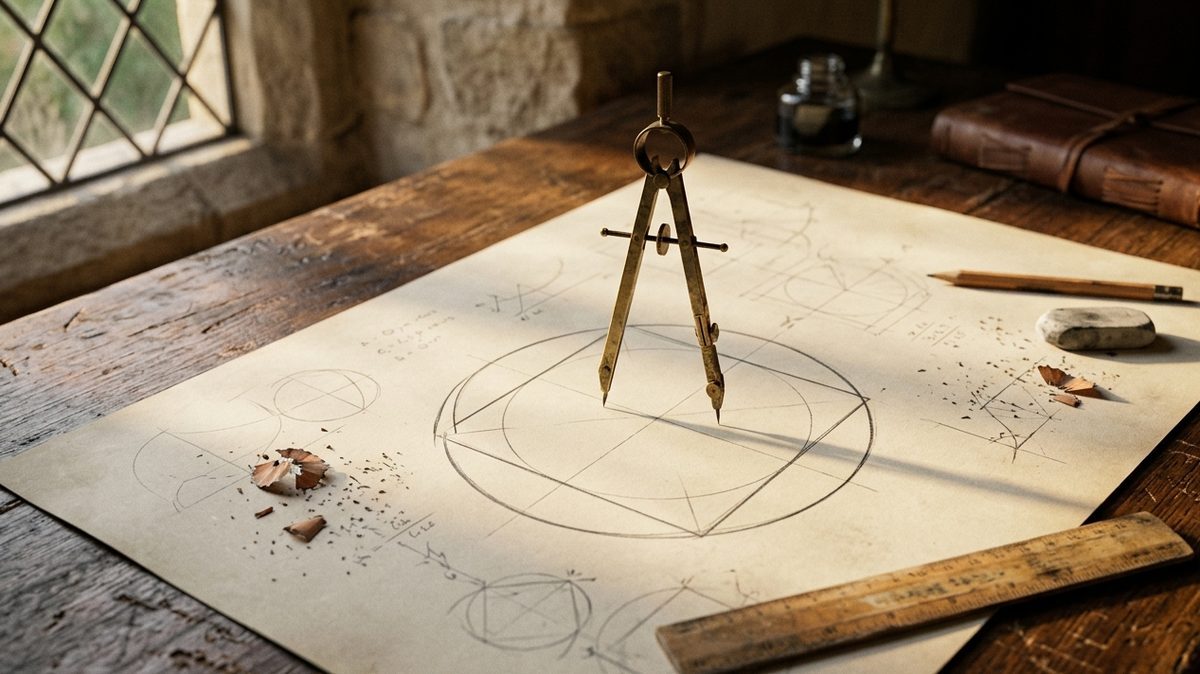
The article maps a peculiar class of problems that look easily solvable and yield promising partial results, yet for which no general solution exists within the given framework in principle — from the ancient squaring of the circle, angle trisection, and perpetual motion, through Gödelian incompleteness and the Collatz conjecture, to today's promises of fusion and AGI. The author shows that the trap has two layers: a mathematical structure (specific cases can be solved; only the general step is impossible) and the brain's cognitive mechanisms (the near-miss effect, confirmation bias, sunk costs, the Dunning–Kruger effect), which together keep the solver in the illusion of "just a little more and I've got it." The point is that impossibility depends on the chosen rules — the Greek problems can be solved by folding paper (origami) — and the key question for distinguishing perseverance from obsession is Popper's "what would refute my hypothesis?"
Joey went to the library from the first grade on. Not because anyone sent him there — they sent him outside. But outside there were only trees and other children, while in the library there were mysteries. Joey kept in his head a list of things that looked as though he might solve them if he tried hard enough. He read a book about the ancient Greeks and their puzzles. One of them caught him: how do you construct a square that has exactly as much space as a given circle? A straightedge, a compass, a sheet of paper. You don't need more.
Joey tried it all afternoon. He almost got it. Then he tried again the next afternoon. Almost again. "Just a little more," he told himself.
He didn't know that people had been telling themselves exactly the same thing for over two thousand years. And that for some of them, it had wrecked their lives.
There is a peculiar category of problems. They look simple — a schoolchild can grasp the statement. The tools to solve them are within everyone's reach. The first few attempts give promising results. And then comes the moment when a person says: "Just a little more and I've got it!"
Except that little more never comes. Not because the solver isn't clever enough. Because the solution, in principle, does not exist — at least not in the way he is attempting it. Yet the problem looks so attainable that a reasonable person refuses to accept this. And so he carries on. Months. Years. A whole lifetime.
Behind this lies a double trap. The first is in the very structure of the problems: specific cases can be solved; only the general step is impossible. The second is in the human brain: the dopamine reward for a "near win," confirmation bias, sunk costs. Both traps cooperate so elegantly that geniuses and charlatans alike have fallen for them, ancient philosophers as well as modern engineers.
This is a story about all of them. And a little bit about Joey, too.
Three problems for all eternity
In secondary school, in the library, Joey found his problem in an encyclopedia of mathematics. It had its own name: squaring the circle. And it was not alone. The Greeks knew it together with two others: trisection of an angle (dividing an arbitrary angle into thirds) and doubling the cube (constructing a cube with twice the volume). The rules of the game: you may use only a straightedge and a compass, in a finite number of steps.
The rules matter. It is precisely in them that the trap hides.
The impossibility of trisection and of doubling the cube was proved by Pierre Wantzel in 1837 — and the way he did it is the key to understanding the whole phenomenon. Straightedge-and-compass constructions correspond mathematically to solving equations of degree 2ⁿ. But trisecting a sixty-degree angle requires solving an irreducible cubic equation — and three is not a power of two. It never will be.
Squaring the circle was buried for good by Ferdinand von Lindemann in 1882, when he proved that π is a transcendental number — it is not a root of any polynomial equation with rational coefficients. A square with the area of the circle would have a side of r·√π, and that is a length impossible to construct with a straightedge and compass.
But — and here is where the trap begins — proofs of impossibility were of no interest to anyone. As the historian of mathematics Jesper Lützen showed, Wantzel's result was practically ignored for a whole century. Why?
Because plenty of angles can be trisected. A hundred and eighty degrees into sixty? Easily. Ninety into thirty? No problem. And approximate constructions are visually indistinguishable from exact ones — the Indian mathematician Srinivasa Ramanujan published in 1913 a geometric construction whose result corresponds to a value of π ≈ 355/113 = 3.1415929… The deviation shows up only at the seventh decimal place. A person sees that it works. He just has no idea that exactly this never works.
Morbus cyclometricus
Augustus De Morgan, a nineteenth-century mathematician and tireless chronicler of mathematical cranks, coined for their obsession the term morbus cyclometricus — the disease of the circle-measurers. In his book A Budget of Paradoxes he proposed Saint Vitus as their patron — a reference to St. Vitus's dance as a mass hysteria of the era — and described the typical course of the infection: once the virus enters the brain, the victim circles around the problem like a moth around a flame.
One of his cases — a certain James Smith, a Liverpool merchant — was convinced that π = 3.125. De Morgan explained the error to him in correspondence until he discovered that Smith was arguing in a circle about the circle. Lewis Carroll (the mathematician Charles Dodgson) exchanged over twenty letters with another circle-measurer before "sadly arriving at the conviction that he had no chance."
The American mathematician Underwood Dudley, author of Mathematical Cranks (1992) and The Trisectors (1994), assembled a profile of the typical mathematical crank: male, older in age, often retired, education ending with secondary-school geometry, convinced of a future reward and of a conspiracy of academics. As a joke he fitted a regression line to the values of π reported by circle-measurers in the years 1832–1879 and calculated that π had been exactly equal to π at 10:54 p.m. on 10 November 219 BC.
In the eighteenth century the European academies of science were so swamped with submissions from circle-measurers, trisectors, and builders of perpetual-motion machines that in 1775 the French Academy of Sciences officially stopped accepting such submissions — apparently the first scientific institution in history to do so.
An old man, a crust of bread, and a catgut cord
Joey leafed a few shelves further on — into the physics section — and ran into another mystery with the same structure. Perpetual motion, a machine that works without an input of energy, is the physical mutation of the same illusion.
The story of Johann Bessler, who called himself Orffyreus, would be enough for a novel. In 1712 he demonstrated in Gera a "self-moving wheel" two meters in diameter. In 1717, at Weissenstein Castle, the Landgrave of Hesse-Kassel had a room with a wheel 3.7 meters in diameter sealed and posted guards. After 54 days the seal was broken — the wheel was still turning. Willem 's Gravesande, professor of mathematics and astronomy in Leiden, examined the wheel and wrote to Newton that he could not detect any fraud. No answer was ever found. Bessler demanded £20,000 for the secret, but no buyer was willing to pay without inspecting the mechanism. He died in 1745 in poverty, from a fall off a windmill.
Charles Redheffer had less luck in Philadelphia in 1812. He charged admission to view his perpetual-motion machine — men paid five dollars, women got in free. When inspectors visited him, the son of one of them, Coleman Sellers, noticed that the gears were worn on the wrong side: the small wheel was driving the large one, not the other way round. The machine was not running by itself — something was driving it from outside.
The exposure came in New York. Robert Fulton, the pioneer of steam navigation, recognized the irregular running of the machine — the uneven cadence typical of a hand crank — and tore the boards out of the wall. Behind them a catgut cord ran up into the attic, where an old bearded man sat on a chair, turning a crank with one hand and eating a crust of bread with the other. The crowd destroyed the machine on the spot.
Since 1911 the American patent office has refused patents on perpetual motion — the only category of invention for which it requires a working model. Despite this, several dozen patents have been granted for devices that are de facto perpetual-motion machines — machines so complex that the examiners could not figure out why they do not work.
The law on the value of pi
In the library Joey opened a chapter on curiosities and laughed out loud. The librarian reprimanded him. But this story was worth it. Edward J. Goodwin, a physician from a village with the fitting name of Solitude, was convinced that he had squared the circle, trisected the angle, and doubled the cube. He told the newspapers: "If I live ten years, watch Goodwin. There are about 40,000 square miles on the surface of the Earth that aren't there."
The representative Taylor I. Record, who admitted that he had completed only elementary school, introduced House Bill 246 — a law "introducing a new mathematical truth." The text never mentions π directly, but it contains a sentence from which it follows that π = 3.2. The House passed the bill unanimously, 67–0, and sent it to the Senate Committee on Temperance.
Rescue came by chance. Clarence Abiathar Waldo, professor of mathematics at Purdue University, happened to be in the State House that day for budget lobbying. When he was offered an introduction to Dr. Goodwin, he declined — saying he already knew enough cranks. He instructed the senators on the absurdity of the bill. Senator Orrin Hubbell moved to postpone it indefinitely, with the words: "It is not proper for the Senate, which costs the state $250 a day, to waste its time on such frivolity." The bill died.
Indiana became a national laughingstock. But the story has a deeper point: 67 representatives voted in favor because Goodwin's "discovery" sounded technical to them — and none of them had the tools to recognize the nonsense. The illusion of solvability does not work only on individuals. It works on entire institutions.
Gödel's earthquake
Before 1931 a heroic optimism reigned in mathematics. David Hilbert, the most famous mathematician of his time, formulated an ambitious program: to formalize all of mathematics into a complete, consistent, and decidable axiomatic system. At the congress in Bologna in 1928 he declared that the work of Ackermann and von Neumann had essentially proved the consistency of number theory. Two years later, in his retirement address in Königsberg, he summed up his credo in a famous sentence: "Wir müssen wissen — wir werden wissen." We must know — we shall know.
At a round table of the conference on the epistemology of the exact sciences in Königsberg — the day before Hilbert's address — Gödel quietly announced that no sufficiently strong formal system can be both complete and consistent. The reaction of the room was almost nil. The sole exception was John von Neumann, who took Gödel aside, independently derived the second incompleteness theorem, and wrote him a letter dated 20 November 1930. But Gödel's manuscript had reached the editors three days earlier.
Why is this a trap of "near solvability"? Because for any particular undecidable statement you can add it as an axiom — and the system will be a little more complete. But in doing so you only create a new system with its own undecidable statements. You are always "just one axiom" away from completeness. And besides, there exist systems that are complete: Presburger arithmetic (addition without multiplication) is decidable. It is only the addition of multiplication that triggers incompleteness. A person gets the impression that all he needs is to find the right combination.
For a long time it seemed that undecidable statements were "artificial" — Gödel's theorem is an elegant version of the liar: "This statement is not provable in system F." But the Paris–Harrington theorem of 1977 showed that there exist entirely natural mathematical claims — a modification of the finite Ramsey theorem — that are true but not provable in Peano arithmetic.
Turing's halting problem of 1936 is a close relative. By a diagonal argument Alan Turing showed that there is no general algorithm to decide whether an arbitrary program halts. But for vast classes of programs we can decide halting. Compilers routinely detect some infinite loops. The impossibility is only for the general case — and that is exactly the crack through which hope creeps into the solver's mind.
The hypnosis of simple statements
On the next shelf Joey found a mystery he could have spent an entire afternoon on. And he did — with a pencil and a notebook right there among the shelves, until the librarian threw him out into the hallway. The rule is simple: take any natural number. If it is even, divide by two. If it is odd, multiply by three and add one. Repeat. The question: does the sequence always reach one?
It was formulated by Lothar Collatz in 1937. Since then no one has proved it — nor disproved it. Paul Erdős said of it that "mathematics may not be ready for such problems," and offered $500 for a solution. The conjecture has been verified for all numbers up to 2⁶⁸ (approximately 2.95 × 10²⁰). The number 27 requires 111 steps, with a maximum of 9,232. Heuristically "it ought to work" — an odd number on average grows by a factor of 3/2, an even one drops by 1/2, so on average the sequence decreases.
But an average is not a proof. Terence Tao proved in 2019 that "almost all" Collatz orbits reach almost bounded values — but "almost all" still allows potentially infinitely many exceptions. There even exists a fifteen-state Turing machine that halts precisely if a certain Collatz-type conjecture is false — which suggests a possible connection to undecidability.
Fermat's Last Theorem is a case where the trap finally yielded — but only after 358 years. The claim is childishly simple: for n > 2 the equation aⁿ + bⁿ = cⁿ has no solution in natural numbers. Pierre de Fermat noted in the margin of Diophantus's Arithmetica that he had "discovered a truly marvelous proof, which this margin is too narrow to contain."
A scene from 1 March 1847 shows how the illusion works on professionals. Gabriel Lamé announced at a session of the French Academy of Sciences a complete proof — by factorization in cyclotomic fields. Joseph Liouville immediately rose and pointed out a fatal flaw: Lamé had assumed unique factorization, which does not hold in general. On 15 March Wantzel claimed to have proved unique factorization — his argument was likewise mistaken. And on 24 May Liouville read out a letter from Ernst Kummer, who enclosed his 1844 work proving that unique factorization fails in the fields in question. But Kummer had invented ideal numbers, with which he proved Fermat's theorem for all regular primes — about 61% of primes. For the remaining 39% his method was not enough.
Between 1908 and 1912 over a thousand erroneous proofs were published — motivated by the Wolfskehl Prize of 100,000 gold marks. By an irony of fate, Lindemann himself, the man who had proved the transcendence of π, published several invalid proofs of Fermat's theorem.
Andrew Wiles worked in secret for seven years at Princeton before announcing a proof in June 1993 — which had a gap. He repaired it in September 1994 with the help of Richard Taylor. The final proof runs to 130 pages across two papers in the Annals of Mathematics. Fermat's, then, was a trap — but only because the solution required mathematics that did not exist in his time. Not every problem that looks unsolvable really is unsolvable. To tell one category from the other is the whole point.
The brain as accomplice
Why is the illusion of "it almost works" so reliable? Because the human brain is not a neutral observer — it is an active accomplice.
The near-miss effect is the fundamental mechanism. A study by Clark and colleagues from 2009, published in the journal Neuron, used fMRI to show that on a simplified slot machine "near wins" activate brain circuits overlapping with those of real wins — the ventral striatum, the anterior insula, the dopaminergic midbrain nuclei. The paradox: participants rated near misses as more unpleasant than outright losses, yet at the same time reported a stronger desire to continue. The effect was strongest when they felt they had personal control over the choice. A circle-measurer whose construction is accurate to five decimal places experiences neurochemically the same thing as a slot-machine player who is missing one cherry.
The Dunning–Kruger effect explains why it is mostly amateurs who fall into the trap. Kruger and Dunning showed in 1999, in the Journal of Personality and Social Psychology, that participants in the bottom quartile of performance overestimated their percentile by about 50 points. The key mechanism: the competencies needed to succeed are the same competencies needed to recognize one's own incompetence. A person who does not understand the transcendence of π cannot recognize the error in his "proof" of squaring the circle. This effect has methodological critics — but the concept of metacognitive failure is directly applicable to mathematical cranks.
Confirmation bias is devastating. Wason's 2-4-6 experiment of 1960 is the classic demonstration: participants are to discover the rule behind a sequence of numbers, but they test only confirming hypotheses — they never ask where their approach breaks down. Only about 10% solve the task correctly. A circle-measurer whose approximation of π is accurate to three decimal places sees confirmation. The fourth decimal place he overlooks.
Sunk costs close the trap. Arkes and Blumer, in a series of experiments in 1985, showed that respondents were significantly more often willing to continue a doomed project when prior investments were mentioned than without that information. Kahneman and Tversky's prospect theory explains why: losses hurt roughly twice as much as equivalent gains. Abandoning the project is a certain loss; continuing is hope. And when the pursuit becomes part of one's identity — when a person is "the one who will solve the squaring of the circle" — abandoning it means losing oneself.
The Zeigarnik effect completes the picture: the psychologist Bluma Zeigarnik described in 1927 that unfinished tasks create a lasting cognitive tension that keeps the problem at the forefront of the mind. The effect appears most strongly when a person does not think the task is impossible — exactly the state of the mathematical crank.
And finally flow: Csíkszentmihályi's theory of optimal experience holds that maximum absorption occurs when the challenge slightly exceeds current skills. "Almost solvable" problems create the perfect conditions: they are demanding enough for full absorption, yet seem just within reach. The cruel irony: the impossibility of the problem ensures that it never leaves this channel through completion.
All six mechanisms reinforce one another. The near-miss effect provides dopamine. Flow sustains attention. Confirmation bias filters out failures. Sunk costs prevent departure. The Zeigarnik effect won't let the problem out of one's head. Dunning–Kruger makes it impossible to recognize that the problem is unsolvable. The trap is perfect.
Thirty years from fusion — and always will be
Joey grew up, stopped going to the library, and started going to work. But the mechanism he had studied in the library was waiting for him there at full size.
The sardonic adage "fusion is 30 years away — and always will be" has empirical support. A systematic study published in the Springer Journal of Fusion Energy analyzing 45 publications found that the predicted date of realization consistently oscillates around "the current year + 30 years," regardless of the decade in which the prediction was made. Homi J. Bhabha said at the UN conference on the peaceful uses of atomic energy in 1955 that he ventured to predict the finding of a method "within two decades." ITER, conceived at the meeting of Reagan and Gorbachev in 1985, was supposed to cost five billion euros; the current estimate is 18–25+ billion, with the first full operation postponed to 2039.
The pattern repeats with artificial general intelligence. Herbert Simon in 1960: machines will be able, within twenty years, to do any work a human can do. Marvin Minsky in 1970, for Life magazine: within three to eight years we will have a machine with the general intelligence of an average human. The year 1982 — Minsky admits: the problem of AI is "one of the hardest science has ever undertaken." Ray Kurzweil has consistently said 2029 since 1999. The pattern of two "AI winters" (1974–1980 and 1987–1993) shows a cycle in which each generation believes that it is the one with the missing ingredient.
Even in the everyday practice of sophisticated systems the mechanism reproduces itself. RAG (Retrieval-Augmented Generation) creates a specific illusion of completeness: the outputs cite sources, which lends an impression of rigorous verification. On ordinary queries it works splendidly. But on "long-tail" queries — questions that do not appear often — accuracy drops. A single fabricated citation of a legal precedent can have consequences that no approximation can justify.
The structure is the same every time: specific instances work excellently. The general solution seems within reach. And it is precisely for this reason that it is so hard to admit that the general solution may not exist — or not in the way we are looking for it.
The solution no one was looking for
And then there is a story that turns the whole narrative on its head.
While circle-measurers fought in vain for centuries with the straightedge and compass, the solution was hiding in ordinary paper. The Italian mathematician Margherita P. Beloch showed as early as 1936 that by folding paper one can solve cubic equations — exactly the class of equations that the straightedge and compass cannot reach. The key is the so-called axiom 6 (the Beloch fold): given two points and two lines, there exists a fold that simultaneously places both points onto the respective lines. Hisashi Abe in 1980 described an origami trisection of an angle, Peter Messer in 1986 an origami doubling of the cube. Robert J. Lang in 2001 proved that the seven origami axioms (Huzita–Hatori) are complete.
The impossibility depended on the rules of the game. Changing the tools changed the boundaries of the possible. The solution was not in more sophisticated technology — it was in a simpler medium.
This is the most important lesson of the whole story. Wiles's story, which we spoke of above, is proof of this — but origami offers an even more radical lesson: the ancient Greek problems do have a solution, just not within the framework the Greeks set for themselves. And approximation algorithms show that "almost" is sometimes good enough: the Christofides algorithm for the traveling salesman problem guarantees a solution at most 1.5× worse than the optimum, and in practice that is enough.
Where the truth is more complicated
It would be convenient to tell the story in black and white: traps are bad, recognize them, run away. But it is not that simple.
First — the cognitive mechanisms that create the trap are adaptive for genuinely solvable challenges. Flow sustains engagement. The near-miss effect motivates the next attempt. The Zeigarnik effect ensures a return to important unfinished tasks. Without them we would abandon hard problems too soon. Wiles would not have finished his proof had he not felt absorbed.
Second — the boundary between a "trap" and a "long road to a solution" is often visible only in hindsight. No one in 1900 knew whether Fermat's theorem was provable or not. No one today knows whether the Collatz conjecture is provable or undecidable. Sometimes perseverance is a virtue, sometimes madness — and to tell the two apart in advance is itself a problem on the edge of solvability.
Third — even failed attempts have by-products. As we saw, Kummer invented ideal numbers precisely in the search for a proof of Fermat's theorem. The construction of perpetual-motion machines led to a deeper understanding of thermodynamics. And a whole fleet of erroneous attempts to solve the P vs. NP problem — Gerhard Woeginger compiled 116 of them between 1986 and 2016 — helped identify three fundamental barriers (relativization, natural proofs, algebrization) that mark out the limits for any future proof.
How to tell a trap from perseverance
Joey is grown up now. Occasionally he stops by the library — the same one where, as a first-grader, he leafed through mysteries. On his list he still has problems that look solvable. Only now, with each one, he asks one extra question.
Karl Popper would phrase that question like this: What would refute your hypothesis?
If you have an answer to it — "if a counterexample were found," "if a measurement showed X" — you are on the road to a solution. If you cannot answer it — if your conviction is immune to any evidence — you may be in a trap.
Joey's childhood mystery — how big a square must be to have the same space as a circle — has an exact answer: the side is r·√π. A calculator can compute it. No one can construct it with a straightedge and compass, and no one ever will. But fold it out of paper? That would have been the first thing to occur to Joey in the library.
Some problems are not unsolvable. They are just badly framed. And sometimes all it takes is to move one shelf over.
The concept, structure, and editorial line of the article are the work of the author, who prepared the content outline, set out the key theses, and directed the entire creative process. Generative AI (Claude, Anthropic) was used as a tool for research, fact-checking, and fleshing out the author's draft.
The author edited the outputs continuously, verified the key findings, and approved the final wording. No part of the text was published without human review. All factual data were verified against the publicly available sources cited in the text.
The procedure complies with the requirements of Article 50 of EU Regulation 2024/1689 (the AI Act) on the transparency of AI-generated content. #poweredByAI
Read the Czech original on Médium.cz.
AI · Claude — machine translation, may contain inaccuracies.