
Great Claude, Weaker Empire. Why Anthropic's IPO Could Be a Trap
The author argues that Anthropic's planned IPO at a valuation of roughly $965 billion is a risky bet — not because of Claude's quality, but because of the price and the expectations baked into it. Anthropic has a top-tier model, but unlike Microsoft/OpenAI and Google it owns no mass distribution layer (OS, office suite, browser, developer ecosystem), and it faces pressure from cheap and open-weight models along with the uncomfortable cost structure of agentic AI. The piece weighs the counterarguments too, and concludes that a near-trillion-dollar price tag no longer values great technology but an as-yet-unproven victory — plain sobering-up would be enough to knock tens of percent off it.

Anthropic in April 2026: Record Revenue Crushes Infrastructure, Mythos Terrifies Bankers
The article maps the most turbulent period in Anthropic's history in spring 2026, when a surge of users following the #QuitGPT movement and a dispute with the Pentagon brought record revenue (over $30 billion annualized) and a $30 billion investment at a $380 billion valuation, but also exposed critical capacity limits — dozens of outages, tightened rate limits, and a demonstrable decline in Claude Code quality documented by AMD's analysis. The author also examines the legal dispute with the U.S. Department of Defense, the secret Claude Mythos model, and the interplay of five factors (inadequate infrastructure, quiet cost optimization, reasoning redaction, error-prone iterations, and lagging QA) behind the service failures. In closing, he assesses whether the company can stabilize its infrastructure, restore developer trust, and achieve a clear legal outcome before its planned IPO in autumn 2026.

Brave: the company that monetizes artificial intelligence at everyone else's expense
Thanks to its independent search index, Brave Software has become a key supplier of web data for most leading language models. After the shutdown of Bing's public API and Google's lawsuit against SerpApi, Brave has remained practically the only commercially available source of up-to-date web data on a global scale, achieving annual revenue of over 100 million dollars. The article analyzes the paradox of a company that, at a fraction of the cost, profits from those investing billions in artificial intelligence, and warns of the risks of the entire industry's dependence on a single supplier.
Perplexity AI: A Twenty-Billion-Dollar Company That Spends More Than It Earns
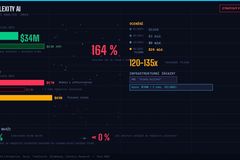
Perplexity AI has reached a valuation of $20 billion, but its financial situation is problematic — in 2024 it spent 164% of its revenue on cloud services and AI models and reported an operating loss of $65 million on actual revenue of just $34 million. Its reported 60% gross margin is distorted by accounting that classifies the cost of non-paying users outside cost of revenue; the company has abandoned its advertising model and faces a growing number of copyright infringement lawsuits.
How to Make Money from an AI Assistant: Five Models, No Profit
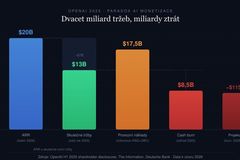
The article analyzes the five main monetization models for conversational AI (subscriptions, API, advertising, vertical integration, and transaction commissions) and shows that none of them has yet managed to make standalone AI assistants profitable. The roughly 40% gross margins of AI companies are a fraction of those of traditional SaaS software, because inference costs grow with every user. The most successful approaches are vertical specialization (e.g., Claude Code with ARR of USD 2.5 billion) and integrating AI into existing ecosystems (Google, Microsoft), while generic AI assistants remain loss-making.

Claude's Pricing Policy: Quiet Inflation Behind a Facade of Fixed Prices
The article analyzes Anthropic's pricing policy for its Claude service, where nominal subscription prices remain fixed ($20/month for Pro, $100–$200/month for Max), but the real value systematically declines. The causes are the growing token consumption of newer models (especially due to adaptive thinking in Opus 4.6), a non-transparent billing system with rolling windows and weekly limits, and repeated tightening of limits that Anthropic denies. The author likens this phenomenon to shrinkflation – users get less for the same price, while the problem of non-transparent limits is an industry-wide pattern shared by OpenAI and Google as well.