A Glassmaker, a Photographer, and Artificial Intelligence: How to Create with AI Without Losing Your Copyright
The article examines the question of copyright in works created in collaboration with artificial intelligence. Through analogies from the art world (glass artist Chihuly, conceptual artists) and an analysis of Czech, European, and American case law, it shows that the key to authorship is not physical execution but control over the creative conception. It offers a practical scale of protection—from fully protected works to works in the public domain—and six principles for creators working with AI.
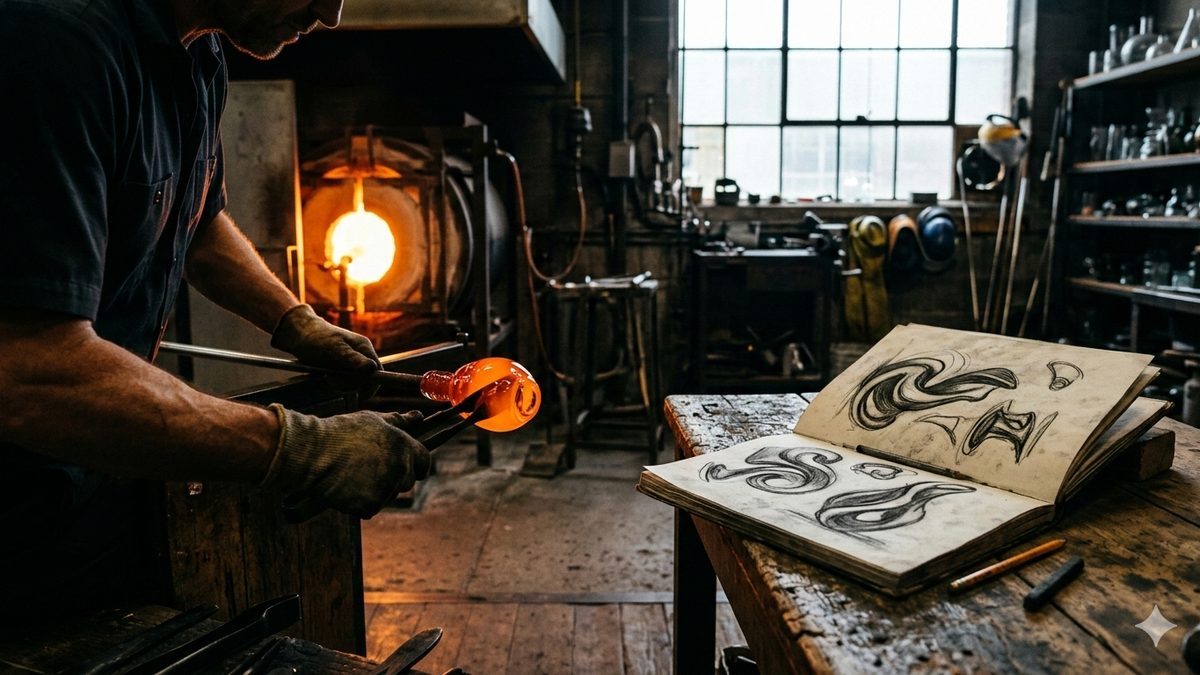
Dale Chihuly stands beside a glass furnace in Tacoma. He is not holding the blowpipe; he is not touching the molten glass. And yet it is he — and he alone — to whom the law grants authorship of the work taking shape under the hands of the master glassblower. The glassblower blows, shapes, responds to the temperature of the melt with thousands of tiny decisions per second. He brings decades of experience, an aesthetic sense, and the physical uniqueness of his own breath to the work. And yet: in the eyes of the law, he is "merely a tool."
When I first thought about this, it struck me as unjust. But it was precisely this contradiction — that a living being with an irreplaceable creative contribution can be legally invisible — that helped me better understand one of the most pressing questions of our time: who, in fact, is the author of a work created in collaboration between a human and artificial intelligence?
In 2025, generative AI penetrated every creative profession. Microsoft CEO Satya Nadella stated at the LlamaCon conference (April 2025) that 20–30% of the code in the company's repositories is generated by AI. Journalists collaborate with language models on research. Graphic designers use image generators. The question "who is the author?" has ceased to be academic — and it began to concern me as well.
Current law, in most jurisdictions, rests on two pillars more than a hundred years old. First: what is protected is the original expression, not the idea (Section 2(6) of the Czech Copyright Act No. 121/2000 Coll.; Article 2 of the WIPO Copyright Treaty; Section 102(b) of the U.S. Copyright Act). Second: the author can only be a natural person (Section 5(1) of the Czech Act; Berne Convention, Articles 6bis and 7; Compendium of U.S. Copyright Office Practices, Section 306).
And this is where it gets interesting. Professor Mark Lemley of Stanford (2024) described a problem that strikes me as precise: traditionally a human supplies both the idea and its expression — and the law protects the expression. With AI, the human supplies the idea (the prompt, concept, structure) and the AI generates the expression. The valuable human contribution — the creative concept — is precisely what copyright does not protect. And the expression generated by artificial intelligence lacks human authorship.
The result? Works created with AI may, in theory, fall into the category of public-domain works — and anyone may appropriate parts of them. Or they may enjoy protection — if the creator knows what they are doing.
This article summarizes what we know so far about the legal situation, and offers a reflection on what a sensible approach might look like for creators who collaborate with AI. I am not a lawyer — I am a programmer and analyst who creates with AI every day and wants to understand the rules of the game. Take this as material for discussion, not as legal advice.
For orientation — the three key sections that appear most often in the debate over AI authorship:
Section 2(1) defines a work as "the unique result of the creative activity of the author" expressed "in any objectively perceptible form." Two conditions: (1) the result of creative activity, and (2) expression in a perceptible form.
Section 5(1) says it plainly: "The author is the natural person who created the work." Not a legal person, not a machine.
Section 8(2) is, from my point of view, the most interesting: it excludes from the circle of co-authors a person who contributed "merely by providing assistance or advice of a technical, administrative, or professional nature" or "merely gave the impulse for the creation of the work." This provision can be read in two directions — as an argument against authorship by the AI user (who only gave the impulse), but also against the AI itself (which only provided technical assistance).
Section 2(6) then establishes the idea–expression distinction: a work does not include "the subject matter of a work in itself," "an idea, procedure, principle, method." A text prompt entered into an AI could be understood as subject matter — and subject matter is not a work.
The EU standard of originality emerged from a series of CJEU rulings and is worth knowing — because it defines what "authorship" actually means in the EU:
Infopaq (C-5/08, 2009): A work is protected if it constitutes "the author's own intellectual creation."
Painer (C-145/10, 2011): Originality requires "free and creative choices" through which the author imprints a "personal touch" on the work. It is worth noting that Advocate General Trstenjak, in her opinion (not in the judgment itself), explicitly stated that only human creations are eligible for protection.
Football Dataco (C-604/10, 2012): The Court rejected the doctrine of "skill and labour" — mere substantial effort without creative freedom is not enough.
Cofemel (C-683/17, 2019): A work must reflect the personality of the author. And here is precisely where we run into the problem — does an AI have a personality?
The U.S. Copyright Act protects "original works of authorship." The Act does not expressly define the term "author," but the courts and the Copyright Office have consistently interpreted it as requiring a human being — based on the Constitution, the decision in Burrow-Giles v. Sarony (1884), and Compendium Section 306: only a work "created by a human being" can be registered.
The question of whether a technological tool affects authorship is not new at all. And the answers the law has given to it strike me as surprisingly consistent.
In 1884, the U.S. Supreme Court decided the case Burrow-Giles Lithographic Co. v. Sarony (111 U.S. 53). The photographer Napoleon Sarony took a portrait of Oscar Wilde. The defendant argued that a photograph is a "mere mechanical reproduction" with no room for creative activity — the camera merely transfers the appearance of the subject onto the plate.
The Court rejected this argument. Sarony staged the pose, chose the costume and accessories, adjusted the light and shadow, and evoked the desired expression on Wilde's face. The Court defined the author as the inventive or master mind that conceives the work. The camera is merely a tool.
This precedent laid the foundation for the principle of technological neutrality: the tool of creation does not affect the existence of authorship.
When an author dictates a text to a stenographer, the author is the person dictating. In the case Cala Homes v. Alfred McAlpine (1995), an English court said something that struck me: "to focus only on who held the pen is too narrow a view of authorship." The design director provided detailed instructions and sketches to draftsmen — and the court recognized him as the principal author of the drawings, even though he "never held the pen."
Professor Jane C. Ginsburg of Columbia University summarized this in two principles that I find useful for the AI debate as well: authorship "places mind over muscle" — the author is the one who conceives the work, not the one who carries out the instructions. And authorship "places mind over machine" — the use of tools does not negate authorship.
Here I came across a series of examples that opened my eyes:
Jeff Koons has his works produced by specialized workshops. In the cases Rogers v. Koons (1992) and Blanch v. Koons (2006), the courts dealt with questions of plagiarism and fair use, but never questioned Koons's authorship of works produced by craftsmen.
Damien Hirst, of approximately 1,400 Spot Paintings, personally painted about 5 — the rest were painted by assistants according to precise rules (perfectly circular dots, even spacing, no color repeated). Hirst himself confirmed this, saying that he left the painting to others because "he couldn't be bothered."
Sol LeWitt created over 1,260 wall drawings, each consisting of a written set of instructions executed by teams of draftsmen. LeWitt himself did not physically execute the drawings. He compared his instructions to musical scores.
Ai Weiwei, for the installation Sunflower Seeds (2010), had 1,600 craftsmen in Jingdezhen hand-make and hand-paint 100 million porcelain sunflower seeds.
In every case, the author is exclusively the conceptual artist — not the craftsman.
An architect designs a building but builds nothing himself. Construction workers are never considered co-authors. The entire profession is founded on the premise that the designer, not the builder, is the creative author. The U.S. Architectural Works Copyright Protection Act (1990) expressly enshrined this protection.
And here we come to the problem that interested me the most — and which, it seems to me, the current debate elegantly sidesteps.
Dale Chihuly has not personally blown glass since 1979 — following a shoulder injury. In the case Moi v. Chihuly Studio (W.D. Wash. 2019, affirmed by the 9th Cir. 2021), the court held that Chihuly is the sole author, because he "owned and exercised control over the creative process." His former assistant Michael Moi, who physically participated in producing 285 works, failed to demonstrate an "independent copyrightable contribution."
But a glassblower is not a machine. He brings to the work experience that cannot be verbalized — minute real-time decisions, an aesthetic sense, the physical uniqueness of his breath. Similarly, in France, the sculptor Daniel Druet physically produced Maurizio Cattelan's wax sculptures. The Paris court, in a decision of 8 July 2022, declared Druet's claim inadmissible and at the same time found that the works had been published exclusively under Cattelan's name and that their staging was exclusively his doing.
What follows from this for the AI debate? Here I dare to state my own opinion:
If the law systematically overlooks the creative contribution of a living craftsman, then the argument "AI cannot be an author because it lacks human input" rests on different foundations than it appears at first glance. It seems to me that the law never based authorship on the quality of the input during execution, but on control over the conception. The glassblower's contribution is legally insignificant not because it is small (it is not), but because it operates within a framework defined by someone else.
At the same time, I see here a key difference from AI: the glassblower carries out specific instructions in direct interaction with the artist. Chihuly stands at the furnace, points, corrects. There is a direct causal chain. With generative AI, this chain looks different — the user enters an abstract description and receives an unpredictable output. The same prompt produces a different result every time.
But this distinction is gradual, not binary. A programmer continuously steering Claude Code strikes me as closer to the Chihuly-at-the-furnace model than a user entering a single prompt into an image generator. And that is precisely the point — the degree of control.
Case law on AI authorship is still taking shape. The following cases show the direction the courts have taken so far — but it is good to keep in mind that this is the beginning, not the end, of the story.
Thaler v. Perlmutter (D.D.C. 2023, affirmed by the D.C. Circuit on 18 March 2025; certiorari denied by the Supreme Court on 2 March 2026). Stephen Thaler applied to register an image created by the AI system DABUS, with the AI listed as the author. The appellate court confirmed that the Act requires human authorship. Judge Millett argued that the Act "makes no sense if 'author' is not a human being" — a reference to ownership, the author's lifespan, and so on. The Supreme Court declined to hear the case — so Thaler exhausted all remedies. The requirement of human authorship is now firmly established in the United States.
Zarya of the Dawn (USCO, February 2023). Kris Kashtanova created a graphic novel with their own text and images from the Midjourney image generator. The USCO recognized protection for the text and for the creative arrangement of text with images as a compilation, but denied protection to the individual AI-generated images. Kashtanova lacked "sufficient control" over the output — the prompts "do not dictate a specific result."
Théâtre D'opéra Spatial (USCO, September 2023). Jason Allen used over 624 iterations of prompts in Midjourney plus edits in Photoshop, totaling 114 hours of work. The USCO nevertheless refused registration: Allen had "no control over how the AI tool analyzed, interpreted, or responded to those prompts." In September 2024, Allen filed suit (Allen v. Perlmutter, D. Colo.) — the case is ongoing and could set a significant precedent on the question of whether extensive, repeated prompting establishes authorship.
The Municipal Court in Prague (case no. 10 C 13/2023, October 2023) issued what is probably the first judgment in the EU on AI outputs. The plaintiff entered a prompt into DALL-E and sued a law firm that used the resulting image. The court dismissed the claim, holding that AI cannot be an author (Section 5), that the image "is not the unique result of the creative activity of a natural person," and that the prompt is merely an "idea" within the meaning of Section 2(6).
What strikes me as essential: the court did not rule out that, with a sufficient creative contribution (detailed parameterization, manual editing), an AI-assisted work could obtain protection. In other words — the door was left open.
Li v. Liu (Beijing Internet Court, November 2023) is an interesting counterpoint. Mr. Li created an image using Stable Diffusion, continuously selecting among variants and refining the result. The court granted him authorship — the image, in its view, reflects an "original intellectual investment" and a "distinctive expression." The AI was assessed as a tool. This is so far the most accommodating approach of any major jurisdiction.
Law No. 132/2025 (effective 10 October 2025) amended the Italian Copyright Act: works "are protected… even if they were created with the assistance of artificial intelligence tools, provided they are the result of the author's intellectual work." It is the first national legislation in the EU expressly addressing this question.
This is, in my view, the best guidance we have so far — not because it applies in the Czech Republic, but because it most consistently names the problems:
Prompts alone are not enough. They function as "instructions conveying unprotected ideas" — they do not control how the AI processes the ideas. Even hundreds of repeated prompts were found insufficient. AI as a tool is fine. "The use of AI tools to assist human creativity, rather than to replace it, does not affect the availability of copyright protection." Human edits may establish authorship. The creative selection, coordination, and arrangement of AI-generated elements may be protected as a compilation. Substantial human edits may be protected independently.
From the decisions so far, an approximate scale emerges for me — take it as my interpretation, not as legal certainty:
Clear protection — AI as a pure tool (proofreading, error detection, color correction). The human work remains essentially untouched.
Probable protection — the human supplies a detailed outline, data, and structure; the AI formulates; the human substantially edits. Close to the Chihuly-at-the-furnace model.
Possible protection of a compilation — the human gives a topic, the AI writes everything, the human selects among variants and arranges. The selection and arrangement may be protected (Zarya of the Dawn), but not the individual AI-generated elements.
Probably unprotected — mere prompting, even extensive and continuous (the Allen case — 624 prompts, 114 hours). That is how the USCO and the Municipal Court in Prague see it for now.
Public-domain work — fully AI-generated content with no human input. Anyone may freely copy it.
Based on what I have studied from the case law and the opinions, six principles have crystallized for me. They are not legal advice — rather common sense backed by how the courts have ruled so far.
Your own outline — the key theses, lines of argument, the structure of the work — is, in my view, the equivalent of an artist's sketchbook. It serves as evidence that the creative conception comes from you, not from the AI. The glassblower, without a sketch from the artist, does not know what to blow. Your AI, without an outline, does not know what to write.
This strikes me as the key difference between "merely an impulse for the creation of a work" (Section 8(2)) and creative activity that could establish authorship. The prompt "write an article about salt" looks like an impulse. A detailed outline with theses, structure, a selection of sources, and a line of argument looks like a creative conception.
Chihuly does not sit in an office waiting for a finished vase. He stands at the furnace, points, corrects. The same approach makes sense to me with AI: do not enter a single prompt and accept the output. Steer the AI continuously — reject what you do not want, specify what you do want, send it back for revision.
The more intensive your continuous control, the stronger, in my view, the analogy to Chihuly, the architect, or the editor-in-chief — and the weaker any argument that you "merely gave an impulse."
The introduction, the conclusion, the key argument — at least one expressive part of the work should be demonstrably your own formulation. Not because the law expressly requires it, but because it gives you the strongest position in case of a dispute. The court in Zarya of the Dawn separated the protected (the human text) from the unprotected (the AI images). If your own formulations are "inseparably merged" with the AI-generated text (the USCO's language), the entire work could be protected — at least that is how I understand it.
This is something that occurred to me from practice — and what I consider the best safeguard. Archive your content sketch (the one you wrote), the key prompts where you steer the content, structure, and argumentation, the rejected versions ("not this, I want it differently"), the editorial interventions (what you changed from the AI working draft), and the verification process (how you checked the facts).
This is your equivalent of an artist's sketchbook — evidence of creative control over the result. The U.S. Copyright Office, in its March 2023 guidance, requires the disclosure of AI-generated elements; documentation allows you to precisely separate your contribution from the AI's.
The USCO distinguishes: AI as "assistance" does not affect protection; AI as a "replacement" for human creativity jeopardizes protection. The line, it seems to me, lies in whether you control the final form of the work — the structure, the logic, the choice of approaches, the key formulations.
From my own experience: a programmer steering Claude Code is in the role of an architect — provided he controls the system architecture and reviews the code. A journalist steering AI research is in the role of an editor-in-chief. In both cases, the point is that the human steers the process, rather than merely accepting the result.
The obligation to label AI-generated content follows from Article 50 of EU Regulation 2024/1689 (the AI Act) — full effect from August 2026. But even without a legal obligation, it strikes me as sensible to be transparent. The wording I use myself:
Methodological note
The concept, structure, and editorial line of the article are the work of the author, who prepared the content sketch, set out the key theses, and steered the entire creative process. Generative AI (Claude, Anthropic) was used as a technical tool for research, fact-checking, and elaborating the author's draft.
The author continuously edited the outputs, verified the key findings, and approved the final wording. No part of the text was published without human oversight. All factual data were verified against the publicly available sources cited in the text.
The procedure complies with the requirements of Article 50 of EU Regulation 2024/1689 (the AI Act) on the transparency of AI-generated content.
This wording, in my view, does three useful things at once: it asserts your creative contribution, classifies the AI as a tool (not a co-author), and meets the transparency requirement of the AI Act.
Even if a court were to rule that a particular work does not meet the conditions of the Copyright Act, that need not be the end of the world. At least four fallback lines occur to me:
Database right (Sections 88–94 of the Copyright Act). If you systematically create a series of articles with a substantial investment in obtaining and verifying the content, the entire collection could enjoy special protection even without authorship of the individual parts.
Unfair competition (Section 2976 of the Civil Code). Even for an unprotected work, "free-riding on reputation" is actionable — if someone takes your text and passes it off as their own.
Contractual protection. A platform's license (e.g., the Seznam Média terms) may contain rules for handling content independently of copyright.
Protection of a compilation (Section 2(5) of the Copyright Act). Even if individual AI-generated passages were unprotected, your selection, arrangement, and presentation of the material as a whole could be protected — exactly as in Zarya of the Dawn.
Czech Republic — No protection where the contribution is insufficient; the prompt is treated as subject matter. Key authority: Municipal Court in Prague, case no. 10 C 13/2023; Sections 2, 5, 8 of the Copyright Act.
EU — Requires "the author's own intellectual creation"; purely AI works are not protected. Key authority: Infopaq (C-5/08); Painer (C-145/10); draft EP report, rapporteur Axel Voss 2025.
USA — No protection for AI works without sufficient human authorship. In March 2026 the Supreme Court declined to hear the Thaler case. Key authority: Thaler v. Perlmutter (D.C. Cir. 2025, cert. denied 2026); USCO Report Part 2.
United Kingdom — Statutory protection under Section 9(3) CDPA 1988: the author of a computer-generated work is the person who undertakes the "necessary arrangements" for its creation. The position is under review by the UKIPO.
China — Protection is possible upon demonstrating an intellectual investment. Key authority: Li v. Liu (Beijing Internet Court, 2023).
Italy — Express protection for AI-assisted works, provided they are "the result of the author's intellectual work." Key authority: Law No. 132/2025.
A few things worth watching:
Allen v. Perlmutter (D. Colo., filed September 2024) tests whether 624 iterations of prompts and 114 hours of work establish authorship. The decision could significantly shift the boundary.
The review of the Digital Single Market Directive (DSM, June 2026 at the earliest) opens up the possibility of addressing AI-generated content at the EU level.
The report of the EP Committee on Legal Affairs (rapporteur Axel Voss, draft June 2025, approved by the JURI committee on 28 January 2026) "insists that AI-generated content should remain ineligible for copyright protection." A plenary vote is scheduled for March 2026.
GEMA v. OpenAI (LG München I, 42 O 14139/24, November 2025) — the court ruled that the memorization of protected song lyrics in language models infringes copyright. OpenAI has appealed. An eventual affirmation would have a major impact on the training of AI models across the entire EU.
Napoleon Sarony proved in 1884 that the camera is a tool — not an obstacle to authorship. Dale Chihuly has been proving since 1979 that the glassblower is a tool — not a co-author. Jeff Koons, Sol LeWitt, and Ai Weiwei demonstrate that hundreds of craftsmen are tools — not creators.
In all these cases, as I understand it, the same principle applies: authorship rests on the creative conception and control over the process, not on the physical execution.
AI adds a complication to this equation: unlike the glassblower, it transforms instructions unpredictably. The same prompt produces a different output every time. In this way it disrupts the direct causal chain between intent and result — and that is why the degree of human control over the process is so important.
The solution, in my view, is not to give up AI. It is to understand where on the scale, from Chihuly at the furnace to an anonymous prompt in an image generator, you are located — and to ensure that you stand as close as possible to that furnace. Your content sketch, your continuous steering of the process, your editorial interventions, and your fact-checking are what distinguish you from a user who "merely gave an impulse for the creation of the work."
The glassblower brings an irreplaceable human contribution to the work — and yet the law does not grant him authorship. You bring a creative conception to the work — and that is why you should be the author. That is how it has worked since 1886. AI — for now — changes nothing about that.
And what if I am wrong? Let's discuss it.
I am not a lawyer — this text expresses my opinion based on publicly available sources and is intended as material for discussion, not as legal advice. Data cutoff: 7 March 2026.
Act No. 121/2000 Coll., on Copyright (the Copyright Act) — Sections 2, 5, 8. Berne Convention for the Protection of Literary and Artistic Works (1886/1971) — Articles 2, 6bis, 7. WIPO Copyright Treaty (WCT, 1996) — Article 2. U.S. Copyright Act, 17 U.S.C. § 102. Copyright, Designs and Patents Act 1988 (UK) — Sections 9(3), 178. EU Regulation 2024/1689 (the AI Act) — Articles 50, 53. EU Directive 2019/790 (DSM) — Articles 3, 4. Law No. 132/2025 (Italy).
Burrow-Giles Lithographic Co. v. Sarony, 111 U.S. 53 (1884). Cala Homes v. Alfred McAlpine [1995] FSR 818. Rogers v. Koons, 960 F.2d 301 (2d Cir. 1992). Blanch v. Koons, 467 F.3d 244 (2d Cir. 2006). Moi v. Chihuly Studio, Inc., W.D. Wash. 2019 (affirmed 9th Cir. 2021). Druet v. Cattelan, Tribunal judiciaire de Paris (8 July 2022). Infopaq International A/S v. Danske Dagblades Forening, C-5/08 (CJEU, 2009). Painer v. Standard Verlags GmbH, C-145/10 (CJEU, 2011). Football Dataco v. Yahoo!, C-604/10 (CJEU, 2012). Cofemel v. G-Star Raw, C-683/17 (CJEU, 2019). Thaler v. Perlmutter, D.D.C. 2023, affirmed D.C. Cir. 18 March 2025, cert. denied by the Supreme Court 2 March 2026. Allen v. Perlmutter, D. Colo. (filed September 2024, ongoing). Naruto v. Slater, 888 F.3d 418 (9th Cir. 2018). Li v. Liu, Beijing Internet Court (27 November 2023). Municipal Court in Prague, case no. 10 C 13/2023-16 (October 2023). GEMA v. OpenAI, LG München I, 42 O 14139/24 (11 November 2025).
USCO, Copyright Registration Guidance: Works Containing Material Generated by AI, 88 Fed. Reg. 16,190 (March 2023). USCO, Copyright and Artificial Intelligence Part 2: Copyrightability (January 2025). Compendium of U.S. Copyright Office Practices, 3rd ed., Section 306. European Parliament fact sheet, AI and copyright (December 2025). Draft EP report, rapporteur Axel Voss (June 2025; approved by the JURI committee on 28 January 2026). EP resolution of October 2020 — legal personality of AI.
Ginsburg, J. C. (2019). Authors and Machines. Columbia Journal of Law & the Arts, 42(3). Hugenholtz, P. B. and Quintais, J. P. (2021). Copyright and Artificial Creation. SSRN / study for the EC. Lemley, M. A. (2024). How Generative AI Turns Copyright Upside Down. Stanford Law Review (forthcoming).
Transparency of creation
The concept, structure, and editorial line of the article are the work of the author, who prepared the content sketch, set out the key theses, and steered the entire creative process. Generative AI (Claude Opus 4.6, Anthropic) was used as a tool for research, fact-checking, and elaborating the author's draft.
The author verified the key findings and approved the final wording. No part of the text was published without conscious authorial oversight. The factual data were verified against the publicly available sources cited in the text.
The procedure conforms to the transparency principles of EU Regulation 2024/1689 (the AI Act). #poweredByAI
Read the Czech original on Médium.cz.
AI · Claude — machine translation, may contain inaccuracies.