You're Not the Author Anymore: How Your Word Processor Strips You of Your Rights
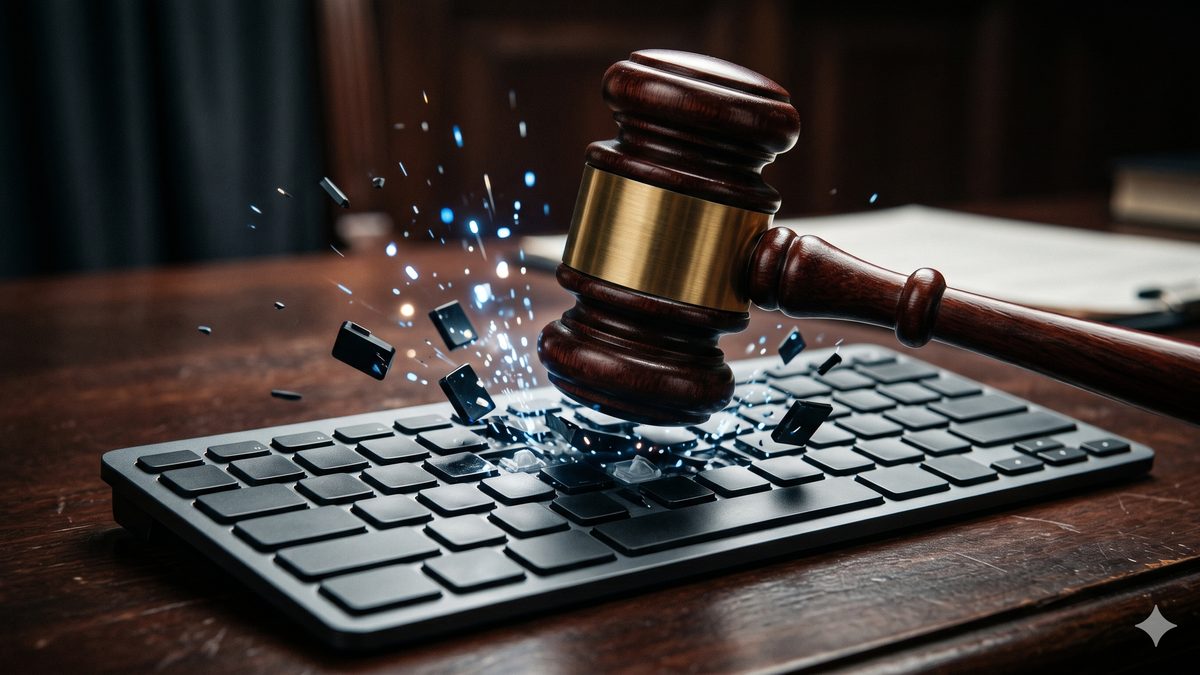
The article argues that copyright is threatened not by the big lawsuits against OpenAI, but by AI assistants built directly into text editors (Word, Google Docs, Copilot). In traditional creative work — like a master glassmaker who only designs the piece — there is an unbroken chain of human signatures and transfers of rights; a machine, however, cannot sign a contract and has no legal personality, so in the author's view no copyright in AI-processed text arises at all. He calls on the law to stop recognizing only two boxes — author and tool — and to learn to work with the category of an intelligent co-author; otherwise, he warns, we will soon discover that half of our culture belongs to no one.
Imagine you write a brilliant analytical article. The paragraphs follow one another perfectly, the arguments have a razor's edge. You click publish — and moments later you find out that your text belongs to no one. Anyone can take it, copy it and sell it, and the law will laugh in your face. Welcome to the legal hell of artificial intelligence, where creators are reduced to mere commissioning clients.
Copyright is sinking. And what is sinking it is not the lawsuits filed by giant media houses against OpenAI, as the newspaper headlines would have us believe. It is being sunk by something far less conspicuous: the smart assistant that already lives inside your text editor.
For many years a clear social contract applied. The tool is passive. A quill pen, a typewriter, even Microsoft Word from 2015 made no creative decisions. You had to come up with every word, assemble the syntax and set the rhythm of the sentence. The tool merely recorded your unpredictable human "micro-decisions" obediently.
But then Word, Google Docs and code editors learned to think.
Picture a master glassmaker. They produce a perfect drawing and a plaster mould, and set the furnace temperature. They never touch the molten glass themselves — the physical sculpture is blown and cut for them by craftsmen at the glassworks. No one in the world (least of all an intellectual property office) doubts that the sole author of the work is that master with the pencil. Because they created the vision.
Now picture today's author. They build a complex conceptual skeleton, define the arguments and write a detailed prompt. The editor (equipped with artificial intelligence) takes that vision and "blows" out of it a dense, stylistically polished text.
From the standpoint of the creative process, this is an absolutely identical symbiosis. The architect designs, the labourer (or the algorithm) builds. From the standpoint of the law, however, the difference is fatal.
The current Copyright Act recognises the transfer of rights only between human beings. The craftsman at the furnace, or the engineers who build the giant kinetic sculptures for David Černý, sign contracts by which they waive their technical and authorial claims in favour of the commissioning party. The system sees an unbroken chain of human signatures and is satisfied.
A machine, however, cannot sign any contract. From the perspective of state authorities, all you did was feed an idea (which cannot be protected) into an automaton, and the automaton did the real, legally protected work for you: it assembled words into sentences. And because a machine has no legal personality, no right comes into existence at all. Your text falls into the public domain before you can even save the file.
Defenders of the old order claim it is our own fault. We supposedly stopped creating and started merely issuing instructions. But that is nonsense, stemming from a failure to understand what complex work with AI looks like today. It is a perfect, iterative symbiosis in which the human supplies life experience, logic and a point of view, while the machine functions as a cognitive sparring partner honing the form.
The trouble is that the legal system knows only two boxes: the author and the tool. It cannot handle the category of an intelligent co-author.
Until recently one could pretend this was only a marginal problem affecting a handful of enthusiasts messing about in a ChatGPT window. But now AI has soaked straight into the basic digital canvas. The moment you click "make it punchier" in corporate Word, or let Copilot turn bullet points into flowing paragraphs, the law loses the ability to tell whose work is whose. Your protected authorial text turns into a legislative minefield.
It is time to admit that the era of the romantic "author with a quill" is over. We are shifting into the role of curators, editors and architects of ideas. Technology has already made that leap. Now it is the lawyers' turn to stop pretending that a text editor in 2026 is the same thing as a piece of printed paper. If they don't, we will soon discover that half of our culture belongs to no one.
Transparency of creation:
The concept, structure and editorial line of the article are the work of the author, who prepared the content outline, established the key theses and directed the entire creative process. Generative AI (Google Gemini) was used as a tool for research, for locating primary sources and for elaborating the wording of the author's content outline.
The author edited the outputs throughout, verified the key findings and approved the final wording. No part of the text was published without human review. All factual data were verified against the publicly available sources cited in the text.
This procedure complies with the requirements of Article 50 of EU Regulation 2024/1689 (AI Act) on the transparency of AI-generated content. #poweredByAI
Read the Czech original on Médium.cz.
AI · Claude — machine translation, may contain inaccuracies.