Hormuz Will Never Go Back. Why Trump Can't Open the Strait
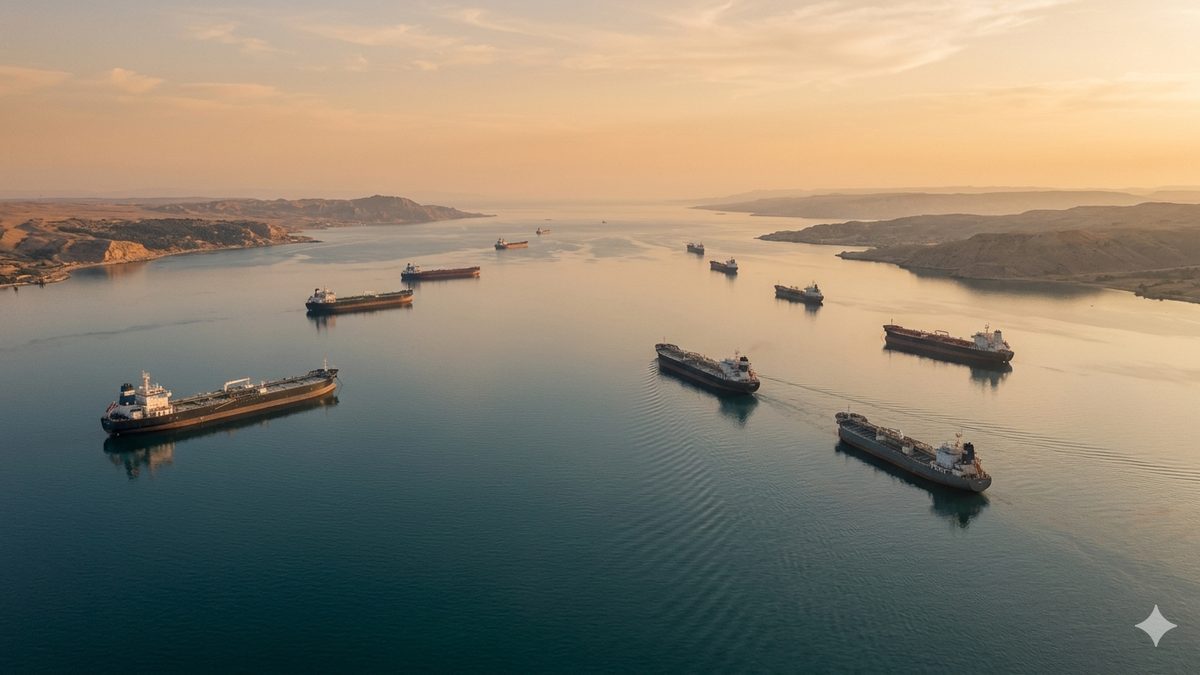
The article analyzes how Iran, during the 2026 US–Israeli–Iranian war, turned the Strait of Hormuz into a tool of strategic control over a fifth of the global oil flow using "smart" naval mines (Maham-3/7, the Chinese EM-52) — with a cost asymmetry in which a mine worth thousands of dollars threatens vessels worth billions. The author shows that the US cannot respond to this threat in the conventional way, because it has long neglected its mine-countermeasure capabilities (the last Avenger-class minesweepers were scrapped weeks before the war), and Trump's "Project Freedom" operation is a narrative rather than a real military solution. In closing, it examines the broader implications — permanently higher insurance premiums, a precedent threatening the freedom-of-navigation regime in other straits (the Bosphorus, Suez, Bab-el-Mandeb, Malacca), and the consequences for energy prices and for the Czech Republic's strategic planning.
In September 2025, five months before the outbreak of the American‑Israeli‑Iranian war, the U.S. Navy loaded its last four Avenger‑class mine countermeasures ships in Bahrain onto the cargo vessel M/V Seaway Hawk and sent them to a shipyard in Philadelphia. Scrapping awaited them there. USS Devastator, USS Dextrous, USS Gladiator, and USS Sentry — wooden hulls with a fiberglass coating, optimized against magnetic mines — had served in the Persian Gulf for decades. On January 9, 2026, seven weeks before the war began, they were loaded in Manama onto the deck of a semi‑submersible heavy‑lift ship and set off halfway across the planet, homeward bound. British security analyst Emma Salisbury of the American Foreign Policy Research Institute summed it up briefly for NPR: "Honestly completely baffled." Utterly baffled as to why anyone would send mine countermeasures capabilities away from the theater of a possible conflict at precisely that moment.
Let me put it another way. On April 21, 2026, Iran's Revolutionary Guard laid dozens of Maham‑3 and Maham‑7 naval mines in the Strait of Hormuz. The Maham‑3 is a moored influence mine with a deployment depth of up to one hundred meters, an explosive charge of 120 kilograms, and a combination of magnetic and two passive acoustic sensors that can recognize the characteristic signature of a target vessel. The second type — the bottom mine Maham‑7 — is a very precise copy of the Italian SEI MN103 Manta mine. The very same one that, on February 18, 1991, in the Persian Gulf, struck the American cruiser USS Princeton so badly that it put it out of service for weeks and broke its keel like a hinge. The price of one Iranian contact mine: 1,500 to 5,000 U.S. dollars. The price of an American Arleigh Burke–class destroyer that is supposed to sail safely past it: 2 billion dollars. The cost asymmetry: 1 to 1,333,333.
On May 3, 2026, President Donald Trump announced on Truth Social the operation "Project Freedom" — an American initiative to reopen the Strait of Hormuz. Fifteen thousand American troops, more than a hundred aircraft and unmanned systems, twelve destroyers in Central Command. From the Wall Street Journal and the website Axios, however, a different picture emerges: this is not a classic convoy escort, but a "coordination framework" and an operation "in an escort shadow," in which American ships sail in the vicinity of commercial vessels with the intention of intervening only "if Iran attacks." Former Royal Australian Navy officer Jennifer Parker, today a nonresident fellow at the Lowy Institute, put it precisely for CNN: less about providing direct protection to one or two ships, more about an attempt to change the situation in the strait so that commercial vessels "feel safe."
This article is about why a classic convoy operation in Hormuz is not possible — and what that means for the future of international maritime navigation. The main thesis is this: the current Iranian combination of smart mines, dispersed swarm‑laying vessels, and coastal missile systems, compounded by many years of strategic neglect of American mine countermeasures capabilities, fundamentally changes what it means to control a strategic strait in the 21st century. Brian Katulis of the Middle East Institute, for the WSJ on March 12, 2026: opening Hormuz would "probably require some ground forces, if a diplomatic solution is not reached." Trump does not have that. Iran knows it. And therein lies the entire strategic calculus.
I. Anatomy of technical superiority: what Iran actually has
Iranian mine capabilities have transformed over the past decade. To understand the current crisis, one must abandon the image of a primitive moored mine from World War I that still dominates the popular imagination, and realize that a modern Iranian mine is a computer with explosives.
Let us return to the Maham‑3, which the reader already knows from the introduction. After being dropped from a vessel, it rises beneath the keel level of a passing ship and waits there. Weight 383 kilograms, explosive charge 120 kilograms, diameter 80 centimeters, height 1.32 meters. A combination of sensors: one magnetic plus two passive low‑frequency acoustic, optionally supplemented by a directional acoustic sensor and a magnetic detonator for attacks on submarines. These data come from analyses by H. I. Sutton published on Covert Shores, one of the most respected open sources on Iranian naval weapons systems, and they are confirmed by specifications from U.S. CENTCOM as well. The mine computes the optimal moment of detonation — it explodes when the target vessel is approximately three meters from it, and using an underwater shock wave and a gas bubble it breaks the vessel's keel from below. That is not a trick. That is physics.
I have already mentioned the Maham‑7 — a bottom "limpet‑style" mine for shallower waters, weighing roughly 220 kilograms, with multi‑influence activation (acoustic and magnetic). An Iranian engineering copy of the Italian Manta from the 1990s. It can be deployed from surface vessels, helicopters, or fixed‑wing aircraft. The Central Command of the U.S. armed forces confirmed the presence of both these types in the main shipping lane through Hormuz on March 23, 2026 — that is the first public identification of specific designations Washington has ever made.
There is yet a third, less discussed type: the Maham‑2. A bottom mine with an explosive charge of 320 kilograms, the largest in the series, but the key feature is its "smart features" that set it apart from older types. A programmable delayed activation arming time allows the mine, after being dropped, to remain inactive for several days; during this period a minesweeper could theoretically remove it, but will not detect it as a threat because it does not respond. An adjustable ship counter allows the minelayer to program it to ignore the first N passes. If a minesweeper simulating the target's signature passes over such a mine fifty times without detonation, that does not mean the mine is not present. Perhaps it is merely waiting for a target with a higher probability of value.
Alongside the domestic Maham series, Iran also has Chinese EM‑52 mines in its arsenal. This is a rocket‑propelled rising mine developed at the 710th Research Institute of CSIC in the 1980s, manufactured in the 1990s. Length 3.7 meters, diameter 45 centimeters, total weight just under a ton, explosive charge 140 kilograms in the older version, 300 and more in the export configuration. Deployment depth in the range of approximately 5 to 200 meters. The multi‑influence activation system combines acoustic (above 20 kHz, ultrasonic), magnetic inductive, and pressure activation. Upon detection it releases a rocket that reaches a speed of over 50 meters per second — roughly 180 kilometers per hour — and strikes the vessel's keel from below with a probability of success of around eighty percent (Chinese test data). A key feature is the nonmagnetic body, which frustrates both sonar and magnetic search systems, and the programmable modes: "safe," "combat," and "immediate detonation."
The Strauss Center for International Security and Law at the University of Texas at Austin confirms that Iran acquired the EM‑52 from China. The United States Naval Institute identified the EM‑52 as early as 2012 as the primary deepwater threat to large surface ships. According to the latest estimates, the Iranian arsenal includes hundreds of units of this class.
Caution is warranted regarding the total size of the arsenal. The Strauss Center cites a minimum of 2,000 contact mines plus a "significant collection" of advanced ones. The Stimson Center in April 2026 estimates 2,000 to 6,000. The International Institute for Strategic Studies, in a citation for NPR (Nick Childs), speaks of 5,000 to 6,000 mines in the inventory. The Saudi security research institute Al Habtoor published in May 2026 that Iranian official figures cite approximately 5,000 mines, while some American estimates rise to 10,000 to 12,000. The Defense Intelligence Agency in 2019 spoke of Iran's ability to "rapidly deploy over 5,000 mines using high‑speed boats." A safe guide: 2,000 to 6,000 with high confidence; the upper estimates are probably inflated.
The key thing, however, is not the absolute quantity of mines, but the ability to deploy them quickly. Iran's Revolutionary Guard operates hundreds of small Gashti‑type vessels, capable of carrying two to four mines per voyage. The Stimson Center confirms that after the American February strikes the IRGC retained "hundreds, perhaps thousands" of these vessels. In addition, Iran has three Kilo‑class submarines (each with a capacity of 24 mines) and 14 to 21 Ghadir‑class mini‑submarines (copies of the North Korean Yono class). Mi‑17 helicopters were caught during a training deployment of the Maham‑2.
Real capacity: according to Al Habtoor and the DIA, "thousands of mines within a matter of days." The actual deployment, however, is slower. As of March 23, 2026, CBS News estimated "at least a dozen" Maham‑3/7 mines in the main shipping lane. General Dan Caine, Chairman of the Joint Chiefs of Staff, announced on March 10 that American forces had destroyed at least 16 Iranian mine‑carriers in the first hours of the ground phase. Later figures speak of 44 mine‑laying vessels and 120 other vessels destroyed. So: the mining is proceeding under the pressure of American anti‑ship strikes, not at leisure.
What distinguishes the current Iranian mines from their predecessors can be summed up in several technical characteristics. First, multi‑influence triggering requires the simultaneous match of acoustic, magnetic, and pressure signatures. This eliminates classic sweeps that try to mimic one signature (for example, the magnetic field of a hull's steel); a mine that waits for all three to match simultaneously is not overwhelmed by an avalanche of old techniques. Second, the acoustic signature of the target: the Maham‑3 and EM‑52 have sensitivity in frequencies above 20 kHz, where each class of vessel has a unique signature from its propellers, engines, and cavitation. The mine can distinguish a tanker (broad, slow spectrum) from a destroyer (narrower, faster spectrum) and from a minesweeper (often a very specific signature due to its noise‑suppression construction). Third, the programmable number of ignored passes, which I described above. Fourth, the multi‑day activation delay, which frustrates preventive searching. Fifth, drift in the currents of Hormuz — some mines slowly travel up to several kilometers a day owing to the currents, so fixed mapping loses its validity. What is a "safe corridor" today may not be safe in a week. And finally, the nonmagnetic body and low‑signature design frustrate search sonar systems designed for classic steel mines.
If we return to the fundamental question: these are not passive explosives. They are semi‑autonomous weapons systems that wait for their target according to its profile. "Smart mine" is not a marketing label. It is a description of function.
II. The strategic amnesia of the U.S. Navy
For the reader to understand why Trump cannot carry out a classic convoy escort, they must know the state of American mine countermeasures capabilities. It is structurally limited, and the Pentagon knew this for years.
The Avenger class was introduced into service in the 1980s as specialized mine countermeasures vessels — minesweepers and hunters of mines. A characteristic feature was the wooden hulls clad in fiberglass, which minimize the magnetic signature and thus the detonation of magnetic mines. The Avengers were optimized precisely for the type of threats Iran is deploying today. The decommissioning ceremony of the last of them, USS Devastator, took place in Manama on September 25, 2025; four months later, on January 9, 2026, all four ships (Devastator, Dextrous, Gladiator, Sentry) were loaded in Bahrain onto the M/V Seaway Hawk and set off for the Philadelphia Inactive Ship Maintenance Facility. Seven weeks before the first American missiles fell on Iranian targets.
The remaining four Avengers are in Sasebo, Japan. Two of them — USS Chief and USS Pioneer — were redeployed to the Persian Gulf in mid‑April 2026 as a stopgap measure. But that is temporary: their primary mission is in the Western Pacific.
The replacement platform was supposed to be the Littoral Combat Ship with the mine countermeasures (MCM) mission package. Three Independence‑class LCS — USS Canberra, USS Santa Barbara, and USS Tulsa — are equipped with this module in Bahrain. Naval News in September 2025 published a devastating assessment: LCS with the MCM package are "combat ineffective." The components include the MH‑60S Seahawk helicopter with the AN/AES‑1 ALMDS system (laser mine detection) and the AN/ASQ‑235 AMNS (neutralization), CUSV unmanned surface vessels from Textron Systems, and Mk 18 Kingfish underwater drones. The problems are structural. The USS Tulsa test ended with the unmanned vessel running out of control, the crew unable to bring it back, and it making its way nearly to the Mexican border. The CUSV sonars have insufficient resolution to identify modern smart mines. The lasers on the MH‑60S helicopter do not function in the turbid waters of Hormuz, where sediment and currents reduce transparency. Data‑throughput limitations force the LCS "mothership" to operate near or directly inside the minefield, which entirely negates the point of an unmanned system. And the USS Tulsa does not have enough time to train MCM operations because, as a multi‑mission platform, it also performs other tasks. Add to that the critical fact: the LCS has a metal hull. Its magnetic signature is therefore higher than that of the Avenger class. That is the opposite direction from what a mine countermeasures mission needs.
On May 1, 2026, Reuters reported that the U.S. Navy had concluded a contract worth up to 100 million dollars (more precisely 99.7 million) with the firm Domino Data Lab in San Francisco to develop software that will teach existing unmanned underwater vehicles to identify "new types of mines in a matter of days, not years." That sentence must be read carefully. It implies that the U.S. Navy's existing AI classifiers — trained on Russian and Baltic Cold War–era mine types — cannot recognize the Maham‑3 and Maham‑7 quickly enough. This capability is only now being built. In a crisis.
The Pentagon, in a classified briefing for the House Armed Services Committee on April 22, as reported by the Washington Post, admitted that fully clearing Hormuz of mines could take up to six months. Trump publicly disputed this timeline. War Secretary Pete Hegseth said only that he had "confidence in our ability within the appropriate time frame." This is not about six weeks. It is about six months — perhaps more.
The United States currently has seven dedicated mine countermeasures vessels worldwide: four Avengers in Sasebo plus three LCS with the MCM module in Bahrain. The Washington Institute for Near East Policy estimates that a Hormuz operation would require up to sixteen vessels — that is, more than double the available capacity. The Strauss Center notes that a combined "mine sweeping plus mine hunting" operation would take "weeks, not days," and that under optimal conditions.
Brian Katulis of the Middle East Institute, in an interview with the Wall Street Journal: "Strategic priorities such as opening Hormuz… will probably require some ground forces, if no diplomatic path is being pursued." In practice this means an amphibious operation on the Iranian coast — the largest since Inchon in the Korean War in 1950. Trump cannot do this politically. Nor can he do it militarily or in terms of capacity. This is not a rhetorical exercise; it is a structural limit of American naval power in 2026.
III. The asymmetry of cost and deniability
Iran's strategy in Hormuz rests on two pillars: cost asymmetry and deniability.
The price of one Maham‑1 contact mine: 1,500 to 5,000 dollars. The price of a Maham‑2/3/7 influence mine: 30,000 to 50,000 dollars (open estimate). The price of an EM‑52 rocket mine: 50,000 to 100,000 dollars. The price of an American Arleigh Burke–class destroyer: 2 billion dollars. The price of a Gerald R. Ford–class aircraft carrier: 13 billion. The price of an Avenger minesweeper in 1991 prices: 130 million dollars. The price of an LCS Independence: 360 to 500 million. These ratios are not merely a financial curiosity. They are the core of the cost‑imposition doctrine — economic coercion. Iran's strategy is built on the fact that every U.S. defensive success costs orders of magnitude more than the attack it was meant to prevent.
A political element is added to this. The IRGC published on April 9, 2026, via the Iranian semi‑official agency ISNA, a navigation map. On it, it marked the routes of the IMO Traffic Separation Scheme as a "danger zone" and directed shipping to a five‑mile corridor north and south of Larak Island — under IRGC control. The accompanying statement was clear: ships without IRGC authorization would be "targeted and destroyed"; the strait "will never return to its previous state."
That map is strategically elegant. Iran does not formally close Hormuz — it "manages" it. It fulfills the duty to inform mariners of danger under the San Remo Manual, while at the same time preserving plausible deniability regarding the precise positions of the mines. Ships that obey the IRGC map are under Iranian jurisdiction (and thus must pay a "toll"). Ships that ignore the map and hit a mine were "warned." If a ship is struck by a mine in a corridor that the IRGC marked as safe, Iran can always say: "We didn't lay that mine. It must have been something else." In game theory this is a commitment device with a preserved exit option — a perfect design.
On May 1, 2026, the IRGC Navy command formalized control over two thousand kilometers of Iranian coastline. Mojtaba Khamenei, the new Iranian Supreme Leader installed on March 9 after the death of his father on February 28, declared in a message for Persian Gulf Day (April 30): foreigners who come from a thousand kilometers away "with greed and malice have no place here — except at the bottom of its waters." This statement was read by a state television announcer. Mojtaba himself did not appear publicly. According to Trump, Vice President Vance, and Secretary Hegseth, he is seriously wounded from the February strike — "alive, but unable to actively perform his function." Information that cannot be independently verified.
The implication of this state of affairs is fundamental. Mining in Hormuz is not the decision of the Iranian Supreme Leader. It is a decision of the IRGC, whose command was assumed on March 1, 2026, by General Ahmad Vahidi — former commander of the Quds Force, against whom Interpol issued an international arrest warrant for his role in the 1994 AMIA bombing in Argentina (85 dead). This context should figure in any analysis of the 14‑point Iranian proposal to end the conflict, which I dissected in the previous article in this series.
IV. A nine‑dash line, only underwater
If the reader wants to understand what is happening in Hormuz at the strategic level, it is useful to compare it with China's "nine‑dash line" in the South China Sea. Beijing's strategy there operated in several layers: first facts on the ground (artificial islands built from sand on coral reefs), then legal framing (declarations of historical claims), then normalization through international ignoring (because no one wants to escalate). The result is a situation in which de facto Chinese control exists, even though no international court de jure has recognized it.
Iran's strategy in Hormuz follows the same pattern, only underwater.
Smart mines create facts on the ground (more precisely: on the seabed). The IRGC map of April 9 and the Navy directive of May 1 create the legal framework. And the 14‑point Iranian proposal, with which Tehran returned to the negotiating table in early May, contains among its points a "new mechanism for managing Hormuz." It is not a diplomatic demand — it is the formalization of the status quo that the smart mines created.
Marco Rubio, in an interview with Fox News on April 27, 2026, diagnosed it sharply: "What they mean by opening the strait is: yes, the straits are open as long as you coordinate with Iran, get our permission, or we blow you up and you pay us. That is not opening the straits. These are international waterways. They cannot normalize, nor can we tolerate their attempt to normalize, a system in which the Iranians decide who may use an international waterway and how much they must pay for it."
The diagnosis is correct. The solution is impossible. If the U.S. formally accepts Iranian control over Hormuz, a precedent arises that immediately transfers to other strategic straits: Bab al‑Mandab between Yemen and Ethiopia, Malacca between Indonesia and Malaysia, the Bosporus between Turkey and the Black Sea, Suez. International law on freedom of navigation under UNCLOS, Part III, Articles 34–45, would lose its structural integrity. It would be the collapse of a regime that has functioned since the end of the Second World War.
If the U.S. refuses formal acceptance — and Trump will do so, because he can do nothing else — Iran will not undo the reality underwater. The smart mines will remain. The insurance premiums will remain elevated. The region's economy will remain in crisis. And in a few years the world will live with a new normal: chokepoints belong not to international law, but to whoever has technological superiority off their coast.
V. Insurance premiums and alternative routes
The economics of Hormuz transformed within a few weeks. Before the war, in January 2026, the war insurance premium for tankers passing through the strait was 0.1 to 0.25 percent of the vessel's value. The peak in March was values around 10 percent — a four‑thousand‑fold increase. For a tanker worth 100 million dollars, that means a war premium of one million dollars per voyage, compared with two hundred thousand before the war. In some cases (a Suezmax tanker, at the peak of the crisis) the insurance premium reached 7.5 million dollars — which was more than the freight value of the cargo (6.5 million).
These figures come from S&P Global and Marketplace; they rely on data from Lloyd's List Intelligence and the P&I (Protection and Indemnity) clubs. The Trump administration responded by creating a 40‑billion‑dollar revolving reinsurance facility through the Development Finance Corporation — a federal insurance mechanism that covers the political risk of Hormuz transits. According to the World Economic Forum, this is a level of state intervention in the insurance market not seen in the past twenty years.
The key point in the long term: even if the conflict were resolved tomorrow, insurance premiums will remain structurally higher. Smart mines may remain in the water for months or years after an agreement (the Pentagon estimates six months for complete clearance — and that is the optimistic scenario with full cooperation from the Iranian side). A market that remembers the 2026 crisis will never forget it. That is a permanent economic cost that will be paid by every reader in the Czech Republic who fills up with gasoline or pays for natural gas.
There are five main pipeline routes that partially bypass Hormuz, and none of them comes close to normal throughput. The Saudi East‑West Pipeline (Petroline) has a design capacity of 7 million barrels per day, but realistically transports 4 to 4.5 million — the terminal in Yanbu on the Red Sea is a bottleneck; in April 2026 it was moreover hit by Iranian drones, temporarily reducing capacity by 700 thousand barrels. The ADCOP pipeline from the United Arab Emirates to the port of Fujairah (outside Hormuz, on the Indian Ocean coast) has a capacity of 1.5 to 1.8 million barrels per day; Fujairah was the target of Iranian drone attacks between March 3 and 16, 2026. Iraq's Kirkuk‑Ceyhan pipeline has a capacity of 1.6 million barrels, but realistically, after reopening in September 2025, it transports only around 250 thousand. Iran's own Goreh‑Jask pipeline has a design capacity of 1 million barrels, but the terminal infrastructure at the port of Jask is insufficient. The sum of all alternative routes: 3.5 to 5.5 million barrels per day. Twenty million normally flow through Hormuz. The bypass infrastructure can handle roughly a quarter of the normal flow. The global energy deficit cannot be fully compensated for.
According to the Financial Times, the Gulf states are discussing new investments worth more than 10 billion dollars in a pipeline connected to the new port of Duqm in Oman. The payback period at current oil prices is "in months." This is a structural shift in global energy infrastructure that is a consequence of the smart mines in Hormuz — and one that will persist long after the conflict is formally resolved.
VI. Project Freedom: a hybrid operation, or theater?
Let us return to May 3, 2026, when Trump announced Project Freedom. Fifteen thousand troops. More than a hundred aircraft. Twelve destroyers. Adm. Brad Cooper of CENTCOM confirmed to CBS News that the military support would include "guided‑missile destroyers, more than 100 aircraft and unmanned systems, multi‑domain unmanned platforms."
The Wall Street Journal and Axios, however, report from behind‑the‑scenes sources a substantially more sober picture. One of two senior officials told Axios: the new initiative need not necessarily include American ships escorting commercial vessels; U.S. Navy ships will be nearby to intervene if Iran attacks commercial ships. CNN, in an analysis of May 4, put it sharply: a convoy escort operation with American destroyers traveling alongside merchant ships is "unlikely." The Wall Street Journal speaks of the operation as a "coordination framework rather than a naval escort operation." The Navy will provide information about sea lanes that "have not been mined by the Iranian military."
And here is the key point: Iran knows where its mines are. The U.S. does not. If a convoy sailing under American escort hits a mine, the culprit is not clear. Iran can deny it. The U.S. cannot respond with a massive strike, because it has no proof. The smart mine is the perfect weapon of deniability — it explodes, but who specifically activated it is unknown.
Jennifer Parker described it precisely for CNN: to stop the operation, Iran would have to directly confront the U.S. Navy, which it has not done so far. "In some respects, Trump is pushing Iran into a corner. They would have to escalate and fire on American warships, which is a different level of escalation." Parker here described Trump's hand. Project Freedom is a narrative operation — primarily diplomatic, not military. Trump needs a signal of "action" before the midterm elections in November (the price of gasoline in the U.S. is reaching 4.45 dollars per gallon, a four‑year high according to AAA), while militarily he realistically cannot guarantee safety. The operation simultaneously preserves the narrative of strength and avoids an incident that would push him toward a larger war.
Iranian reactions followed immediately. Ebrahim Azizi, head of the parliamentary committee for national security: "The Strait of Hormuz and the Persian Gulf will not be managed by Trump's delusional posts!" And on May 4, according to the Iranian agency Tasnim and Press TV, two missiles allegedly struck an American vessel off Jask — which the American side did not confirm. Confirmation would mean a political mandate for a strike that the U.S. could not currently carry out.
VII. Timeline: 30 days to May 30
On April 30, 2026, the IRGC's electronic reconnaissance unit published on the platform X a statement that crucially frames the following month: "There is only one way to read this: Trump must choose between an impossible military operation or a bad deal with the Islamic Republic of Iran. The space for American decision‑making has narrowed." Added to this was a thirty‑day deadline. May 30, 2026.
From a technical standpoint, this is an Iranian commitment trap turned inward — Iran has committed to an action it must carry out, or else it loses credibility. From the perspective of smart mines, however, it is something more. It is a boundary line after which incidents will sharpen.
There are three possible scenarios. A commercial ship strikes a mine — so far none of the 21 confirmed incidents with ships in Hormuz since February 28, 2026, has been attributed to a classic laid mine; all were caused by drones, missiles, USVs, or limpet mines from small vessels. So far, therefore, psychological mining is underway — even a few mines are enough to de facto close the strait owing to insurance fear, but so far no ship has seen a direct hit from a classic installed mine. That will change. The probability of the first such incident within 30 days: high. The second scenario: an American ship strikes a mine. Strategically worse, because it would generate political pressure for a strike. Probability: lower, but not zero. Iran knows that this is a red line. The third scenario: Iran carries out a demonstrative strike on a commercial or American ship. The political risk is enormous for the IRGC, but the rhetoric around May 30 tends to reinforce it.
A statistical consideration: in a dense, stressed environment — two American carrier strike groups (USS Theodore Roosevelt and USS Carl Vinson), 12 escort ships, 100+ aircraft, the IRGC Navy with dozens of fast vessels and submarines, commercial traffic at five percent of pre‑war levels, allied ships (UK, France, Italy) — an incident is not a choice, it is a statistic. The USS Vincennes in 1988 shot down an Iranian civilian airliner (290 dead) as a classic unintended incident. In 2026 a parallel event will be more probable, not less.
VIII. What this means for the Czech Republic
It must be said that the Czech debate about Hormuz has so far been mainly a debate about energy prices. That is the correct angle — the impacts on household economics are direct and measurable — but it is only the first‑layer angle.
Brent in the range of 108 to 126 dollars per barrel since the beginning of April 2026 is reflected in the price at filling stations in the Czech Republic with a latency of one to two weeks. Gas for households, fixed for most in the middle of 2025, will hold until the spring of next year — but the new price level that will form in the summer of 2026 will be permanently higher. The smart mines will not disappear even after a formal agreement. The insurance market will keep higher premiums for years to come. The structural shift in energy infrastructure (Duqm, Saudi East‑West expansion, ADCOP capacity increase) will take a decade.
The second layer: the Hormuz precedent will change the security architecture of other regions. The Bosporus, Suez, Bab al‑Mandab. If an asymmetric state with technological superiority at one point can de facto formalize control over an international waterway, parallels will proliferate. Turkey already controls navigation in the Bosporus under the Montreux Convention, but not formally under its own legislation. Egypt in Suez could, after the 2026 crisis, begin to discuss a "management mechanism" reciprocally exceeding the framework of the Constantinople Convention of 1888. Indonesia and Malaysia in Malacca. International law of the sea will fragment.
The third layer: military. Both NATO and the EU must reassess their strategic dependence on American naval power. If the U.S. has seven mine countermeasures vessels worldwide against a need for 16 in a single crisis, European navies (the Royal Navy, the Marine Nationale, the Italian Marina Militare) gain strategic value that it made no sense to preserve for thirty years. This is an argument that Friedrich Merz, the German Chancellor, repeatedly mentions. During a visit to a Gymnasium in Marsberg on April 27, 2026: "The Iranians are evidently stronger than expected, and the Americans have no truly convincing strategy."
Czech strategic planning should take this into account. Specifically: the Czech Republic, as a landlocked state dependent on the IKL and Druzhba pipelines and on gas from Norway and Germany, is not directly exposed to Hormuz, but it is exposed to the global price effect. The diversification of energy sources (nuclear expansion, renewables, domestic extraction) gains a strategic weight that no one in the 2010s addressed. That is the impact of smart mines in Hormuz on Czech political decision‑making in 2026 and beyond.
IX. A diplomatic instrument, not a tactical threat
The key analytical takeaway of this article is this: Iranian smart mines are not a tactical threat. They are a strategic instrument for regulating global energy flows.
Three layers make this possible. The technical sophistication of the Maham‑3, Maham‑7, and EM‑52 — multi‑influence triggering, ship counters, arming delays — frustrates counter‑mine systems designed for Cold War–era weapons. The dispersed delivery across hundreds of small IRGC vessels makes preemption impossible. The political legalization through the April 9 map, the IRGC Navy directive of May 1, and Mojtaba's Persian Gulf Day statement converts a military fact into permanent diplomatic leverage.
Project Freedom is the narrative counterpart of this campaign. Trump cannot carry out a classic convoy escort, because it would require either an amphibious operation on the Iranian coast — which Brian Katulis explicitly told the Wall Street Journal — or it would cost American destroyers, of which there is a shortage. The hybrid "shadow" operation acknowledges the reality that Iran is currently consolidating with the mine: Hormuz will never return to its pre‑war state.
This shift has consequences far beyond the war. The global energy system is transitioning from dependence on a chokepoint to pipeline diversification. It accelerates the energy transition and creates a precedent for a "cost imposition strategy" by a nuclear‑threatening state that asymmetrically controls 20 percent of global oil with an arsenal costing less than 50,000 dollars apiece against two‑billion‑dollar vessels. Smart mines are not merely weapons — they are a diplomatic instrument that fundamentally redefines what "control" of an international waterway means in the 21st century.
Wonsan Harbor in 1950 taught us something. Rear Admiral Allen E. "Hoke" Smith, commander of the mine countermeasures forces, telegraphed at the time to the Chief of Naval Operations about the North Korean mines: "We have lost control of the sea to a nation without a navy, using weapons that predate the First World War, laid by vessels used at the time of the birth of Christ." Seventy‑six years later, it is the Iranian case. A nation under sanctions for 47 years, whose GDP per capita is roughly an eighth of America's, controls a fifth of the global oil flow with a technology that the Americans — who in the 1990s identified it as the future of naval warfare — neglected to invest in. Defense One in April 2026 published an article titled "Unheeded lessons from the US warship nearly sunk by an Iranian mine." The U.S. Navy's institutional amnesia about mine warfare is a strategic catastrophe that the whole world is paying for in 2026.
And the Avengers, optimized precisely for this type of threat, lay in January 2026 on the cargo ship M/V Seaway Hawk, headed for scrapping. Seven weeks before the war began. While the Mahams sank to the bottom of Hormuz, the wooden hulls that could have searched for them sailed in the opposite direction.
Tier 1 (high confidence, primary and institutional):
H. I. Sutton (Covert Shores), "Guide to Iran's Naval Mines"; technical specification of the Maham series and the Iranian arsenal.
Strauss Center for International Security and Law, University of Texas at Austin, "Strait of Hormuz – Mines"; mine arsenal and campaign analysis.
USNI News (United States Naval Institute), "Mine the Gap: Iranians and the Strait of Hormuz" (2012); historical and technical overview.
USNI News, "Last U.S. Avenger Mine Countermeasure Ship in Middle East Decommissions" (September 25, 2025).
Stimson Center, "Five Things to Know About Iranian Minelaying" (April 2026).
The War Zone (TWZ), "Navy's Avenger Class Mine Hunters Have Left The Middle East For Good" (January 2026); "U.S. Navy Won't Be Ready To Escort Tankers Through Hormuz For Weeks" (March 2026).
Defense One, "Unheeded lessons from the US warship nearly sunk by an Iranian mine" (April 2026).
Hunterbrook Media, "Demining Hormuz: How the U.S. Navy Arrived at Worst‑Case Scenario Unprepared" (March 2026); critical analysis of LCS MCM.
Naval News, "Unproven Littoral Combat Ships are replacing retired MCM ships in Bahrain" (September 2025); "combat ineffective" assessment.
Reuters / U.S. News & World Report, "US Navy Turns to AI Firm Domino for Options to Counter Iranian Mines" (May 1, 2026).
The Washington Post (via France 24), "Pentagon denies clearing Hormuz Strait mines will take six months" (April 22–23, 2026).
Axios, "Iran deploys more mines in the Strait of Hormuz, sources say" (March 23, 2026); "Project Freedom" analysis.
CBS News, identification of the Maham‑3 and Maham‑7 by CENTCOM (March 23, 2026); interviews with General Dan Caine.
CNN Politics, "Iran begins laying mines in Strait of Hormuz, sources say" (March 10, 2026); "'Project Freedom': Trump's plan to 'guide' ships through Hormuz leaves many questions unanswered" (May 4, 2026).
International Institute for Strategic Studies (IISS) Military Balance, cited by NPR (Nick Childs).
Wall Street Journal, citation of Brian Katulis of the Middle East Institute on ground forces (March 12, 2026).
NPR, "Is the U.S. Navy ready to clear sea mines in the Persian Gulf?" (April 1, 2026); citation of Emma Salisbury.
CIMSEC / USNI Proceedings, "Modern Naval Mines: Not Your Grandfather's Weapons That Wait" (2021); USS Princeton and the MN103 Manta.
Tier 2 (medium confidence, regional and opposition):
The Times of Israel (Jose Lev Alvarez Gomez), "Iran's Mines Tighten Their Grip on Hormuz"; deployment numbers.
Al Jazeera, series of explainers: "When will Strait of Hormuz be 'safe' for commercial shipping again?" (April 28, 2026); "What's Iran's 14‑point proposal" (May 3, 2026); citation of Chancellor Friedrich Merz (April 28, 2026).
Iran International, faction analysis Pezeshkian/Vahidi/Mojtaba; "Rift deepens between Iran's president and Guards chief over war, economy."
Press TV / Tasnim News Agency, official Iranian perspective; IRGC Navy directive.
Foreign Policy Research Institute (Emma Salisbury), "The Mine Gap: America Forgot How to Sweep the Sea" (March 2026).
S&P Global / Marketplace, war insurance premiums and Hormuz transit data.
World Economic Forum, "What stopping war‑risk insurance in the Strait of Hormuz tells us"; DFC reinsurance facility.
Globalmil (Chinese defense outlet), EM‑52 specifications.
Military Periscope, EM‑55 specifications.
Wikipedia (secondary, for chronology and summaries): "2026 Iran war"; "Avenger‑class mine countermeasures ship"; "Te‑1 rocket propelled mine"; "Iran–North Korea relations"; "Ghadir‑class submarine"; "East–West Crude Oil Pipeline"; "Blockade of Wonsan."
H‑Gram 055 (Naval History and Heritage Command) — the authentic source of the RADM Allen E. "Hoke" Smith quote from Wonsan (1950).
Tier 3 (informative, caution with claims):
Habtoor Research Centre (UAE), "Beneath the Surface: The Naval Mine Crisis in the Strait of Hormuz."
Gulf News, "Iran's Hormuz trap: What to know about IRGC's naval mines deployment."
House of Saud, "IRGC Mine Chart Marks Hormuz Lanes as Danger Zone"; "US Names Iran's Maham Mines in Hormuz Clearance Op."
Mappr, "Strait of Hormuz Crisis 2026: Sea Mines, IRGC Toll & Global Energy Emergency."
Investinglive (echoing WSJ), "US Navy to shadow Hormuz convoys but stop short of direct escorts."
Fox News (Trey Yingst interview with Marco Rubio, April 27, 2026); Newsweek (Mojtaba's health condition).
The concept, structure, and editorial line of the article are the work of the author, who prepared the content outline, established the key theses, and directed the entire creative process. Generative AI (Claude, Anthropic) was used as a tool for research, fact‑checking, and elaborating the author's draft.
The author continuously edited the outputs, verified the key findings, and approved the final wording. No part of the text was published without human oversight. All factual data were verified against the publicly available sources cited in the text.
The procedure complies with the requirements of Art. 50 of EU Regulation 2024/1689 (AI Act) on the transparency of AI‑generated content. #poweredByAI
Read the Czech original on Médium.cz.
AI · Claude — machine translation, may contain inaccuracies.