Tea with honey is worse for your child's teeth than candy. And science knows exactly why
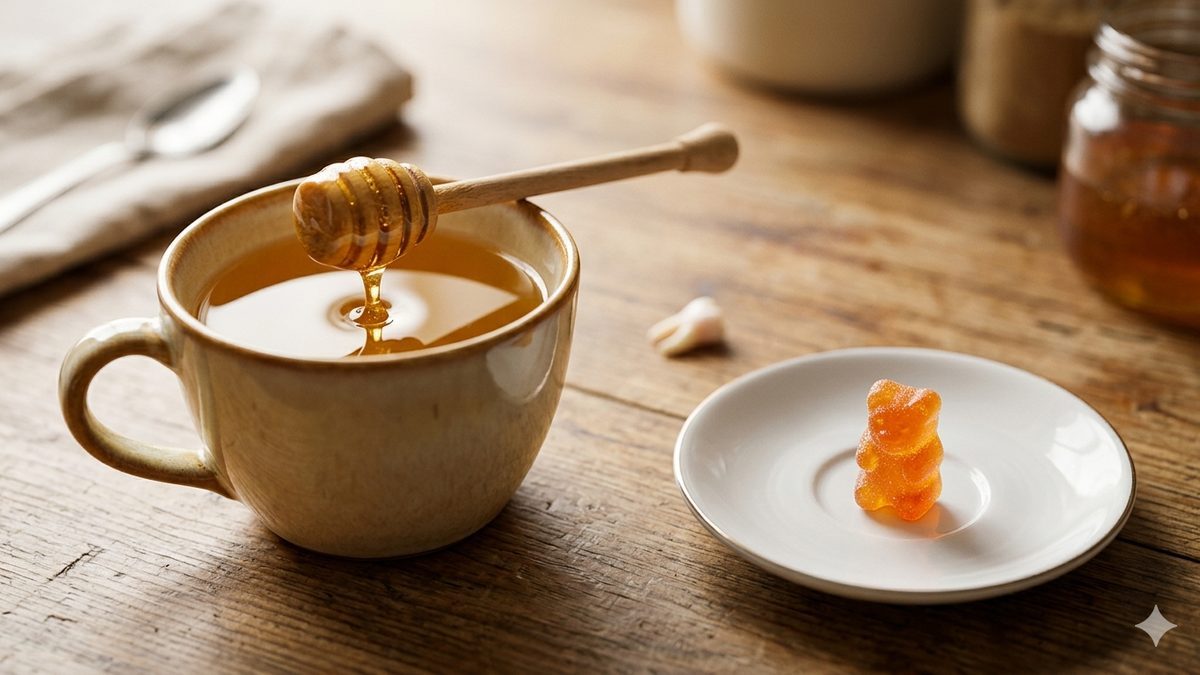
Tooth decay is the most widespread health problem in the world (2.24 billion people) and is not an infectious disease but a non-communicable one driven by sugar. The key factor is not the amount of sugar but the frequency of intake — every contact with sugar triggers a 30–60 minute acid attack on the enamel, which is why tea with honey five times a day is worse for the teeth than a single dessert after lunch. The article debunks widespread myths (honey as a healthy alternative, transmission of decay by sharing a spoon, an apple as a natural toothbrush) and offers concrete preventive rules based on the current scientific consensus.
Imagine two mothers in a dentist's waiting room. The first never lets her four-year-old son have candy — instead she gives him tea with honey. He drinks it five times a day, in small sips. The second mother gives her son a few sweets after lunch. Otherwise he eats nothing sugary.
Which of them will leave the dentist with the worse news?
If you guessed the first one — you're right. And if that strikes you as absurd, read on. The mechanism by which tooth decay forms is one of the best-researched things in all of medicine — and yet most parents don't understand it. What's worse: much of what "everyone knows" about cavities is either outdated or flat-out wrong.
In February 2025, the prestigious medical journal The Lancet published the most comprehensive analysis of oral diseases to date — part of the Global Burden of Disease (GBD) 2021 study, covering 204 countries. Within the GBD, which tracks more than 370 diseases and injuries, untreated decay of permanent teeth turned out to be the most widespread health condition of all: it affects 2.24 billion people — more than back pain, migraine, depression, diabetes or cardiovascular disease.
To this must be added 520 million children with untreated decay of deciduous (baby) teeth. In total, 3.69 billion people are affected by oral diseases — almost half of humanity.
And the trend is alarming. Between 1990 and 2021, the absolute number of cases of untreated decay rose from 1.46 to 2.24 billion — a 53% increase, which outpaces the rate of world population growth. A separate study by Heidelberg University (Jevdjevic & Listl, Journal of Dental Research, 2024) put the global economic cost of oral diseases at 710 billion dollars per year. And yet: in no country in the world is decay ranked among health priorities comparable to diabetes or cardiovascular disease.
Why? Partly because decay is viewed as a trivial problem — "your tooth hurts, you go to the dentist." But mainly because most people — including many parents — have no idea what decay actually is and how it forms. And the most widespread myth goes: decay is an infectious disease that you "passed on" to your child.
If you've ever heard that you shouldn't lick your child's spoon or blow on hot food, because that would "transmit the cavity bacteria" to the child — you're only partly right. And that partial truth is dangerously misleading.
In 1993, the American microbiologist Page Caufield and his team published a study that identified the so-called "window of infectivity" — a period around the 26th month of a child's age (range 19–31 months), when children typically acquire the bacterium Streptococcus mutans from their mothers through the sharing of cutlery, kissing, or pre-chewing food. This bacterium had, since the 1960s, been considered the chief culprit of decay.
The problem is that transmission of the bacterium alone is not enough to cause decay. A child can be colonized by S. mutans and never develop decay — provided it doesn't have enough fermentable sugars in its diet. Conversely: modern metagenomic studies (Simón-Soro & Mira, 2015, Trends in Microbiology) repeatedly find carious lesions where S. mutans makes up less than 1% of the microbiome or is entirely absent. The carious biofilm typically contains eight or more genera of acidogenic bacteria — Lactobacillus, Bifidobacterium, Scardovia wiggsiae, Actinomyces — any of which, under suitable conditions, can drive demineralization.
This is a fundamental difference from genuine infectious diseases. No single microbe is a necessary condition for decay. Decay arises when the entire community of oral bacteria is thrown out of balance — and that happens primarily under the pressure of sugar.
That is why, in 2021, leading cariologists Nigel Pitts, Svante Twetman, Julian Fisher and Philip Marsh published an article in the British Dental Journal arguing that decay shares the characteristics of non-communicable diseases (NCDs): long duration, slow progression, and a strong link to modifiable behavioral risk factors. The World Health Organization (WHO) reflected this shift by including oral diseases in the framework of NCD policy. The current scientific consensus says: dental decay is a non-communicable, biofilm-mediated, sugar-driven disease.
What does this mean for parents? The bacteria you "transmit" by sharing a spoon are, in most cases, part of the normal oral flora. What truly decides matters are the dietary habits you pass on to your child — and here the problem is often the exact opposite of what parents think.
Tooth enamel is 96% made of hydroxyapatite — a crystalline mineral with the formula Ca₁₀(PO₄)₆(OH)₂. It is the hardest tissue in the human body, harder than bone. But it has one Achilles' heel: it dissolves in acids.
Under normal conditions, saliva is supersaturated with respect to hydroxyapatite — it contains more calcium and phosphate ions than corresponds to equilibrium. This means the mineral does not dissolve; on the contrary, a slow remineralization takes place — minor damage to the enamel is continuously repaired. The teeth, in fact, slowly repair themselves all day long.
But after the intake of a fermentable sugar — glucose, fructose, sucrose, it doesn't matter — a chain reaction is set off:
Within 2–5 minutes the bacteria in the dental plaque process the sugar by glycolysis and produce lactic acid (and, to a lesser extent, acetic, propionic and formic acid). The pH of the plaque drops from a resting 6.8–7.0 to values around 4.5–5.0.
The critical threshold is pH 5.5. Below this value the surrounding solution becomes undersaturated with respect to hydroxyapatite — calcium and phosphate ions begin to leave the crystal lattice of the enamel. This is demineralization — the first phase of decay.
The return to normal takes 30–60 minutes. It depends on the buffering capacity of saliva — its ability to neutralize acids by means of the bicarbonate and phosphate systems.
This cycle was described by the American researcher Robert Stephan as early as 1944, and his "Stephan curve" is one of the best-verified concepts in all of dentistry. Every intake of sugar = one "acid attack" on the enamel. And here is the key to understanding why tea with honey five times a day is worse than candy once:
Sweets after lunch = 1 acid attack, 30–60 minutes below the critical pH.
Tea with honey five times a day = 5 acid attacks, cumulatively 2.5–5 hours below the critical pH.
In the first case the enamel manages to remineralize. In the second, the cumulative time of destruction is five times longer — and when you add the fact that sipping tea prolongs each individual exposure (each sip resets the Stephan curve), the real time below the critical pH can be even longer.
The most compelling evidence that frequency, and not the quantity of sugar, is what decides comes from one of the most ethically problematic experiments in the history of medicine.
Between 1945 and 1954, a study was conducted at the Swedish psychiatric institution Vipeholm on 436 patients with mental disabilities. The participants (without their informed consent — 1940s ethics) were given various forms of sugar under controlled regimens. The results were unambiguous and remain unchallenged to this day:
The group that received a large amount of sugar all at once with meals had a minimal increase in decay. The group that received sticky toffees between meals — that is, with the same total amount of sugar, but a higher frequency — had dramatically higher rates of decay.
This result has since been confirmed by dozens of observational studies. On its basis the WHO recommends limiting free sugars to less than 10% of total energy intake, ideally under 5% (approximately 25 grams per day) — but it stresses that limiting the frequency of intake is just as important as limiting the amount.
For parents this has one fundamental implication: it's not just about WHAT a child eats. It's about HOW MANY TIMES A DAY and IN WHAT FORM.
Not all sugars are the same — and not all foods containing sugar are equally dangerous. Three factors decide: the content of fermentable carbohydrates, stickiness (the retention time on the teeth), and the food's own acidity.
Honey — high risk. It contains 70–80% fermentable sugars, has a high viscosity (it clings to the teeth for a long time), and its own pH is around 3.5–4.5 — meaning it directly erodes the enamel even before the bacteria begin producing lactic acid. The antibacterial properties of honey (methylglyoxal in manuka) play no role in preventing decay. From the teeth's point of view, honey is comparable to refined sugar, and in some respects worse, due to the combination of stickiness and acidity.
Sweetened drinks — very high risk. A combination of dissolved sugar with an acidic pH (cola: pH 2.4; orange juice: pH 3.5; sweetened tea: pH 5.0–5.5). On top of that, the typical mode of consumption — sipping throughout the day — maximizes the frequency of acid attacks. A child who sips sweetened tea or juice all afternoon exposes the teeth to a continuous acidic environment.
Dried fruit (raisins, dates, apricots) — high risk. Concentrated sugar (60–70%) in an extremely sticky form. In cariogenicity tests, raisins are comparable to toffee. A "healthy" school snack in the form of a bag of dried fruit is problematic from the point of view of decay.
Bananas — medium risk. A high sugar content (~12 g/100 g) in a sticky texture that clings in the fissures and interdental spaces. More cariogenic than most other fresh fruit.
A whole apple — lower risk, but not zero. It contains ~10 g of sugar per 100 g, but the high proportion of water (86%) dilutes the sugars, chewing stimulates salivation (increased buffering capacity), and the fiber mechanically cleans the smooth surfaces. Beware, however, of malic acid (an apple's pH is 3.3–3.9), which causes erosive demineralization — a different mechanism from decay, but it likewise damages the enamel. The myth of the apple as a "natural toothbrush" is exaggerated — an apple cleans neither the fissures nor the approximal surfaces, where decay most often forms.
Raw vegetables — minimal to zero risk. Carrots, celery, cucumber, peppers — less than 2–5 g of sugar per 100 g, intensive chewing stimulates salivation, high content of water and fiber. Practically the ideal snack from the point of view of dental health.
Milk and cheese — protective effect. Milk contains lactose (fermentable), but at the same time casein and calcium-phosphate complexes that support remineralization. Hard cheese after a meal raises the pH of the plaque and supplies calcium ions — it is one of the few foods with a demonstrably protective effect.
If decay is the result of a chemical imbalance between demineralization and remineralization, then prevention logically rests on three pillars:
It's not about never eating anything sweet. It's about limiting the number of acid attacks per day. In practice: consume sweets with the main meal — during a meal salivation is at its maximum, buffering is most effective, and above all: no further separate acid attack is created.
The worst thing is "sweet grazing" — continuous sipping of sweetened tea, juice, lemonade, sucking on candy, repeated snacks of dried fruit. Each contact = a new acid attack = another 30–60 minutes below the critical pH.
Water and unsweetened tea are the only drinks between meals that do not cause an acid attack.
Fluoride changes the chemistry fundamentally. It replaces the hydroxyl group in hydroxyapatite with a fluoride ion and creates fluorapatite — a mineral that has a critical pH of 4.5 instead of 5.5. This means enamel containing fluorapatite withstands acid attacks that would dissolve normal enamel.
In addition, fluoride ions in the plaque fluid accelerate remineralization (they act as a catalyst), inhibit the bacterial enzyme enolase (reduced lactic acid production), and at concentrations above 100 ppm directly suppress bacterial metabolism.
In practice: fluoride toothpaste is the most important preventive tool you have at home. For specific recommendations, see rule #5 below.
Community water fluoridation (where it is in place) reduces the incidence of decay by approximately 25%, according to historical data. The updated Cochrane review of 2024, however, points out that in countries with widespread use of fluoride toothpaste this effect is probably smaller today — fluoride in toothpaste partly replaces the benefit of fluoride in water.
Brushing teeth removes the bacterial biofilm — it reduces the amount of acidogenic bacteria and thereby the intensity of acid attacks. But beware of timing: do not brush your teeth immediately after consuming acidic foods (fruit, juices). Immediately after an acid attack the surface of the enamel is softened by demineralization, and mechanical brushing can paradoxically accelerate erosion. Recommendation: wait at least 30 minutes, or rinse your mouth with water before brushing.
It would be convenient to write that decay is caused solely by sugar and everything else is a myth. But the science is more nuanced:
Genetics plays a role. Twin studies show the heritability of decay susceptibility in the range of approximately 40–60%, although estimates vary depending on the methodology (a broader range of 20–80% depending on the study and the parameter examined). Genes influence the quality of the enamel (AMELX, ENAM), the composition of saliva (CA6), antimicrobial defense (DEFB1), and even taste perception — the preference for sweetness is partly hereditary. Some people really do have "weaker teeth" than others. But without sugar in the diet, even a genetically susceptible tooth will not develop decay — see hunter-gatherer populations with a decay prevalence of 0–5% despite zero hygiene.
Socioeconomic factors are dominant. Low income markedly increases the risk of decay. A mother's education is one of the strongest predictors of decay in children (Schwendicke et al., Journal of Dental Research, 2015). Families with lower incomes have less access to dental care, less information about prevention, and a higher consumption of cheap foods rich in sugar. This is not an individual failing — it is a systemic problem.
Vertical transmission of bacteria is real. A mother really does pass oral bacteria on to her child. But what decides matters is not the transmission itself — it is the environment into which the bacteria arrive. A mother with a high rate of decay very likely shares with her child not only bacteria, but also dietary habits, access to fluoride, and hygiene routines. "I have bad teeth after my mum" is partly true — but mostly not for the reasons people think.
Decay is not just about sugar — it is a multifactorial disease. The American cariologist John Featherstone created the model of the "caries balance," in which on one side stand the pathological factors (acidogenic bacteria, frequent intakes of carbohydrates, reduced salivary flow) and on the other the protective factors (salivary buffering, fluoride, remineralization capacity). Decay arises when the pathological factors outweigh the others. Sugar is the strongest single pathological factor — but it is not the only one.
1. Limit the frequency, not necessarily the amount. One dessert after lunch is, from the point of view of decay, practically harmless. Five "healthy" snacks with sugar spread across the whole day — not so.
2. Honey is not a healthy alternative to sugar — at least not for the teeth. Honey has the same or higher cariogenic potential as refined sugar. Sweetening tea with honey "for health" is, from the teeth's point of view, counterproductive, especially if the child sips the tea all morning.
3. Water between meals, nothing else. Sweetened tea, juice, lemonade, fruit syrup with water — everything that contains sugar or acid and is drunk repeatedly during the day is risky. Unsweetened tea or plain water are the only safe drinks between meals.
4. Dried fruit is not a "healthy snack" for the teeth. A bag of raisins or dried apricots is, from the point of view of decay, comparable to a bag of sweets. If you give them, give them with a meal, not separately as a snack.
5. Brush teeth with fluoride toothpaste twice a day. In the morning after breakfast and in the evening before bed (the more important of the two — overnight, saliva production and protective buffering drop). The WHO and the European Academy of Paediatric Dentistry (EAPD) recommend, for children under 6, a toothpaste with 1000 ppm fluoride, in an amount the size of a grain of rice (under 3 years) or a pea (3–6 years). From age 6, a standard toothpaste with 1400–1500 ppm. Note: recommendations may differ in practice — some Czech pediatric dentists still recommend lower concentrations (500 ppm under 3 years). Consult your dentist about the specific regimen.
6. Cheese after a meal really is protective. It is not a myth — hard cheese raises the pH of the plaque and supplies calcium for remineralization. A piece of cheese at the end of a meal is simple and effective prevention.
7. Don't worry about sharing spoons — worry about sharing habits. The transmission of bacteria from mother to child is a normal part of the development of the oral microbiome. What you really "pass on" are dietary habits. If you drink sweet tea all day, your child will drink it too — and that is a bigger risk factor than any shared spoon.
Let us return to the dentist's waiting room. The mother who gave her son tea with honey five times a day — in the good-faith belief that honey is "natural" and therefore healthy — exposed his teeth to five acid attacks a day. The mother who gave her son a few sweets after lunch — at the time of maximum salivation, as a one-off attack after which the saliva had time to repair things — did practically no harm to his teeth.
Dental decay is neither a punishment for bad genes nor an infection from a kiss. It is the result of simple chemistry: acid from the bacterial fermentation of sugar dissolves enamel faster than saliva can repair it. And in this equation, one variable decides more than all the others: how many times a day you attack your teeth with sugar.
"Natural" does not mean safe for the teeth. And the best thing you can do for your child's teeth is not to buy a more expensive toothpaste — it is to stop giving them sweet tea between meals.
Sources:
Transparency of creation
The concept, structure, and editorial line of the article are the work of the author, who prepared the content outline, established the key theses, and directed the entire creative process. Generative AI (Claude Opus 4.6, Anthropic) was used as a tool for research, fact-checking, and elaborating the author's draft.
The author verified the key findings and approved the final wording. No part of the text was published without conscious authorial control. The factual data were verified against the publicly available sources listed in the text.
The procedure complies with the transparency principles of EU Regulation 2024/1689 (AI Act). #poweredByAI
Read the Czech original on Médium.cz.
AI · Claude — machine translation, may contain inaccuracies.